Most small businesses don’t struggle because they lack effort; they struggle because their marketing is scattered. One week it’s Instagram posts, the next it’s try some ads, then a blog… and nothing connects. Without a clear strategy, time and budget get spent on activity instead of results.
This complete guide is built to fix that. You’ll learn what a digital marketing strategy actually is, how it fits your business goals, and how to build a simple system that consistently brings in leads and sales. We’ll break down the most effective digital marketing strategies for small businesses, from SEO and content to email, social media, and paid campaigns, in a way that’s practical, measurable, and easy to execute even with a small team.
You’ll also get a step-by-step framework for planning, choosing the right channels, setting up tracking, and improving performance using real data, not guesses. Whether you run a service business, an e-commerce store, a B2B company, or you’re just starting out, this page is designed as an “everything you need to know” resource you can follow, apply to, and revisit as you grow.
What Is a Digital Marketing Strategy (and How It Fits Your Business Strategy)
A digital marketing strategy for business is your clear plan for how you will attract the right people online, turn them into leads or customers, and keep them coming back. It’s not a random checklist of “do SEO, post on Instagram, run ads.” Instead, it connects your marketing to your business goals, so every action has a purpose, a target audience, and a measurable outcome.
In plain English, your digital marketing business strategy answers three core questions:
- Who are we trying to reach? (your ideal customers and their problems)
- What do we want them to do? (subscribe, book a call, request a quote, buy, repeat purchase)
- How will we guide them there? (the best channels, content, and offers, sequenced logically)
When your business strategy focuses on growth, profitability, and customer loyalty, digital becomes the system that supports it. That’s why business strategy and the management of digital marketing should work together. Your business strategy defines the destination; your digital marketing strategy maps the route and tracks progress.
Strategy vs Tactics vs Channels (So You Stop Random Posting)
Many small businesses confuse activity with strategy. Here’s the difference:
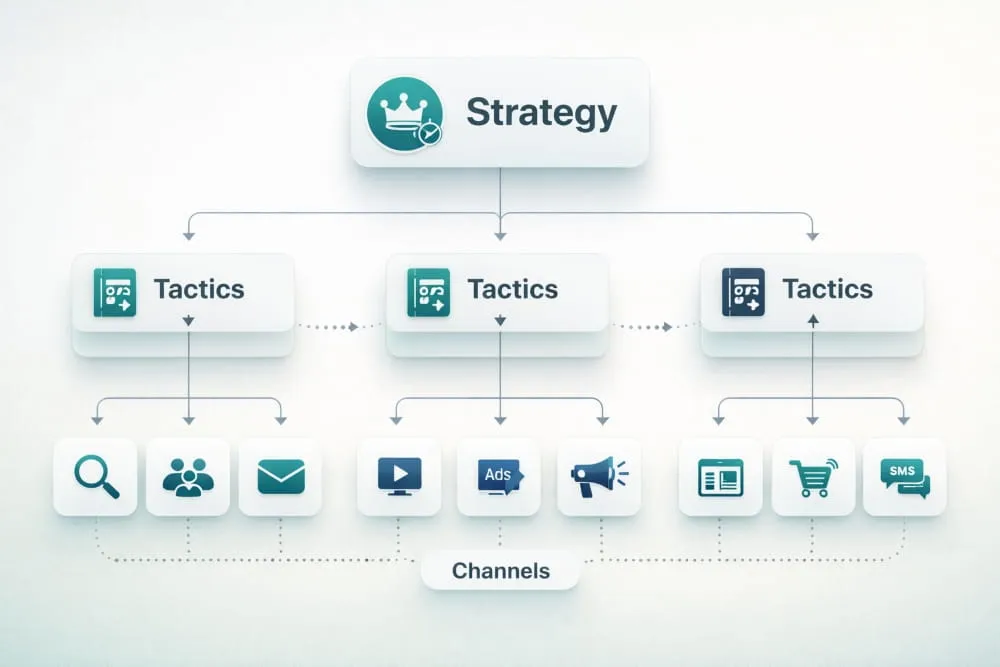
- Strategy = the plan (goal + audience + positioning + funnel + measurement)
- Tactics = the actions (posting, running ads, writing blogs, email campaigns)
- Channels = the platforms (Google, Instagram, YouTube, email, marketplaces)
Without a strategy, tactics become noise, and channels become distractions. With a strong plan, your digital marketing strategies for business turn into a repeatable process: you pick the right channels, publish the right messages, and guide customers toward conversion.
This is why one business can post daily and still see no growth, while another posts less but grows faster, because their digital marketing strategies for businesses are built around clear goals and a system that makes sense.
How Digital Supports Revenue Goals (Leads, Sales, Retention)
A smart digital plan supports revenue in three ways:
1) Leads: Your website, SEO, content, and paid campaigns bring targeted prospects into your funnel.
2) Sales: Landing pages, offers, product/service pages, and follow-up sequences help convert interest into purchases.
3) Retention: Email marketing, remarketing, and helpful content keep customers engaged so they buy again and refer others.
When you approach it this way, your digital marketing strategy for business becomes a growth engine, not a guessing game. It gives you clarity on what to do, why you’re doing it, and what success looks like, so every marketing decision moves your business forward.
Why Digital Marketing Matters for Small Businesses
For small businesses, growth usually comes down to one thing: consistent customers. And that’s exactly why digital matters. A strong digital marketing business strategy isn’t just “being online”; it’s a system that helps you get discovered, earn trust, and convert attention into revenue.
When you treat it as a real digital marketing strategy for business (not random posting), it becomes one of the most scalable ways to compete with bigger brands, because you’re using clarity, targeting, and measurement, not just budget.
Key Benefits (Predictable Leads, Lower CAC, Measurable Growth)
1) More predictable leads
Instead of relying only on referrals or seasonal spikes, digital creates steady demand. With the right digital marketing strategies for business, you can build repeatable lead sources through SEO, content, email, and targeted ads.
2) Lower CAC over time
Customer acquisition cost (CAC) drops when you invest in assets that compound, like search visibility, evergreen content, email lists, and remarketing audiences. This is one of the biggest benefits of integrating a digital marketing strategy into a business: you stop paying from zero every month and start building momentum.
3) Measurable, trackable growth
Digital gives you real numbers: clicks, leads, conversion rates, cost per lead, and revenue attribution. That’s why business strategy and the management of digital marketing go together so well, because you can connect marketing work directly to business outcomes.
When Digital Works Best (And When It Won’t)
Digital marketing performs best when your strategy is aligned with how your business actually makes money. The most successful companies focus on aligning digital marketing strategy with business objectives, not chasing trends. That means your goal isn’t “more followers,” it’s qualified leads, sales, repeat customers, and profit.
| Digital works best when you have | Digital won’t work well if |
|---|---|
| A clear offer and who it’s for | Your offer is unclear or priced wrong for the market |
| A website or landing page that converts | You’re trying to copy competitors without differentiation |
| A simple funnel (traffic → trust → action) | You expect instant results without testing or optimization |
| Tracking in place to measure what’s working | Your marketing is disconnected from business goals |
| Consistency (even small weekly progress) | You spread yourself across too many channels at once |
That’s why the focus isn’t just tactics, it’s how businesses align digital marketing strategies with goals. Once you learn how to integrate digital marketing with business strategy, your marketing stops feeling like “extra work” and starts functioning like a growth engine built into the business itself.
Align Your Digital Marketing Strategy With Business Objectives
The fastest way to waste time in marketing is to start with channels, posting on Instagram, running ads, writing blogs, without knowing what the business actually needs. The best digital marketing strategies for small businesses start somewhere else: business objectives.
When your strategy is tied to clear outcomes, your marketing becomes focused, measurable, and easier to improve. That’s how you build digital marketing strategies for business growth, not just “activity.” Whether your goal is more leads, more online sales, or higher retention, alignment is the difference between random effort and consistent results.
Turning Business Goals Into Marketing KPIs
Business goals are the “why.” KPIs are the “how we measure progress.”
Here are common business goals and the KPIs that support them:
- Goal: Generate more leads
- KPIs: website conversions, cost per lead, lead quality, booking rate
- Goal: Increase sales revenue
- KPIs: conversion rate, average order value, revenue from campaigns, ROAS (if running ads)
- Goal: Grow repeat customers
- KPIs: repeat purchase rate, email engagement, retention rate, customer lifetime value
- Goal: Build brand trust and awareness
- KPIs: organic traffic growth, branded search, content engagement, return visitors
This is where effective digital marketing strategies for small businesses come from: you pick KPIs that match the goal, then choose the actions that move those numbers.
Choosing the Right North Star Metric
A north star metric is the single number that best reflects real business progress. It keeps the whole strategy aligned and prevents you from chasing vanity metrics.
Examples:
- Service business: qualified leads per month or booked calls
- E-commerce: monthly revenue or repeat purchase rate
- B2B: sales-qualified leads (SQLs) or pipeline value influenced
When you pick a north star metric, everything gets clearer: what content to publish, what offers to promote, and what channels deserve your attention. It’s a core piece of the best digital marketing strategy to grow a business, because it creates focus.
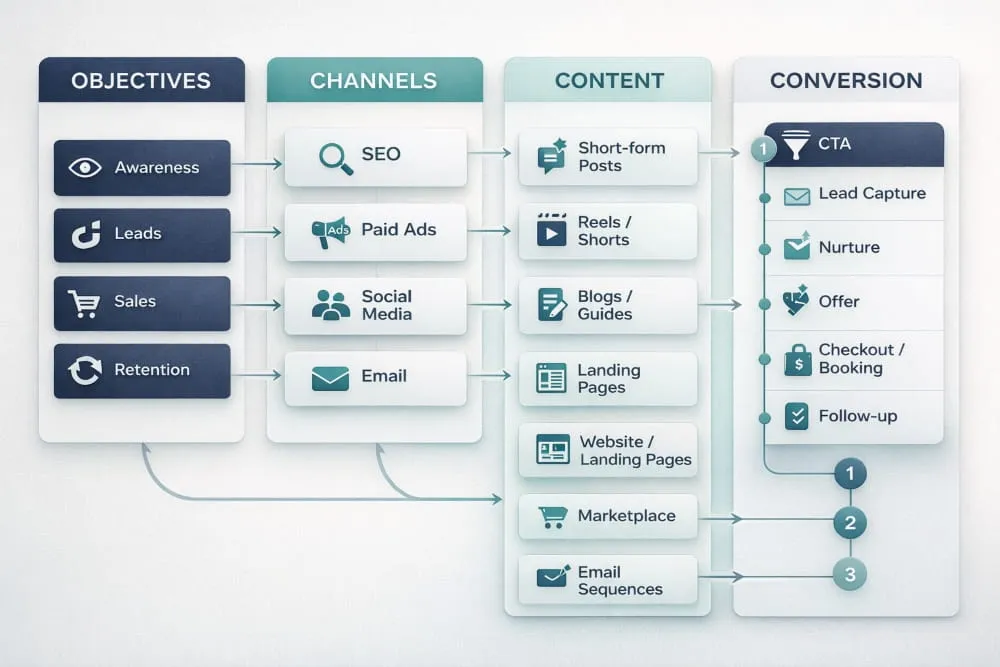
Mapping Objectives → Channels → Content → Conversion
Once your objectives are set, you build a direct path to results:
1) Objective: What are we trying to achieve?
Example: “Increase leads by 30% in 90 days.”
2) Channels: Where will the right audience come from?
Example: SEO for long-term intent, paid ads for fast volume, social for trust, email for follow-up.
3) Content: What will earn attention and build confidence?
Example: service pages + problem-solving articles + case studies + short-form trust content.
4) Conversion: What action do we want them to take?
Example: book a call, request a quote, buy a product, join the email list.
This structure is the foundation of digital marketing strategies for business success, because it turns marketing into a system. And when your system is clear, you can improve it with testing, optimization, and smarter budget allocation over time.
That’s the real secret behind digital marketing strategies to grow your business: not doing more, but doing the right things in the right order, tied directly to what your business needs most.
The Small Business Digital Marketing Strategy Framework (Step-by-Step)
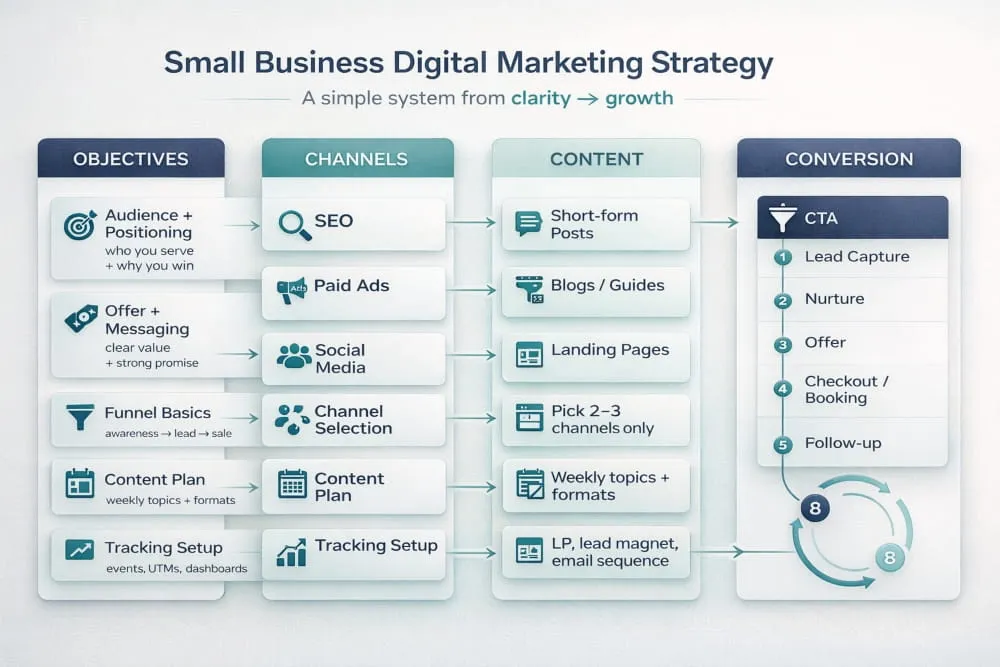
If you’ve ever wondered how to create a digital marketing strategy for small businesses without getting overwhelmed, this is the exact framework to follow. It’s designed for real-world execution, limited time, small teams, and tight budgets, while still building a system that can scale.
Think of this as the blueprint for creating digital marketing strategies for small businesses that actually drive results. Each step builds on the last, so you’re not doing random marketing; you’re building a growth engine.
Step 1: Audience + Positioning (Who You Serve, Why You’re Different)
Start with clarity. Your marketing only works when it speaks to the right people.
- Who is your ideal customer?
- What problem do they want solved right now?
- Why should they choose you over alternatives?
Strong positioning turns “generic marketing” into relevance. This is the foundation of any digital marketing strategy for your business, because you can’t attract the right leads if your message is unclear.
Step 2: Offer + Messaging (Value Prop That Converts)
Most small businesses don’t need more traffic; they need a stronger offer.
Define:
- What you’re selling (service/package/product)
- The outcome customers get
- The proof/benefit that makes it believable
- A clear call to action
Your messaging should make the value obvious in seconds. This is where conversion starts, long before someone clicks “Buy” or “Book.”
Step 3: Funnel Basics (Awareness → Consideration → Conversion)
Your customer doesn’t go from stranger to buyer instantly. Your strategy should guide them:
- Awareness: they discover you (SEO, social, ads)
- Consideration: they evaluate you (guides, reviews, case studies, comparisons)
- Conversion: they take action (landing page, checkout, booking form)
When you build around this funnel, creating a small business digital marketing strategy becomes simpler because every piece of content has a job.
Step 4: Channel Selection (Pick 2–3, Not 10)
One of the biggest mistakes is trying to be everywhere. The smarter move is focus.
Choose 2–3 primary channels based on where your customers already are and what matches your goal:
- SEO + content (high intent, compounding results)
- Email (retention + repeat sales)
- Social (trust + community)
- Paid ads (speed + scale, when you’re ready)
This is how you create digital marketing strategies for small businesses that don’t burn you out.
Step 5: Content Plan (Topics, Cadence, Repurposing)
Content isn’t “post more.” It’s “answer what customers are searching for and thinking about.”
Build content around:
- Problems people want solved
- Objections that stop them from buying
- Proof that builds trust
- Use cases and outcomes
Keep it simple:
- A realistic weekly cadence
- A repeatable topic structure
- Repurpose one core piece into multiple formats (blog → short posts → email → reel)
This is the easiest way to stay consistent while still building authority.
Step 6: Conversion Assets (Landing Pages, Forms, CTAs)
Traffic without conversion assets is like pouring water into a bucket with holes.
Make sure you have:
- A clear landing page or service/product page
- Simple forms (not too many fields)
- Strong CTAs (Book, Get Quote, Buy Now, Download)
- Trust signals (testimonials, reviews, guarantees, FAQs)
This turns attention into outcomes, the heart of creating a digital marketing strategy for small business growth.
Step 7: Tracking Setup (Analytics + Events)
If you can’t measure it, you can’t improve it.
Set up tracking for:
- Page views and traffic sources
- Form submissions/purchases / bookings
- Button clicks and key actions
- Cost per lead/cost per purchase (if ads)
This step removes guesswork and makes your strategy reliable.
Step 8: Monthly Optimization Loop (Improve What Works)
This is where small businesses win, by improving consistently, not constantly reinventing.
Every month:
- Review performance by channel
- Identify what’s bringing the best leads/sales
- Double down on winners
- Fix weak links (landing page, offer, targeting, content)
- Run 1–2 small tests (headline, CTA, offer, audience)
That’s the secret to how to create a small business digital marketing strategy that keeps getting better: a simple loop that builds momentum over time.
Follow these eight steps, and you’ll have a clear, measurable digital marketing strategy for your business, one that’s focused, scalable, and built to drive real growth rather than random online activity.
Best Digital Marketing Strategies for Small Businesses (What Works Now)
The best marketing isn’t the most complicated; it’s the most consistent. Small businesses win when they choose a few proven channels, execute them well, and improve month after month. The good news? Many of the best digital marketing strategies for small businesses are also the most practical, because they can be started small, measured easily, and scaled only when they’re working.
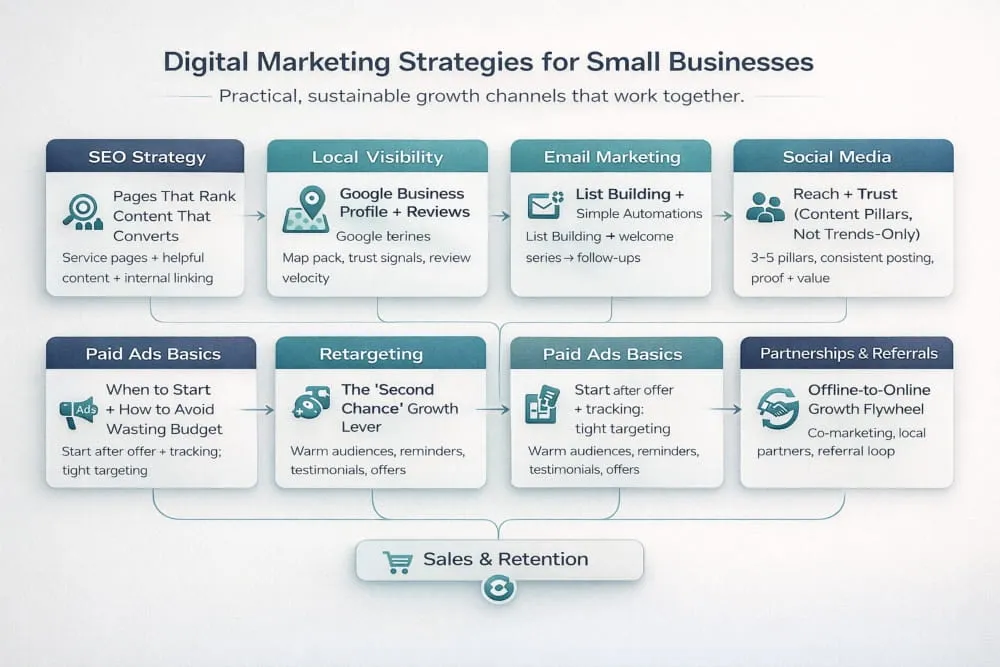
Below are easy-to-implement digital marketing strategies for small businesses that are effective right now, built for real teams with limited time and budget.
SEO Strategy: Pages That Rank + Content That Converts
SEO is one of the most cost-effective digital marketing strategies for small businesses because it compounds. Instead of paying for every click, you build visibility that can keep bringing leads for months or years.
Focus on two things:
- Money pages: service pages, product pages, category pages, built to convert
- Support content: helpful articles that answer questions your customers are searching for
When SEO is done right, it doesn’t just bring traffic; it brings intent, which is what fuels growth.
Local Visibility (Sub-Section): Google Business Profile + Reviews
Even if you’re not targeting specific cities on your website, you still want local discovery working for you. A well-optimized Google Business Profile helps people find you when they’re ready to take action.
Key moves:
- Complete your profile (services, photos, hours, categories)
- Post updates regularly
- Ask for reviews consistently and respond to every one
- Use FAQs to answer common questions up front
It’s one of the most affordable digital marketing strategies for small businesses because it’s mostly effort, not ad spend.
Email Marketing: List Building + Simple Automations
Email is often the highest ROI channel for small businesses, because it turns one-time visitors into repeat opportunities. The goal isn’t sending “newsletters” randomly, it’s building a system.
Start with:
- One simple lead magnet or incentive (discount, checklist, free guide, quote request)
- A basic welcome sequence (3–5 emails)
- A monthly or weekly value email to stay top-of-mind
This is one of the easiest to implement digital marketing strategies for small businesses because you can set up the core automations once, then let them run.
Social Media: Reach + Trust (Content Pillars, Not Trends-Only)
Social media works best when it’s built around trust, not chasing viral trends. Instead of posting whatever comes to mind, use content pillars that match your funnel:
- Education: solve common problems and answer FAQs
- Proof: testimonials, results, case studies, behind-the-scenes
- Authority: your process, your standards, your expertise
- Connection: brand story, values, team, community
This approach creates consistent messaging and makes your social channels support your business, not distract from it.
Paid Ads Basics: When to Start + How to Avoid Wasting Budget
Ads can be powerful, but they burn money fast when the basics aren’t ready. Start ads when:
- Your offer is clear
- You have a landing page that converts
- You know what a lead/customer is worth
- You can track conversions properly
To avoid wasting budget:
- Start with one goal (leads or purchases)
- Test small budgets first
- Focus on simple creatives with clear benefits
- Optimize based on cost per result, not likes
Paid ads become a growth tool when they amplify what already works.
Retargeting: The “Second Chance” Growth Lever
Most people won’t buy on their first visit. Retargeting brings them back, often at a lower cost than cold traffic.
Retargeting works great for:
- Visitors who viewed key pages but didn’t convert
- People who added to the cart but didn’t buy
- Leads who haven’t booked a call yet
This is one of the smartest, cost-effective digital marketing strategies for small businesses because you’re marketing to people who already shown interest.
Partnerships & Referrals: Offline-to-Online Growth Flywheel
Partnerships and referrals are underrated digital growth levers. The strategy is simple: collaborate with businesses that serve the same audience but aren’t competitors.
Examples:
- Joint promos or bundles
- Guest content swaps
- Referral agreements
- Co-hosted webinars or local events promoted online
You can use digital to scale word-of-mouth, turning real relationships into repeatable growth.
The Small-Team Rule: Pick 2–3 and Execute Deeply
If you want easy-to-implement digital marketing strategies for small businesses that actually perform, don’t do everything. Pick 2–3 strategies from above based on your goals, execute consistently for 60–90 days, and measure results.
That’s how small teams build momentum, through focus, simple systems, and smart optimization.
Testing, Measurement, and Improving Results With Data
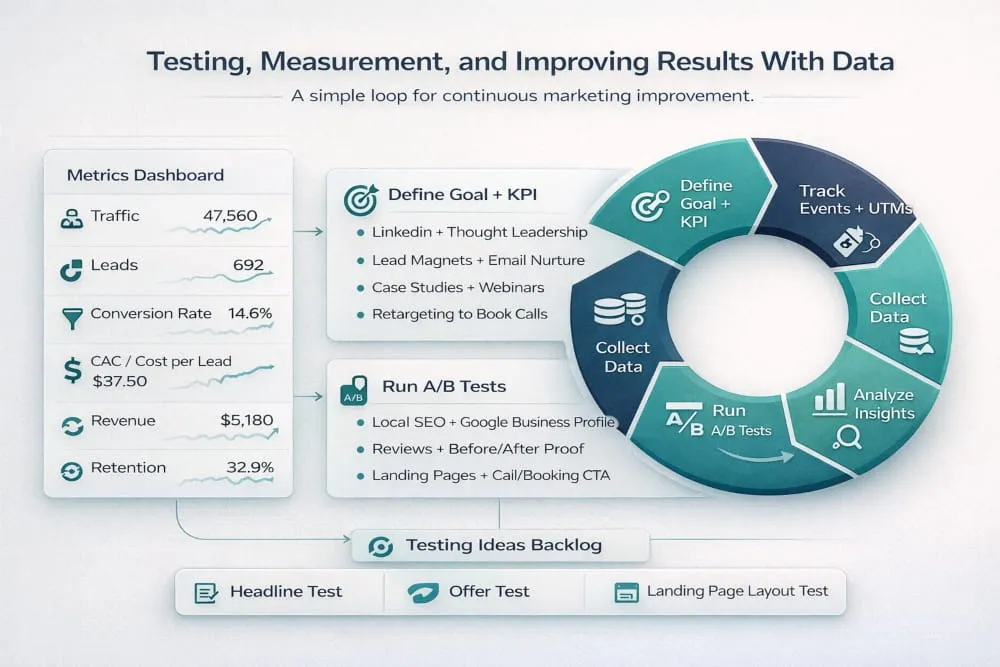
Small businesses don’t win by doing more marketing. They win by doing smarter marketing, measuring what matters, fixing what’s weak, and doubling down on what works. When you track the right metrics and run small, consistent tests, you build a digital marketing system that improves month after month instead of restarting every week.
What to Track (Traffic Quality, Leads, Conversion Rate, CAC, LTV)
Not all traffic is good traffic. A spike in visitors means nothing if it doesn’t produce leads or revenue. Focus on metrics that connect directly to growth:
- Traffic quality: Which sources bring engaged visitors (time on page, pages per session, returning users)
- Leads: Form submissions, booked calls, quote requests, email sign-ups
- Conversion rate: The percentage of visitors who take your main action
- CAC (Customer Acquisition Cost): What it costs to get a new customer (especially if you run ads)
- LTV (Lifetime Value): How much a customer is worth over time (repeat purchases, renewals, upsells)
These numbers tell you whether your marketing is building a business or just generating noise.
A Simple Testing Strategy (Headlines, Offers, Landing Pages)
You don’t need complicated experiments. Small businesses get big gains from simple tests focused on the conversion path.
Start here:
- Headlines: Test clarity vs. cleverness (clear usually wins)
- Offers: Change what you’re promising (outcome, guarantee, bundle, bonus)
- Landing pages: Test layout, CTA placement, proof, and friction reduction
- CTAs: “Book a Call” vs “Get a Quote” vs “Check Availability”
- Trust signals: Add testimonials, reviews, case studies, before/after, logos
Rule of thumb: test one change at a time, give it enough traffic to be meaningful, and keep a simple log so you don’t repeat the same mistakes.
How to Adjust Your Digital Marketing Strategy Based on Data
Data should guide decisions, not overwhelm you. A practical way to use it is to find where the funnel is leaking:
If traffic is low:
- Improve SEO foundations, publish more targeted content, refine targeting, and add partnerships/referrals
If traffic is high but leads are low:
- Fix landing page clarity, strengthen offer, simplify forms, add proof, sharpen CTA
If leads are high but sales are low:
- Improve follow-up speed, refine qualification, adjust pricing/packaging, strengthen trust (case studies)
If CAC is too high:
- Optimize targeting, improve conversion rate, add retargeting, focus on higher-intent keywords/content
If LTV is low:
- Add email nurture, retention offers, upsells, repeat-purchase reminders, loyalty incentives
This is how marketing becomes a system: you diagnose the bottleneck, adjust one lever, and measure again.
Monthly Reporting Checklist (Keep It Simple)
Use a quick monthly review, so you’re always improving:
- Top traffic sources (and which ones convert best)
- Total leads + lead-to-sale conversion (if tracked)
- Best-performing pages/content
- Conversion rate by landing page
- Paid spend + results (CPL/CPA/ROAS if applicable)
- Email list growth + top campaigns
- 3 wins, 3 problems, 3 priorities for next month
- 1–2 tests to run next month
Consistency here is more valuable than perfection.
Easy and Cost-Effective Strategies for Small Teams
If you’re short on time, you don’t need a “bigger strategy.” You need a minimum viable marketing system, something you can execute weekly without burning out, while still building compounding results.
The 80/20 Execution Plan (Minimum Viable Marketing System)
Focus on the activities that create the most impact:
Your 80/20 core:
- One traffic driver (SEO/content or simple ads)
- One conversion asset (landing page/service page with a strong CTA)
- One follow-up system (email sequence + reminders)
- One trust builder (reviews/testimonials/case study)
That’s it. Build those four pieces, and you’ll have a system that can generate leads consistently.
Repurpose Once, Distribute Everywhere
Create one strong “core” piece of content and reuse it across channels.
Example:
- One blog post → 5 short social posts
- One blog post → 1 email to your list
- One blog post → 1 short video script
- One customer story → testimonial post + website section + email proof
This approach keeps quality high while cutting workload.
Weekly Template (Only 2 Hours/Week)
Here’s a simple schedule small teams can actually follow:
- 30 min: review metrics + pick one improvement
- 45 min: create one core content piece (or update a key page)
- 30 min: repurpose into 3–5 social posts
- 15 min: follow-up + collect one testimonial/review request
Two hours, every week, builds momentum fast.
Low-Budget Creative That Still Looks Premium
You don’t need expensive production. You need clarity and consistency.
Keep creative premium by focusing on:
- Clean layouts and consistent branding
- Real photos (team, process, product, behind-the-scenes)
- Simple, bold messaging with one clear promise
- Proof-based content (results, reviews, customer stories)
- Short videos with strong hooks and clear outcomes
When your execution is simple but consistent, and your decisions are data-driven, you don’t just “do marketing.” You build a growth system that gets stronger over time.
Digital Marketing Strategies by Business Type (Use-Case Playbooks)
One strategy framework can work for almost any small business, but the execution should match how your business actually sells. A B2B company needs trust and lead quality. An e-commerce store needs conversion and retention. A service business needs bookings and reviews. And a new business needs speed: the fastest route to first customers.
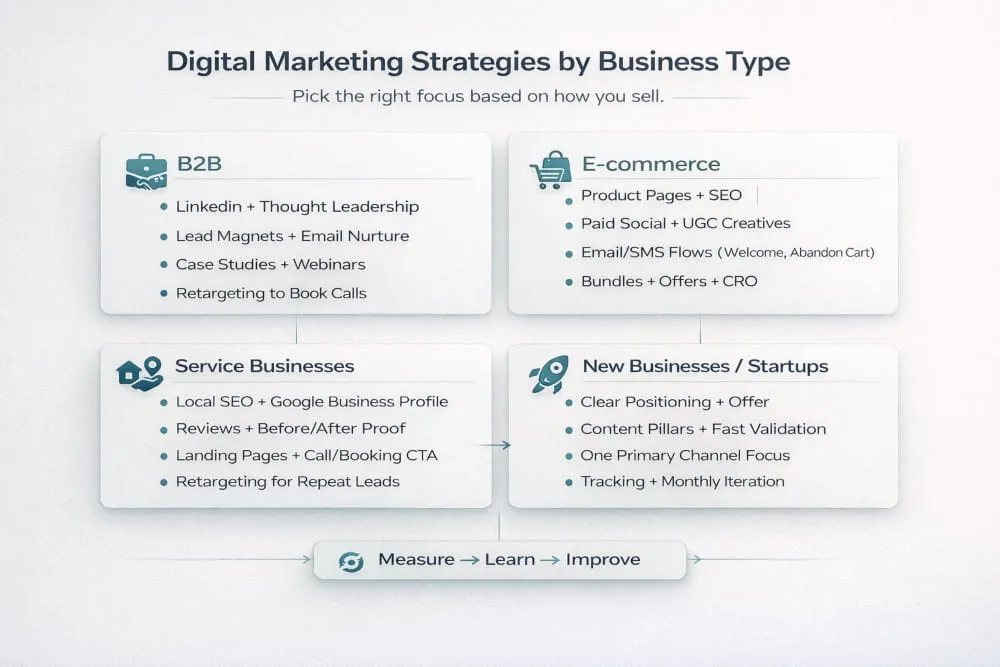
Below are focused playbooks you can plug into your overall strategy, so your marketing stays aligned with your business model, not generic advice.
B2B: Lead Quality, Authority Content, Longer Sales Cycles
Business-to-business digital marketing strategies succeed when they prioritize quality over volume. In B2B, one strong lead can be worth more than a hundred low-intent inquiries. Your business-to-business digital marketing strategy should build authority and reduce buyer uncertainty over time.
What works best:
- Authority content: thought leadership, guides, “how it works,” comparisons, case studies
- Proof assets: testimonials, results, client logos, industry credibility
- Lead magnets: checklists, audits, calculators, templates, webinars
- Nurture sequences: email follow-ups that educate and move leads toward a call
- Clear qualification: forms that filter out poor-fit leads without creating friction
A strong digital marketing strategy for a B2B business is less about quick wins and more about building trust at every step of the funnel.
E-commerce: Product Pages, Bundles, Email Flows, Retention
For online stores, growth is usually a mix of conversion optimization + repeat customers. The most effective digital marketing strategies for e-commerce businesses don’t just “drive traffic”; they improve the shopping experience and increase lifetime value.
What works best:
- High-converting product pages: clear benefits, strong visuals, FAQs, reviews, and shipping/returns clarity
- SEO for category + product intent: structure that helps buyers find exactly what they want
- Bundles and upsells: increase average order value without more traffic
- Email flows: welcome series, abandoned cart, post-purchase, replenishment, win-back
- Retention focus: loyalty perks, customer education, UGC, community-building
In e-commerce, the real growth lever is often what happens after the first purchase.
Service Businesses: Booking Calls, Trust Signals, Reviews
For service-based companies, the goal is simple: turn attention into inquiries, and inquiries into booked work. Digital marketing strategies for service-based businesses work best when they reduce hesitation and make the next step feel easy.
What works best:
- Service pages designed to convert: outcomes, process, pricing range (if possible), strong CTA
- Booking system: “book a call” or “get a quote” with minimal friction
- Trust signals: reviews, before/after, case studies, certifications, guarantees
- Local visibility support: Google Business Profile optimization + consistent review requests
- Social proof content: client stories, behind-the-scenes, real results
For service businesses, trust is the currency. Your strategy should build it fast, then make booking effortless.
New Businesses / Startups: Fastest Path to First Customers
When you’re starting out, your biggest need isn’t “brand awareness.” It’s validation and revenue. A digital marketing strategy for a new business should focus on speed, learning, and a clear offer, without trying to perfect everything at once.
What works best:
- Clear niche + message: exactly who you help and what result you deliver
- One strong offer: a simple package/product that’s easy to say yes to
- One acquisition channel: pick one primary channel (content + SEO, partnerships, or targeted ads)
- Direct outreach + credibility: early testimonials, founder story, proof of results
- Feedback loop: measure, refine, repeat every month
The goal is momentum: get your first customers, collect proof, improve your offer, and scale what works.
All of these models use the same strategy foundation, audience, offer, funnel, channels, content, conversion, tracking, but the priorities shift based on how you sell.
That’s the advantage of using scenario-based playbooks: you keep one unified intent, avoid confusion, and still make your marketing feel specific to your business type.
Common Mistakes That Kill Small Business Marketing
Most small businesses don’t fail at marketing because they pick the “wrong platform.” They fail because the basics are missing: clarity, structure, and measurement. These mistakes quietly drain time and budget, making even good tactics look ineffective.
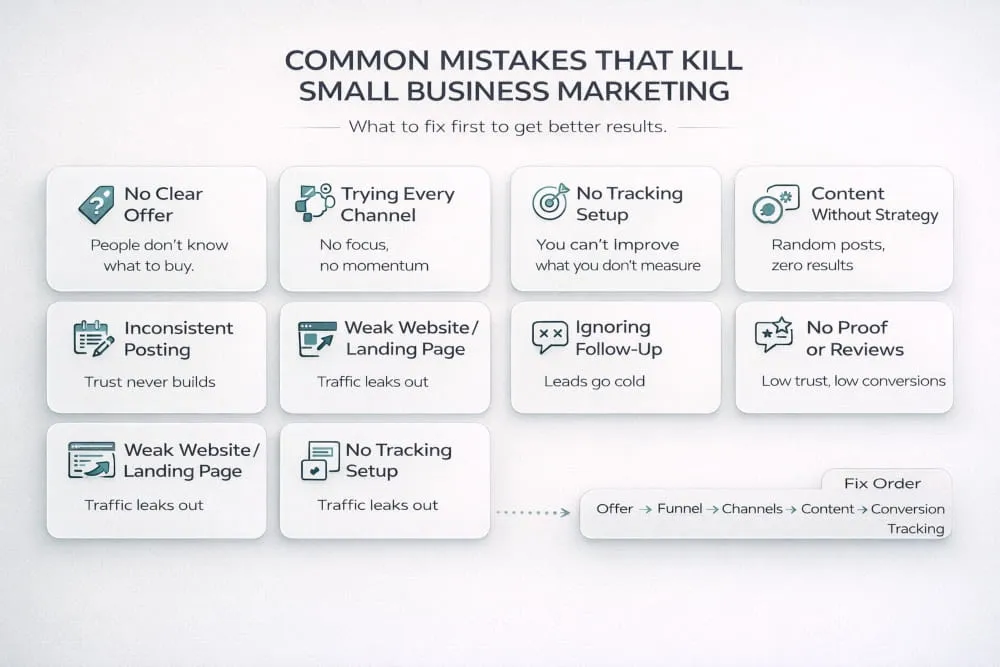
Here are the most common traps to avoid (including common mistakes in digital marketing strategy for mid-sized businesses, where bigger teams can waste even more money faster).
1) Mixing Channels Without a Funnel
Being active on multiple channels isn’t a strategy. If you’re posting on social, running ads, and doing “a little SEO” without a clear path from attention → action, results will stay random.
Fix it by building a simple funnel:
- Traffic source (SEO, social, ads, referrals)
- Trust builder (content, proof, case studies, reviews)
- Conversion step (landing page, booking form, checkout)
- Follow-up (email, retargeting, nurture)
When every channel pushes toward the same conversion goal, marketing becomes consistent.
2) Chasing Vanity Metrics
Likes, views, and followers can feel good, but they don’t always translate into revenue. A campaign can “perform” on social and still produce zero qualified leads.
Focus on metrics that matter:
- leads, bookings, sales
- conversion rate
- cost per lead/cost per sale
- repeat customers and retention
This shift alone fixes a huge percentage of failed marketing efforts.
3) No Offer Clarity
If customers don’t quickly understand what you do, who it’s for, and what outcome they get, they won’t take action, no matter how much traffic you drive.
Offer clarity means:
- a simple promise (what result you deliver)
- a clear audience (who it’s for)
- a reason to believe (proof, process, trust signals)
- a strong CTA (what to do next)
A weak offer makes every channel expensive and frustrating.
4) No Tracking → No Learning
Without tracking, you can’t improve. You’ll keep guessing why results are up or down, and you’ll repeat the same mistakes.
At minimum, track:
- traffic sources
- conversions (forms, calls, purchases)
- conversion rate per key page
- cost per result (if ads)
This is the difference between “trying marketing” and building a system.
5) Spreading Budget Too Thin
Small budgets don’t fail because they’re small; they fail because they’re scattered. Doing tiny spends across too many platforms usually produces weak signals, poor learning, and slow progress.
Better approach:
- Pick 1–2 priority channels
- Run focused tests
- improve conversion first
- scale only what proves profitable
This is the smart path for small businesses, and it applies just as strongly to mid-sized companies with larger budgets.
Avoiding these mistakes won’t just “improve your marketing.” It will make your strategy simpler, your results clearer, and your growth more predictable.
Conclusion
Small business marketing works best when it stops being random and starts being structured. With a clear digital marketing strategy, you’re not just “doing SEO” or “posting on social”, you’re building a focused system that connects your business goals to the right channels, the right content, and a conversion path that turns attention into leads and sales.
The key is simplicity and consistency: pick 2–3 proven strategies, create strong conversion assets, track what matters, and improve every month based on data. When you do that, growth becomes predictable because your marketing is no longer guesswork. It’s a repeatable engine you can refine, scale, and rely on as your business grows faster.
Frequently Asked Questions (FAQ’s)
1) What’s the best digital marketing strategy to grow a small business?
The best digital marketing strategy to grow a business is a focused system that aligns one clear goal (leads or sales) with 2–3 channels, strong conversion pages, and monthly optimization. Most small businesses get the fastest wins by combining SEO/content for intent, email for follow-up, and either social or targeted ads for reach.
2) What are the best digital marketing strategies for small businesses right now?
The best digital marketing strategies for small businesses right now are: SEO pages that rank, content that answers buyer questions, email list building with simple automations, proof-driven social content, retargeting, and a conversion-focused landing page.
3) What are effective digital marketing strategies for small businesses on a small budget?
The most effective digital marketing strategies for small businesses on a budget are: Google Business Profile + reviews, SEO for high-intent searches, consistent educational content, email nurture sequences, and referral/partner marketing. These are also cost-effective digital marketing strategies for small businesses because they compound over time.
4) How do I create a digital marketing strategy for small businesses step by step?
To create digital marketing strategies for small businesses, follow: define your audience and positioning, sharpen your offer and messaging, build a simple funnel, pick 2–3 channels, create a content plan, set up landing pages and CTAs, add tracking, then optimize monthly based on results.
5) Which channels should a small business start with?
A small business should start with channels that match intent and resources: SEO/content for long-term leads, email for retention and follow-up, and one trust channel like social media. If you need speed and can track conversions, add ads later; don’t start with too many channels at once.
6) How do I integrate digital marketing with the overall business strategy?
To integrate digital marketing with overall business strategy, start with business objectives (revenue, leads, retention), translate them into KPIs, then choose channels and content that directly support those goals. This is aligning digital marketing strategy with business objectives in practice.
7) How do businesses align digital marketing strategies with goals?
How businesses align digital marketing strategies with goals is by choosing one north star metric (like qualified leads or sales), mapping objectives → channels → content → conversion, and reviewing performance monthly to double down on what produces the best outcomes.
8) How long does it take to see results from SEO, ads, and email?
SEO often shows meaningful movement in 3–6 months, ads can generate leads quickly once tracking and landing pages are solid, and email can improve conversions within weeks if you have traffic or a list. Timelines depend on offering clarity, competition, and consistency.
9) How do I adjust my digital marketing strategy based on data?
To adjust your strategy, identify the bottleneck: if traffic is low, improve targeting/SEO; if traffic is high but leads are low, fix landing pages and offers; if leads are high but sales are low, improve follow-up and trust assets. Then test one change at a time and measure again.
10) What are common mistakes in digital marketing strategy for mid-sized businesses (and small businesses too)?
Common mistakes include mixing channels without a funnel, chasing vanity metrics, unclear offers, no tracking, and spreading the budget too thin. These issues scale badly; mid-sized businesses often lose more money faster because the lack of structure is multiplied across teams and channels.