Digital marketing has evolved from simple email campaigns and website analytics into a complex, data-driven ecosystem powered by automation, artificial intelligence, search optimization, and real-time performance tracking. At the center of this transformation are digital marketing tools, the platforms and software solutions that help businesses plan, execute, analyze, and scale their online marketing efforts.
Whether you’re managing SEO campaigns, running paid ads, building automated email funnels, tracking conversions, or optimizing customer journeys, digital marketing tools enable you to turn strategy into measurable results. Without them, modern marketing would be guesswork. With them, it becomes precise, scalable, and performance-driven.
But the term digital marketing tools is broad. It includes everything from search engine optimization platforms and analytics dashboards to marketing automation systems, CRM software, social media management platforms, and AI-powered content engines. Some tools help you attract traffic. Others help you convert leads. Many work together as part of a larger marketing stack designed to improve efficiency and ROI.
The challenge is not just understanding what these tools are; it’s knowing how they fit together, which categories matter most, when free tools are enough, how AI is changing the landscape, and how to choose the right combination for your goals. As marketing technology expands, clarity becomes more valuable than ever.
This ultimate guide to digital marketing tools is designed to provide that clarity. It explores the core categories, explains how different platforms function, breaks down automation and AI integration, compares free versus paid solutions, and outlines how to measure performance effectively. Instead of offering a shallow list of products, this guide focuses on structure, strategy, and long-term scalability.
By the end, you will understand not only what digital marketing tools are, but how modern marketers use them to build cohesive systems that drive traffic, generate leads, increase conversions, and deliver measurable growth.
Let’s begin by defining what digital marketing tools truly are, and why they have become essential in today’s competitive online environment.
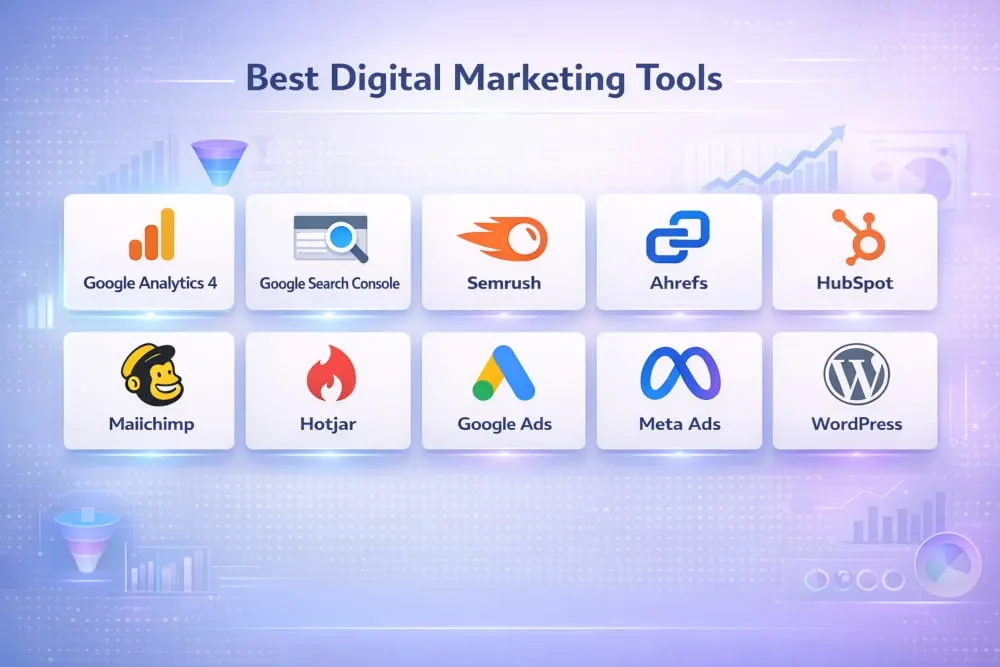
Top 21 Digital Marketing Tools
1) Google Analytics 4 (GA4)
What it’s for: Website and funnel performance tracking, traffic sources, user behavior, conversions.
Key features: Event-based tracking, funnel exploration, attribution reports, and integrations across Google products.
Pros: Powerful core analytics; widely supported; works for nearly any site.
Cons: Setup can be confusing; reporting takes time to master; some limits vs enterprise GA 360. GA4 is free; GA 360 is a paid enterprise tier.
Free/Paid: Free (GA4), Paid (GA 360).
2) Google Search Console
What it’s for: Organic search visibility, queries, rankings, indexing, and technical SEO issues.
Key features: Search performance reports, coverage/indexing, sitemaps, URL inspection.
Pros: Direct data from Google; essential for SEO diagnostics.
Cons: Not a full SEO suite (no deep competitor research). Google positions it as a free tool.
Free/Paid: Free.
3) Semrush
What it’s for: All-in-one SEO + competitive research + PPC insights (strong for research-heavy marketing).
Key features: Keyword research, site audits, backlink analysis, content tools, competitor intelligence, paid search research.
Pros: Very broad toolkit; strong competitive insights; popular for agencies.
Cons: Can feel expensive; learning curve; plans vary by features.
Free/Paid: Paid (with limited free access or trials/trials depending on region/offers).
4) Ahrefs
What it’s for: SEO research, especially backlinks, competitor analysis, and keyword discovery.
Key features: Site Explorer, Keywords Explorer, Site Audit, rank tracking; free Webmaster Tools exist for verified sites.
Pros: Best-in-class backlink intelligence; strong competitor research.
Cons: Paid plans can be pricey; best features sit behind subscriptions.
Free/Paid: Free (limited Webmaster Tools), Paid (full suite).
5) Looker Studio
What it’s for: Marketing dashboards and reporting, turns data into clean, shareable visuals.
Key features: Interactive dashboards, Google-native connectors, and sharing/collaboration.
Pros: Great for reporting clients/teams; easy to share; the core product is free.
Cons: Advanced connectors can add cost; data modeling can take effort.
Free/Paid: Free (core), Paid options exist (e.g., Pro/connectors).
6) HubSpot (CRM + Marketing Hub)
What it’s for: CRM + inbound marketing platform, capture leads, nurture, automate, and report.
Key features: CRM, forms, email marketing, automation (tiered), landing pages, reporting.
Pros: Strong “all-in-one” ecosystem; excellent for lead generation + nurturing.
Cons: Costs can scale as contacts/features grow; advanced features are gated.
Free/Paid: Free tools available; Paid tiers for marketing automation and advanced features.
7) Mailchimp
What it’s for: Email marketing + basic automation (popular for SMBs).
Key features: Email builder, segmentation, basic automations, and reporting.
Pros: Easy to start; strong templates; broad integrations.
Cons: Free plan limits have tightened recently; advanced automation is paid.
Free/Paid: Free tier + Paid plans.
8) Zapier
What it’s for: Automation glue, connecting apps, and building workflows without coding.
Key features: App integrations, multi-step automations, triggers/actions, basic logic.
Pros: Huge integration library; fast to automate repetitive marketing tasks.
Cons: Costs rise with task volume; some apps/features require paid plans.
Free/Paid: Free tier + Paid plans.
9) Hotjar
What it’s for: Conversion insights, see how users behave, where they drop off, and why.
Key features: Heatmaps, session recordings, and feedback surveys.
Pros: Makes UX issues obvious; great for landing page optimization.
Cons: Needs thoughtful sampling/privacy setup; advanced features cost more. Hotjar has a Free tier and paid tiers; it’s now under Contentsquare.
Free/Paid: Free tier + Paid plans.
10) Google Ads
What it’s for: Paid search + display acquisition at intent moments.
Key features: Keyword targeting, bidding, conversion tracking, audiences, and performance reporting.
Pros: High intent traffic; scalable; deep targeting options.
Cons: Competitive costs in many markets; needs continuous optimization. Google notes you pay for clicks/calls (platform access vs spend).
Free/Paid: Free to use, paid media spend required.
11) Meta Ads Manager (Facebook/Instagram Ads)
What it’s for: Paid social reach + demand generation.
Key features: Audience targeting, creatives, conversion campaigns, and reporting.
Pros: Powerful targeting; great for creative testing; strong for ecommerce and lead-gen.
Cons: Performance depends heavily on the creative; tracking/attribution can be tricky post-privacy changes. Meta Ads Manager itself is generally free; you pay for ad spend.
Free/Paid: Free to use, paid media spend required.
12) LinkedIn Campaign Manager
What it’s for: B2B paid acquisition, job titles, industries, and company targeting.
Key features: Lead Gen Forms, ABM-style targeting, conversion tracking, and reporting.
Pros: Best B2B targeting; strong lead quality for many niches.
Cons: Higher CPM/CPL than on many platforms; requires a strong offer and landing page.
Free/Paid: Free to use, paid media spend required.
13) WordPress
What it’s for: Website + content publishing foundation (blog + landing pages).
Key features: CMS, plugins, SEO extensibility, speed optimization options.
Pros: Flexible; huge ecosystem; strong for content-led growth.
Cons: Maintenance/security depend on setup; plugin bloat can slow sites.
Free/Paid: Free (open-source) + Paid hosting/themes/plugins.
14) Canva
What it’s for: Fast marketing design, social graphics, ads, presentations, thumbnails.
Key features: Templates, brand kit, collaboration, and AI-assisted design features by plan.
Pros: Extremely fast production, low skill barrier, and great for teams.
Cons: Advanced brand/asset control is better in paid tiers; template sameness can be overused.
Free/Paid: Free plan + Paid plans.
15) Google Tag Manager (GTM)
What it’s for: Tracking implementation, managing tags/events without constant dev cycles.
Key features: Tag deployment, event triggers, variables, and debugging.
Pros: Faster measurement setup; cleaner tracking governance when managed well.
Cons: Can become messy without naming conventions; needs QA.
Free/Paid: Free.
16) Google Keyword Planner
What it’s for: Keyword discovery and rough volume ranges (especially for PPC planning).
Key features: Keyword ideas, forecasts, bid estimates (varies by account activity).
Pros: Directly tied to the Google Ads ecosystem; good starting point.
Cons: Volume ranges can be broad; less competitor insight than in paid suites.
Free/Paid: Free with a Google Ads account.
17) Buffer
What it’s for: Social media scheduling and publishing.
Key features: Scheduling, queues, basic analytics (plan dependent).
Pros: Clean workflow; easy scheduling.
Cons: Deep listening/enterprise features aren’t its core strength.
Free/Paid: Free tier + Paid plans.
18) Hootsuite
What it’s for: Social media management at scale, publishing, monitoring, and team workflows.
Key features: Scheduling, inbox/engagement, monitoring, analytics (tiered).
Pros: Strong for teams and multi-account management.
Cons: Can be expensive for small teams; feature depth depends on plan.
Free/Paid: Paid (some trials/offers may exist).
19) Trello
What it’s for: Content planning and campaign workflow (simple, visual).
Key features: Boards, calendars, checklists, automation (tiered).
Pros: Easy adoption; great for editorial calendars.
Cons: Limited for complex dependencies; basic reporting unless extended.
Free/Paid: Free tier + Paid plans.
20) Notion
What it’s for: Marketing documentation + content systems (SOPs, briefs, calendars, knowledge base).
Key features: Docs + databases, templates, collaboration, publishing workflows.
Pros: Excellent for organizing strategy and content ops.
Cons: Can become messy without structure; permissions at scale are plan-dependent.
Free/Paid: Free tier + Paid plans.
21) Google Business Profile
What it’s for: Brand presence in Google’s local ecosystem (even if you’re not “local SEO-focused,” it supports trust + discoverability).
Key features: Reviews, posts, business info, insights, messaging (varies).
Pros: High visibility; boosts credibility; supports branded searches.
Cons: Needs ongoing review management; listings can be suspended if mismanaged.
Free/Paid: Free.
How to Use This List
A smart way to frame these tools in your guide is by decision context, not hype:
- Research & visibility: Semrush, Ahrefs, Search Console
- Measurement & reporting: GA4, GTM, Looker Studio
- Growth execution: Google Ads, Meta Ads, LinkedIn
- Nurture & automation: HubSpot, Mailchimp, Zapier
- Conversion improvements: Hotjar
- Content & ops: WordPress, Canva, Trello, Notion
- Social publishing: Buffer, Hootsuite
What Are Digital Marketing Tools?
Before exploring categories, comparisons, and strategy, it’s important to clearly answer a foundational question: What are digital marketing tools?
In simple terms, digital marketing tools are the platforms, software, and technologies used to plan, execute, analyze, and optimize online marketing activities. They help businesses attract traffic, generate leads, nurture prospects, measure performance, and improve return on investment across digital channels.
But the meaning of digital marketing tools goes beyond “software.” These tools act as operational systems behind modern marketing. They replace manual guesswork with data-driven insights, automation, and scalable processes. From search engine optimization platforms to analytics dashboards and marketing automation systems, the tools used in digital marketing form the backbone of today’s marketing infrastructure.
To define digital marketing tools more precisely:
A digital marketing tool is any platform or software application that helps manage, measure, or improve digital marketing efforts across channels such as search engines, social media, email, paid advertising, and websites.
These tools serve different purposes depending on their function. Some help increase visibility through SEO. Others support campaign management, track user behavior, automate communications, or analyze customer data.
The types of digital marketing tools typically include:
- SEO and keyword research tools
- Social media management tools
- Email marketing platforms
- Marketing automation software
- Analytics and reporting tools
- CRM systems
- Paid advertising management tools
Each category plays a specific role, but together they create an integrated system designed to drive growth.
Why Businesses Use Digital Marketing Tools
Understanding what digital marketing tools are naturally leads to the next question: why are they essential?
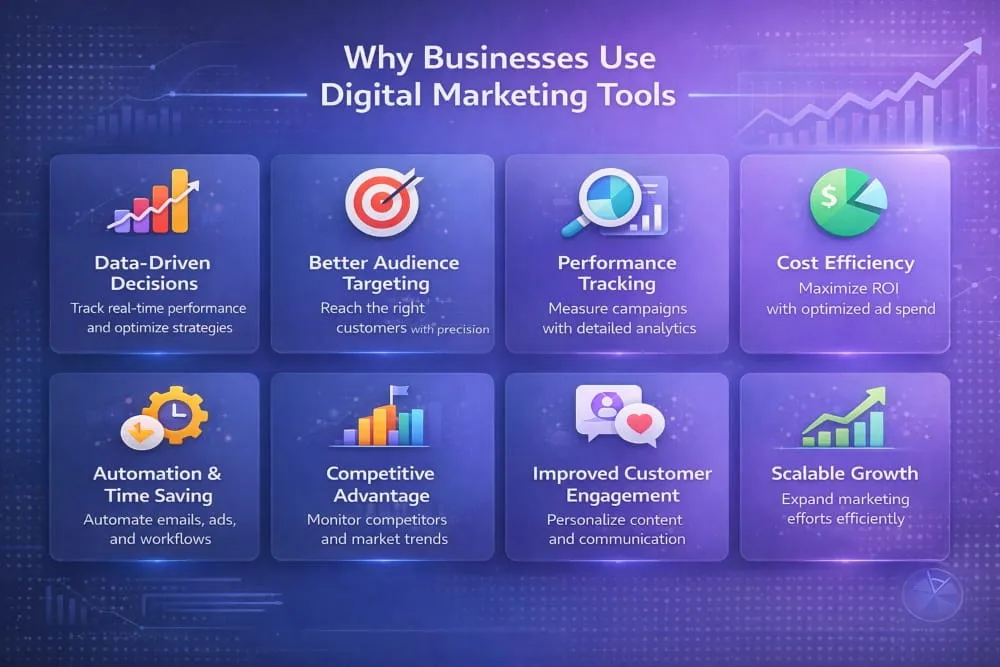
Modern marketing operates in a highly competitive and data-driven environment. Businesses no longer rely solely on creative messaging; they rely on measurable performance. Digital tools in marketing provide the structure needed to:
- Track campaign effectiveness in real time
- Understand customer behavior
- Improve targeting and personalization
- Automate repetitive tasks
- Measure ROI accurately
- Optimize conversion funnels
Without these systems, marketing decisions would depend on assumptions rather than evidence. Essential digital marketing tools enable teams to move from reactive marketing to strategic, performance-based marketing.
For small businesses, basic digital marketing tools may focus on website analytics, email campaigns, and social media scheduling. Larger organizations often expand into advanced automation, attribution modeling, and AI-powered personalization. Regardless of scale, the main digital marketing tools serve one shared goal: improving efficiency while maximizing results.
How Digital Tools Power Modern Marketing Campaigns
Digital marketing campaigns today are multi-channel and interconnected. A single campaign may involve search optimization, paid ads, social media engagement, email sequences, and conversion tracking, all running simultaneously.
This complexity is manageable only because digital marketing tools integrate these moving parts into one ecosystem.
For example, analytics tools measure traffic sources and user behavior. Automation tools nurture leads based on actions. CRM systems track customer interactions. Reporting platforms visualize performance metrics. Together, these digital marketing tools transform scattered activities into coordinated, measurable strategies.
The most important digital marketing tools are not isolated applications; they are components of a larger marketing stack. When properly selected and integrated, they allow businesses to scale campaigns, optimize continuously, and make informed decisions backed by real data.
Now that we’ve clarified what digital marketing tools are and why they matter, the next step is to understand the different types of digital marketing tools and how each category contributes to a complete marketing system.
Types of Digital Marketing Tools
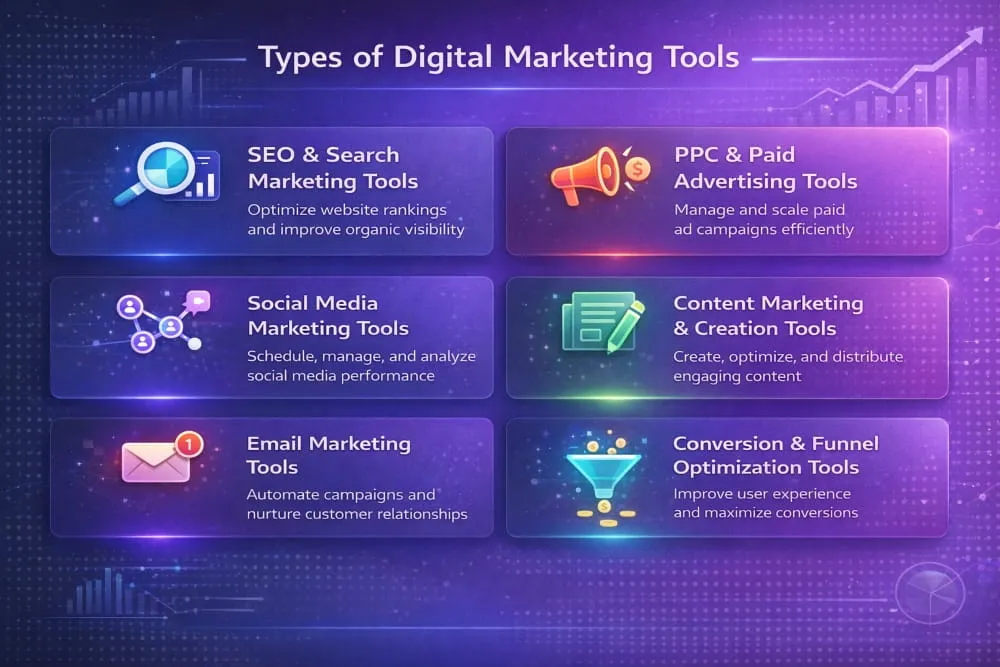
To build an effective strategy, it’s not enough to know which digital marketing tools are available; you need to understand the different categories and how each supports specific objectives. Modern marketing relies on a connected ecosystem of tools, each designed to improve visibility, engagement, conversion, or measurement.
Below is a complete breakdown of the main types of digital marketing tools and how they function within a performance-driven marketing stack.
SEO & Search Marketing Tools
Search visibility remains one of the most powerful drivers of sustainable online growth. SEO tools for digital marketing help businesses improve search rankings, enhance website health, and attract qualified organic traffic.
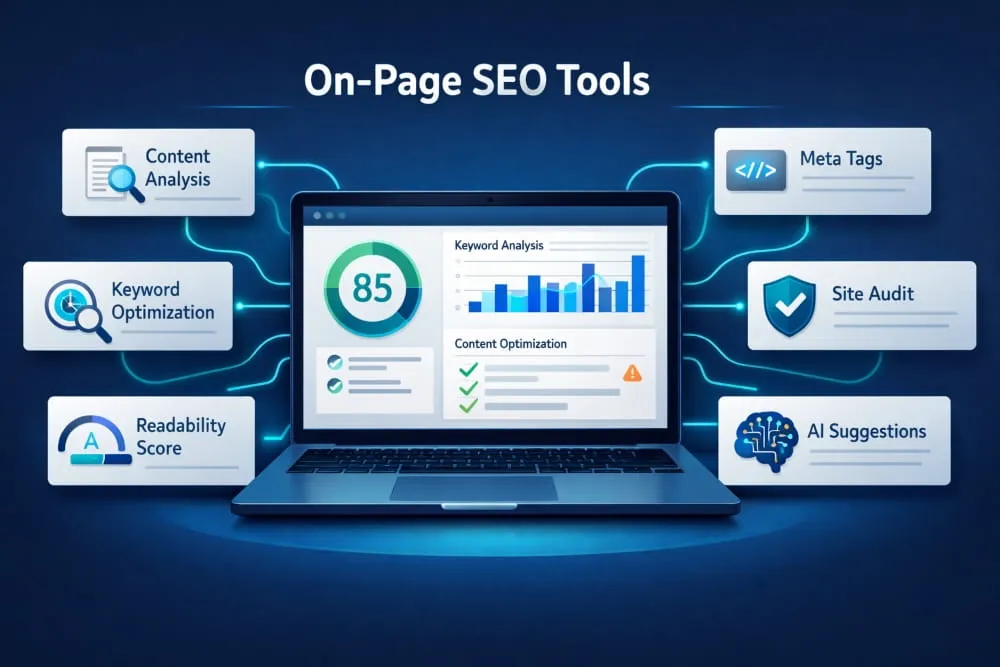
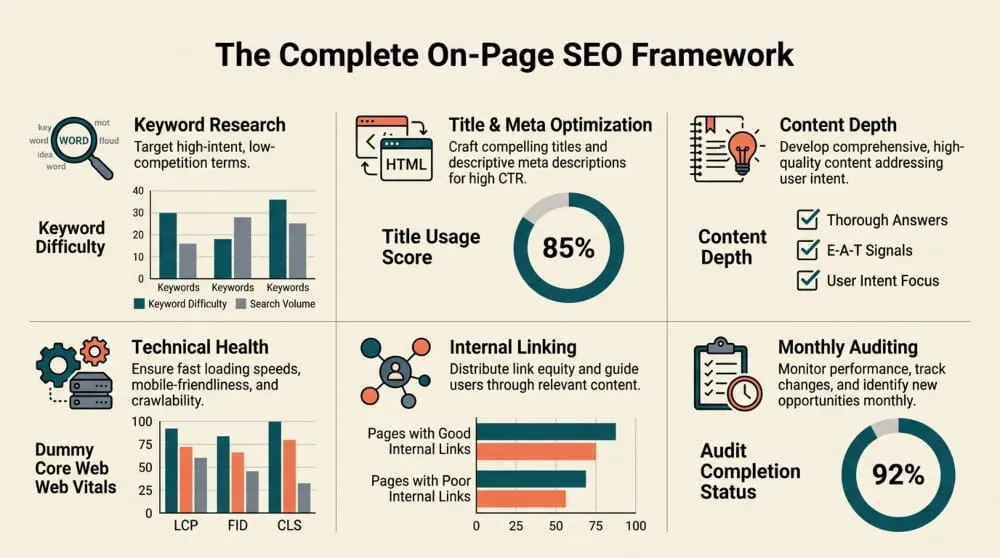
Search engine optimization tools for digital marketing typically focus on keyword research, on-page optimization, backlink analysis, and technical audits. A keyword research tool in digital marketing helps identify high-intent search queries. In contrast, an SEO audit tool for digital marketing agency teams evaluates site performance, indexing issues, and optimization gaps.
SEO and SEM digital marketing tools are often paired to manage both organic and paid search strategies. While SEO focuses on long-term visibility, PPC tools in digital marketing support paid search campaigns that deliver immediate traffic through targeted advertising.
Together, these SEO tools in digital marketing ensure that brands are discoverable when customers actively search for solutions.
PPC & Paid Advertising Tools
Paid advertising tools are designed to manage and optimize campaigns across search engines, display networks, and social platforms. These tools allow marketers to control budgets, target specific audiences, test creatives, and monitor performance metrics in real time.
PPC tools in digital marketing focus on bid management, keyword targeting, conversion tracking, and ad performance reporting. They help ensure that advertising spend is efficient and aligned with business goals.
When integrated with analytics and attribution systems, paid advertising tools provide clear visibility into customer acquisition costs and campaign ROI.
Social Media Marketing Tools
Social media marketing tools streamline the management of multiple platforms while improving engagement and consistency. These tools allow marketers to schedule content, monitor audience interactions, track performance metrics, and analyze trends.
Advanced social media analytics tools in digital marketing provide insight into reach, engagement rates, follower growth, and campaign effectiveness. Social listening capabilities also help brands understand conversations around their products and industry.
By centralizing management and reporting, social media tools improve efficiency while maintaining strategic oversight.
Content Marketing & Creation Tools
Content remains central to digital strategy. Content marketing tools in digital marketing support ideation, creation, optimization, and distribution of blog posts, landing pages, videos, and social content.
These tools support editorial planning, keyword optimization, performance tracking, and cross-team collaboration. Content creation platforms often integrate with SEO systems to ensure that content aligns with search intent and ranking opportunities.
Effective content tools transform creativity into measurable traffic and engagement outcomes.
Email Marketing Tools
Email marketing tools help businesses communicate directly with subscribers through automated campaigns, newsletters, and behavioral triggers. These platforms manage subscriber lists, segment audiences, personalize messaging, and track engagement metrics such as open rates and conversions.
Modern email marketing tools in digital marketing often integrate with CRM systems and automation workflows, enabling personalized customer journeys that increase retention and lifetime value.
Conversion & Funnel Optimization Tools
Driving traffic is only part of the equation. Conversion tools in digital marketing focus on turning visitors into leads and customers.
Funnel optimization platforms support landing page testing, A/B experiments, heatmaps, behavioral tracking, and user experience improvements. These tools identify friction points and provide insights that improve conversion rates across the customer journey.
By refining every stage of the funnel, businesses can increase revenue without necessarily increasing traffic.
CRM & Lead Generation Tools
Customer relationship management systems are essential for organizing and nurturing leads. CRM tools in digital marketing centralize customer data, track interactions, and automate follow-up processes.
Digital marketing lead generation tools capture prospect information through forms, landing pages, and gated content. Once captured, CRM systems segment and manage those leads to support targeted communication and sales alignment.
These tools ensure that no opportunity is lost and that customer relationships are built strategically over time.
Analytics & Performance Tracking Tools
Analytics tools for digital marketing provide the data foundation behind every decision. They track website traffic, user behavior, campaign performance, and conversion metrics across channels.
Web analytics tools in digital marketing reveal where visitors come from, how they interact with content, and which campaigns drive results. Digital marketing performance-tracking tools enable marketers to monitor KPIs and adjust strategies in real time.
Without analytics, optimization becomes speculation. With analytics, strategy becomes evidence-based.
Attribution & ROI Measurement Tools
Attribution tools determine how different touchpoints contribute to conversions. In complex multi-channel environments, understanding attribution is critical for allocating budgets effectively.
Digital marketing attribution tools connect user journeys across search, social, email, and paid campaigns. Combined with digital marketing ROI measurement tools, they help businesses calculate profitability and optimize investment decisions.
These tools move marketing from activity-based reporting to revenue-based evaluation.
Marketing Automation Tools
Marketing automation tools streamline repetitive tasks and nurture leads at scale. Automation tools in digital marketing manage workflows such as email sequences, behavioral triggers, audience segmentation, and lead scoring.
By reducing manual effort, automation increases efficiency while maintaining personalization. It ensures that prospects receive relevant communication at the right time without overwhelming marketing teams.
Automation transforms disconnected campaigns into coordinated customer journeys.
AI-Powered Digital Marketing Tools
Artificial intelligence is reshaping how digital marketing tools function. AI-powered digital marketing tools enhance targeting accuracy, dynamically personalize content, predict customer behavior, and automatically optimize campaigns.
AI tools for digital marketing assist with content generation, performance forecasting, audience segmentation, and data analysis. Rather than replacing marketers, AI systems amplify decision-making by processing large volumes of data quickly and identifying actionable insights.
As AI integration expands, digital marketing becomes more adaptive, predictive, and efficient.
All-in-One Marketing Platforms
Some businesses prefer unified systems instead of managing multiple standalone tools. All-in-one marketing platforms combine SEO, email, automation, CRM, analytics, and campaign management into a single interface.
These digital marketing platforms and tools simplify integration and reporting, making them especially attractive for small to mid-sized teams seeking streamlined workflows.
While specialized tools often offer deeper functionality in specific areas, integrated platforms provide convenience and centralized control.
Understanding these types of digital marketing tools allows businesses to build a structured, scalable marketing ecosystem. Each category plays a distinct role, but their real power emerges when they work together as part of a unified strategy.
Best Digital Marketing Tools by Category
Choosing the best digital marketing tools is not about chasing trends; it’s about selecting the right platforms for your goals, resources, and growth stage. While thousands of options exist, the strongest tools consistently excel in performance, usability, integration, and data accuracy.
Below is a structured look at the best digital marketing tools by category, helping you understand what to prioritize and why each category matters.
Best SEO Tools
The best SEO tools are designed to improve search visibility, uncover keyword opportunities, analyze competitors, and optimize technical performance. Strong search engine optimization tools for digital marketing typically include features such as keyword research, backlink analysis, rank tracking, and site auditing.
A high-quality SEO audit tool helps identify indexing issues, broken links, slow page speeds, and optimization gaps. Meanwhile, a reliable keyword research tool in digital marketing reveals search intent, competition levels, and traffic potential.
The most effective SEO digital marketing tools combine data accuracy with actionable recommendations. They don’t just show rankings, they explain how to improve them.
When evaluating the best SEO tools, focus on:
- Data depth and reliability
- Technical audit capabilities
- Competitive analysis features
- Integration with analytics platforms
SEO remains a foundational channel, and the right tools make long-term organic growth predictable and measurable.
Top 5 SEO Tools
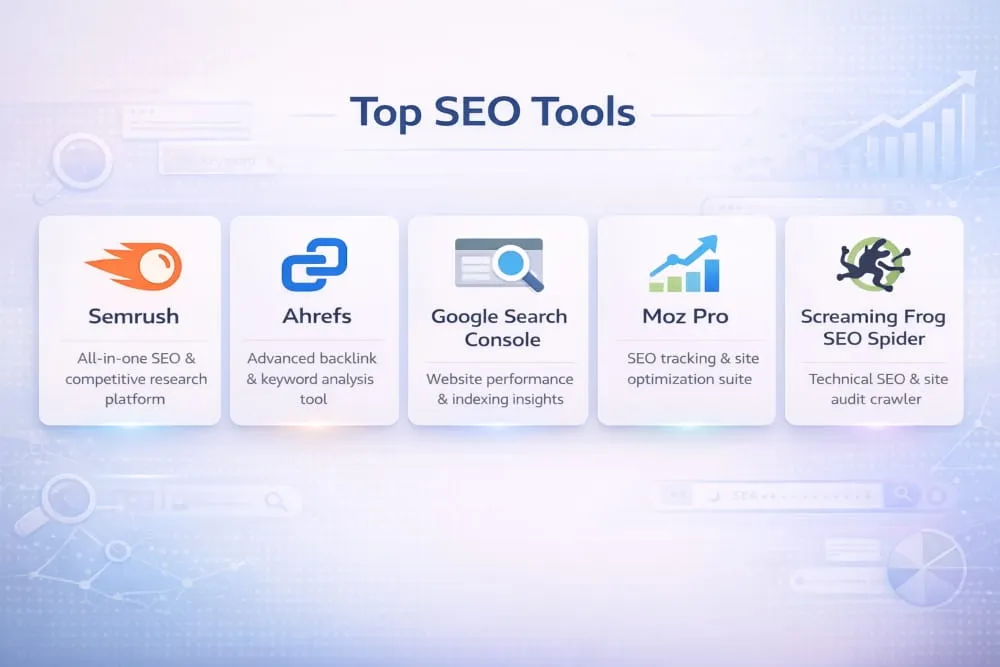
When it comes to search visibility, keyword discovery, site health, and competitive research, the right SEO tools can make all the difference. Below is a polished top 5 SEO tools list with a brief explanation of what each does, standout features, plus pros and cons — ideal for informational comparison and decision-making.
1) Semrush
What it is: A comprehensive SEO and competitive research platform used by marketers, agencies, and in-house teams.
Features:
Detailed keyword research, site audits, backlink analysis, rank tracking, competitor insights, PPC research, and content optimization tools.
Pros:
- All-in-one SEO suite
- Strong competitive intelligence
- Great for keyword + competitor strategy
Cons:
- Can be pricey for smaller teams
- Some features are limited on lower tiers
Best for: SEO professionals, agencies, and competitive research.
2) Ahrefs
What it is: A powerful SEO toolset with best-in-class backlink and search research capabilities.
Features:
Site Explorer, Keywords Explorer, Site Audit, Content Explorer, and rank tracking.
Pros:
- Excellent backlink database
- Fast, accurate keyword data
- Easy competitor gaps analysis
Cons:
- Cost can be high for full access
- Learning curve for beginners
Best for: Backlink analysis and deep organic research.
3) Google Search Console
What it is: Google’s core SEO performance platform that shows how your site appears in search results.
Features:
Search performance reports, indexing status, URL inspection, and sitemap submission.
Pros:
- Direct data from Google
- Essential for indexing and search visibility
- Free and trustworthy
Cons:
- Not a full keyword research suite
- Limited competitor data
Best for: Monitoring organic search performance and technical issues.
4) Moz Pro
What it is: A user-friendly SEO toolset focused on both analytics and education for marketers.
Features:
Keyword Explorer, site audits, rank tracking, backlink analysis, and SERP features data.
Pros:
- Clean interface and beginner-friendly
- Helpful SEO metrics for content planning
- Good support and learning resources
Cons:
- Data depth is slightly less than that of some competitors
- Backlink database is smaller than Ahrefs/Semrush
Best for: Marketers new to SEO or focused on on-page optimization.
5) Screaming Frog SEO Spider
What it is: A desktop-based technical SEO crawler that analyzes your site’s structure.
Features:
Crawls entire sites to identify broken links, redirects, duplicate content, meta issues, and more.
Pros:
- Excellent for deep technical audits
- Works well with Google Analytics/Search Console export data
- One-time license option available
Cons:
- Not a full suite — specializes in technical SEO
- Interface can feel technical for beginners
Best for: Technical SEO audits and site health diagnostics.
Quick Comparison
| Tool | Best Strength | Free Option | Best For |
|---|---|---|---|
| Semrush | All-in-one SEO + competitor research | ✘ | Agencies + SEO pros |
| Ahrefs | Backlink + keyword analysis | Limited | Competitive SEO research |
| Search Console | Google native performance insights | ✔ | All sites |
| Moz Pro | User-friendly SEO insights | ✘ | Beginners + content SEO |
| Screaming Frog | Technical audits | Limited | Site architecture & debugging |
How to Choose Your Top SEO Tool
If you’re just starting, Google Search Console + a basic keyword explorer can get you far.
For deep competitive insights, Semrush or Ahrefs delivers the most comprehensive data.
If technical SEO is a priority, Screaming Frog is unmatched in crawl analysis.
Best Analytics Tools
The best analytics tools provide clarity across campaigns, channels, and customer behavior. These digital marketing analytics tools track traffic sources, engagement metrics, and conversion pathways, allowing marketers to make informed decisions.
Strong analytics tools for digital marketing go beyond basic visitor counts. They reveal how users interact with content, where drop-offs occur, and which campaigns drive revenue. Web analytics tools in digital marketing also support goal tracking, event measurement, and audience segmentation.
The most valuable analytics platforms offer:
- Real-time performance dashboards
- Conversion tracking
- Behavioral insights
- Multi-channel reporting
Without robust analytics, optimization becomes guesswork. The best tools turn performance data into strategic direction.
Best Automation Tools
Marketing automation tools streamline repetitive processes and create consistent customer journeys. The best automation tools in digital marketing manage email sequences, lead nurturing workflows, segmentation, and behavioral triggers.
Automated digital marketing tools reduce manual workload while increasing personalization. They allow businesses to respond to user behavior instantly, whether someone downloads a resource, abandons a cart, or signs up for a newsletter.
When choosing the best digital marketing automation tools, look for:
- Workflow flexibility
- CRM integration
- Personalization capabilities
- Reporting and performance tracking
Effective automation tools connect marketing activity with sales outcomes, improving efficiency without sacrificing relevance.
Best AI Tools for Digital Marketing
Artificial intelligence has introduced a new layer of intelligence into digital marketing tools. The best AI tools for digital marketing enhance targeting accuracy, generate content, optimize campaigns, and forecast performance.
AI-powered digital marketing tools analyze vast data sets to uncover patterns that would otherwise go unnoticed. They assist with predictive analytics, personalization engines, automated ad optimization, and even content creation support.
The most impactful AI tools for digital marketers typically provide:
- Data-driven audience insights
- Smart content recommendations
- Automated performance adjustments
- Predictive lead scoring
Rather than replacing strategy, AI tools amplify it, helping marketers move faster while making smarter decisions.
Best Social Media Tools
The best social media marketing tools centralize scheduling, engagement monitoring, and analytics across platforms. Social media tools in digital marketing ensure consistency, streamline content distribution, and provide measurable insights into audience behavior.
Advanced social media analytics tools help track reach, engagement rates, conversion impact, and audience growth. Social listening capabilities also allow brands to monitor conversations, trends, and brand mentions in real time.
Strong social media tools provide:
- Multi-platform management
- Content scheduling and automation
- Performance reporting
- Audience insights
For businesses heavily invested in brand visibility and community building, these tools are essential.
Best Free Digital Marketing Tools
Not every strategy requires a large budget. The best free digital marketing tools provide powerful functionality without immediate financial investment.
Free tools often include basic SEO analysis, web analytics, keyword research features, and email marketing capabilities. While they may have usage limitations or restricted features, they are valuable for startups, small businesses, or early-stage campaigns.
Free digital marketing tools are particularly useful for:
- Testing strategies before scaling
- Learning digital marketing fundamentals
- Managing lean marketing operations
However, as complexity grows, businesses often transition to paid platforms for advanced features and scalability.
Best Paid & Enterprise Tools
Paid and enterprise digital marketing tools offer advanced capabilities, deeper data analysis, enhanced automation, and enterprise-grade integrations. These platforms are designed for scalability, collaboration, and high-volume performance tracking.
Enterprise digital marketing tools typically include:
- Multi-user management
- Advanced attribution modeling
- Sophisticated automation workflows
- Deep analytics and reporting
- Integration with CRM and sales systems
While free tools are valuable starting points, paid tools provide the infrastructure required for sustained growth, complex campaigns, and cross-channel integration.
AI in Digital Marketing Tools
Artificial intelligence is no longer an emerging concept in marketing; it has become a core component of modern digital marketing tools. From automated workflows to predictive analytics, AI is redefining how marketers plan campaigns, create content, segment audiences, and optimize performance.
AI-powered digital marketing tools combine machine learning, data analysis, and automation to improve efficiency and decision-making. Instead of relying solely on manual analysis, marketers can now leverage intelligent systems that adapt, learn, and refine strategies in real time.
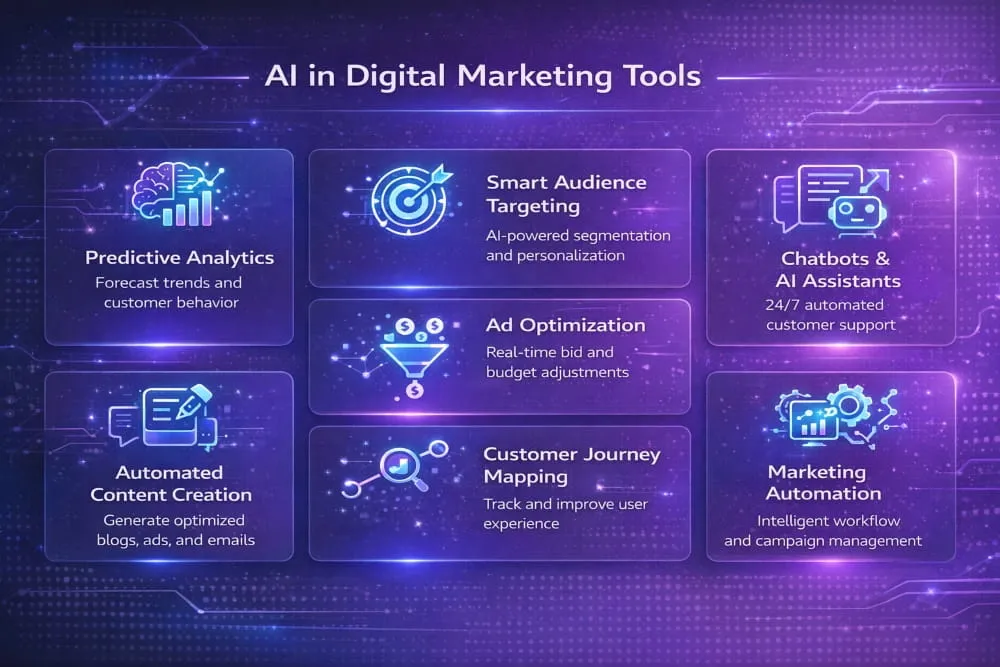
As competition increases and customer journeys become more complex, AI digital marketing tools provide the speed, scalability, and precision required to stay competitive.
How AI Is Transforming Digital Marketing
Artificial intelligence tools for digital marketing are transforming the industry by shifting it from reactive execution to predictive strategy. Traditional digital marketing automation tools already helped streamline tasks, but AI introduces intelligent optimization layered on top of automation.
AI tools used in digital marketing can analyze massive datasets, identify behavioral patterns, and generate actionable insights faster than manual processes ever could. This allows marketers to:
- Detect trends early
- Refine targeting with greater accuracy
- Adjust campaigns dynamically
- Improve customer segmentation
Where traditional automation tools in digital marketing follow predefined workflows, AI-powered systems adapt based on performance data. This evolution turns static campaigns into continuously improving systems.
AI for Content Creation
Content remains central to digital strategy, and AI tools for digital marketing now play a significant role in accelerating content production.
AI-driven content tools assist with:
- Topic ideation based on search trends
- Draft generation for blogs, ads, and emails
- SEO optimization recommendations
- Content performance analysis
These AI-powered digital marketing tools do not replace creative strategy; instead, they enhance productivity and reduce time spent on repetitive drafting and research tasks. Marketers can focus more on messaging, positioning, and storytelling, while AI handles data-intensive optimization.
When integrated with broader digital marketing automation tools, AI-generated content can also be personalized and distributed at scale.
AI for Personalization
Personalization has moved from optional to essential. Customers expect relevant experiences tailored to their interests and behaviors.
AI digital marketing tools enable advanced personalization by analyzing user data, browsing patterns, purchase history, and engagement signals. These artificial intelligence tools for digital marketing dynamically adjust content, email messaging, product recommendations, and advertising creatives to match individual preferences.
Instead of segmenting audiences into broad categories, AI systems create micro-segments or even one-to-one personalization at scale. This level of precision improves engagement, increases conversion rates, and enhances customer loyalty.
In digital marketing, AI, combined with marketing automation tools, ensures personalized communication is delivered automatically and consistently.
AI for Predictive Analytics
Predictive analytics is one of the most powerful applications of AI in digital marketing tools. By analyzing historical data, AI can forecast future outcomes such as customer lifetime value, churn probability, and campaign performance.
AI tools used in digital marketing leverage machine learning models to answer critical strategic questions:
- Which leads are most likely to convert?
- Which customers are at risk of disengagement?
- Which campaigns will generate the highest ROI?
These insights allow businesses to allocate budgets more effectively and prioritize high-value opportunities. Rather than reacting to results after a campaign ends, marketers can proactively adjust strategies based on predictive signals.
AI for Campaign Optimization
Campaign optimization has traditionally required manual monitoring and frequent adjustments. Today, automated digital marketing tools enhanced with AI can manage much of this process independently.
AI-powered digital marketing tools continuously analyze performance metrics, including click-through rates, cost per acquisition, and conversion rates. Based on this data, they can automatically:
- Adjust bids in paid campaigns
- Reallocate budget across channels
- Test variations of creative assets
- Refine audience targeting
This level of automation improves efficiency while reducing wasted spend. Instead of periodic manual updates, campaigns evolve dynamically.
When integrated into digital marketing automation tools, AI creates a feedback loop where data informs optimization, optimization improves performance, and improved performance generates new data.
AI in digital marketing tools represents the convergence of automation, analytics, and strategic intelligence. While automation tools in digital marketing streamline processes, AI enhances them with adaptive learning and predictive insights.
The result is a more responsive, data-driven marketing system, one capable of scaling personalization, improving ROI, and delivering measurable growth in an increasingly competitive digital landscape.
Ultimately, the best digital marketing tools depend on your objectives. A small business may prioritize essential digital marketing tools for SEO and email campaigns, while a larger organization may invest in enterprise analytics and automation platforms.
The key is not choosing the most popular tool; it’s selecting the right combination that aligns with your strategy, integrates seamlessly, and delivers measurable results.
Free vs Paid Digital Marketing Tools
One of the most common decisions businesses face when building their marketing stack is whether to rely on free digital marketing tools or invest in paid platforms. Both options have value, but the right choice depends on your goals, growth stage, and performance expectations.
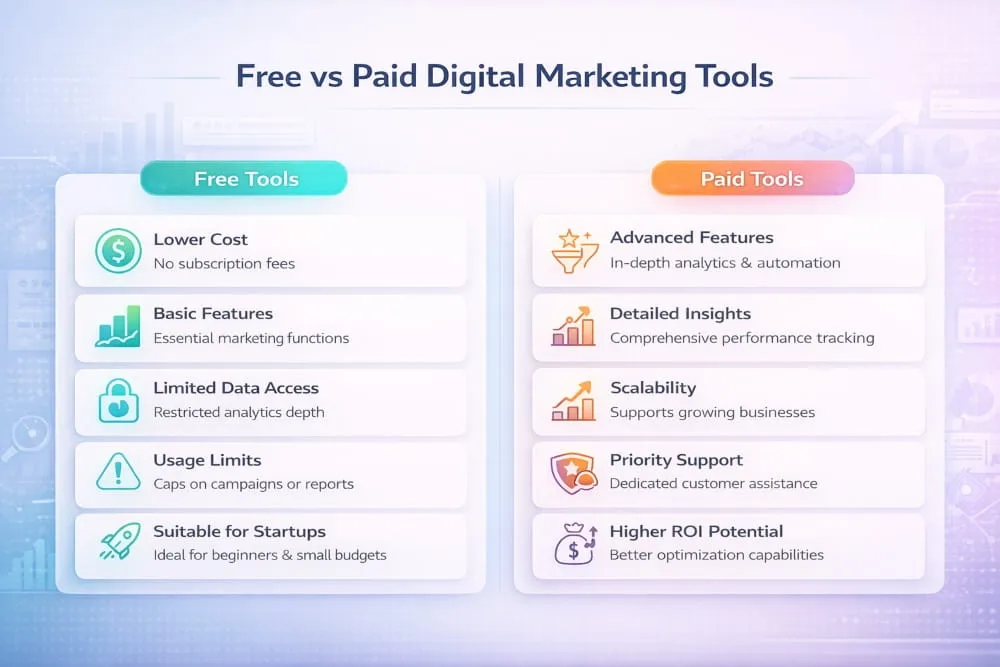
Digital marketing tools range from basic free solutions to advanced enterprise software. Understanding the trade-offs between free and paid tools helps you build a system that supports both efficiency and scalability without overspending or underperforming.
When Free Tools Are Enough
Free digital marketing tools are often ideal for startups, small businesses, or early-stage campaigns. They provide access to essential features such as website analytics, keyword research, social media scheduling, and email marketing without requiring upfront investment.
For businesses testing new strategies or learning how digital marketing tools work, free platforms offer a low-risk starting point. They can help you:
- Monitor basic website traffic
- Track simple performance metrics
- Schedule and publish content
- Conduct limited keyword research
- Manage small email lists
If your marketing efforts are relatively straightforward and your traffic volume is modest, essential digital marketing tools in their free versions may be sufficient.
However, as campaigns grow more complex, the need for deeper insights and automation often increases.
Limitations of Free Tools
While free digital marketing tools are valuable, they typically come with constraints. These limitations may include restricted data access, usage caps, limited automation features, or fewer integration options.
Basic digital marketing tools may not offer advanced analytics, multi-channel attribution, predictive insights, or scalable automation workflows. As a result, performance tracking can become fragmented, and manual work may increase.
Another limitation is scalability. Free tools are usually designed for smaller operations. As traffic, leads, and campaigns expand, businesses may encounter data thresholds or functionality gaps that restrict growth.
In short, free tools are useful for foundational tasks but may lack the depth required for long-term optimization and competitive performance.
When to Upgrade to Paid Tools
Upgrading to paid digital marketing tools becomes necessary when the strategy shifts from experimentation to expansion. Paid platforms offer enhanced capabilities, including advanced analytics, marketing automation tools, CRM integration, AI-powered features, and detailed reporting dashboards.
Businesses typically consider paid tools when they need to:
- Manage higher volumes of traffic and leads
- Implement complex automation workflows
- Access in-depth SEO or competitive research
- Track multi-channel campaigns accurately
- Measure ROI across customer journeys
Paid digital marketing software tools are designed for reliability, scalability, and performance optimization. They reduce manual effort and provide deeper data insights that support strategic decision-making.
For growing organizations, the transition from free to paid tools often marks the shift from basic digital marketing to a structured, data-driven system.
ROI Considerations
The decision between free and paid digital marketing tools should ultimately be based on return on investment. While free tools reduce upfront costs, they may increase time investment and limit optimization opportunities.
Paid tools require financial commitment, but they often improve efficiency, accuracy, and campaign performance. When used correctly, advanced analytics, automation, and AI-powered digital marketing tools can significantly increase conversion rates and reduce wasted spend.
The key question is not simply “Which is cheaper?” but rather “Which option generates better long-term value?”
If a paid tool saves hours of manual work, improves targeting precision, and increases revenue, the investment may quickly justify itself. On the other hand, if your marketing activities remain simple and manageable, free tools may continue to serve your needs effectively.
In many cases, the most practical approach is a hybrid model, using free digital marketing tools for foundational tasks while strategically investing in paid platforms to drive measurable growth.
Ultimately, the goal is not to accumulate more tools but to build the right system, one that balances cost, capability, and performance to support sustainable digital success.
How to Choose the Right Digital Marketing Tools
With hundreds of digital marketing tools available across SEO, automation, analytics, social media, and AI, selecting the right combination can feel overwhelming. The goal is not to adopt the most popular platforms, but to build a cohesive system that aligns with your strategy and delivers measurable results.
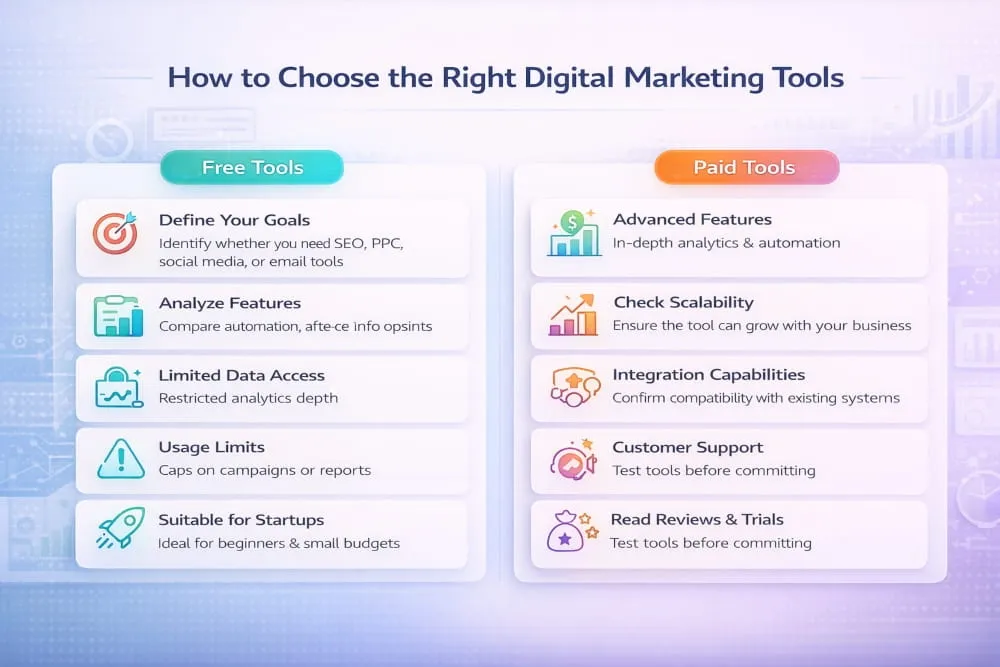
Choosing the right digital marketing tools requires clarity, foresight, and a structured evaluation process. Below are the key factors that should guide your decision.
Define Your Marketing Goals
Before evaluating features or pricing, clearly define what you want to achieve. Digital marketing tools should support strategy, not replace it.
Are you focused on increasing organic traffic through SEO? Generating qualified leads? Improving conversion rates? Automating email campaigns? Measuring ROI across channels?
Your objectives determine which types of digital marketing tools are most important. For example:
- If visibility is the priority, SEO and search marketing tools should come first.
- If nurturing leads is critical, marketing automation tools and CRM systems become essential.
- If performance optimization is the goal, analytics and attribution tools should be central to your stack.
Without clearly defined goals, it’s easy to accumulate overlapping tools that add complexity without improving results.
Budget & Scalability
Budget plays an obvious role, but scalability is just as important. Some free digital marketing tools may work well initially, but lack the flexibility to grow with your campaigns.
When evaluating digital marketing software tools, consider not only current costs but also long-term expansion. Ask:
- Can the platform handle higher traffic volumes?
- Does pricing increase significantly as contacts or campaigns grow?
- Are advanced features locked behind higher tiers?
The right digital marketing tools should support both present needs and future growth. A scalable solution prevents the disruption of migrating systems later as your marketing operations expand.
Integration & Compatibility
Modern marketing relies on interconnected systems. In digital marketing, SEO tools, analytics platforms, CRM systems, email marketing tools, and automation tools should work together seamlessly.
Strong digital marketing tools offer integrations with other platforms, allowing data to flow between systems without manual exports or duplicated work. Integration improves accuracy, reduces operational friction, and enhances reporting capabilities.
For example, connecting marketing automation tools with analytics and CRM systems ensures that customer behavior, campaign performance, and sales outcomes are tracked in a cohesive manner. This creates a unified marketing stack rather than isolated tools operating independently.
Compatibility is especially critical for organizations using AI-powered digital marketing tools, as these systems rely on consistent, centralized data.
Ease of Use
Even the most advanced digital marketing tools lose value if teams struggle to use them effectively. A platform should balance functionality with usability.
Evaluate the interface, onboarding process, documentation, and learning curve. Overly complex tools can slow execution and increase training costs. Conversely, overly simplified tools may lack the depth required for strategic growth.
The ideal solution empowers both beginners and experienced marketers. It should streamline workflows rather than create additional operational layers.
Ease of use also influences adoption across teams. If marketing, sales, and leadership can easily access dashboards and insights, collaboration improves significantly.
Reporting & Analytics Capabilities
Every digital marketing strategy depends on measurable performance. Reporting and analytics capabilities should be a primary consideration when choosing digital marketing tools.
Strong analytics tools for digital marketing provide:
- Clear dashboards for key performance indicators
- Conversion tracking across channels
- Customizable reports
- Attribution modeling
- Real-time data updates
Without robust reporting, optimization becomes reactive and incomplete. The best digital marketing tools transform raw data into actionable insight, enabling continuous improvement.
As campaigns grow more complex, advanced reporting features become increasingly valuable. Tools that offer detailed segmentation, multi-channel tracking, and ROI measurement provide deeper strategic visibility.
Selecting the right digital marketing tools is not about assembling the largest collection of platforms. It’s about building a streamlined, scalable system aligned with your goals, budget, and growth trajectory.
When strategy leads the selection process, supported by integration, usability, and strong analytics, digital marketing tools become more than software. They become the operational engine that powers sustainable, measurable growth.
How Digital Marketing Tools Work Together
Individually, digital marketing tools serve specific functions, SEO improves visibility, analytics measure performance, CRM systems manage relationships, and automation streamlines communication. But their real power emerges when they operate as a connected system.
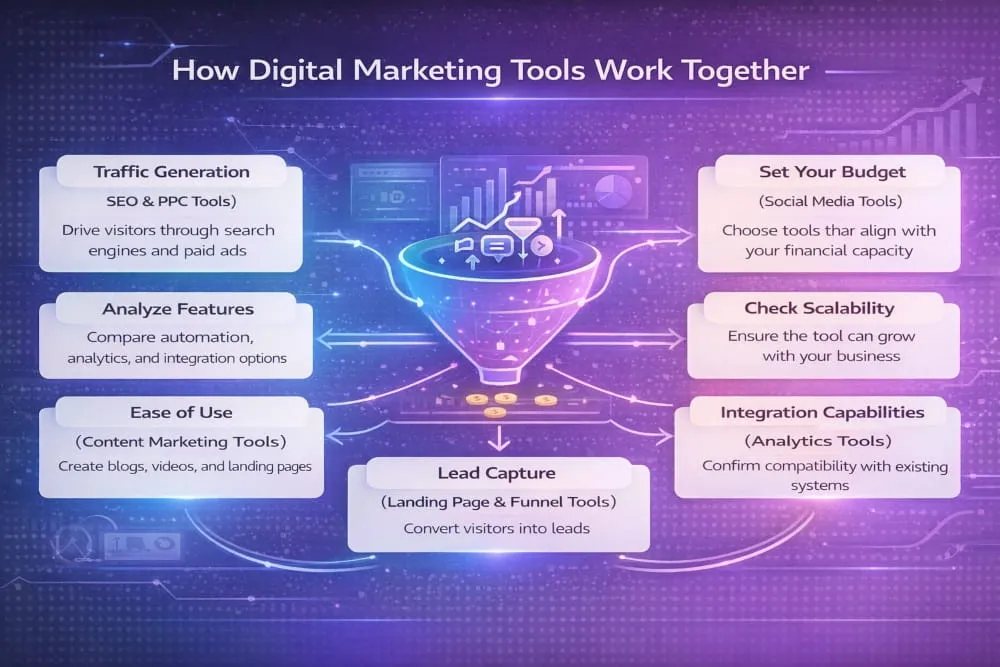
This interconnected framework is known as the marketing tech stack. Rather than relying on isolated platforms, modern marketers build structured ecosystems where tools share data, automate workflows, and provide unified performance insights. When properly integrated, digital tools in marketing transform scattered tactics into a coordinated growth engine.
The Modern Marketing Tech Stack
The modern marketing tech stack is a layered structure of digital marketing tools designed to support the full customer journey, from awareness to conversion and retention.
At the top of the funnel, SEO and paid advertising tools drive traffic. In the middle, content marketing platforms and automation tools nurture engagement. At the bottom, CRM systems and conversion optimization tools support lead management and revenue generation. Throughout every stage, analytics tools monitor performance and provide actionable insights.
Instead of treating each category separately, businesses view these tools as interconnected components of a single architecture. This approach reduces redundancy, improves efficiency, and ensures seamless data flow between platforms.
A strong marketing stack typically includes:
- Search and advertising tools for traffic acquisition
- Content and social platforms for engagement
- CRM systems for relationship management
- Marketing automation tools for nurturing
- Analytics and attribution tools for performance measurement
The key is cohesion. Tools must complement one another rather than compete or duplicate functionality.
Integrating SEO, Ads, CRM & Automation
Integration is the foundation of effective marketing stack architecture. When SEO, digital marketing tools, PPC platforms, CRM systems, and automation tools work together, strategy becomes more intelligent and measurable.
For example, SEO tools identify high-intent keywords that drive organic traffic. Paid advertising tools amplify that visibility. Once users convert into leads, CRM tools capture and organize their data. Marketing automation tools then nurture those leads through targeted email sequences and personalized messaging.
This integration creates a continuous loop:
Traffic generation → Lead capture → Automated nurturing → Conversion tracking → Performance optimization.
Without integration, teams risk data silos. Leads may be captured in one system but never properly tracked in another. Analytics may show traffic, but not connect it to revenue. Digital marketing tools must communicate to ensure that every touchpoint contributes to measurable growth.
Modern platforms often provide APIs and native integrations that allow systems to sync automatically. This ensures that insights gathered from SEO, ads, and customer behavior inform automation workflows and campaign decisions in real time.
Data Flow & Attribution Tracking
Data flow is what transforms digital marketing tools from isolated software into a unified strategy engine. Every interaction, click, page view, download, and purchase generates data. When that data moves seamlessly across tools, it becomes actionable intelligence.
Attribution tracking plays a critical role in this process. Digital marketing attribution tools connect touchpoints across channels, revealing how SEO efforts, paid ads, email campaigns, and social media interactions contribute to conversions.
For example, a customer may first discover a brand through organic search, later click a paid ad, and finally convert through an email campaign. Without proper data flow and attribution tracking, the full journey remains unclear.
Integrated analytics tools for digital marketing provide visibility into:
- Traffic sources
- User pathways
- Campaign impact
- Conversion contribution
- Revenue attribution
This insight allows businesses to allocate budgets effectively, refine targeting strategies, and optimize campaigns based on actual performance rather than assumptions.
When digital marketing tools are aligned within a structured marketing stack, data flows naturally from acquisition to conversion and beyond. The result is a cohesive system where every platform contributes to measurable growth.
In today’s competitive landscape, success depends not only on having the right tools but on ensuring they work together as a synchronized, data-driven ecosystem.
Benefits of Using Digital Marketing Tools
In today’s competitive digital environment, success depends on precision, speed, and measurable performance. Digital marketing tools provide the structure that enables all three. Rather than relying on guesswork or manual processes, businesses can use integrated platforms to streamline operations, analyze behavior, and continuously optimize campaigns.
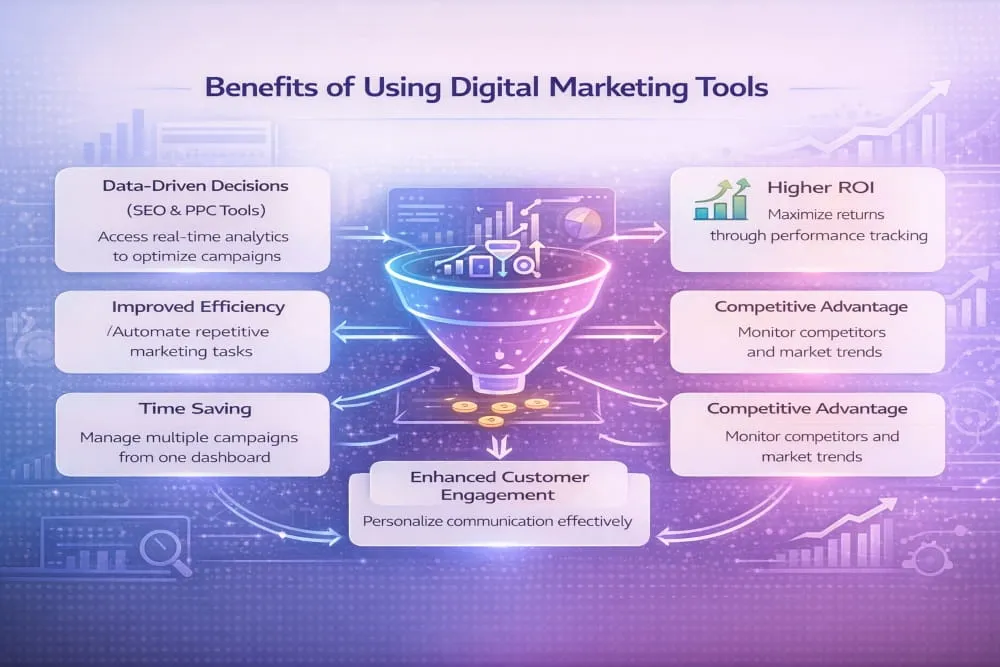
When used strategically, digital tools in marketing become more than supportive software; they become the operational backbone of sustainable growth.
Efficiency & Automation
One of the most immediate benefits of digital marketing tools is improved efficiency. Tasks that once required hours of manual work, such as sending emails, segmenting audiences, and analyzing performance data, can now be automated.
Marketing automation tools in digital marketing streamline repetitive workflows such as follow-up sequences, lead nurturing, and audience segmentation. Automated digital marketing tools reduce the risk of human error while ensuring consistent communication across channels.
By integrating automation tools with CRM systems and analytics platforms, businesses can create intelligent workflows that respond instantly to user behavior. This not only saves time but also ensures that opportunities are captured at the right moment.
Efficiency allows teams to focus on strategy and creativity rather than administrative tasks.
Data-Driven Decisions
Modern marketing thrives on data. Digital marketing analytics tools provide clear visibility into campaign performance, user behavior, traffic sources, and conversion patterns.
Instead of relying on assumptions, businesses can make decisions based on measurable insights. Analytics tools for digital marketing reveal which strategies are working, which channels drive the highest engagement, and where optimization is needed.
With integrated reporting and attribution tracking, marketing leaders gain a comprehensive view of performance across SEO, paid advertising, social media, and email campaigns. This clarity improves forecasting, budgeting, and long-term planning.
Data-driven decision-making transforms marketing from an experimental to a strategic approach.
Better Targeting
Reaching the right audience is critical for effective digital marketing. Digital marketing tools enhance targeting capabilities by analyzing user behavior, demographics, interests, and engagement history.
AI-powered digital marketing tools further refine this process by identifying patterns and predicting customer intent. These insights allow businesses to personalize messaging, adjust ad targeting, and deliver relevant content at the right time.
CRM tools in digital marketing also support advanced segmentation, enabling tailored communication based on customer lifecycle stage or behavioral triggers.
Better targeting reduces wasted spend, increases engagement rates, and improves overall campaign effectiveness.
Higher ROI
One of the most compelling benefits of digital marketing tools is improved return on investment. By combining automation, analytics, attribution tracking, and performance monitoring, businesses can continuously optimize campaigns.
Digital marketing ROI measurement tools connect marketing efforts directly to revenue outcomes. This allows organizations to identify high-performing channels, reallocate budgets efficiently, and eliminate underperforming tactics.
When campaigns are guided by real-time data and supported by automation, marketing spend becomes more efficient. The result is higher conversion rates, lower acquisition costs, and stronger profitability.
Scalable Growth
As businesses expand, marketing complexity increases. Managing larger audiences, multi-channel campaigns, and higher data volumes requires scalable infrastructure.
Digital marketing tools provide that scalability. Cloud-based platforms, integrated marketing stacks, and advanced automation systems enable companies to grow without proportionally increasing operational workload.
Scalable digital marketing tools allow businesses to launch new campaigns, enter new markets, and manage growing customer bases while maintaining performance standards.
Instead of rebuilding systems with each stage of growth, organizations can rely on flexible, adaptable tools that evolve alongside their strategy.
The benefits of using digital marketing tools extend far beyond convenience. They improve efficiency, enhance targeting precision, enable data-driven strategy, increase ROI, and support scalable growth.
When implemented thoughtfully within a cohesive marketing stack, these tools empower businesses to compete effectively in an increasingly digital world, turning strategy into measurable, sustainable success.
Common Mistakes When Using Digital Marketing Tools
Digital marketing tools can dramatically improve performance, efficiency, and scalability, but only when used strategically. Many businesses invest in powerful platforms yet fail to achieve results due to avoidable implementation mistakes.
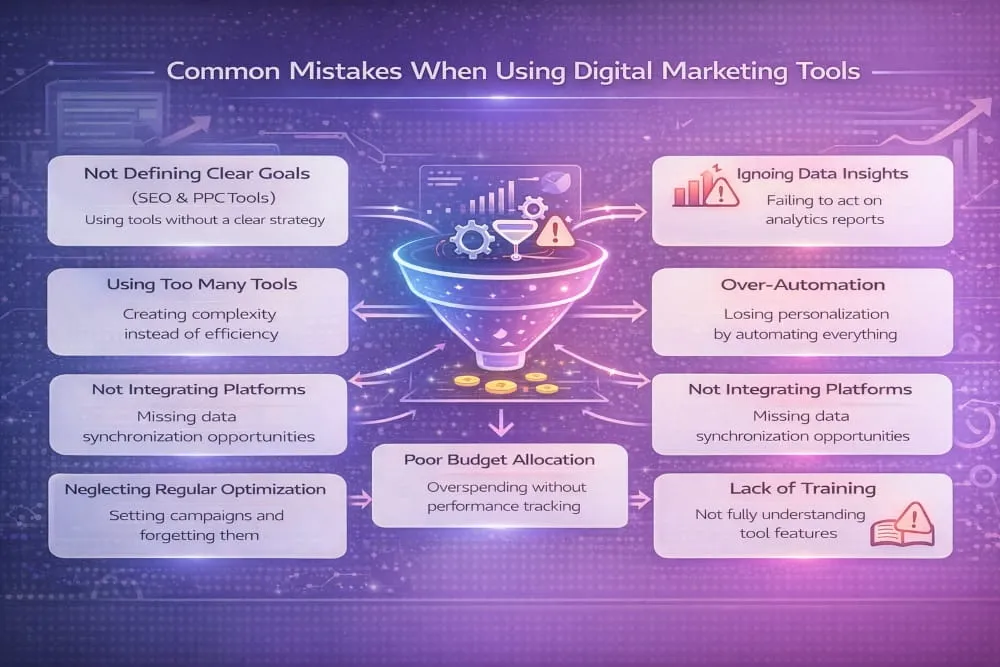
Understanding these common pitfalls helps ensure that your digital marketing tools support growth rather than create complexity.
Tool Overload
One of the most frequent mistakes is adopting too many digital marketing tools without a clear structure. With countless SEO tools, analytics platforms, automation systems, and AI-powered solutions available, it’s easy to accumulate overlapping software.
Tool overload leads to:
- Duplicate functionality
- Fragmented data
- Increased subscription costs
- Steeper learning curves
- Reduced team productivity
Instead of improving efficiency, excessive tools can create confusion. The most effective marketing stacks focus on essential digital marketing tools that complement one another rather than compete for attention.
Quality integration and strategic alignment matter more than the sheer number of platforms.
Poor Integration
Even the best digital marketing tools lose value when they operate in isolation. Poor integration between SEO tools, CRM systems, analytics dashboards, and marketing automation tools can create data silos.
For example, if lead data captured through landing pages doesn’t sync with CRM tools in digital marketing, valuable customer insights may be lost. Similarly, if paid advertising platforms are not connected to attribution tracking systems, it becomes difficult to measure true ROI.
Digital marketing tools should work as part of a cohesive marketing stack. Seamless data flow between systems ensures accurate reporting, better personalization, and smarter decision-making.
Without integration, teams may rely on manual exports, disconnected reports, and incomplete performance visibility, ultimately limiting strategic impact.
Ignoring Analytics
Another common mistake is underutilizing analytics capabilities. Many businesses invest in digital marketing analytics tools but fail to consistently monitor or interpret the data.
Analytics tools for digital marketing provide critical insights into traffic behavior, campaign performance, and conversion pathways. Ignoring these metrics can result in:
- Missed optimization opportunities
- Inefficient budget allocation
- Inaccurate performance assessments
- Reduced ROI
Data should guide every marketing decision. Performance tracking tools exist to identify what works, what doesn’t, and where improvement is needed. Without active analysis, digital marketing becomes reactive instead of strategic.
Choosing Tools Without Strategy
Perhaps the most significant mistake is selecting digital marketing tools based on trends rather than objectives. New AI tools for digital marketing and advanced automation platforms may appear attractive, but without a defined strategy, even powerful tools deliver limited value.
Before adopting any platform, businesses should clarify:
- Marketing goals
- Target audience
- Budget constraints
- Required integrations
- Key performance indicators
Digital marketing tools should support a clear plan, not replace one. When strategy leads tool selection, platforms enhance execution and measurement. When tools are chosen without direction, they often become underutilized expenses.
Avoiding these common mistakes ensures that digital marketing tools remain assets rather than liabilities. By prioritizing strategic alignment, integration, data analysis, and focused implementation, businesses can maximize the value of their marketing stack and drive measurable, sustainable growth.
Conclusion
Digital marketing tools are no longer optional add-ons; they are the infrastructure that powers modern marketing. From SEO and paid advertising to analytics, automation, CRM, and AI-driven optimization, these platforms transform strategy into measurable execution.
Throughout this guide, we’ve explored what digital marketing tools are, the different types available, how they work together within a marketing stack, and how to evaluate the best options based on goals, budget, and scalability. The key takeaway is simple: tools alone do not create growth, systems do.
The most successful marketers do not chase every new platform. Instead, they build structured ecosystems where SEO tools improve visibility, analytics tools measure performance, automation tools streamline engagement, CRM systems manage relationships, and AI-powered digital marketing tools enhance targeting and decision-making. When these components are integrated thoughtfully, marketing becomes efficient, data-driven, and scalable.
Choosing the right digital marketing tools begins with clarity. Define your objectives. Understand your audience. Align tools with measurable KPIs. Prioritize integration and reporting. Avoid unnecessary complexity. Focus on building a cohesive stack rather than collecting isolated software.
Whether you rely on free digital marketing tools to get started or invest in advanced enterprise platforms, the goal remains the same: create a connected system that supports consistent optimization and long-term growth.
In a landscape defined by rapid technological change, the advantage goes to businesses that combine strategy with the right digital marketing tools, not just to execute campaigns, but to refine them continuously.
Master the tools. Integrate them intelligently. Measure everything.
That is how modern marketers turn digital strategy into sustainable results.
What are the most important digital marketing tools?
The most important digital marketing tools typically include:
- SEO tools for search visibility
- Analytics tools for performance tracking
- CRM systems for managing leads and customers
- Marketing automation tools for nurturing campaigns
- Paid advertising platforms for traffic acquisition
- Reporting tools for measuring ROI
Together, these digital marketing tools support traffic generation, lead management, campaign optimization, and revenue tracking.
Which tools do digital marketers use most?
Digital marketers most commonly use:
- Google Analytics for website performance tracking
- Google Search Console for SEO insights
- SEO platforms for keyword research and audits
- Email marketing tools for campaign automation
- CRM tools for lead tracking
- Social media management platforms for content scheduling
- Paid ad platforms for search and social advertising
These tools form the foundation of a modern digital marketing stack.
Are free digital marketing tools effective?
Yes, free digital marketing tools can be effective, especially for small businesses and early-stage campaigns.
Free tools are suitable for:
- Basic website analytics
- Entry-level SEO research
- Email marketing with small lists
- Social media scheduling
- Performance reporting
However, free tools often have feature limitations, data caps, or restricted automation capabilities. As marketing complexity increases, businesses typically upgrade to paid tools for advanced insights and scalability.
What is the difference between marketing automation and AI tools?
Marketing automation tools follow predefined workflows to automate tasks such as email sequences, lead nurturing, and segmentation.
AI-powered digital marketing tools use machine learning and data analysis to make predictive decisions, dynamically optimize campaigns, and automatically personalize content.
In simple terms:
- Automation executes rules.
- AI analyzes data and adapts strategies.
Many modern digital marketing tools combine automation and AI to improve performance.
How do you measure ROI using digital marketing tools?
ROI is measured by comparing revenue generated from marketing campaigns to the total cost of those campaigns.
Digital marketing ROI tools calculate:
Revenue from campaigns ÷ Marketing spend = Return on Investment
To measure ROI effectively, businesses use:
- Analytics tools to track conversions
- Attribution tools to identify contributing channels
- Reporting tools to connect performance to revenue
- CRM systems to track lead-to-sale progression
Accurate ROI measurement requires integrated digital marketing tools that connect traffic, engagement, conversions, and revenue data into one reporting system.