Every month, thousands of people in your city open Google and type “dentist near me” or “best dental clinic in [city].” They click one of the first three results, book an appointment, and become someone’s patient, just not yours.
That’s not a visibility problem. That’s a revenue problem.
Dental SEO services exist to fix exactly this. Search engine optimization built specifically for dental practices helps your clinic appear where patients are already looking, at the top of Google’s local results, inside the map pack, and ahead of every competitor who hasn’t invested in their online presence yet.
Unlike paid ads, which stop when your budget runs out, SEO compounds over time. The rankings you build this quarter keep delivering new patient inquiries next quarter, and the quarter after that, without paying Google a cent per click.
But dental SEO isn’t just general SEO with a tooth icon slapped on it. It requires a deep understanding of how patients search for dental care, how Google evaluates local healthcare providers, and how to position your practice as the most trustworthy option in your area. Done right, it becomes the single most cost-effective patient acquisition channel your practice has.
This page breaks down everything you need to know about professional dental SEO services, what’s included, what actually moves the needle, and what to look for when choosing a provider.
What Are Dental SEO Services?
Dental SEO services are specialized search engine optimization for dental practices. While the underlying principles of SEO apply across industries, the strategy, execution, and priorities look very different when the goal is putting a dental clinic in front of local patients who are ready to book, not just browse.
At their core, dental SEO marketing services combine technical website optimization, local search strategy, content development, and authority-building into a cohesive system. The result is a practice that ranks higher on Google, attracts more qualified traffic, and converts that traffic into actual appointments.
How Dental SEO Differs From General SEO
General SEO is built around scale, ranking for broad topics, driving large volumes of traffic, and monetizing that audience over time. Dental SEO operates on a fundamentally different logic. You don’t need a million visitors. You need the right two hundred people in your zip code to find you, trust you, and call your front desk.
That shift in objective changes everything. Keyword targeting becomes hyper-local. Content is written to address real patient concerns rather than generic industry topics. Link building focuses on local directories, healthcare citations, and community partnerships rather than high-volume media placements. And success isn’t measured in pageviews, it’s measured in new patient inquiries, booked appointments, and Google Business Profile actions like calls and direction requests.
Professional dental SEO services are built around that outcome from day one.
Why Google Treats Dental Practices as Local Businesses
Google classifies dental clinics under its YMYL (Your Money or Your Life) category, which includes topics where the quality and trustworthiness of the information directly affect people’s health and financial well-being. This means Google applies stricter evaluation criteria to dental websites than it does to, say, a lifestyle blog or an e-commerce store.
At the same time, dental searches are overwhelmingly local. When someone searches for a dentist, Google understands they want a provider nearby, not a national directory or a general article about tooth care. This is why dental practices compete primarily in the local map pack and the localized organic results beneath it, rather than in national rankings.
Dental local SEO marketing services are built to work within this framework, optimizing your Google Business Profile, building local authority signals, and ensuring Google sees your practice as the most relevant and trustworthy option in your specific service area.
What’s Actually Included in a Dental SEO Service Package
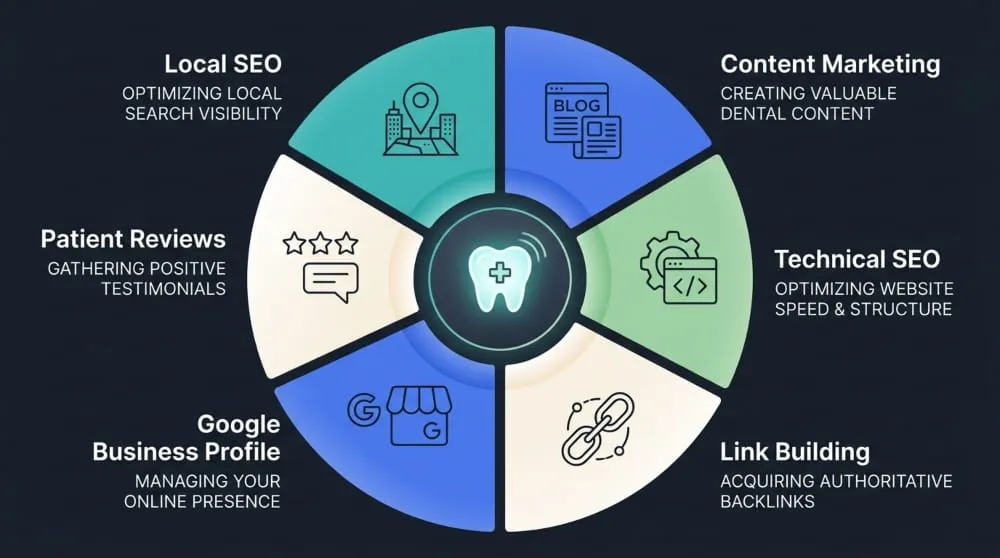
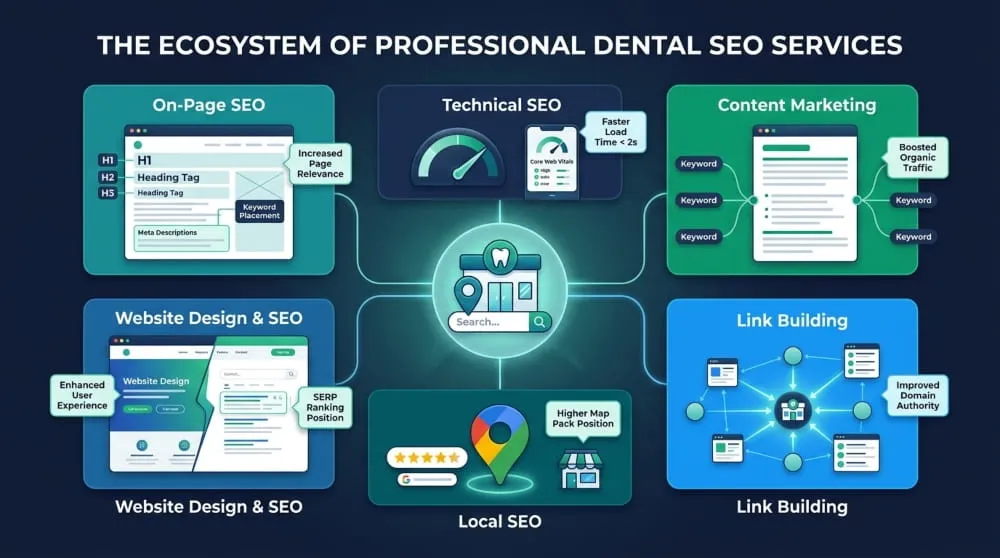
The best dental SEO services aren’t a single tactic; they’re a coordinated system of multiple disciplines working together. A properly structured dental SEO marketing service typically covers the following areas:
Local SEO, optimizing your Google Business Profile, building consistent citations across dental and healthcare directories, managing patient reviews, and ensuring your name, address, and phone number are accurate everywhere Google looks.
On-Page Optimization, refining your website’s page titles, meta descriptions, headers, and content to align with how patients search and how Google evaluates dental websites.
Technical SEO, ensuring your site loads fast, performs well on mobile devices, passes Core Web Vitals, and has no crawl errors or indexing issues holding it back.
Content Development, Creating service pages, location pages, and supporting content that targets real patient search queries and builds topical authority around your dental specialties.
Link Building, Earning backlinks from reputable local and industry sources that signal to Google your practice is trusted and established.
When all of these elements are executed consistently, the compounding effect is significant. That’s what separates dental internet marketing services with a real SEO foundation from the surface-level packages that promise rankings but deliver very little.
Why Your Dental Practice Needs SEO in 2026
Patient acquisition has changed permanently. The referral networks and yellow page listings that built dental practices a generation ago now play a secondary role to something far more powerful, Google. If your practice isn’t visible in local search results, a growing segment of your potential patient base simply doesn’t know you exist. In 2026, the gap between the visible and the invisible is wider and more expensive than ever.
How Patients Search for Dentists Online Today
The patient journey almost always begins with a search. Someone needs a cleaning, has a toothache, or is new to the area and needs to establish care, and the first thing they do is open Google. What they see in the next ten seconds determines which practice gets their call.
What’s changed in recent years is how sophisticated that search behavior has become. Patients aren’t just typing “dentist.” They’re searching for “family dentist accepting new patients near me,” “emergency dental clinic open Saturday,” or “affordable dental implants in [city].” These are high-intent, specific queries from people who are ready to book, not just researching.
Google has kept pace with this behavior. The local map pack now dominates the top of dental search results, and AI-generated answer summaries are beginning to appear above even those. Practices that have invested in dental SEO services are positioned to capture all of these touchpoints. Practices that haven’t been invisible at every one of them.
What Happens When Your Competitors Outrank You
When a competing practice ranks above yours, the consequences go beyond losing a single click. Studies consistently show that the top three local results capture the overwhelming majority of clicks on any given search. If you’re sitting in position four, five, or beyond the first page entirely, most patients will never reach you, not because they chose a competitor, but because they never saw you as an option.
The compounding effect is what makes this genuinely serious. Every month you’re outranked, a competitor is building more reviews, more brand recognition, and more patient relationships in your own service area. Their authority grows. Their rankings strengthen. And the gap between their position and yours becomes progressively harder to close.
Investing in professional dental SEO services now is significantly less expensive than trying to recover lost ground twelve months from now.
SEO vs. Paid Ads for Dental Practices: Which Wins Long-Term
Paid search, particularly Google Ads, can quickly put your practice at the top of results. For new practices or short-term promotions, it has real value. But the economics of paid advertising in dentistry are increasingly difficult to justify as a primary strategy.
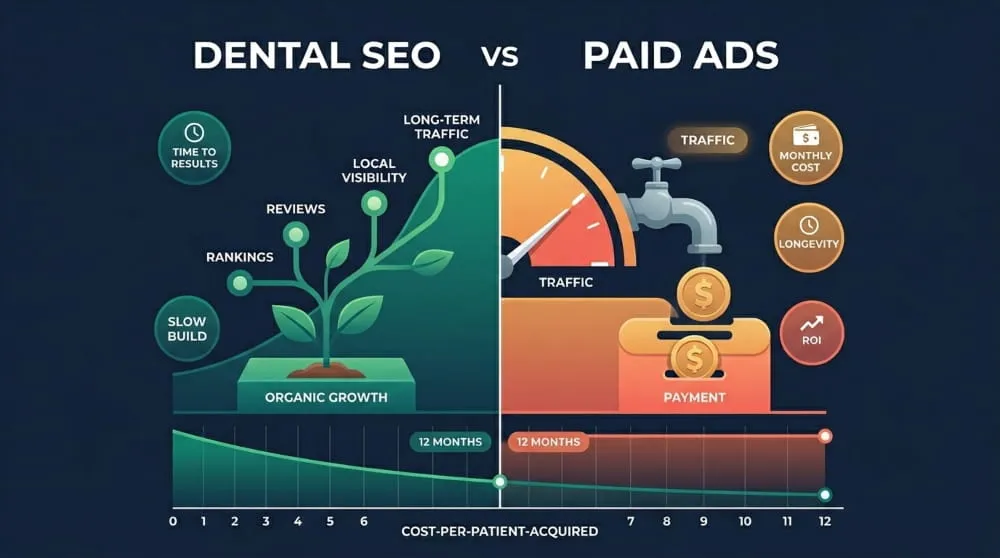
Dental keywords are among the most competitive in local paid search. Cost-per-click for terms like “dental implants” or “emergency dentist” can run well into the tens of dollars, and the moment your budget pauses, your visibility disappears entirely. You’re essentially renting attention rather than building an asset.
SEO operates on the opposite logic. The work you do this month, optimizing your site, earning local citations, and building content authority, continues to pay dividends for months and years afterward. Rankings, once earned, don’t vanish when you stop writing a check. The cost per new patient acquired through organic search is typically a fraction of what paid ads demand over the same period.
The most effective dental practices in competitive markets use both paid ads for immediate visibility and SEO to build the long-term foundation. But if forced to choose where to invest for sustainable, compounding growth, dental SEO wins every time.
Core Components of Professional Dental SEO Services
No single tactic makes a dental practice rank. What works is a coordinated system where every component reinforces the others, local signals strengthen content, content supports link building, and technical health ensures none of that effort goes to waste. Here is what a properly executed dental SEO service actually looks like under the hood.
Local SEO for Dental Practices (Google Business Profile, Map Pack)
For most dental practices, the local map pack is the single most valuable piece of real estate on Google. It appears above the organic results, displays your reviews and contact information immediately, and drives direct calls and directions requests without the patient ever visiting your website. Winning that map pack position is the foundation of dental local SEO marketing services.
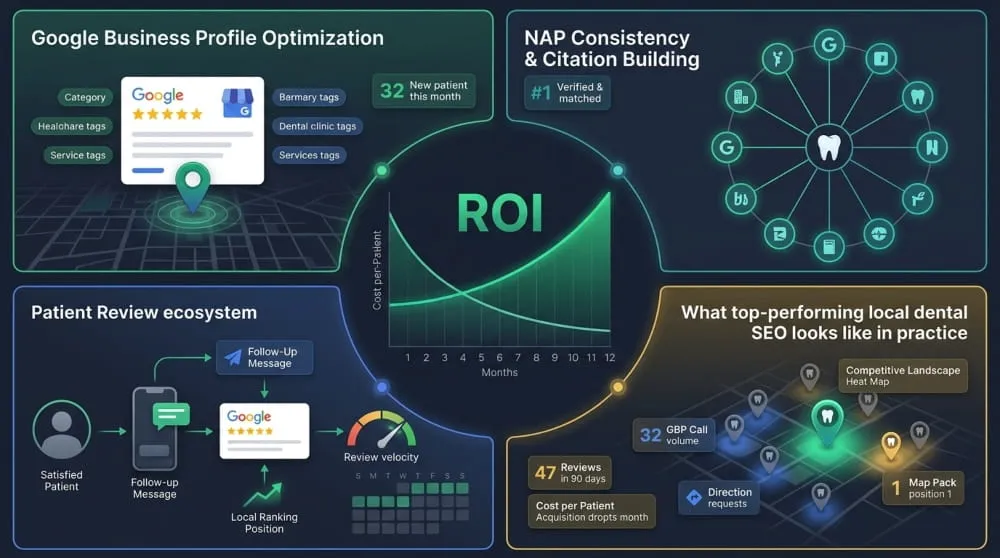
It starts with your Google Business Profile. A fully optimized profile, with accurate categories, complete service listings, consistent hours, high-quality photos, and regular posts, signals to Google that your practice is active, legitimate, and relevant to local searches. Beyond the profile itself, local SEO involves building citations across dental and healthcare directories, ensuring your name, address, and phone number are identical everywhere they appear online, and developing a consistent strategy for generating and responding to patient reviews.
Reviews deserve particular attention. Google’s local algorithm heavily weights both the quantity and recency of reviews. A practice with 40 reviews from 3 years ago will consistently lose ground to a competitor with 20 reviews from the past 6 months. A sustainable review-generation process is not optional; it is a core local SEO function.
On-Page SEO for Dental Websites
On-page SEO is the work done directly on your website to help Google understand what your practice offers, who it serves, and where it operates. For dental websites, this means far more than inserting keywords into page titles.
Every service your practice offers, general dentistry, cosmetic procedures, orthodontics, implants, and emergency care, should have its own dedicated, fully optimized page. Each page needs a clear title tag, a compelling meta description, properly structured headers, and content that addresses the specific questions patients have about that service. Location signals need to be embedded naturally throughout, connecting your services to the geographic areas you actually serve.
Internal linking also plays a significant role. A well-structured dental website guides both patients and search engines through your content logically, from a service overview page to a specific treatment page to a contact or booking page, in a way that distributes authority across the site and improves the ranking potential of every page, not just your homepage.
Technical SEO, Site Speed, Mobile, Core Web Vitals
A dental website can have excellent content and strong local signals and still underperform in rankings if the technical foundation is weak. Google evaluates how your site performs, not just what it says, and in 2026, the bar for technical health is higher than ever.
Site speed is the most immediate concern. Patients searching on mobile devices, which now account for the majority of dental searches, will abandon a slow-loading site within seconds. Google tracks this behavior and factors it directly into rankings. Core Web Vitals, Google’s set of performance metrics covering loading speed, visual stability, and interactivity, have become a confirmed ranking signal and a reliable measure of overall site health.
Mobile optimization goes beyond responsive design. Buttons need to be tappable, phone numbers need to be clickable, and the path from landing on your site to contacting your practice needs to be frictionless on a four-inch screen. Technical SEO for dental websites also covers crawlability, indexing, structured data markup, and eliminating any errors that prevent Google from properly reading and ranking your pages.
Content Marketing for Dental Clinics
Content is how your practice builds topical authority, the signal to Google that your website is a genuinely comprehensive and trustworthy resource on dental topics relevant to your patients. But dental content marketing is not about publishing generic articles. It is about creating the right content, targeting the right searches, and connecting every piece back to your practice’s services and location.
This means developing detailed service pages that go beyond surface-level descriptions, building location-specific pages if you serve multiple areas, and publishing supporting content that addresses the questions patients are actually asking, questions about procedures, costs, recovery, and what to expect. Over time, this content structure creates a topical ecosystem that earns rankings across dozens of patient search queries simultaneously.
Content also plays a critical role in AI search visibility. As tools like Google’s AI Overviews and other LLM-based search surfaces become more prominent, practices with clearly structured, entity-rich content are far more likely to be cited and surfaced in those results than practices with thin or poorly organized websites.
Link Building for Dental Websites
Backlinks remain one of Google’s most powerful ranking signals. When reputable websites link to yours, they pass authority that strengthens your ability to rank, both locally and in broader organic results. For dental practices, link building requires a different approach than what works for media companies or e-commerce brands.
The most valuable links for a dental website come from local sources, community organizations, local news outlets, neighborhood business directories, and healthcare networks in your service area. Dental and medical association listings, sponsorships of local events, and partnerships with complementary healthcare providers are all legitimate and effective link acquisition strategies.
What doesn’t work, and actively creates risk, is buying links, participating in link schemes, or using generic outreach tactics designed for non-local industries. Google’s ability to identify manipulative link patterns has improved significantly, and the penalties for low-quality link profiles can set a dental practice’s rankings back by months. Quality and relevance are the only metrics that matter.
Dental Website Design and SEO, Why They Must Work Together
A common and costly mistake dental practices make is treating website design and SEO as separate projects, building a visually impressive site first, then attempting to optimize it afterward. By that point, expensive-to-reverse structural decisions have already been made, and the SEO work becomes a series of compromises rather than a coherent strategy.
Design and SEO need to be planned together from the start. Site architecture determines how authority flows between pages. Navigation structure affects how Google crawls and understands your content. Page layouts influence whether patients convert after landing, and conversion rates are behavioral signals that feed back into rankings.
The best dental practice website design SEO services treat the two disciplines as inseparable. A site that looks professional and loads fast, has a logical structure, clear calls to action, and content Google can properly read is not just better for SEO, it is better for every patient who visits it. That alignment between user experience and search performance is what separates high-converting dental websites from ones that simply look good in a browser.
Specialized Dental SEO Services by Practice Type
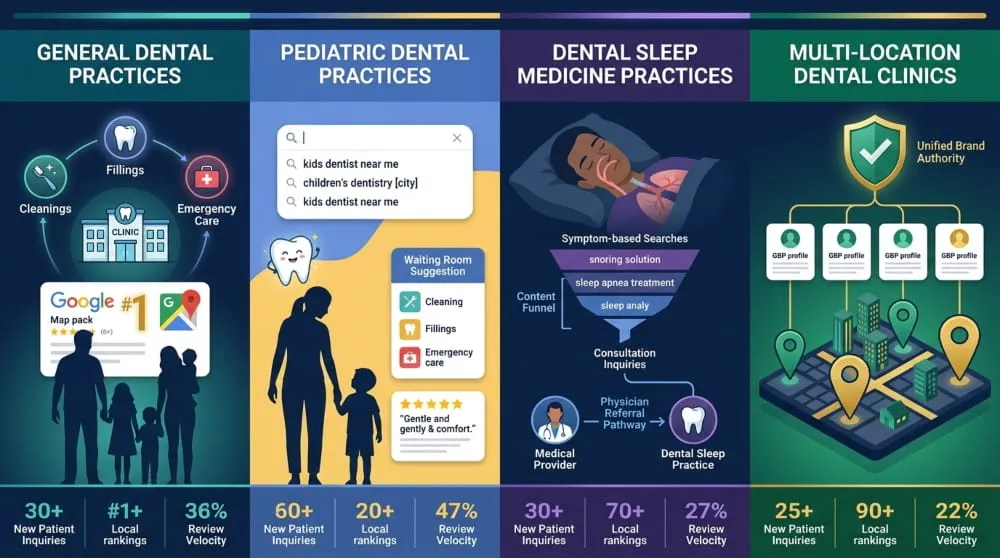
Not every dental practice has the same patients, services, or competitive landscape. A pediatric clinic in a family-oriented suburb competes on entirely different terms than a sleep medicine practice targeting adults with chronic snoring or sleep apnea. Cookie-cutter SEO ignores these distinctions and pays the price in mediocre rankings and mismatched traffic. Specialized dental SEO services are built around the specific realities of each practice type.
SEO Services for General Dental Practices
General dental practices serve the broadest patient population, which means competing for the highest volume of local searches and facing the most competition doing it. The SEO strategy for a general practice is built around dominance in the local map pack, comprehensive service page coverage, and consistent review generation that keeps the practice visible and trusted across the full range of patient searches.
The keyword landscape for a general practice is wide. Patients are seeking cleanings, fillings, crowns, emergency appointments, family dentistry, and cosmetic consultations, often within the same geographic area. SEO services for dental practices in this category need to ensure each service has dedicated, well-optimized content, that local signals are airtight, and that the practice’s Google Business Profile is positioned to capture the broadest possible range of appointment-ready searches.
Trust signals matter enormously here. A general practice is often a family’s long-term healthcare relationship, not a one-time transaction. The website, the reviews, and the content all need to communicate stability, professionalism, and genuine care, qualities that convert a first-time visitor into a patient who stays for years.
Pediatric Dental Practice SEO, Targeting Parents, Not Patients
Pediatric dental SEO operates on a fundamental insight that changes everything about the strategy: the person searching is never the patient. Parents are the decision-makers, and they search with a completely different set of concerns than an adult looking for their own dentist.
A parent searching for a pediatric dentist is evaluating safety, gentleness, child-friendliness, and the dental team’s ability to handle anxious or young children. They are reading reviews with those specific qualities in mind. They are looking at photos of the waiting room. They are checking whether the practice accepts their insurance and whether the hours work around school schedules. Pediatric dental practice SEO services need to address those concerns directly at every touchpoint: in the content, the imagery direction, the review strategy, and the Google Business Profile categories and attributes selected.
SEO for Dental Sleep Medicine Practices
Dental sleep medicine is one of the most underserved niches in dental SEO, making it a significant opportunity for practices that specialize in it. Most people experiencing symptoms of sleep apnea, chronic snoring, daytime fatigue, and difficulty concentrating do not immediately associate their dentist with a solution. SEO for these practices must do double duty: capture patients who are already searching for dental sleep solutions and educate those who are searching for symptoms but haven’t yet connected them to a dental provider.
This requires a content strategy built around the full spectrum of patient awareness. Some pages target high-intent searches like “oral appliance therapy for sleep apnea” or “dental sleep medicine near me.” Others address broader symptom-based queries from patients who are earlier in their journey. Together, they create a funnel that pulls in patients at multiple stages and guides them toward a consultation.
SEO services for dental sleep medicine practices also need to account for the referral dimension of this specialty. Many patients arrive through physician referrals from sleep specialists, pulmonologists, or ENTs. A well-optimized website that clearly communicates the practice’s credentials, treatment protocols, and outcomes builds trust with both patients and the referring providers who send them.
Multi-Location Dental Clinic SEO Strategy
Dental clinics operating across multiple locations face a challenge that single-location practices don’t: they need to rank prominently in several distinct local markets simultaneously, without their own locations competing against each other in search results.
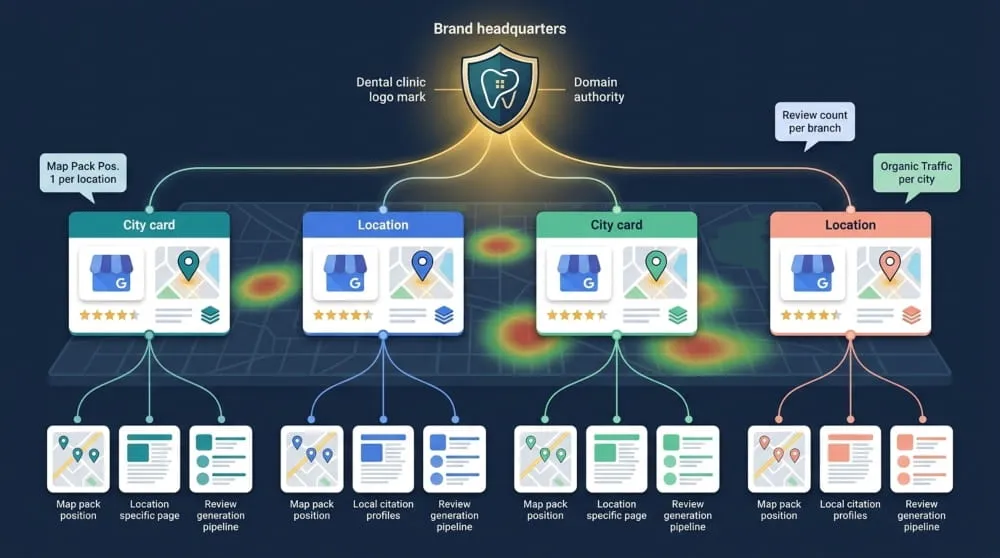
The foundation of a multi-location dental clinic SEO strategy is individual location pages. Each location needs its own dedicated, fully optimized page with unique content, location-specific keywords, a Google Business Profile, and a citation profile in local directories. Duplicating content across location pages is one of the most damaging mistakes a multi-location practice can make. Google will not rank near-identical pages for different geographic areas, and the resulting cannibalization weakens every location’s visibility at once.
Beyond the technical structure, review management becomes significantly more complex at scale. Each location needs its own review generation and response process, because Google evaluates each profile independently. A flagship location with 200 reviews does not lift a newer location with 12. Each site must build its own local authority, and a coordinated SEO service for dental clinics needs systems in place to manage that across every location without letting any location fall behind.
What to Look for in a Dental SEO Services Company
Choosing the right dental SEO services company is one of the most consequential marketing decisions a practice owner makes. The market is crowded with generalist agencies that bolt dental terminology onto a standard SEO package, niche providers who overpromise and underdeliver, and everything in between. Knowing how to evaluate your options before signing a contract saves significant time, money, and frustration.
Questions to Ask Before Hiring a Dental SEO Agency
The right questions reveal more than any sales pitch. Before committing to any dental SEO marketing service, these are the conversations worth having.
Do you work exclusively with dental practices, or do you serve multiple industries?
Dental SEO has enough nuance, YMYL considerations, local map pack dynamics, and patient-specific content strategy that a provider with deep dental experience will consistently outperform a generalist who treats your practice like any other local business.
Can you show me results from other dental clients?
A credible dental SEO services company should be able to demonstrate ranking improvements, traffic growth, and, ideally, increased new patient volume from practices similar to yours. Anonymized or otherwise, case studies are a reasonable expectation.
What does your reporting look like, and how often will we communicate?
Transparency is non-negotiable. You should know exactly what work is being done each month, what metrics are being tracked, and who to call when you have questions. Vague reporting is often a sign that vague work is being done.
How do you handle Google algorithm updates?
SEO is not a set-and-forget service. Agencies that stay ahead of algorithm changes and adjust strategy proactively rather than reactively protect your rankings in ways that passive providers simply cannot.
What is your approach to local SEO specifically?
Given that local visibility drives the overwhelming majority of dental patient acquisition, any agency that leads with technical SEO or content strategy before addressing local search should raise questions about their priorities.
How to Evaluate Results, KPIs That Actually Matter
Once an SEO engagement is underway, knowing which metrics to track and which to ignore keeps the relationship honest and the strategy accountable.
The metrics that most directly reflect SEO success for a dental practice are Google Business Profile actions (calls, direction requests, and website clicks from your profile), new patient inquiries attributed to organic search, and rankings for your core service and location keywords. These are the numbers that connect SEO activity to actual practice revenue.
Organic traffic growth matters, but only when measured with context. An increase in traffic from out-of-area visitors or irrelevant search queries is not progress; it is noise. Traffic quality, measured by engagement rates, time on site, and conversion to contact, tells a more accurate story than raw visitor counts.
Keyword ranking reports are useful benchmarks, but they should track the right keywords. Rankings for broad, non-local terms that patients in your area aren’t actually searching for are largely meaningless. The keywords that matter are the ones with genuine local intent, service-specific, location-specific queries that map directly to appointment bookings.
The table below summarizes the metrics worth tracking versus those that tend to distract:
KPI Why It Matters
| Metric | Significance / ROI Impact |
|---|---|
| New patient inquiries (organic) | Clearest measure of SEO ROI; direct conversion from search. |
| GBP calls & direction requests | Direct patient acquisition signal; high-intent local actions. |
| Local keyword rankings | Tracks visibility for appointment-ready searches (e.g., “doctor near me”). |
| Organic traffic (local, qualified) | Measures reach within your actual service area vs. global traffic. |
| Engagement rate / Time on site | Indicates content relevance and user experience; helps build patient trust. |
| Impressions only | Vanity metric: Visibility without action; shows potential but not results. |
| Domain authority score | Useful context, but not a direct performance indicator for revenue. |
| Total keyword count | Volume without intent is meaningless; focus on high-intent terms. |
A dental SEO services company worth retaining will proactively share these metrics, explain what is driving changes in either direction, and adjust strategy when the numbers indicate something is not working. Accountability is not a feature of the best dental SEO services; it is the baseline expectation.
Local SEO for Dentists, The Highest-ROI Channel
If a dental practice could only invest in one area of digital marketing, local SEO would be the answer every time. No other channel delivers the same combination of high-intent traffic, low ongoing cost, and compounding returns. When a patient searches for a dentist in your area and your practice appears at the top of the map pack with strong reviews and complete information, the conversion from searcher to booked appointment happens faster and more reliably than through almost any other marketing touchpoint.
The reason local SEO performs so well for dentistry specifically comes down to intent. Someone clicking a paid ad may be casually browsing. Someone who finds your practice through a local organic search has already decided they need a dentist; they are choosing between you and the practice listed next to you. Winning that moment is what dental local SEO marketing services are designed to do.
Optimizing Your Google Business Profile for Dentistry
Your Google Business Profile is the single most visible representation of your practice in local search. It is what patients see before they visit your website, before they read your reviews in full, and often before they make any decision at all. An incomplete or poorly maintained profile is not a neutral presence; it actively costs you patients to competitors with more complete and compelling profiles.
Optimization starts with the fundamentals. Your primary category should be “Dentist,” with additional categories added for any specialties your practice offers, such as pediatric dentistry, orthodontics, cosmetic dentistry, or oral surgery, depending on your services. Every service should be listed individually within the profile, because Google uses those service entries to match your practice to specific patient searches.
Beyond the basics, the practices that dominate local results treat their GBP as a living asset rather than a one-time setup. They upload fresh photos regularly, of the practice interior, the team, and the patient experience. They publish GBP posts that highlight offers, new services, or seasonal reminders. They answer publicly submitted questions and respond to every review. These ongoing activities signal to Google that the practice is active and engaged, which directly influences map pack positioning.
Attributes also deserve attention. Google allows dental practices to specify details such as “wheelchair accessible,” “accepts new patients,” “LGBTQ+ friendly,” and the insurance types they accept. Patients filter by these attributes, and practices that have them filled in accurately capture searches that incomplete profiles miss entirely.
Building Local Citations and NAP Consistency
A citation, in local SEO terms, is any online mention of your practice’s name, address, and phone number (NAP). Citations appear across dental directories, healthcare listing platforms, general business directories, and local chamber of commerce websites. Google cross-references these listings to verify that your practice is a legitimate, established local business, and inconsistencies between them create a trust problem that suppresses local rankings.
NAP consistency means your practice name, address, and phone number are formatted identically across every platform where your practice appears. A suite number listed on your website but absent from your Yelp profile, or a phone number that differs between your Google profile and a dental directory, introduces conflicting signals that dilute your local authority. At scale, these small inconsistencies add up to a measurable ranking disadvantage.
Building citations involves claiming and optimizing your listings on the platforms that matter most for dental practices, Healthgrades, Zocdoc, WebMD, Yelp, the American Dental Association directory, and local business directories specific to your city or region. Each listing should be complete, consistent, and linked back to your website where possible. The cumulative effect of a clean, comprehensive citation profile is a stronger local authority signal that reinforces everything else your SEO strategy is building.
Getting and Managing Dental Reviews at Scale
Reviews are the currency of local dental SEO. They influence rankings, shape first impressions, and are often the deciding factor when a patient chooses between two practices with similar visibility. Google’s local algorithm factors in the quantity, recency, and sentiment of reviews when determining map pack positions, which means review generation is not a one-time effort but an ongoing operational priority.
The most effective approach is systematic rather than sporadic. Practices that consistently generate reviews have a process built into the patient journey, a follow-up text or email sent within hours of an appointment, timed to arrive when the patient’s experience is still fresh. The message is simple, personal, and makes leaving a review as frictionless as possible with a direct link to the Google profile.
Volume matters, but recency matters more. A steady flow of new reviews, even just a handful per month, consistently outperforms a large archive of older ones. Google interprets recent reviews as evidence that the practice is currently active and satisfying patients, which is exactly the signal that supports strong local rankings.
Managing reviews means responding to all of them, not just the negative ones. A thoughtful, professional response to a five-star review reinforces the patient relationship and signals to prospective patients that the practice is attentive and communicative. A calm, solution-oriented response to a critical review demonstrates professionalism and often impresses prospective patients more than the negative review concerns them. Silence, by contrast, signals indifference.
Best Local SEO Dental Services: What Top Performers Do Differently
The gap between a dental practice that ranks in position one of the local map pack and one that sits just outside it is rarely a difference in budget. It is almost always a difference in consistency, strategic depth, and attention to the details that most practices overlook.
Top-performing practices treat local SEO as an ongoing operational commitment rather than a project with a finish line. Their Google Business Profile is updated regularly. Their review pipeline runs automatically. Their citations are audited periodically to catch and correct any inconsistencies that accumulate over time. Their local content strategy connects their services explicitly to the neighborhoods, communities, and patient populations they serve.
They also closely monitor the competitive landscape. The best local SEO dental services include regular monitoring of competitor profiles, rankings, and review velocity, not to copy what others are doing, but to identify gaps and opportunities that a less attentive practice would miss. When a competing practice loses rankings after an algorithm update, a well-managed SEO strategy is positioned to capture that traffic rather than have it redistributed randomly.
What ultimately separates the top performers is that they understand the compound nature of local SEO. Every review earned, every citation cleaned, every GBP post published, and every locally relevant page added to the website builds on what came before it. There is no single action that creates dominance, but a sustained, coordinated effort makes it virtually inevitable.
White Label Dental SEO Services
Not every agency serving dental clients has the internal capacity to execute a comprehensive dental SEO strategy from scratch. White-label dental SEO services exist to close that gap, allowing agencies, consultants, and marketing resellers to deliver specialized dental SEO work under their own brand without building an in-house team.
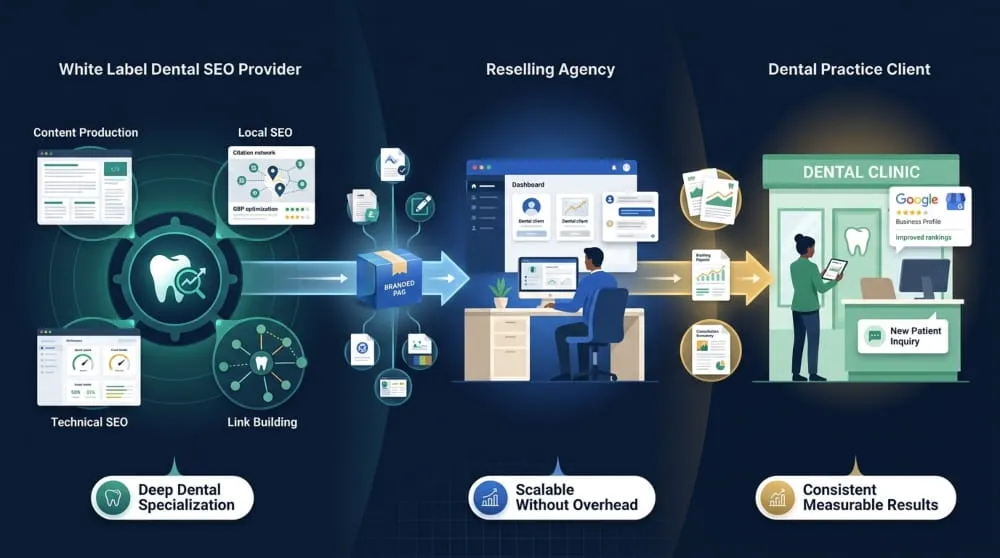
For the dental practice on the receiving end, the experience is seamless. They work with the agency they hired, receive reports branded to that agency, and see results delivered by a specialized team operating invisibly in the background. For the agency, it is a way to expand service offerings, retain clients, and grow revenue without the overhead of hiring and training dental SEO specialists.
What White Label Dental SEO Means
White-label dental SEO is a fulfillment arrangement in which a specialized provider executes dental SEO services on behalf of another company, which then presents that work to its clients as its own. The end client, the dental practice, typically has no visibility into or relationship with the white-label provider. Everything is delivered under the reselling agency’s brand.
The scope of white-label work varies by arrangement. Some providers offer fully managed campaigns covering local SEO, on-page optimization, content creation, link building, and reporting. Others offer specific components, content production, citation building, or GBP management, that agencies slot into their existing workflows. In either case, the white-label provider provides dental SEO expertise, while the agency maintains the client relationship.
What makes dental-specific white-label services distinct from generic white-label SEO is the depth of industry knowledge that underpins their execution. Dental practices face unique compliance considerations, patient-sensitive content requirements, and local search dynamics that a generalist white-label provider will handle less effectively than a provider with genuine dental SEO experience. The quality of the fulfillment ultimately reflects on the agency reselling it, making choosing the right white-label partner a decision with real consequences.
Who Uses White Label Dental SEO (Agencies, Resellers, Consultants)
The market for white-label dental SEO services is broader than most people assume, and the use cases vary considerably depending on who is doing the reselling.
Digital marketing agencies with an existing dental client base are the most common users. These agencies often have strong capabilities in paid media, web design, or social media, but lack the specialized knowledge to execute dental SEO at a high level internally. Rather than turning away dental SEO business or delivering substandard work, they partner with a white-label provider to fulfill those campaigns while maintaining the client relationship they have already built.
Freelance consultants and independent marketing professionals use white-label arrangements differently. A solo consultant advising a dental group on their overall marketing strategy may not have the capacity or technical infrastructure to run a full SEO campaign. A white-label partner provides execution capacity, while the consultant continues to add strategic value and manage the client relationship.
Web design agencies that build dental practice websites are another significant segment. These agencies are often the first point of contact when a dental practice is investing in its digital presence and adding SEO services to its offering, fulfilled through a white-label partner, allowing them to deliver greater value and generate recurring revenue beyond the initial website project.
In each case, the motivation is the same: serve dental clients at a higher level than internal capacity currently allows, without the cost and timeline of building that capacity from scratch.
How to Choose a Reliable White Label Partner
The white-label relationship only works as well as the provider behind it. A poor fulfillment partner creates client-facing problems that the reselling agency has to own, including ranking stagnation, missed deliverables, thin content, or, worse, penalties for low-quality tactics executed under your brand. Choosing the right partner requires the same level of scrutiny you would apply to any vendor with direct influence over your clients’ results.
Start with dental specialization. A white-label provider that works across dozens of industries is not the same as one that has built its entire methodology around dental practices. The latter understands patient search behavior, YMYL content standards, local map pack dynamics, and the compliance sensitivities specific to healthcare marketing. That depth of specialization translates directly into better outcomes for the dental practices your agency serves.
Transparency in process and reporting is the next critical factor. A reliable white-label partner provides clear documentation of what work is being done, when, and why, not because you will share all of that detail with your clients, but because you need to understand and trust the strategy being executed under your name. Providers who are vague about their methodology or reluctant to explain their approach are best avoided.
Examine their deliverables critically before committing. Request sample reports, content examples, and citation audit outputs. The quality of these materials reflects the quality of the ongoing work. Templated, generic content that could apply to any dental practice is a warning sign; effective dental SEO content is specific, locally grounded, and written with a genuine understanding of the patient audience.
Finally, evaluate the communication and support structure. When your client has an urgent question or a ranking drops unexpectedly, you need a white-label partner who responds quickly and provides clear answers. Slow communication at the fulfillment level creates client relationship problems at the agency level that are difficult to recover from. Reliability and responsiveness are not secondary considerations; they are as important as the quality of the SEO work itself.
How Much Do Dental SEO Services Cost?
Cost is one of the first questions dental practice owners ask, and one of the hardest to answer without context. Dental SEO services are not a commodity with a fixed price tag. What you pay depends on the scope of work, the competitiveness of your market, the current state of your website, and the experience level of the provider you choose. What matters more than finding the lowest price is understanding what different price points actually buy, and what they don’t.
Pricing Models, Monthly Retainer vs. Project-Based vs. Performance
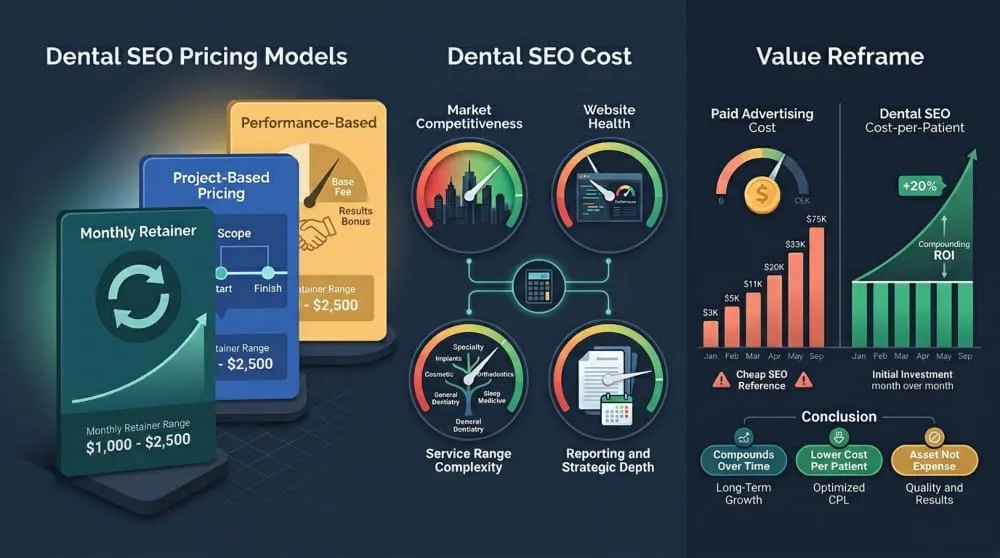
Dental SEO services are typically structured around one of three pricing models, each suited to different practice needs and risk tolerances.
Monthly retainer is the most common and generally the most effective model for dental practices serious about long-term growth. A fixed monthly fee covers an ongoing scope of work, local SEO management, content production, technical maintenance, link building, and reporting, executed consistently over time. Retainers typically range from $1,000 to $5,000 per month for a single-location dental practice, with multi-location clinics and highly competitive markets pushing that figure higher. The advantage of this model is continuity. SEO compounds over time, and a retainer-based relationship allows a provider to build on prior work rather than starting from scratch with each engagement.
Project-based pricing suits practices with a specific, defined need, such as a website audit, citation cleanup, a content build-out for a new service line, or a one-time local SEO setup. Projects are scoped, priced, and delivered within a fixed timeline. This model works well as an entry point or as a complement to internal marketing efforts, but it is rarely sufficient as a standalone patient acquisition strategy. SEO maintained only through occasional projects tends to plateau quickly and lose ground to competitors on retainer-based programs.
Performance-based pricing ties some or all of the agency’s compensation to specific outcomes, rankings, leads generated, or new patient inquiries. The appeal is obvious: you pay for results rather than effort. In practice, however, performance models introduce complications. They can incentivize providers to chase easy wins rather than build sustainable authority, and defining “performance” in a way that is measurable, attributable, and fair to both parties requires careful contract negotiation. Some agencies offer hybrid models, a reduced base retainer with performance bonuses, which can align incentives more effectively than a pure performance arrangement.
What Affects the Cost of Dental SEO
Several factors determine where a dental practice’s SEO investment will fall within any given pricing range, and understanding them helps set realistic expectations before any proposal is signed.
Market competitiveness is the most significant variable. Ranking for “dentist” in a mid-sized city with a handful of established competitors requires significantly less meaningful investment than ranking in a dense metropolitan market where dozens of well-funded practices are actively competing for the same local searches. The more competitive the environment, the more content, links, and ongoing optimization it takes to win and hold top positions.
The current state of your website matters a great deal. A practice with a technically sound, well-structured site that simply needs local SEO refinement and content development will require less foundational work than one with a slow, poorly organized website built on an outdated platform. If significant technical remediation or a website redesign is part of the scope, costs increase accordingly.
The range of services your practice offers also affects pricing. A general dental practice targeting a single location and a standard set of service keywords is a simpler SEO challenge than a multi-specialty clinic targeting cosmetic dentistry, implants, orthodontics, and sleep medicine simultaneously. More services mean more pages, more keyword targets, and a more complex content strategy.
Finally, the depth of reporting, communication, and strategic oversight included in a package influences price. Entry-level dental SEO services may deliver work with minimal reporting and limited strategic input. Premium services include detailed monthly reporting, regular strategy calls, competitor monitoring, and proactive recommendations. The difference in outcomes between these two levels of service is often greater than the price difference.
Cheap Dental SEO vs. Professional Dental SEO: What You’re Really Buying
The dental SEO market has no shortage of low-cost providers, agencies offering full SEO packages for a few hundred dollars a month, promising first-page rankings within weeks. For a practice owner managing tight margins, the pricing is tempting. Understanding what sits behind it is essential.
Cheap dental SEO services almost always rely on one or more of the following: templated content duplicated across multiple clients with minimal customization, low-quality link building from irrelevant or spammy sources, automated citation tools that create listings without verifying accuracy, and minimal human oversight of the actual strategy being executed. These tactics can produce short-term ranking fluctuations that appear to be progress, but they do not build the sustainable authority that holds rankings through algorithm updates. They often leave behind technical and link profile issues that a future provider will need to spend time and money cleaning up.
Professional dental SEO services cost more because they require more. Experienced strategists, skilled content writers with healthcare knowledge, legitimate link acquisition, careful technical work, and consistent human oversight are not cheap to deliver properly. What practices receive in return is a patient acquisition asset that grows in value over time rather than a temporary visibility spike that fades, or worse, triggers a penalty, within months of launch.
The most useful way to think about the cost of dental SEO is not as a monthly expense but as a cost per new patient acquired. A well-executed SEO program that generates fifteen to twenty new patient inquiries per month at a $2,000 retainer has a patient acquisition cost that most paid advertising channels cannot come close to matching. Unlike paid ads, the organic presence those campaigns build does not disappear when the invoice stops.
How Long Does Dental SEO Take to Work?
It is the question every dental practice owner asks before signing an SEO contract, and it deserves an honest answer rather than a carefully worded non-commitment. Dental SEO takes time. Not because providers are working slowly, but because Google’s ranking systems are designed to reward sustained, legitimate authority-building rather than overnight optimization. Understanding the realistic timeline before you begin sets the right expectations and prevents the frustration that comes from measuring a long-term strategy against short-term benchmarks.
Realistic Timeline From Start to First-Page Rankings
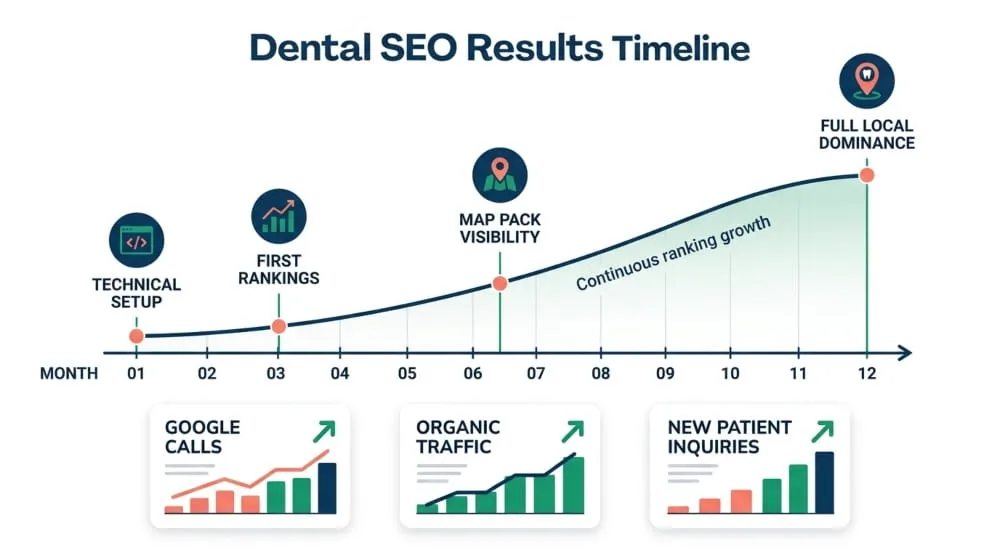
The first month of any professional dental SEO engagement is almost entirely foundational. Technical audits, website fixes, Google Business Profile optimization, citation cleanup, keyword research, and content planning all happen before a single new page is published or a single link is built. This work is essential; it ensures that everything built afterward has a solid base to stand on, but it produces no visible change in rankings. Practices expecting to see results in the first thirty days will be disappointed, and any provider promising otherwise should be treated with significant skepticism.
Months two through four are where initial momentum begins to develop. Content goes live, local signals strengthen, and Google begins processing the site’s changes. Practices with a relatively clean competitive landscape, smaller markets, and fewer well-optimized competitors may begin to see movement in local map pack rankings and improvements for lower-competition service keywords during this period. In more competitive urban markets, this phase is still largely about building the foundation that rankings will eventually rest on.
The three-to-six-month window is typically when meaningful, trackable progress becomes visible. Map pack visibility improves, organic rankings for core service and location keywords begin climbing, and Google Business Profile engagement, calls, and direction requests start to increase measurably. This is also when the compounding nature of SEO becomes apparent. Each piece of content published, each link earned, and each citation strengthened adds to a growing base of authority rather than producing isolated results.
By months six through twelve, practices with consistent, well-executed dental SEO services in place are generally seeing first-page rankings for their primary keywords, sustained map pack presence, and a meaningful increase in organic patient inquiries. For highly competitive markets or practices starting from a very weak baseline, twelve months may mark the beginning of dominance rather than its peak. SEO does not have a finish line; it has a trajectory, and the practices that stay on that trajectory the longest win the most.
What Accelerates or Delays Results
Several factors within and beyond a practice’s control influence how quickly dental SEO produces visible results, and understanding them helps practices make smarter decisions about where to invest alongside their SEO program.
A well-structured, technically healthy website accelerates everything. When Google can crawl and understand your site without friction, new content gets indexed faster, optimizations take effect sooner, and the overall signal strength of your domain improves more quickly. Conversely, a site with significant technical issues, slow load times, crawl errors, duplicate content, or poor mobile performance creates a drag that slows down every other SEO initiative until those problems are resolved.
An established domain with some existing authority moves faster than a brand-new one. Google places some trust in domains with a history, even if that history is modest. A practice that has had a website for 5 years, maintained basic hygiene, incurred no penalties, maintained consistent NAP information, and has a handful of organic backlinks starts in a meaningfully better position than a practice launching its first website alongside its SEO campaign.
Review velocity has a more direct impact on local SEO timelines than most practice owners realize. A practice that generates 10 new Google reviews in the first 90 days of an SEO engagement will see local ranking improvements faster than an identical practice generating 2. Reviews are a real-time trust signal, and Google responds to them relatively quickly compared to other ranking factors.
On the delay side, highly competitive markets simply require more time and more sustained effort to penetrate. If the top three map pack positions in your city are held by practices that have been investing in SEO for three or four years, closing that gap takes consistent, high-quality work over an extended period. There are no shortcuts that work durably in competitive dental markets, only compounding effort applied consistently over time.
Finally, inconsistency delays results more than almost anything else. Practices that pause their SEO program after three months because early results are modest, then restart six months later, are essentially resetting their momentum each time. The practices that reach and hold top positions treat dental SEO as a continuous investment rather than a campaign with a start and end date.
Ready to Grow Your Practice? Let’s Talk.
Every patient who finds a competitor on Google instead of you is a relationship that never starts a recall schedule that never fills, a treatment plan that never gets accepted, and a family that never walks through your door. That is the real cost of poor search visibility, and it compounds quietly every single month.
The practices that consistently attract new patients from Google are not spending more on marketing; they are spending smarter. They have a local search presence that works around the clock, a website that converts visitors into inquiries, and an SEO foundation that grows stronger over time rather than requiring constant reinvestment to maintain.
If you are ready to build that for your practice, the next step is a straightforward conversation. No pressure, no jargon, no generic proposals. Just an honest assessment of where your practice stands in local search, what is holding your visibility back, and what a realistic path to first-page rankings looks like for your specific market.
What to expect when you reach out:
- A review of your current local search presence and Google Business Profile
- An analysis of how your practice compares to the top-ranking competitors in your area
- A clear, practice-specific recommendation, not a templated package
There is no obligation and no hard sell. If what we recommend is not the right fit, you will still leave with a clearer picture of your SEO landscape than you had before.
Why Practices Choose Us
We work exclusively in the dental space. That means every strategy we build, every piece of content we produce, and every local optimization we execute is informed by a deep understanding of how dental patients search, how Google evaluates dental websites, and what it actually takes to rank in competitive dental markets, not what works for retail brands or service businesses in other industries.
Our clients are not buying a service. They are building a patient acquisition asset that appreciates over time. The practices we work with consistently see increases in Google Business Profile calls, growth in first-page rankings for their core service keywords, and, most importantly, a measurable rise in new patient inquiries from organic search.
Conclusion
Patients in your area are searching for a dentist right now. The only question is whether your practice appears when they do.
Dental SEO services are not a marketing expense; they are a patient-acquisition system that compounds in value the longer they run. Every ranking earned, every review generated, and every locally optimized page published brings your practice closer to the kind of search visibility that fills appointment books without relying on paid ads or Word of mouth alone.
The practices dominating local search results did not get there by accident. They made a deliberate, sustained investment in building their online presence, and they are collecting the returns every single day.
The best time to start was a year ago. The second-best time is now.
Frequently Asked Questions (FAQ’s)
Is SEO worth it for a small dental practice?
Yes, in fact, small dental practices often see the highest ROI from SEO because they typically operate in less-saturated local markets. A well-executed local SEO strategy can consistently deliver new patient inquiries at a fraction of the cost of paid advertising, with results that compound over time rather than stopping when a budget runs out.
Can I do dental SEO myself?
The basics, claiming your Google Business Profile, ensuring NAP consistency, and asking patients for reviews, are manageable without outside help. However, the technical optimization, content strategy, and link building required to rank competitively in most dental markets demand specialized expertise and consistent execution, which are difficult to sustain alongside running a practice.
What’s the difference between dental SEO and dental internet marketing?
Dental internet marketing is the broader category, encompassing paid ads, social media, email campaigns, and SEO. Dental SEO is specifically focused on earning organic visibility in Google search results without paying per click. SEO is one channel within a larger internet marketing strategy, but for long-term, cost-efficient patient acquisition, it is typically the highest-performing one.
How do I know if my dental SEO is working?
The clearest indicators are increases in Google Business Profile calls and direction requests, growth in first-page rankings for your core service and location keywords, and a measurable rise in new patient inquiries attributed to organic search. If your reporting only shows impressions and traffic without connecting to actual patient contact, your SEO provider is measuring the wrong things.
Do I need a new website to start SEO?
Not necessarily, many dental practices begin SEO on their existing website while improvements are made incrementally. However, if your current site is significantly slow, poorly structured, or built on an outdated platform that limits optimization, a website rebuild may be the more cost-effective path rather than investing in SEO on a foundation that will constrain results from the start.