Running Google Ads and SEO separately is one of the fastest ways for doctors to waste budget, duplicate keywords, and send patients to the wrong pages. The smarter approach is alignment: using Google Ads data to build an SEO structure that targets real patient intent, and using SEO improvements to strengthen ad performance, landing page relevance, and appointment conversions.
This Google Ads for Doctors SEO Outline is a practical framework designed specifically for medical practices. It shows how to connect paid search and organic search into a single strategy, so your ads and SEO support each other rather than compete.
You’ll learn how to map high-intent services to keywords, build landing pages that convert and rank, avoid cannibalization across service and location pages, and measure performance in a way that reflects what actually matters: booked appointments.
What Does Google Ads for Doctors Mean in an SEO Context?
Google Ads for Doctors in an SEO context means using paid search data to strengthen organic strategy and using SEO improvements to increase ad relevance and conversion performance. Instead of operating separately, both channels share keyword research, landing page structure, and performance insights to drive qualified patient appointments.
In practical terms, this integration works in two directions:
First, Google Ads provides immediate keyword and conversion data. Medical practices can identify which services generate appointment bookings, which search terms reflect treatment intent, and which landing pages convert best. This data reduces guesswork when building SEO service pages or expanding content clusters.
Second, SEO improvements enhance ad performance. Structured service pages, clear treatment descriptions, physician credentials, and technically optimized landing pages improve user experience. Strong UX and content relevance contribute to higher engagement and stronger Quality Scores.
For doctors, alignment is especially important because medical marketing requires precision. Each service page should clearly define:
- The condition treated
- The procedure or consultation offered
- The physician’s qualifications
- A privacy-compliant method to request an appointment
When Google Ads campaigns and SEO pages are structured around the same intent-based architecture, the result is consistent messaging, more relevant landing pages, and more measurable patient acquisition.
Why Should Doctors Integrate Google Ads With SEO Strategies?
Doctors should integrate Google Ads with SEO to create a faster, more measurable path to patient acquisition. Google Ads provides immediate keyword and conversion data, while SEO builds long-term visibility and authority. When both channels are aligned through a single Google Ads for Doctors SEO Outline, practices reduce wasted spend, improve landing page performance, and strengthen trust across search results.
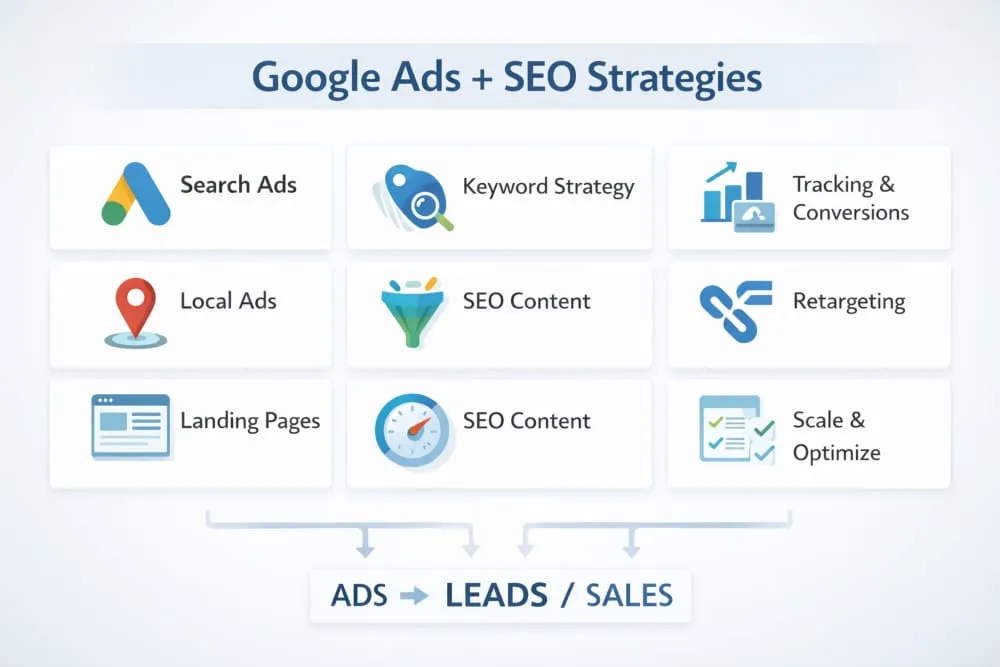
Faster testing of medical keywords (before investing in SEO)
SEO takes time. Google Ads does not. With paid search, medical practices can quickly identify which services and search terms actually lead to appointment requests, so SEO content is built around proven intent, not assumptions.
Improved landing page relevance signals
When ads and SEO share the same page structure, the landing pages become more focused, more helpful, and easier for patients to understand. Clear service descriptions, physician credentials, and privacy-safe contact options improve engagement, supporting both stronger ad relevance and better organic performance.
Consistent SERP presence builds patient trust.
In healthcare, trust matters as much as visibility. When a practice appears in both paid and organic results for the same service, patients see consistent messaging and a stronger brand presence. That repeated exposure often increases click-through rates and improves the likelihood of choosing your clinic over competitors.
When done correctly, the goal is not “Ads vs. SEO.” It’s a unified system where both channels support the same services, patient intent, and conversion path.
How Does a Google Ads for Doctors SEO Outline Improve Campaign Structure?
A Google Ads for Doctors SEO Outline improves campaign structure by aligning services, keywords, ad groups, and landing pages into a single, clear framework. Instead of running disconnected ads and generic service pages, each campaign is built around defined medical services, mapped search intent, and purpose-driven content, reducing wasted spend and improving appointment conversions.
Step 1: Define Core Services
Start by identifying the primary services the practice wants to grow. These should reflect real treatments or consultations, such as knee replacement, pediatric asthma management, or cosmetic dermatology procedures, not vague categories.
Each core service should have:
- A dedicated landing page
- Clear treatment description
- Physician credentials and certifications
- HIPAA-compliant appointment request pathway
This creates a measurable foundation for both paid and organic visibility.
Step 2: Map Services to Search Intent
Next, align each service with patient intent. Search behavior typically falls into categories such as:
- Treatment-focused (“knee replacement surgeon near me”)
- Condition-focused (“chronic knee pain treatment”)
- Consultation-focused (“book orthopedic consultation”)
Mapping intent ensures ads match what patients are actively seeking, and that SEO pages address the same need without overlap.
Step 3: Build Aligned Ad Groups and Content Clusters
For each service-intent pairing, create:
- A tightly themed ad group
- A dedicated landing page
- Supporting SEO content (FAQs, condition guides, related treatments)
This structured alignment is the core strength of a Google Ads for Doctors SEO Outline. Each page has one measurable purpose: to serve a specific service and intent combination.
Why This Prevents Keyword Cannibalization
When every service is mapped to a single primary page and a single aligned ad group, multiple pages no longer compete for the same keywords. This prevents internal competition, protects organic rankings, and keeps ad traffic focused on the most relevant landing page.
The result is a cleaner account structure, clearer performance tracking, and a unified system where SEO and Google Ads support the same strategic goals.
What Keyword Research Approach Works Best for Doctors?
The best keyword research approach for doctors prioritizes patient intent, medical compliance, and local search behavior, not raw search volume. A strong Google Ads for Doctors SEO Outline focuses on keywords that reflect appointment-ready needs, align with ethical advertising standards, and include locality signals that match how patients actually choose providers.
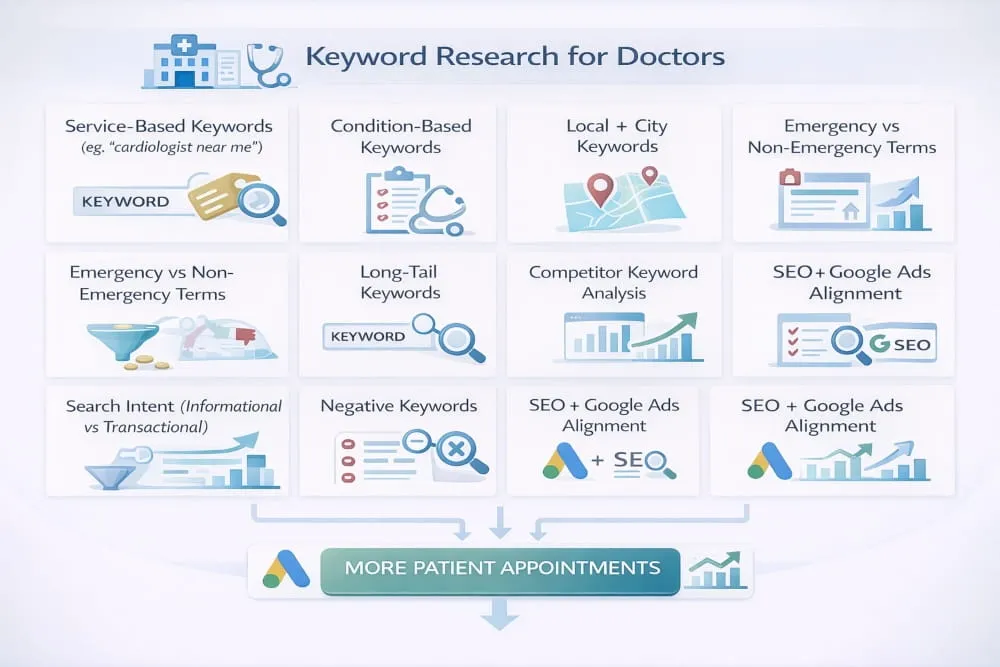
Prioritize intent, compliance, and locality over volume.
High-volume medical keywords often attract mixed intent. For example, a term like “eczema” may include students, researchers, and patients, not all of whom are ready to book. Instead, prioritize keywords that clearly indicate a patient is looking for care, such as:
- “eczema treatment dermatologist”
- “eczema specialist near me”
- “eczema doctor appointment”
This approach supports both ad relevance and long-term SEO without creating misleading or non-compliant messaging.
Use symptom and treatment-based queries.
Most patients do not search using clinical terminology. They search using symptoms, pain descriptions, and outcomes. The strongest keyword sets often come from:
- Symptoms (“burning stomach pain”)
- Conditions (“acid reflux treatment”)
- Treatments (“endoscopy consultation”)
- Procedures (“laser hair removal dermatologist”)
These queries align naturally with service pages, FAQs, and content clusters.
Include local modifiers to match real patient behavior.
For doctors, locality is not optional. Even when patients do not type a city name, Google often treats medical searches as local intent. Your outline should include modifiers such as:
- “near me”
- city + neighborhood terms
- “open now”
- “same day appointment” (where appropriate and accurate)
This improves alignment across Google Ads targeting and SEO landing pages.
Exclude research-only and low-conversion intent terms.
To avoid wasted spend and irrelevant SEO content, filter out terms that typically signal non-patient intent, such as:
- “What is…”
- “definition”
- “case study”
- “PDF”
- “journal”
- “medical school”
These keywords may be useful for educational authority content later. However, they should not dominate your service-driven SEO or your appointment-focused ad campaigns.
When keyword research is built around intent and trust, the result is a cleaner structure: better ad targeting, stronger landing pages, and SEO content that attracts patients, not just traffic.
How Can Google Ads Keyword Data Support SEO Planning?
Google Ads keyword data can support SEO planning by revealing which search terms actually lead to appointment requests. In a well-built Google Ads for Doctors SEO Outline, paid search serves as a testing ground, helping practices identify high-intent, long-tail keywords, filter out irrelevant traffic, and validate patient intent before investing in new SEO pages.
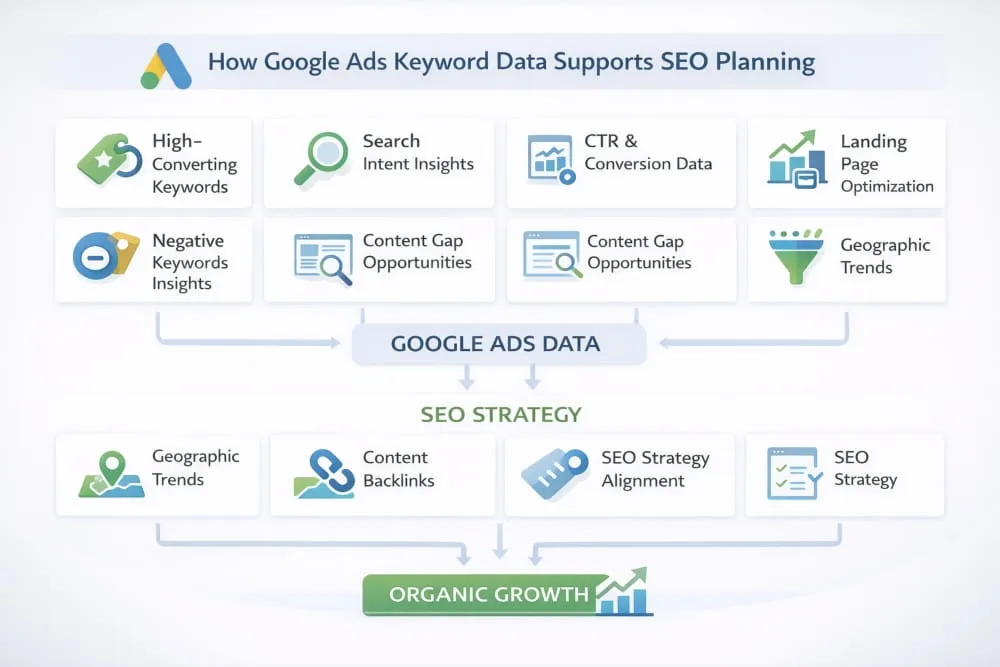
Identify high-converting long-tail terms.
Google Ads quickly shows which specific queries produce real conversions, such as form submissions, calls, or booked consultations. These long-tail terms are often the best foundation for SEO because they reflect precise patient intent, for example:
- “sports injury doctor for knee pain”
- “pediatric ENT specialist near me”
- “same day dermatologist appointment [city]”
Instead of guessing what to build content around, you use real performance data to guide your SEO service pages and supporting content clusters.
Discover negative keywords (and prevent wasted SEO content)
Negative keywords aren’t just for PPC; they also protect SEO strategy. If your ads consistently attract irrelevant searches like:
- “free”
- “home remedies”
- “jobs”
- “medical school”
- “salary”
That is a signal that certain keyword themes may also attract the wrong audience organically. Removing these themes early prevents you from creating SEO pages that generate traffic without patients.
Validate intent before investing in SEO content.
SEO content takes time, budget, and developer resources, especially for medical practices that need trust signals, structured service pages, and compliant messaging. Google Ads helps validate:
- Which services do patients actually search for
- Which wording do patients use (symptom vs. clinical term)
- Which landing page angles convert
This reduces SEO risk and ensures every new page is built around measurable demand.
When used correctly, Google Ads data doesn’t replace SEO; it makes SEO smarter, more efficient, and more aligned with real patient behavior.
How Does Quality Score Affect SEO Outcomes?
The Quality Score does not directly affect SEO rankings. However, it reflects the same relevance and user experience standards that influence organic performance. In a well-structured Google Ads for Doctors SEO Outline, the factors that improve Quality Score often indirectly strengthen SEO outcomes.
The expected click-through rate, ad relevance, and landing page experience influence the Quality Score. While these metrics belong to paid search, they signal how well a page matches user intent. When a landing page clearly explains a medical service, aligns with the search query, and provides a smooth mobile experience, users are more likely to stay, engage, and request an appointment.
This improved engagement reduces bounce rates and increases time on page. Those behavioral signals support stronger trust alignment between the page and the search intent. Over time, pages that consistently satisfy patient expectations perform better in both paid and organic environments.
In practice, optimizing for Quality Score forces better structure. It encourages doctors to use focused service pages, clear language, fast-loading layouts, and compliant messaging. These same improvements strengthen SEO clarity and reinforce topical authority.
Within a Google Ads for Doctors SEO Outline, Quality Score becomes more than a paid metric. It reflects how well the practice communicates relevance, credibility, and usability to patients searching for care.
What Role Does Local SEO Play in Google Ads for Doctors?
Local SEO supports Google Ads for doctors by improving geographic relevance and reinforcing trust signals across the patient journey. In a Google Ads for Doctors SEO Outline, local SEO is not treated as a separate strategy; it’s used to ensure ads, landing pages, and practice information stay consistent for location-based searches.
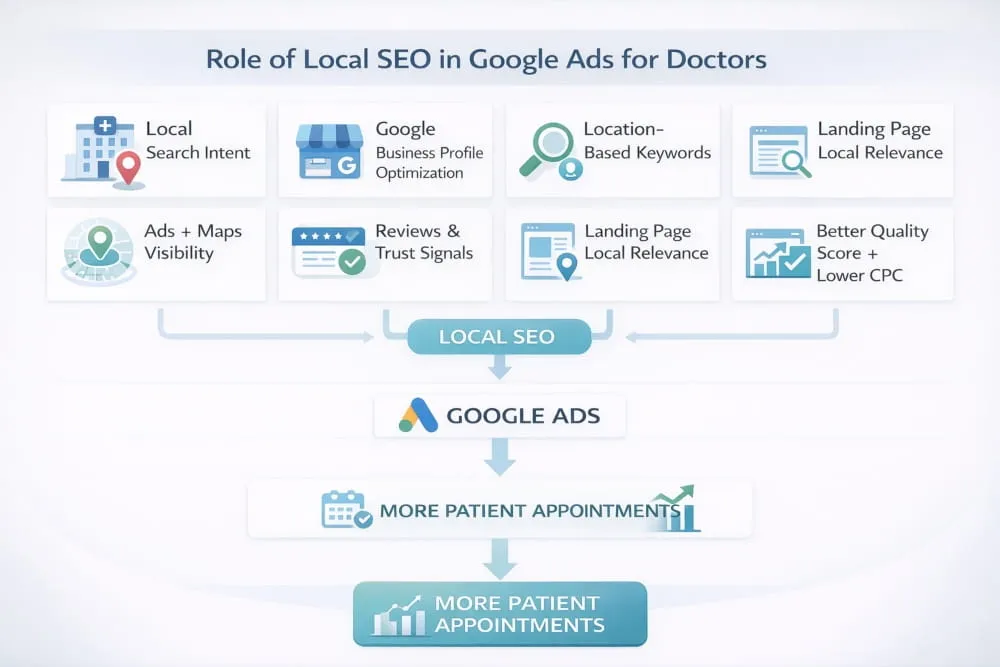
The most important local element is location extensions, which help patients see where the clinic is located and make the ad feel immediately relevant. NAP alignment also matters because your name, address, and phone number should match across your website and ads to avoid confusion and reduce friction during conversion. Finally, optimizing Google Business Profile landing pages ensures that patients clicking from local results reach the most relevant service or location page, not a generic homepage.
For a complete breakdown of local rankings, citations, reviews, and Map Pack strategy, see Local SEO for Doctors: Complete 2026 Guide…
What Compliance Considerations Are Critical for Doctors?
Compliance is essential in any Google Ads for Doctors SEO Outline because medical marketing is regulated and trust-sensitive. Advertising and landing page content must remain accurate, professional, and aligned with healthcare advertising standards.
Doctors should never guarantee results or imply certain outcomes. Statements that promise cures, permanent solutions, or guaranteed recovery can create legal and ethical risks. Medical messaging should focus on qualifications, treatment options, and patient education rather than outcomes that cannot be universally assured.
Sensational language should also be avoided. Emotional exaggeration, fear-based wording, or dramatic claims may harm credibility and violate advertising policies. A neutral, clinical tone reinforces authority and builds patient trust while keeping campaigns compliant.
Privacy protection is equally important. All contact forms, appointment requests, and tracking systems must be HIPAA-compliant where applicable. Patient data should be handled securely, and analytics tools should not improperly capture protected health information. Within a Google Ads for Doctors SEO Outline, compliance is not a separate step. It is built into every ad, landing page, and conversion pathway to protect both the practice and the patient.
How Can Tracking and Analytics Unify Google Ads and SEO?
Tracking and analytics unify paid and organic performance by measuring patient actions instead of isolated traffic metrics. In a well-structured Google Ads for Doctors SEO Outline, data from both channels is fed into a single reporting system focused on appointment generation.
The foundation is accurate appointment conversion tracking. Whether patients book through a form, call tracking number, or online scheduling tool, every completed action should be measured consistently across campaigns and landing pages. This allows doctors to evaluate which services and keywords drive real patient inquiries rather than just clicks.
Integrating Google Analytics with Search Console adds deeper visibility. Analytics reveals user behavior after the click, including engagement and drop-off points. At the same time, Search Console shows how organic queries perform and where impressions grow. Together, they help identify overlap between paid and organic keywords and highlight opportunities for stronger alignment.
Assisted conversion reporting is especially important in healthcare. Patients often research symptoms organically before returning through a paid ad to book an appointment. Tracking assisted conversions helps practices understand how SEO supports Google Ads and vice versa. Within a Google Ads for Doctors SEO Outline, unified tracking ensures that both channels are evaluated as part of a single patient acquisition system rather than competing efforts.
What KPIs Matter Most for Doctors Running Google Ads and SEO?
The most important KPIs for doctors running Google Ads and SEO are cost per appointment, conversion rate by service, and local visibility metrics. These measurements connect marketing performance directly to patient acquisition, rather than focusing only on clicks or traffic volume.
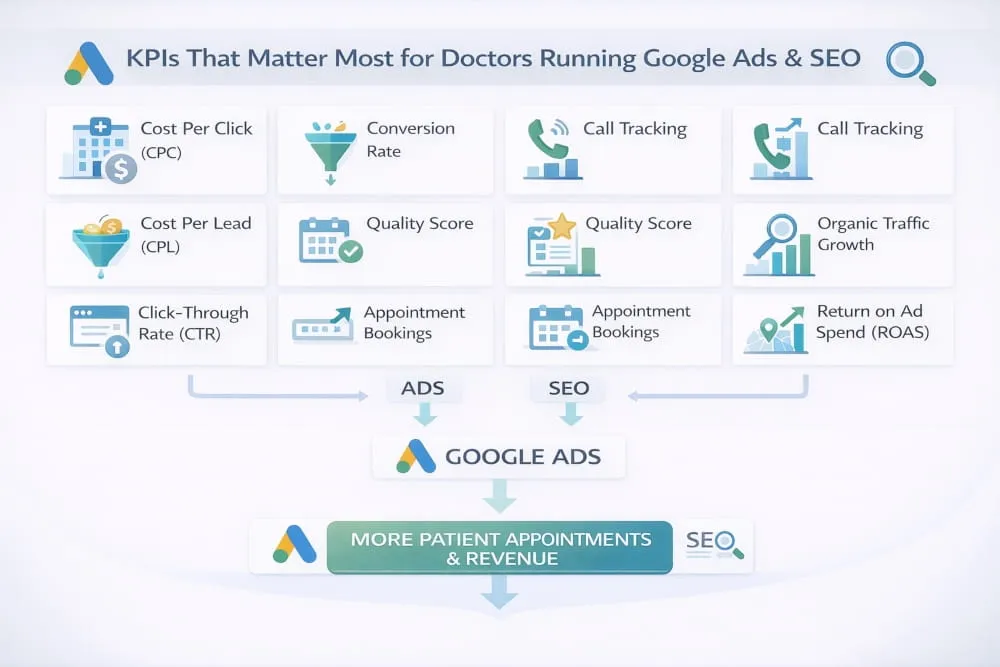
The cost per appointment is the clearest indicator of efficiency because it shows how much the practice pays to generate a real patient inquiry. Conversion rate by service matters because not every treatment converts the same way, and performance should be evaluated at the service-page level, not only at the campaign level. Local visibility metrics are essential because medical searches are highly location-driven, and success depends on appearing consistently in both paid and organic results for local intent queries.
Within a Google Ads for Doctors SEO Outline, these KPIs keep reporting focused on what matters most: profitable growth, service-level clarity, and predictable appointment volume.
How Should Developers Structure URLs and Internal Linking?
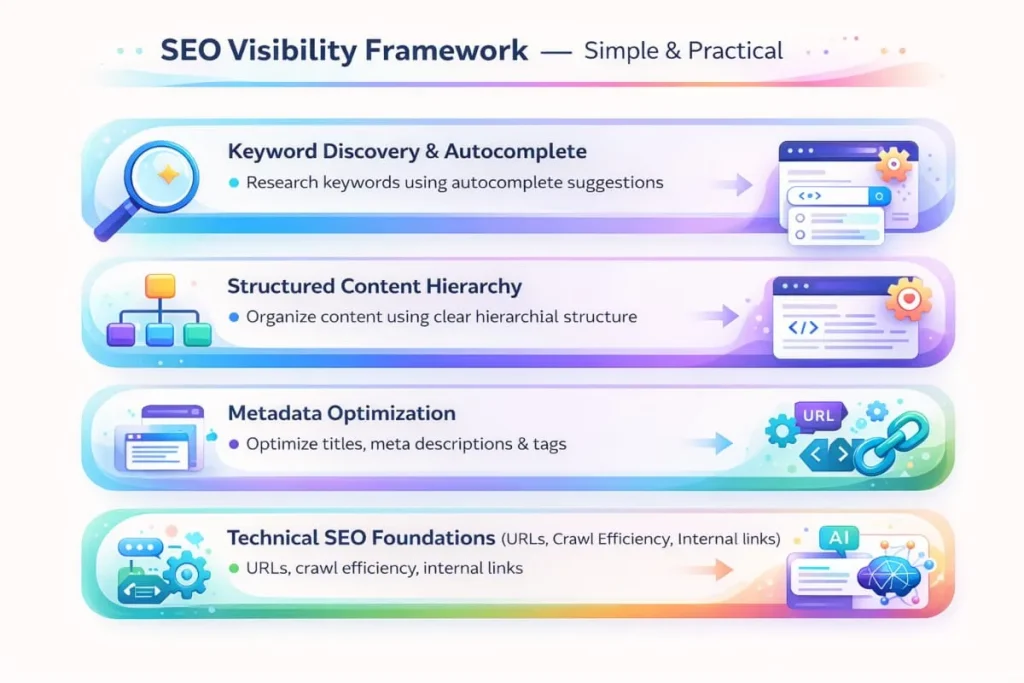
Developers should structure URLs and internal linking around a clear service hierarchy so each page has one primary purpose and one measurable keyword target. In a Google Ads for Doctors SEO Outline, this structure supports both paid landing page relevance and long-term SEO scalability.
The most effective approach is to use clean, readable URLs that reflect real medical services and patient intent. For example, a practice might use a hierarchy such as /services/dermatology/acne-treatment/ or /services/orthopedics/knee-replacement/, with separate pages for distinct treatments rather than combining everything into one generic service page. This makes it easier to align each landing page with a single ad group and a single SEO target.
Internal linking should be contextual and patient-focused, connecting related treatments in a way that matches how people explore care options. A knee pain page can link naturally to physical therapy, imaging, injections, or surgical consultations. In contrast, an acne treatment page can link to scar treatment or prescription options. This creates a stronger topical structure, improves crawlability, and prevents keyword cannibalization by keeping each page focused on a single service intent.
What Content Types Support Google Ads for Doctors SEO Outline?
The most effective content types in a Google Ads for Doctors SEO Outline are service pages, FAQ pages, and location pages. Together, these formats cover the full patient journey, from high-intent appointment searches to informational research and local provider selection.
Service pages are the transactional foundation. They target appointment-ready queries and act as the primary landing pages for both Google Ads and SEO, with clear treatment descriptions, doctor credentials, and a compliant conversion path. FAQ pages support informational intent by answering common patient questions in a direct, structured format, thereby improving visibility of the Featured Snippet and AI Overview. Location pages reinforce local relevance by connecting each service to geographic intent, ensuring patients searching “near me” or by city land on the most relevant page.
To strengthen topical authority, content should be organized into clusters rather than isolated pages. For example, a “knee pain” cluster can include a core knee pain page supported by diagnosis content, treatment options, physical therapy guidance, and patient testimonials. This structure improves internal linking, builds trust, and ensures that ads and SEO work from the same content architecture rather than competing across overlapping pages.
How Does AI Search Impact Google Ads and SEO for Doctors?
AI search prioritizes clear, authoritative, and well-structured medical content, which directly affects how doctors approach both paid and organic strategy. In a modern Google Ads for Doctors SEO Outline, pages must be written not only for traditional rankings but also for AI-driven summaries and answer engines.
AI systems favor content that provides direct answers under clear headings. When service pages use question-based subheadings followed by concise explanations, search engines can easily extract accurate information. This improves visibility in AI Overviews and other enhanced search features while maintaining alignment with patient intent.
Authoritative signals are equally important. Medical content should reflect physician expertise, accurate terminology, and transparent credentials. Factual, neutral language builds trust and reduces the risk of misinformation, which AI systems are increasingly designed to filter out.
Semantic structure also matters. Proper hierarchy, clear service definitions, and logically connected content clusters help AI understand relationships between conditions, treatments, and specialties. Within a Google Ads for Doctors SEO Outline, this structured clarity strengthens both organic discoverability and the quality of traffic generated through paid campaigns.
Who Should Manage Integrated Google Ads and SEO for Doctors?
Integrated Google Ads and SEO for doctors should be managed collaboratively, not by a single isolated role. A Google Ads for Doctors SEO Outline works best when developers, SEO specialists, and compliance-aware marketers operate as one coordinated team.
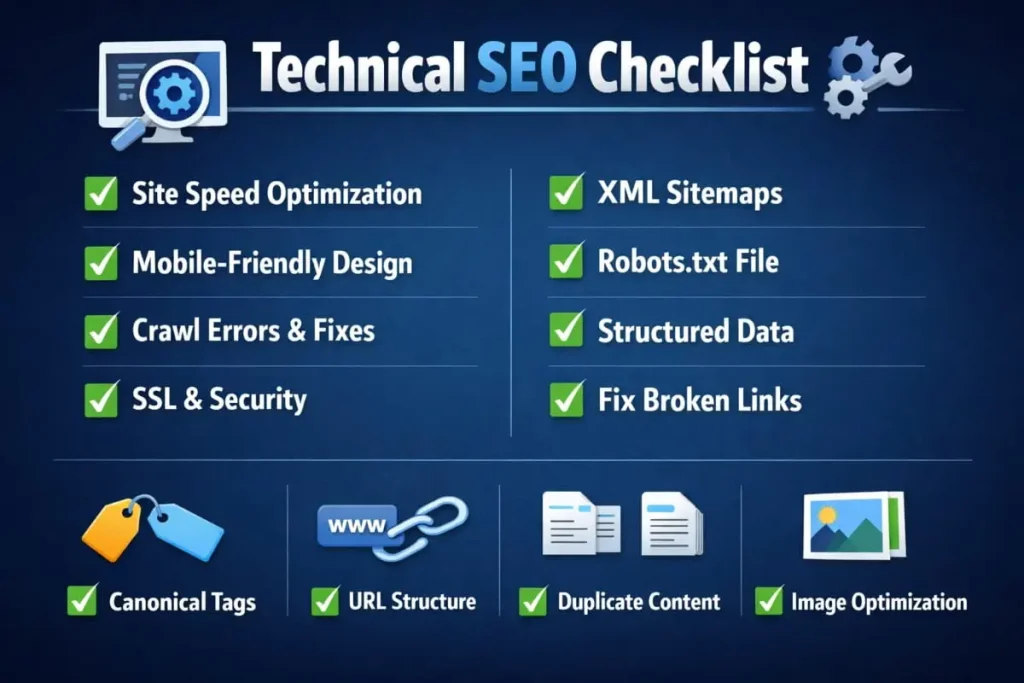
Developers ensure landing pages are fast, technically clean, and structured correctly for both conversion and indexing. SEO specialists build the service hierarchy, keyword mapping, and content clustering needed to avoid cannibalization and grow organic visibility. Compliance-aware marketers align ad copy, targeting, and tracking with medical advertising standards while keeping messaging factual and non-sensational.
When these roles work together, the result is a unified system in which ads, SEO pages, and conversion pathways reinforce one another, improving performance without sacrificing trust or compliance.
How Can Doctors Scale Google Ads While Strengthening SEO?
Doctors can scale Google Ads while strengthening SEO by expanding what already works instead of launching disconnected campaigns. In a structured Google Ads for Doctors SEO Outline, growth comes from using performance data to deepen service coverage, refine targeting, and build authority around proven patient demand.
The first step is expanding high-performing service pages. If a specific treatment consistently generates appointment requests, that page can be enhanced with more detailed treatment information, additional FAQs, and stronger internal linking. This improves both ad conversion rates and organic rankings without creating competing pages.
Next, supporting educational content should be created around the same core service. Informational pages that explain symptoms, preparation steps, recovery timelines, or treatment comparisons help capture earlier-stage searches and feed patients into the main transactional page. This content clustering strengthens topical authority and improves visibility across multiple search intents.
Finally, SEO data can refine ad targeting. Organic search queries reveal how patients phrase their concerns and which pages attract sustained engagement. These insights help adjust ad copy, keyword targeting, and landing page alignment. Within a Google Ads for Doctors SEO Outline, scaling is not about increasing spend alone. It is about strategically expanding while keeping paid and organic growth aligned around the same services and patient intent.
What Are Common Mistakes in Google Ads for Doctors?
Common mistakes in Google Ads for doctors usually stem from poor alignment between ads, landing pages, and search intent. A clear Google Ads for Doctors SEO Outline prevents structural errors that waste budget and reduce patient conversions.
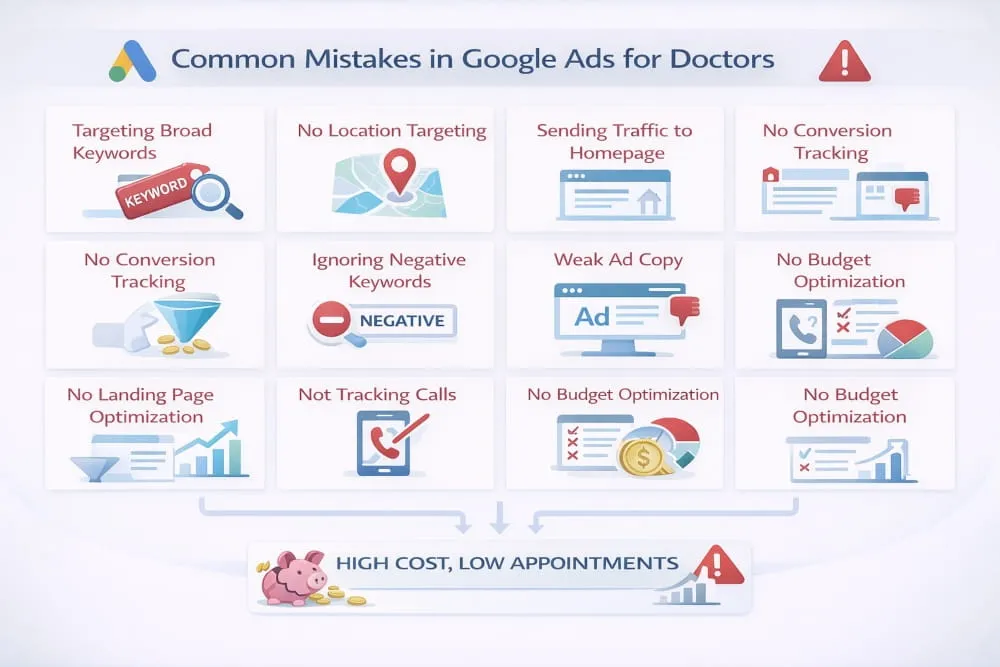
One of the most common mistakes is sending ad traffic to a generic homepage rather than a dedicated service page. When patients click an ad for a specific treatment and land on a broad page, relevance drops and bounce rates increase. This weakens both ad performance and overall user trust.
Another issue is ignoring local intent. Medical searches are highly location-driven, and failing to align ads and landing pages with geographic relevance limits visibility and conversion potential. Without proper location targeting and local page alignment, practices miss appointment-ready traffic.
A more strategic mistake is treating ads and SEO as separate efforts. When paid campaigns and organic pages target the same keywords without coordination, they compete internally, leading to keyword cannibalization. A structured Google Ads for Doctors SEO Outline ensures each service, keyword, and page has a defined purpose, allowing both channels to work together rather than against each other.
How Should Doctors Future-Proof Their Google Ads and SEO Strategy?
Doctors can future-proof their strategy by building performance-focused systems, staying compliant with evolving policies, and adapting to AI-driven search experiences. A sustainable Google Ads for Doctors SEO Outline is designed to evolve without disrupting core service visibility or patient acquisition.
Investing in performance means prioritizing fast-loading pages, clear service architecture, accurate tracking, and consistent measurement of appointment-driven KPIs. When the foundation is technically sound and intent-driven, scaling becomes more predictable and less dependent on short-term tactics.
Monitoring advertising and healthcare policy updates is equally important. Platform guidelines and medical advertising standards change regularly, and compliance must remain integrated into ad copy, targeting, and landing page messaging. Maintaining factual, neutral language protects both visibility and credibility.
Finally, optimization must account for AI-driven search. Structured headings, direct answers, semantic clarity, and authoritative medical content improve discoverability in AI summaries and enhanced search results. Within a Google Ads for Doctors SEO Outline, future-proofing is not about chasing trends. It is about building a structured, compliant, and adaptable system that supports long-term patient growth.
Conclusion
A well-structured Google Ads for Doctors SEO Outline unifies paid and organic search into a single, coordinated growth system. Instead of running ads and SEO independently, medical practices align service pages, keywords, landing page structure, and tracking around the same patient intent.
This integration reduces wasted spend, prevents keyword cannibalization, and improves landing page relevance. Google Ads provides immediate data on what patients are searching for and which services convert. At the same time, SEO builds long-term authority and sustained visibility. Together, they create consistent messaging across the search results and a clearer path to appointment bookings.
For doctors, the objective is not traffic alone. It is measurable, compliant, and scalable patient acquisition. When campaign structure, content architecture, and technical performance work together under one unified framework, both Google Ads and SEO become more predictable, efficient, and aligned with practice growth.
Frequently Asked Questions (FAQ’s)
What is a Google Ads for Doctors SEO Outline?
A Google Ads for Doctors SEO Outline is a structured framework that aligns paid search campaigns with an organic SEO strategy. It maps core medical services to specific keywords, landing pages, and tracking goals. Hence, ads and SEO support the same patient intent and appointment objectives.
Can Google Ads Improve Organic SEO for Doctors?
Google Ads does not directly improve organic rankings, but it provides keyword and conversion data that strengthens SEO planning. Paid search insights help doctors identify high-intent queries, refine landing pages, and validate demand before investing in long-term organic content.
Are Google Ads Compliant for Medical Practices?
Google Ads can be compliant for medical practices when campaigns follow healthcare advertising policies and avoid guarantees or misleading claims. Ad copy and landing pages should use factual language, clearly describe services, and ensure HIPAA-compliant contact and tracking systems where required.
Should Doctors Focus on Local SEO When Running Google Ads?
Yes, because most medical searches carry local intent. Aligning ads with accurate location targeting, consistent NAP information, and optimized local landing pages improves relevance. It increases the likelihood of attracting nearby patients ready to book appointments.
How Long Does It Take to See Results From Integrated Google Ads and SEO?
Google Ads can generate appointment data within weeks, whereas SEO typically takes several months to deliver measurable organic growth. When integrated through a clear outline, paid insights accelerate SEO decisions and improve long-term performance.
Do Doctors Need Developers for Google Ads and SEO?
Developers are important for technical performance, structured service pages, and compliant tracking implementation. While marketing teams manage strategy and content, developer support ensures fast-loading pages, clean architecture, and reliable conversion measurement across both Google Ads and SEO.