Small businesses no longer compete only with the shop down the street. They compete with national brands, global marketplaces, and digitally native startups that understand how to capture attention online. In this environment, visibility is not optional; it is survival. That is exactly where digital marketing changes the game.
Understanding how digital marketing helps small businesses grow is no longer a luxury reserved for tech-savvy entrepreneurs. It is a foundational requirement for sustainable business growth. Digital marketing allows small businesses to reach targeted audiences, generate qualified leads, increase revenue, and build long-term brand authority, all without the massive budgets traditionally required to compete with larger brands.
Unlike traditional advertising, digital marketing is measurable, adaptable, and scalable. It gives small businesses access to data-driven strategies that reveal what customers are searching for, what messaging converts, and which channels drive real results. From search engine optimization and content marketing to paid advertising and email automation, digital strategies create predictable pathways from awareness to revenue.
More importantly, digital marketing levels the competitive playing field. A small business with a focused strategy can outrank, out-position, and out-engage larger competitors by targeting niche audiences and delivering value where it matters most. It enables businesses to enter new markets, adapt to economic shifts, and scale operations with precision rather than guesswork.
This guide will break down exactly how digital marketing helps small businesses grow, not in theory, but in practical, strategic terms. You’ll see how it drives traffic, converts leads, strengthens brand positioning, and creates long-term growth systems that support expansion and resilience.
If growth, competitiveness, and scalability are priorities for your business, digital marketing is not just helpful; it is essential.
What Is Digital Marketing and Why Does It Matter for Small Businesses
Digital marketing is more than posting on social media or running online ads. It is a structured, data-driven approach to attracting, engaging, and converting customers through digital channels. For small businesses, it represents one of the most powerful growth engines available today, because it connects strategy directly to measurable results.
To truly understand how digital marketing helps small businesses grow, we first need clarity on what digital marketing actually is and what it enables a business to accomplish.
Definition of Digital Marketing
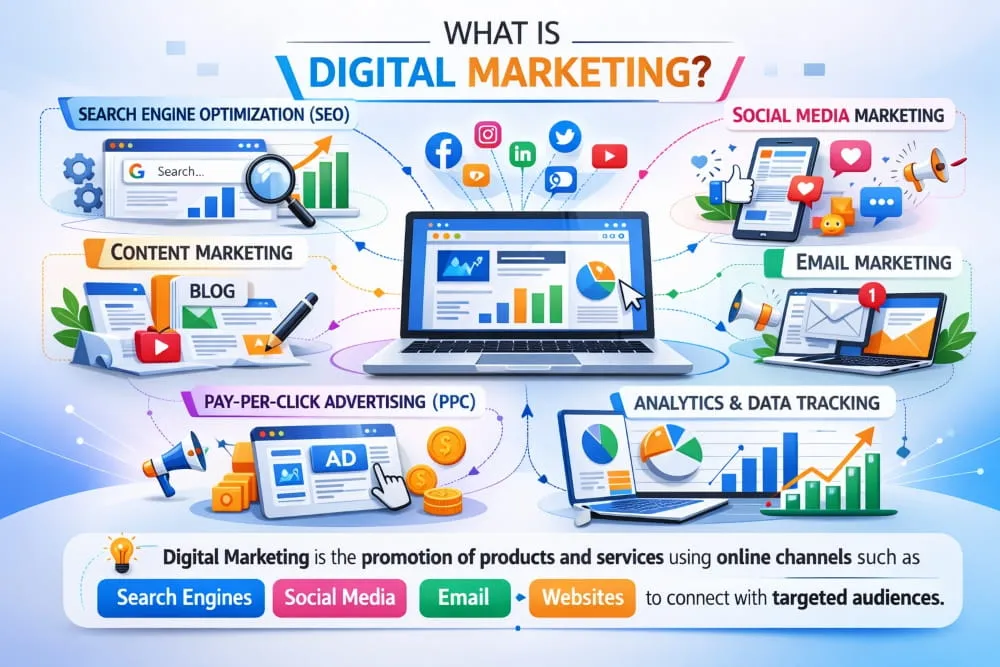
Digital marketing refers to all marketing efforts that use online platforms and digital technologies to promote a business, product, or service. It includes search engines, websites, social media platforms, email communication, and paid advertising networks.
At its core, digital marketing helps businesses increase visibility where modern customers spend most of their time, online. But visibility alone is not the goal. The real objective is growth.
When business owners ask how digital marketing helps a business, the answer goes beyond traffic. Digital marketing helps businesses attract the right audience, communicate value clearly, generate qualified leads, and convert interest into revenue. It creates a predictable system for customer acquisition rather than relying solely on word of mouth or foot traffic.
In simple terms, digital marketing helps business owners move from uncertainty to strategic control.
Core Channels (SEO, Social Media, PPC, Email, Content)
Digital marketing operates across several key channels, each serving a specific role in business growth.
Search Engine Optimization (SEO) improves a website’s visibility in search results, allowing potential customers to discover a business when they actively search for solutions.
Social media marketing builds brand presence and engagement, helping businesses connect directly with their audience and strengthen trust over time.
Pay-per-click (PPC) advertising drives immediate traffic through targeted paid campaigns, accelerating lead generation and sales.
Email marketing nurtures relationships, turning prospects into repeat customers and increasing lifetime value.
Content marketing educates and positions a brand as an authority, answering customer questions and guiding them through the buying journey.
Together, these channels explain how digital marketing helps businesses do what traditional marketing often cannot: precisely target, measure, optimize, and scale.
What Digital Marketing Helps Businesses Actually Do
Many small business owners ask, Digital marketing helps businesses to do what? The answer is strategic and measurable.
Digital marketing helps businesses:
- Increase brand awareness in competitive markets
- Generate consistent, qualified leads
- Build authority and trust with their audience
- Communicate crucial information about products, services, and value propositions
- Convert prospects into paying customers
- Track performance and improve results over time
More specifically, digital marketing helps businesses communicate crucial information such as pricing transparency, service benefits, unique selling points, customer testimonials, and educational insights that influence buying decisions.
Instead of broadcasting generic messages to a broad audience, digital marketing ensures the right message reaches the right person at the right time.
That precision is what drives growth.
The Shift from Traditional to Digital
The transition from traditional marketing to digital platforms marks a fundamental shift in how businesses compete.
Traditional methods, print ads, billboards, and cold calls rely heavily on broad exposure and limited tracking. Digital marketing, in contrast, is targeted and data-driven. It provides real-time insights into what works and what does not.
This shift explains how digital marketing helps a business grow more efficiently. Instead of guessing which advertisement generates results, business owners can analyze engagement metrics, conversion rates, and return on investment.
For small businesses, especially, this shift is transformative. Digital marketing removes barriers that once favored large corporations with massive budgets. It allows smaller brands to compete strategically, allocate resources intelligently, and scale based on performance rather than speculation.
Understanding this foundation is essential before exploring deeper strategies. Once you see what digital marketing is and what it empowers businesses to do, the path to sustainable growth becomes far clearer.
How Digital Marketing Helps Businesses Grow
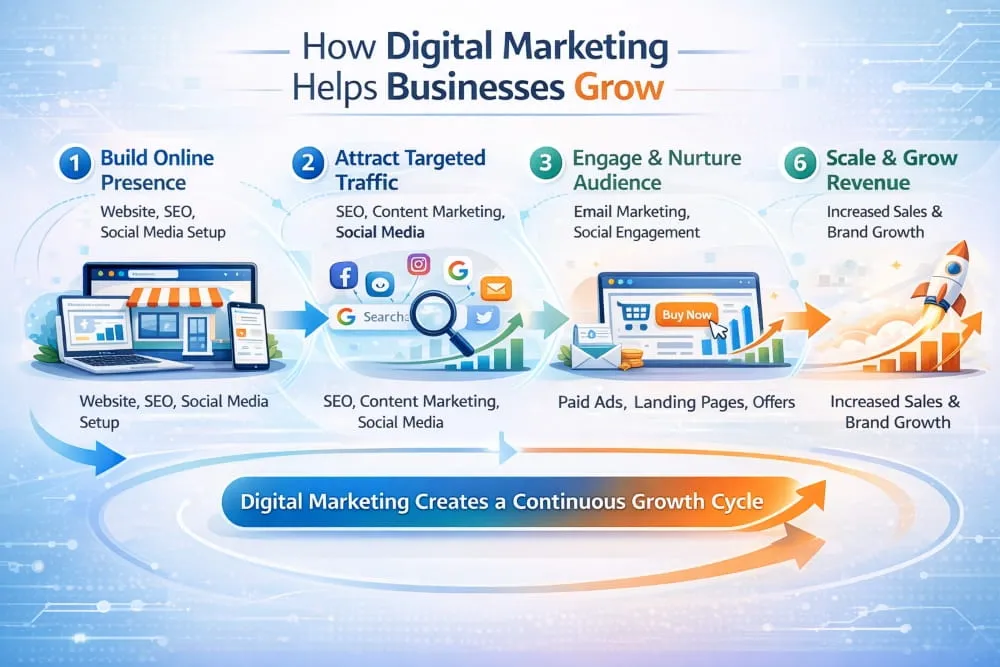
Growth does not happen by accident. It is the result of consistent visibility, targeted outreach, strategic communication, and optimized conversion systems. When business owners ask how digital marketing helps small businesses grow, they are really asking how to build a predictable engine that turns attention into revenue. Digital marketing provides that engine.
Understanding how digital marketing helps in business growth means looking at each stage of the customer journey, from discovery to purchase to long-term loyalty.
Increasing Online Visibility
Before a business can grow, it must be founded. Increasing online visibility is the first and most critical step.
Search engines, social platforms, and online directories have replaced traditional word of mouth as the primary way customers discover brands. Through search engine optimization, local and national search presence, and strategic content publishing, digital marketing ensures that your business appears when potential customers actively search for solutions.
This is one of the clearest ways digital marketing helps grow your business. Instead of waiting for prospects to find you offline, your business becomes discoverable 24/7. Greater visibility leads to more traffic, and more traffic creates more sales opportunities.
For small businesses competing with established brands, this visibility levels the playing field and opens the door to scalable growth.
Attracting Targeted Traffic
Visibility alone is not enough. The real power lies in attracting the right audience.
Digital marketing allows businesses to define and target specific customer segments based on demographics, interests, behaviors, and search intent. Whether through SEO-driven content, paid advertising campaigns, or social media targeting, you can focus on people who are already interested in what you offer.
This precision answers the question, How can digital marketing help a business grow? By reducing wasted marketing spend and concentrating resources on qualified prospects, digital strategies increase the likelihood of conversion.
Targeted traffic means higher engagement, better lead quality, and improved return on investment, all of which contribute directly to sustainable business growth.
Converting Visitors Into Leads
Traffic without conversion does not produce results. Digital marketing integrates systems designed specifically to turn visitors into leads.
Optimized landing pages, compelling calls to action, gated content, email subscription forms, and automated follow-up sequences help capture customer information and move prospects further down the funnel. This structured approach explains how digital marketing helps small businesses grow measurably.
Instead of relying on passive interest, businesses can actively nurture potential customers. Every website visit becomes an opportunity to build a relationship.
Turning Leads Into Paying Customers
Lead generation is only part of the growth equation. Revenue is generated when those leads convert into paying customers.
Digital marketing supports this transition through remarketing campaigns, personalized email sequences, retargeted ads, persuasive content, and data-driven optimization. These strategies guide prospects toward purchase decisions by reinforcing value and addressing objections.
This is how digital marketing can help your business grow beyond short-term gains. Instead of a one-time interaction, prospects experience multiple touchpoints that build trust and credibility.
When executed strategically, digital marketing helps a business succeed by shortening the sales cycle and increasing overall conversion rates.
Building Long-Term Brand Authority
Sustainable growth requires more than transactions; it requires trust.
Content marketing, thought leadership, customer testimonials, and consistent messaging position a business as an authority within its niche. Over time, this authority strengthens brand recognition and reduces customer acquisition costs.
One of the most overlooked ways digital marketing helps drive business growth is by building long-term credibility. When customers recognize your brand as knowledgeable and reliable, they are more likely to choose you over competitors, even larger ones.
This authority-driven approach is especially powerful for small businesses. It allows them to compete strategically, scale responsibly, and maintain growth even during competitive or uncertain economic conditions.
Digital marketing is not a single tactic but an integrated system. It increases visibility, attracts targeted traffic, converts visitors into leads, transforms leads into customers, and builds lasting brand authority. Together, these elements explain clearly how digital marketing helps small businesses grow, not temporarily, but consistently and sustainably.
How Digital Marketing Helps Small Businesses Compete with Big Brands
For many small business owners, the biggest fear is competition. Larger brands often have bigger budgets, established recognition, and expansive teams. But the digital landscape has fundamentally changed how competition works. Today, strategy often matters more than size.
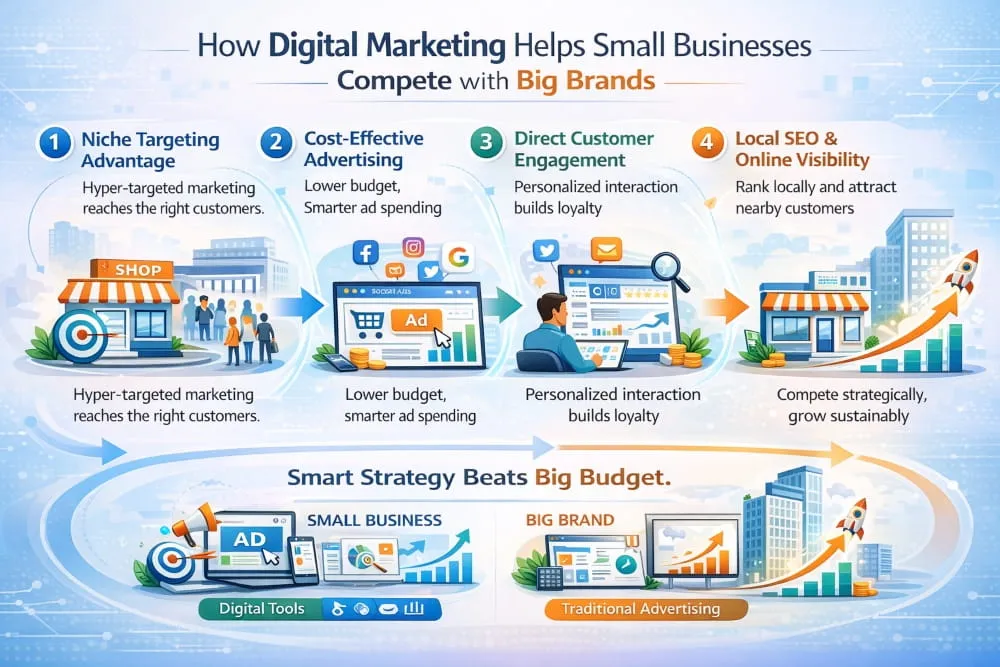
In fact, digital marketing can help small businesses compete with big brands by shifting the focus from spending power to precision, relevance, and authority. When executed correctly, digital strategies allow smaller companies to carve out strategic advantages in crowded markets.
Leveling the Playing Field with SEO
Search engine optimization is one of the most powerful equalizers in modern business.
Unlike traditional advertising, where exposure often depends on budget, SEO rewards relevance, quality, and user experience. A well-optimized website with targeted content can outrank larger competitors for specific keywords and niche queries.
This is how agencies help businesses stand out in competitive digital markets: by identifying gaps in search demand, targeting high-intent keywords, and building content that directly answers customer questions. Instead of trying to dominate broad, highly competitive terms, small businesses can focus on niche opportunities where intent is clear, and conversion potential is high.
SEO transforms search engines into opportunity engines. A small business that understands its audience deeply can outperform a larger competitor that relies solely on brand recognition.
Precision Targeting with Paid Ads
Paid advertising has also evolved beyond simple exposure. Platforms like Google Ads and social media advertising tools allow businesses to target users based on interests, behaviors, demographics, and purchase intent.
This precision targeting explains how digital marketing agencies help businesses compete in crowded markets. Rather than broadcasting a generic message to everyone, campaigns can be tailored to reach the exact audience most likely to convert.
For small businesses, this reduces wasted spend and increases return on investment. Even with modest budgets, strategic targeting ensures visibility among qualified prospects. When every marketing dollar works harder, scale becomes achievable without matching the advertising budgets of industry giants.
Niche Positioning Through Content Marketing
Large brands often speak to broad audiences. Small businesses have the advantage of specialization.
Content marketing allows businesses to demonstrate expertise in specific niches, industries, or problem areas. By publishing in-depth guides, case studies, educational articles, and industry insights, smaller companies can position themselves as authorities within a defined segment.
This niche positioning is a critical way digital marketing can help small businesses compete with big brands. Instead of competing broadly, they compete strategically. Customers seeking specialized solutions often prefer experts over large, generalized providers.
Over time, consistent, value-driven content builds trust and brand equity, creating a competitive advantage that budget alone cannot replicate.
Community Building via Social Media
Social media offers another advantage that large corporations sometimes struggle to replicate: authentic connection.
Small businesses can engage directly with their audience, respond personally to feedback, showcase behind-the-scenes operations, and build meaningful relationships. This humanized presence fosters loyalty and encourages word-of-mouth referrals.
Digital marketing strategies that prioritize engagement over broadcasting help businesses create communities rather than just customer lists. Agencies frequently guide brands in developing consistent messaging, engagement frameworks, and audience-building strategies that strengthen brand identity.
When customers feel connected to a brand, price becomes less decisive and loyalty increases. That emotional connection is often where small businesses outperform large competitors.
Competing with big brands is no longer about matching budgets. It is about leveraging data, precision, specialization, and connection. Digital marketing gives small businesses the tools to compete intelligently, differentiate strategically, and establish authority in markets that once seemed out of reach.
How Digital Marketing Generates Leads and Revenue
Growth becomes meaningful only when it translates into measurable revenue. Visibility and engagement are important, but sustainable success depends on consistent lead generation and predictable sales. One of the most compelling reasons business owners invest in online strategies is that digital marketing helps them generate leads and convert them into paying customers.
Digital marketing for business is not abstract; it is structured around systems that move prospects through a defined journey, from awareness to purchase and beyond.
Lead Generation Funnels Explained
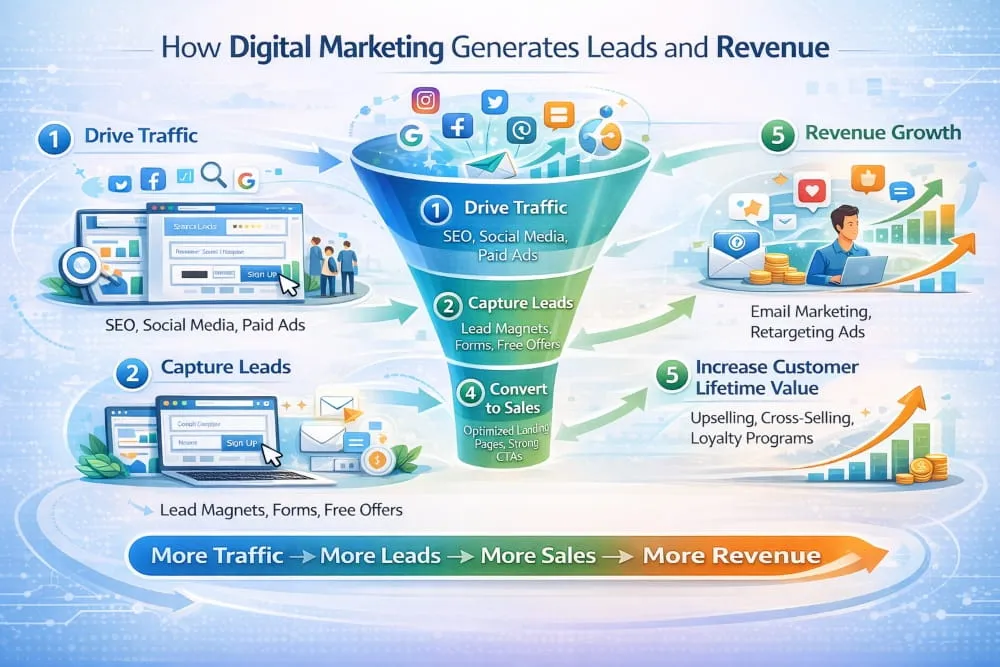
At the heart of revenue growth is the lead generation funnel. A funnel is a structured pathway that guides potential customers from initial interest to active engagement.
It often begins with valuable content, a blog article, guide, webinar, or downloadable resource that answers a specific question or solves a problem. From there, visitors are encouraged to provide contact information in exchange for additional value. That simple action transforms anonymous traffic into identifiable leads.
This is how digital marketing helps businesses generate leads at scale. Instead of waiting for inquiries, businesses proactively capture interest. Each stage of the funnel builds trust, educates the prospect, and prepares them for a purchasing decision.
For small businesses, digital marketing must be intentional to be effective. Clear messaging, strategic calls to action, and aligned offers ensure visitors move smoothly from curiosity to commitment.
Email Marketing for Customer Retention
Generating a lead is only the beginning. Long-term profitability often comes from retention and repeat purchases.
Email marketing remains one of the most powerful tools for nurturing relationships. Once a prospect joins an email list, businesses can provide ongoing value through educational content, product updates, special offers, and personalized communication.
This consistent engagement explains another way digital marketing helps businesses drive revenue. Rather than relying solely on new customer acquisition, businesses can maximize lifetime value by strengthening relationships with existing customers.
Retention strategies reduce acquisition costs, improve brand loyalty, and generate recurring revenue streams, all of which are essential for sustainable growth.
Retargeting Strategies
Not every visitor converts on the first interaction. In fact, most do not.
Retargeting campaigns allow businesses to reconnect with users who have already visited their website or interacted with their content. Through targeted ads displayed across search engines and social platforms, businesses can remind prospects of their offer and encourage them to return.
This strategic follow-up is a key reason why digital marketing helps businesses generate leads more efficiently. Instead of starting from zero each time, retargeting focuses on warm audiences who are already familiar with the brand.
By reinforcing messaging and addressing potential objections, retargeting increases conversion likelihood and shortens the decision-making cycle.
Conversion Rate Optimization
Traffic and leads matter, but optimization determines profitability.
Conversion rate optimization (CRO) involves refining landing pages, improving the user experience, adjusting messaging, and testing calls to action to increase the percentage of visitors who take a desired action. Small improvements in conversion rates can produce significant revenue growth without increasing marketing spend.
This is where small business digital marketing help becomes especially impactful. Rather than simply driving more traffic, businesses can improve their conversion rates for existing visitors. Data-driven testing removes guesswork and identifies what truly resonates with the audience.
When funnels are optimized, emails are strategic, retargeting is consistent, and user experience is refined, digital marketing becomes a reliable revenue engine. It does not just attract attention; it systematically transforms attention into leads and leads into measurable business growth.
How Digital Marketing Agencies Help Businesses Scale
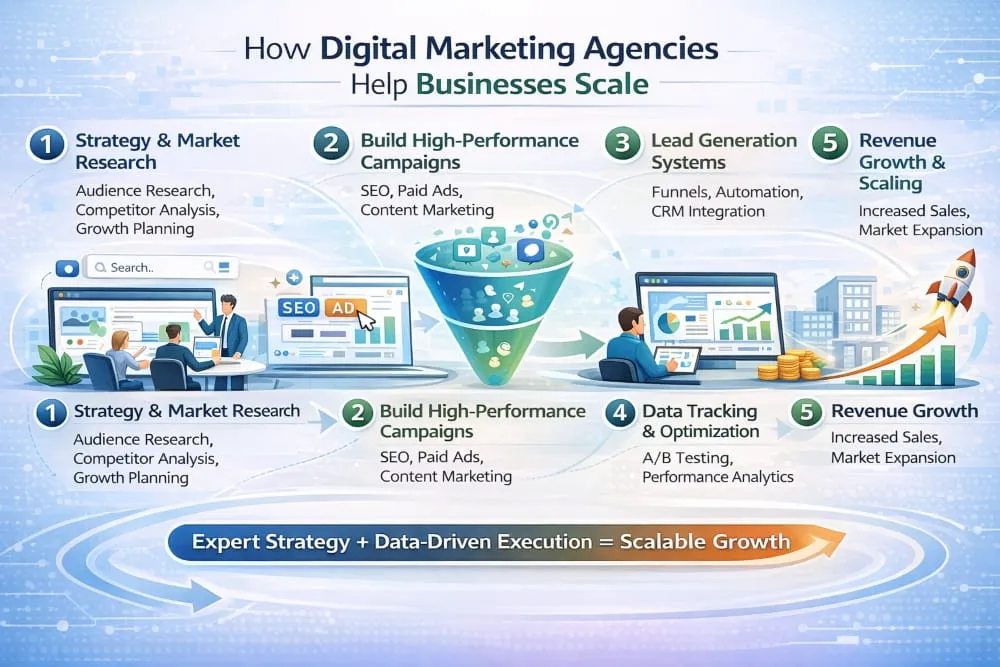
Growth at the early stage often depends on internal effort and experimentation. Scaling, however, requires structure, data, and advanced execution. This is where experienced digital marketing agencies and consultancies play a critical role. They do not simply run campaigns; they build systems designed for expansion.
Understanding how agencies help businesses enter new digital markets and adapt to evolving trends reveals why external expertise often accelerates growth beyond what in-house teams can achieve on their own.
Scaling eCommerce Businesses
eCommerce growth depends on precision. Traffic volume alone does not guarantee revenue; profitability relies on optimized funnels, customer acquisition cost management, and lifetime value optimization.
Digital marketing agencies help eCommerce brands scale by refining paid advertising strategies, improving product page conversions, implementing retargeting campaigns, and expanding into additional acquisition channels. They analyze purchasing behavior, segment audiences, and adjust campaigns based on performance data.
This structured optimization enables businesses to move from steady sales to exponential growth. Instead of increasing spending unthinkingly, agencies scale what works while maintaining efficiency. The result is sustainable expansion rather than short-term spikes.
Scaling SaaS Companies
For SaaS companies, scaling is closely tied to user acquisition, onboarding efficiency, and retention rates. Growth requires attracting qualified leads while ensuring long-term subscription value.
Digital consultancies help businesses enter new markets by identifying high-intent customer segments, optimizing trial funnels, and building content strategies that position the product as a solution to specific pain points. They also refine messaging to reduce churn and increase user engagement.
Because SaaS models rely on recurring revenue, even small improvements in acquisition or retention can significantly impact overall growth. Agencies bring analytical frameworks and conversion-focused strategies that allow SaaS companies to scale predictably.
Entering New Digital Markets
Expansion into new markets requires more than translating a website or launching ads in a different region. It demands research, positioning adjustments, and localized messaging.
This is how agencies help businesses enter new digital markets effectively. They conduct competitive analysis, evaluate demand trends, identify cultural considerations, and adapt campaigns to align with local expectations. By leveraging search data and audience insights, agencies reduce the risk associated with expansion.
Instead of testing unthinkingly, businesses enter new markets with a data-backed strategy that increases the likelihood of success.
Expanding into International Markets
International growth introduces additional complexity, including language barriers, regulatory differences, and varied consumer behavior patterns.
Digital marketing agencies guide businesses through this process by implementing geo-targeted campaigns, multilingual SEO strategies, and region-specific content marketing. They ensure that brand messaging remains consistent while adapting to local nuances.
Through structured analysis and performance tracking, agencies help organizations scale globally without diluting brand identity. This strategic expansion transforms digital marketing from a local growth tool into an international revenue engine.
Transitioning from Traditional to Digital
Many established businesses still rely heavily on traditional marketing methods. While these channels may provide stability, they often lack scalability and measurable precision.
Understanding how agencies help businesses transition from traditional to digital marketing highlights the importance of modernization. Agencies audit existing marketing efforts, identify digital opportunities, and create integrated strategies that blend brand heritage with modern performance channels.
They also help businesses adapt to digital trends, including automation, personalization, and analytics-driven decision-making. This transition is not merely technical; it is strategic. It shifts marketing from broad exposure to targeted engagement and measurable outcomes.
Scaling requires more than ambition. It requires systems, expertise, and strategic direction. Digital marketing agencies provide the infrastructure that enables businesses to expand into new markets, optimize performance across channels, and confidently transition to a data-driven future.
Digital Marketing During Economic Downturns
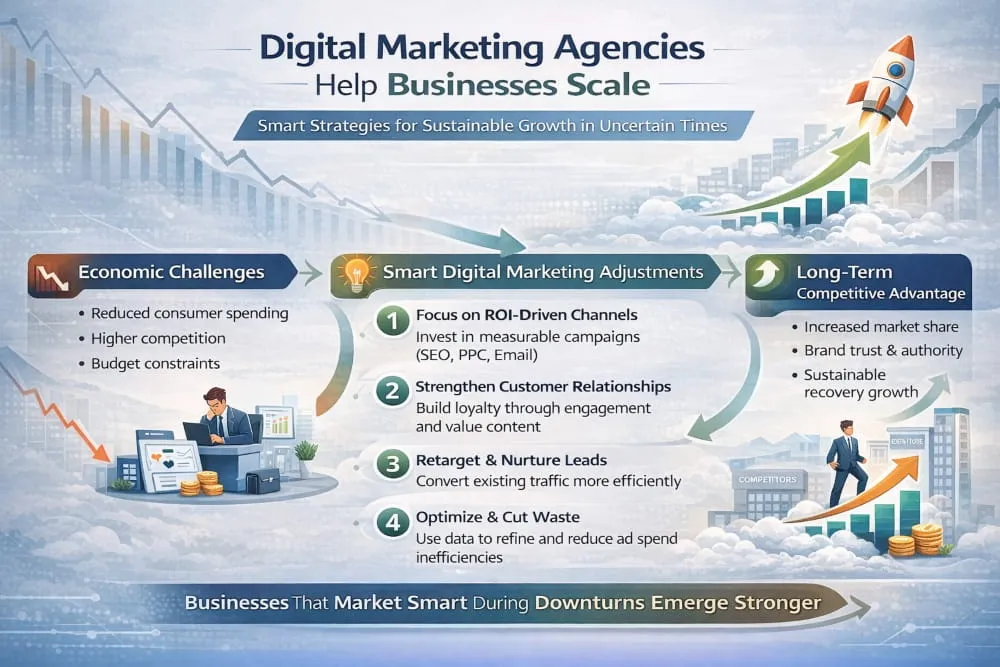
Economic uncertainty forces businesses to rethink priorities. Budgets tighten, consumer behavior shifts, and competition intensifies. During these periods, marketing is often viewed as an expense to reduce. In reality, strategic digital marketing becomes even more critical.
When traditional demand slows, companies that rely on measurable, performance-driven strategies are better positioned to protect revenue and identify new opportunities. This is where structured digital marketing and experienced agencies provide a decisive advantage.
Cost-Effective Customer Acquisition
One of the primary reasons digital marketing remains powerful during downturns is efficiency. Unlike traditional advertising channels that require large upfront investment, digital campaigns can be adjusted in real time based on performance.
Businesses can allocate budget toward high-performing keywords, targeted audiences, and proven conversion funnels while pausing underperforming efforts. This precision lowers acquisition costs and maximizes return on every marketing dollar.
Digital marketing agencies help scale eCommerce businesses even during challenging economic periods by focusing on profitability metrics such as return on ad spend, customer acquisition cost, and lifetime value. Instead of expanding recklessly, scaling becomes controlled and data-informed.
Similarly, digital marketing agencies help scale SaaS businesses by refining subscription funnels, optimizing onboarding sequences, and improving retention strategies. Because SaaS models rely on recurring revenue, even modest improvements in efficiency can stabilize cash flow during uncertain times.
Data-Driven Decision Making
Uncertainty increases risk. Data reduces it.
Digital marketing platforms provide immediate performance insights, allowing businesses to see which campaigns drive traffic, which messages convert, and which channels produce revenue. This transparency enables leaders to make informed decisions rather than reactive ones.
Agencies help businesses scale digital marketing by building analytics frameworks that guide strategic planning. Instead of guessing where growth will come from, companies rely on performance data to refine targeting, adjust messaging, and test new opportunities.
During economic downturns, this level of visibility becomes invaluable. It ensures that every strategic move is backed by measurable results rather than assumption.
Maintaining Revenue During Market Disruptions
Market disruptions often change customer priorities. Search behavior shifts, demand patterns evolve, and purchasing decisions become more deliberate.
Digital marketing allows businesses to respond quickly. Messaging can be updated, campaigns can pivot to reflect new customer concerns, and offers can be repositioned to emphasize value, reliability, or cost savings.
For eCommerce brands, this may involve adjusting product positioning or introducing targeted promotions to maintain conversion rates. For SaaS companies, it may mean highlighting efficiency benefits or cost-reduction features that resonate during economic pressure.
The flexibility of digital channels ensures that revenue strategies remain aligned with current market realities. Rather than going silent during downturns, businesses can strengthen their presence, capture market share from competitors who reduce visibility, and position themselves for accelerated growth when conditions improve.
Economic challenges test resilience. Digital marketing provides the tools to respond with precision rather than panic. Through cost-effective acquisition, data-driven optimization, and adaptive messaging, businesses can protect revenue, refine strategy, and continue scaling, even in uncertain times.
Key Benefits of Digital Marketing for Small Business Growth
Understanding how digital marketing helps small businesses grow becomes even clearer when you examine the direct advantages it offers. Beyond visibility and lead generation, digital marketing delivers structural benefits that support smarter decision-making, stronger customer relationships, and long-term scalability.
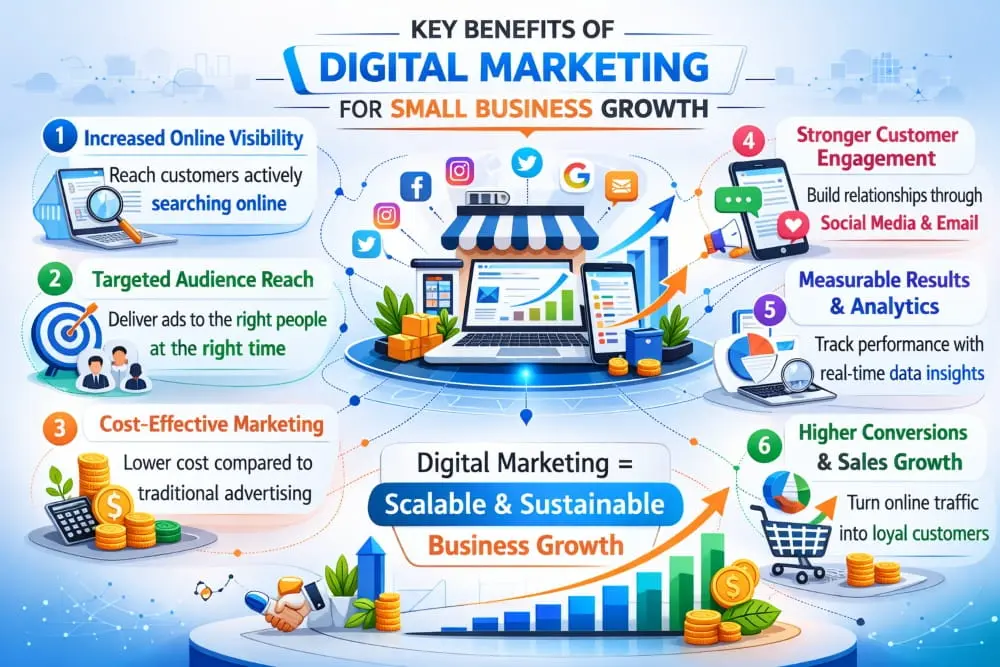
For small businesses operating with limited resources, these benefits are not just helpful; they are transformative.
Measurable ROI
One of the most significant advantages of digital marketing is measurability. Unlike traditional advertising methods, where results can be difficult to track, digital campaigns provide clear performance data.
Businesses can see exactly how much traffic a campaign generates, how many leads it captures, and how much revenue it produces. This visibility allows owners to calculate return on investment with precision.
When leaders understand what is working and what is not, they can reinvest in high-performing strategies and eliminate waste. This level of accountability explains how digital marketing helps businesses grow more efficiently. Growth is no longer based on assumption; it is driven by data-backed performance.
Real-Time Performance Tracking
Speed matters in competitive markets. Digital marketing provides real-time performance insights that allow businesses to respond quickly.
Campaign metrics such as click-through rates, conversion rates, engagement levels, and cost per acquisition are available instantly. If a message underperforms, it can be adjusted. If a campaign performs well, it can be scaled immediately.
This responsiveness is particularly valuable for small businesses. Instead of waiting weeks or months to evaluate results, they can optimize continuously. Real-time tracking turns marketing into an active, adaptable system rather than a static investment.
Budget Flexibility
Financial flexibility is critical for growing companies. Digital marketing allows businesses to start with modest budgets and scale based on performance.
Campaigns can be paused, increased, or redirected at any time. This adaptability reduces financial risk and ensures resources are allocated strategically. Small businesses are not locked into long-term contracts or high upfront costs.
Budget flexibility also supports experimentation. Businesses can test new audiences, creative approaches, or promotional strategies without committing excessive capital. This controlled experimentation often uncovers new growth opportunities.
Improved Customer Insights
Another powerful benefit of digital marketing is access to customer data. Online platforms provide insights into audience behavior, preferences, demographics, and engagement patterns.
These insights help businesses understand what customers care about, how they search for solutions, and what influences purchasing decisions. With this knowledge, messaging becomes more relevant and offers become more compelling.
Improved customer insight strengthens not only marketing performance but also overall business strategy. Product development, pricing decisions, and service improvements can all be informed by real audience data.
Brand Trust & Credibility
Sustained growth depends on trust. Digital marketing builds credibility through consistent content, social proof, reviews, educational resources, and transparent communication.
When customers repeatedly encounter valuable, relevant information from a business, confidence increases. Search engine visibility also reinforces authority; brands that appear prominently in results are often perceived as more credible.
Over time, this trust reduces resistance to purchase decisions and strengthens customer loyalty. For small businesses competing in crowded markets, credibility can become a defining competitive advantage.
The benefits of digital marketing extend far beyond promotion. Measurable ROI, real-time adaptability, financial flexibility, deeper customer insight, and stronger brand trust collectively create a foundation for scalable, sustainable growth. These structural advantages are why digital marketing continues to play a central role in small business success.
Organic vs Paid Digital Marketing for Small Businesses: Which Drives Sustainable Business Growth?
When business owners explore how digital marketing helps small businesses grow, one of the most important strategic questions emerges: Should you focus on organic growth or paid advertising?
Many competitors treat these approaches as separate conversations. Some advocate exclusively for SEO and content marketing, while others emphasize paid campaigns for fast results. In reality, sustainable business growth often depends on understanding the strengths, limitations, and ideal timing of both.
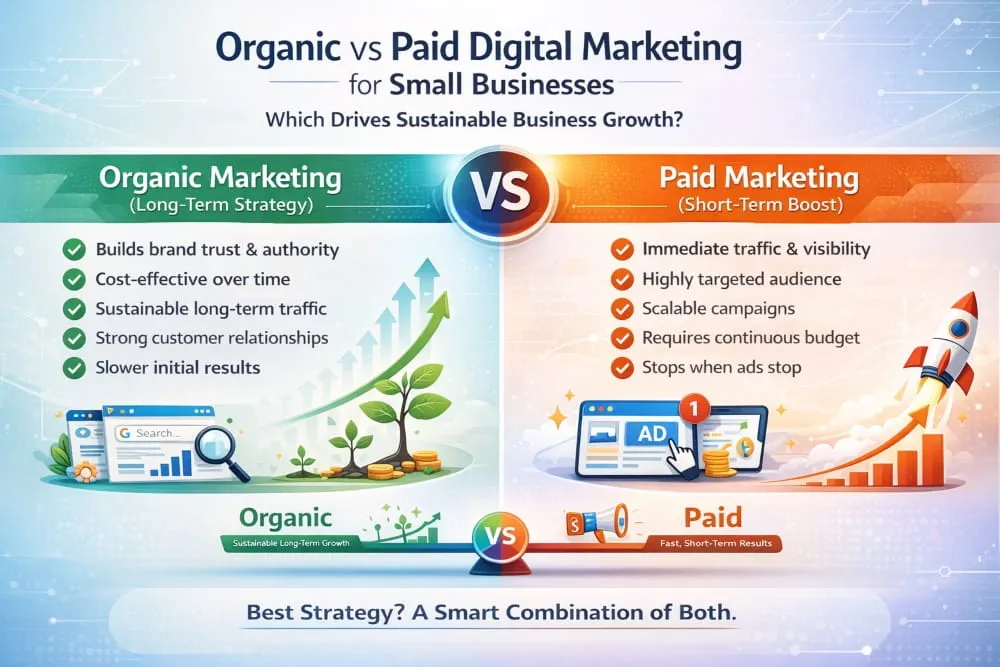
This comparison matters because small businesses must allocate resources carefully. Choosing the right balance between organic and paid digital marketing can directly influence profitability, scalability, and long-term stability.
Speed vs. Sustainability
Paid digital marketing is built for speed. Pay-per-click advertising, social media ads, and sponsored placements can generate traffic almost immediately. For new businesses or product launches, this rapid visibility can create early momentum and valuable performance data.
Organic digital marketing, including search engine optimization and content marketing, operates differently. It requires time to build authority and search visibility. Results may take several months to materialize, but once established, organic traffic often becomes a consistent and cost-efficient growth driver.
In simple terms, paid growth delivers acceleration. Organic growth delivers endurance.
For small businesses seeking immediate lead flow, paid campaigns can provide short-term traction. For those focused on long-term authority and reduced acquisition costs, organic strategies build a stronger foundation over time.
Budget Differences
Budget structure is another critical distinction.
Paid advertising requires ongoing financial investment. When spending stops, traffic typically declines. While campaigns can be optimized for efficiency, they remain directly tied to budget allocation.
Organic strategies, on the other hand, require upfront investment in content creation, website optimization, and strategic planning. However, once search rankings improve and content gains traction, traffic can continue flowing without proportional increases in spend.
This dynamic explains how digital marketing helps small businesses grow strategically. Paid campaigns can fuel early-stage expansion, while organic efforts gradually lower overall customer acquisition costs and improve return on investment.
When to Use Organic vs. Paid
The decision is not about choosing one permanently over the other. It is about timing and business objectives.
Paid marketing is especially effective when:
- Launching a new product or service
- Entering a competitive market
- Testing messaging and audience segments
- Generating immediate leads
Organic marketing is particularly valuable when:
- Building long-term brand authority
- Competing on niche search terms
- Strengthening credibility and trust
- Reducing dependency on ad spend
Small businesses often benefit from starting with targeted paid campaigns to validate demand while simultaneously investing in organic visibility for sustainable growth.
The Power of a Hybrid Strategy
The most resilient growth strategies combine both approaches.
A hybrid digital marketing model leverages paid campaigns for immediate traffic and data insights while developing organic assets that compound over time. Paid ads can test which keywords and messaging convert best. Those insights can then inform SEO and content strategy. As organic visibility strengthens, reliance on paid acquisition can decrease or become more strategic.
This integrated approach is often how digital marketing helps a business grow most effectively. It balances short-term revenue goals with long-term scalability.
Rather than viewing organic and paid marketing as competing tactics, successful small businesses treat them as complementary components of a unified growth system. When speed and sustainability are aligned, they create a stronger, more predictable path to expansion.
Common Questions About How Digital Marketing Helps Businesses
As more entrepreneurs explore online growth strategies, certain questions consistently arise. Business owners want clarity, realistic expectations, and strategic direction before committing time and resources. Addressing these concerns helps demystify how digital marketing helps small businesses grow and why it remains one of the most reliable tools for long-term success.
How does digital marketing help small businesses grow?
Digital marketing helps small businesses grow by creating a structured pathway from visibility to revenue.
It increases online exposure through search engines and social platforms, attracts targeted traffic that aligns with your ideal customer profile, and converts visitors into leads through optimized funnels. From there, automated nurturing systems and strategic messaging guide prospects toward purchase decisions.
Unlike traditional marketing, digital strategies are measurable and adaptable. This allows businesses to identify which channels drive results and scale those efforts strategically. Over time, this combination of visibility, targeting, and optimization builds predictable growth rather than sporadic sales spikes.
Can digital marketing help my business during a recession?
Yes, and often more effectively than traditional methods.
During economic downturns, consumers become more selective, and businesses must operate more efficiently. Digital marketing allows for precise targeting, budget control, and real-time performance tracking. Campaigns can be adjusted instantly to reflect changing demand or shifting customer priorities.
Instead of reducing visibility, businesses that maintain or refine their digital presence often capture market share from competitors who go silent. The ability to analyze data, optimize messaging, and focus on high-converting audiences makes digital marketing a strategic asset during uncertain economic conditions.
How long does digital marketing take to show results?
The timeline depends on the strategy and channels used.
Paid advertising campaigns can generate traffic and leads within days or weeks. Search engine optimization and content marketing typically require several months to build momentum. Still, once established, they create sustainable, long-term growth.
Digital marketing is not a one-time effort; it is a compounding system. Early results often improve as campaigns are optimized and insights are applied. Businesses that approach digital marketing with consistency and strategic patience typically achieve stronger, more stable outcomes over time.
Is hiring a digital marketing agency worth it?
For many businesses, the answer is yes, particularly when scaling or entering competitive markets.
Agencies bring expertise, analytics frameworks, and cross-channel experience that accelerate growth. They understand how to allocate budgets effectively, refine conversion funnels, and adjust campaigns based on performance data. This reduces costly trial-and-error and shortens the learning curve.
While some businesses successfully manage marketing internally, external specialists often provide the structure and advanced execution required for faster, more predictable expansion.
What results should I expect?
Results vary depending on industry, competition, budget, and execution quality. However, businesses implementing a well-structured digital strategy can expect increased visibility, higher-quality leads, improved conversion rates, and measurable revenue growth.
Over time, additional benefits often include stronger brand authority, improved customer retention, and reduced acquisition costs due to optimization and data-driven refinement.
The key is alignment. When digital marketing strategies are aligned with clear business objectives, realistic timelines, and continuous optimization, they become a powerful driver of sustainable growth.
Digital marketing is not a quick fix. It is a scalable growth framework. When approached strategically, it answers the most important question for any business owner: how to compete, expand, and succeed in an increasingly digital marketplace.
Why Digital Marketing Is the Growth Engine Small Businesses Cannot Ignore
Small businesses no longer grow by chance. They grow by strategy.
Throughout this guide, we have examined how digital marketing helps small businesses grow, from increasing online visibility and attracting targeted traffic to generating qualified leads, improving conversion rates, and building long-term brand authority. Each component plays a specific role, but together they form a structured system for predictable expansion.
Digital marketing is not just about being online. It is about being discoverable when customers search, persuasive when they compare options, and trustworthy when they are ready to decide. It creates measurable pathways from awareness to revenue, allowing business owners to scale intelligently rather than rely on guesswork.
We have also seen how digital marketing helps businesses compete with larger brands, adapt during economic downturns, and expand into new markets. Whether through organic strategies that build sustainable authority or paid campaigns that accelerate results, the power lies in strategic integration. The businesses that win are not those that choose one tactic; they are the ones that build a cohesive growth framework.
Most importantly, digital marketing transforms growth from an unpredictable outcome into a controllable process. With data-driven insights, budget flexibility, and performance tracking, small businesses gain clarity on what works and why. That clarity reduces risk, strengthens decision-making, and unlocks long-term profitability.
The question is no longer whether digital marketing can help your business grow. The real question is how intentionally you are willing to use it.
In today’s competitive landscape, digital marketing is not simply a promotional tool. It is the foundation of modern business growth, scalable, measurable, and essential for sustained success.