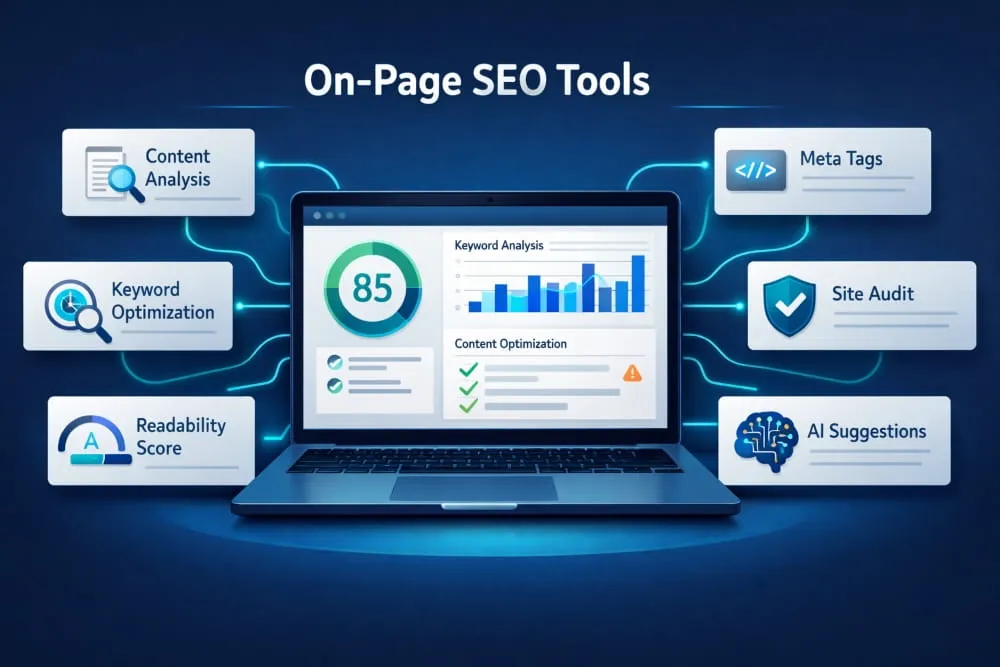
London’s search landscape is competitive. The businesses that win aren’t just building links; they’re obsessing over every title tag, heading, and Word on the page.
What Is On-Page SEO?
On-page SEO refers to the practice of optimising individual web pages so that search engines, and the people using them, can understand, trust, and rank your content. Unlike off-page SEO, which relies on third-party signals like backlinks, on-page SEO lives entirely within your control. That’s both its challenge and its opportunity.
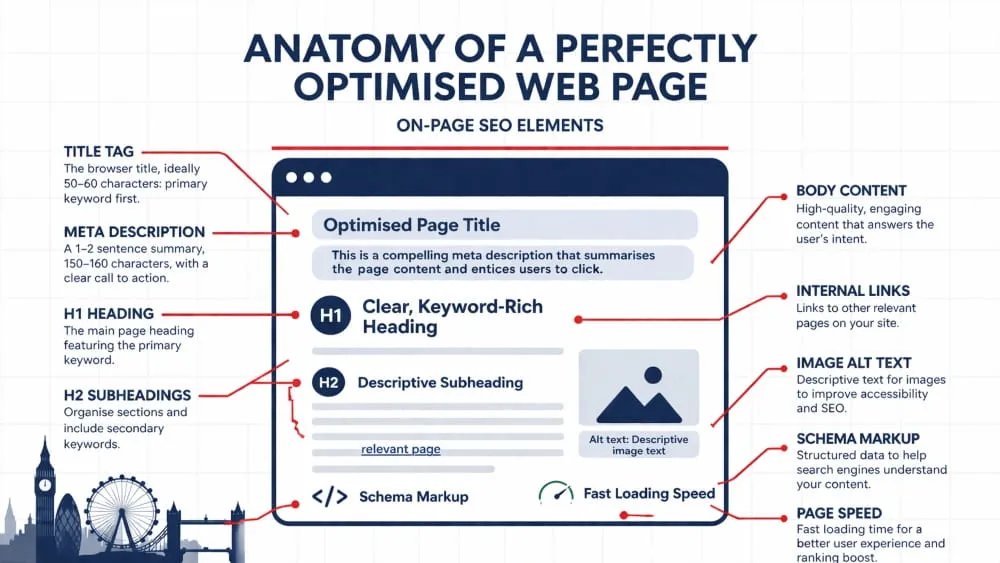
At its core, on-page SEO covers everything visible on a page, your headings, body copy, images, and internal links, as well as what lives in the code: title tags, meta descriptions, schema markup, and page speed signals. When these elements align with what a user is searching for, Google rewards you with visibility.
On-page SEO is not about sprinkling keywords across a page. It’s about building relevance, demonstrating to both Google and the reader that your page fully answers a specific search query better than any competing result.
Why On-Page SEO Matters Specifically for London Businesses
London is one of the most competitive digital markets in the world. Regardless of your industry, law, finance, hospitality, retail, or professional services, your competitors have agencies, in-house teams, and years of domain authority working against you. In this environment, on-page SEO isn’t optional; it’s the baseline.
What makes London on-page SEO distinctive is the hyper-local intent layered into search behaviour. Someone searching on-page SEO agency London isn’t just after general advice; they want a provider who understands the City, the market, and what it takes to rank in a densely competitive geography. Matching that intent precisely, at the page level, is what separates visible businesses from invisible ones.
Whether you’re running a boutique consultancy in Shoreditch, a legal firm in the City, or an e-commerce operation serving the wider UK, the principles of London on-page SEO apply equally and consistently deliver returns when done properly.
How to Do On-Page Optimisation in SEO: The Core Elements
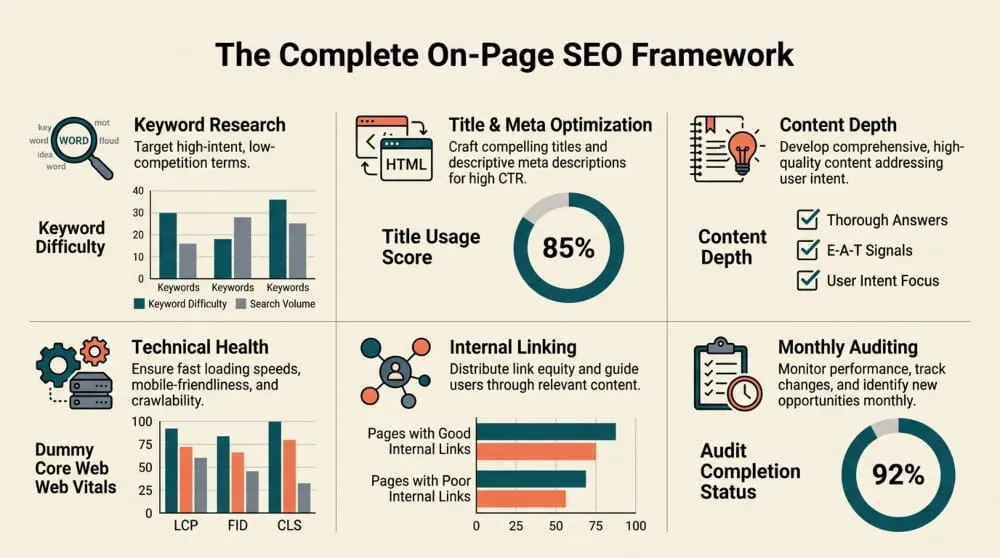
On-page optimisation is not a single task; it’s a system of interconnected decisions.
Keyword Research & Search Intent Mapping,
Before writing a Word, understand who is searching and why. Are they looking for information, a service, or ready to buy? Matching your page’s purpose to the correct search intent is the single most important on-page decision you’ll make.
Title Tags & Meta Descriptions,
Your title tag is the most heavily weighted on-page signal. It should naturally include your primary keyword, accurately reflect the page’s content, and be compelling enough to earn a click. Meta descriptions don’t directly affect rankings, but they powerfully influence click-through rate, which does.
Heading Structure (H1–H3),
Use one H1 per page that leads clearly with your primary topic. Supporting H2s and H3s should create a logical hierarchy that helps readers skim and helps Google understand your content’s structure. Think of it as your page’s table of contents.
Content Depth & Topical Authority
Google’s helpful content system rewards pages that comprehensively cover a topic for real people. Thin, surface-level content ranks poorly. Write for your reader first, cover the subject with genuine depth, and the rankings tend to follow.
Internal Linking
Internal links distribute authority across your site and guide both users and crawlers to your most important pages. A well-structured internal linking strategy is one of the most underused levers in on-page SEO for London businesses.
Image Optimisation & Core Web Vitals,
Page experience matters. Compress images, use descriptive alt text, and ensure your pages load quickly on mobile. Google’s Core Web Vitals are a real ranking factor, and London users browsing on the go are unforgiving of slow pages.
Schema Markup and Structured data
Schema Markup and Structured data help Google display your content as rich results, including star ratings, FAQs, event dates, and more. For local London businesses, especially, the Local Business schema can significantly improve visibility in both organic results and the map pack.
What Does a London On-Page SEO Audit Cover?
A London on-page SEO audit is a systematic review of every factor that could be preventing your pages from ranking at their potential. A thorough audit examines crawlability and indexation, keyword-to-page alignment, content quality and duplication, title tags and metadata, heading structures, page speed across desktop and mobile, internal linking architecture, image optimisation, and schema implementation.
The output isn’t just a list of issues, it’s a prioritised action plan. Not every fix carries the same weight. A skilled on-page SEO agency in London will triage findings based on effort versus impact, so your team works on the changes that move the needle fastest.
Many businesses invest heavily in new content or link-building campaigns while overlooking basic on-page issues. A single audit can surface title tag duplicates, cannibalised keyword targeting, or slow-loading pages that have quietly suppressed rankings for months, without anyone realising.
Working With an On-Page SEO Agency in London
There’s a meaningful difference between hiring a generalist digital marketing agency and partnering with a specialist on-page SEO agency in London. The latter brings a deep understanding of the UK search landscape, familiarity with how Google treats competitive London SERPs, and the technical depth to implement changes that actually stick.
When evaluating on-page SEO services in London, look for transparency in reporting, a clear methodology for audits and implementation, and evidence of results in competitive niches. Be cautious of agencies that promise rankings without showing you the work. On-page SEO is documented, systematic, and traceable. If an agency can’t explain what they’re optimising and why, that’s a signal to keep looking.
Good on-page SEO services don’t deliver overnight results, but they do deliver durable ones. Unlike paid media, which stops the moment your budget does, well-optimised pages continue to earn organic traffic month after month, compounding in value over time.
DIY On-Page SEO vs Hiring a London Agency, An Honest Breakdown
This is the question most London business owners are quietly asking, but rarely find a straight answer to. So here it is.
DIY on-page SEO is genuinely viable, but only within a defined scope. If you have the time to learn, a small site, and low-to-moderate competition in your niche, handling the basics yourself is reasonable. Writing clear page titles, properly structuring your headings, improving your page copy, and compressing images are all things a motivated non-specialist can do without paying anyone.
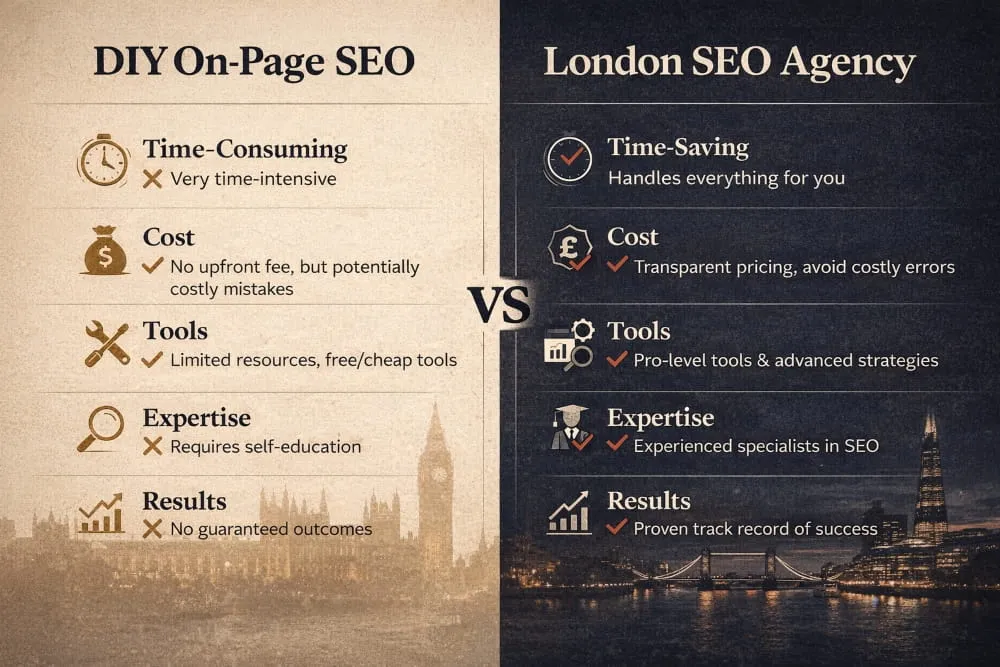
Where DIY breaks down is in depth and consistency. On-page SEO is not a one-time task. It requires ongoing auditing, content refinement, technical awareness, and the ability to interpret data from tools like Google Search Console and Screaming Frog. Most business owners start with good intentions and stall within a month because it competes with everything else on their plate.
Hiring a London on-page SEO agency makes sense when your site has more than 20 to 30 pages, when you are in a competitive local market where rankings directly affect revenue, and when you have had an agency or developer build your site. Still, nobody has ever looked at it through an SEO lens, or when you have been producing content for months, and traffic has not moved.
The honest cost-benefit summary looks like this. DIY costs you time, often more than you expect, and carries the risk of implementing things incorrectly, which can be harder to undo than if you had started right. An agency costs money but brings tools, experience, and accountability that significantly compress the timeline to results.
One thing worth saying plainly: a good London on-page SEO agency should be able to show you exactly what they did, why they did it, and what changed as a result. If they cannot, you are not getting what you are paying for.
Conclusion
On-page SEO is not glamorous. It doesn’t have the immediate feedback loop of paid ads or the social validation of viral content. But it is the bedrock of sustainable organic search performance, and for London businesses competing in crowded markets, it is non-negotiable.
Whether you’re running a self-directed London on-page SEO audit or working with a specialist agency to handle on-page SEO services end-to-end, the principle is the same: every page on your site is an opportunity to earn visibility. The question is whether you’re taking it.
Done well, on-page optimization doesn’t just improve your rankings; it also improves your user experience. It improves the experience of every person who lands on your page, and that, ultimately, is what search engines are trying to reward.