A startup SEO agency builds organic search visibility for young companies through technical fixes, buyer intent content and authority building, usually for about $1,500 to $5,000 (£1,200 to £4,000) a month. It pays off once your offer is validated and you can wait several months for traffic that compounds. The payoff can be large, First Page Sage’s 2026 benchmarks put average B2B customer acquisition cost at about $942 through organic channels, against $1,907 through paid. This guide explains how SEO services work for early stage companies, what they cost at each funding stage and how to choose a partner you can trust.
What Is an SEO Agency for Startups (and What Makes It Different)?
An SEO agency for startups is an outside team that earns organic search traffic for early-stage companies, with strategy, scope and reporting built around a small site, little authority and a limited runway. It does the same core work as any SEO firm, but sequences it so the first pounds or dollars go to the pages most likely to bring in customers.
Startup SEO vs Enterprise SEO
Startup SEO differs from enterprise SEO because a young company has almost nothing to optimize and almost nothing to lose. An enterprise typically has thousands of indexed pages, years of backlinks and a team to ship changes, so its SEO is mostly about protecting and refining what exists. A startup has a handful of pages, a domain that search engines barely know and a runway measured in months, so the work is about building from zero and choosing carefully. That means fewer target keywords, chosen for buying intent over search volume, and a tight focus on the few pages that can turn a visitor into a lead.
Timing needs honest expectations too. Google’s own guidance on hiring an SEO says results typically take four months to a year to appear after changes begin. For a startup, that makes the question less about whether SEO works and more about whether the budget and runway can stretch far enough for it to pay back.
What a Startup SEO Agency Actually Delivers
A startup SEO agency delivers a technical foundation, a focused keyword plan, optimized money pages, content that earns links and citations, and reporting tied to leads rather than rankings. In practice, the work starts with an audit that checks whether search engines can crawl and index the site, followed by research into the questions your buyers type before they are ready to talk to sales. From there the agency fixes site issues, rewrites or builds the pages that carry commercial intent and publishes content that answers those questions better than competitors do.
Better agencies also build authority steadily through relevant mentions and links, and they track whether your brand is cited in AI-generated answers alongside traditional rankings.
Agency vs SEO Consultant vs In-House Head of SEO
A startup should usually hire an agency when it needs several SEO skills at once, a consultant when it needs strategy for a team that can execute, and an in-house head of SEO only once SEO is clearly a core growth channel. Each model trades coverage, cost and control differently.
An agency brings technical, content and link-building specialists under one retainer, which suits teams with no one to implement the plan. A consultant gives you senior thinking at a lower monthly cost but expects you or your developers and writers to do the work. A full-time head of SEO gives you daily focus and deep product knowledge, but that person carries a full salary, tools and benefits, and a single hire rarely covers every discipline.
Many startups start with an agency or consultant, then hire in-house once organic search is producing steady revenue and the strategy is proven. At that point the agency often shifts to a supporting role, handling specialist work such as link building or technical projects.
Why SEO Matters for Startups Benefits and Investor Impact
SEO matters for startups because it turns each published page into an asset that keeps bringing in buyers after the work is done, lowers the cost of winning each customer over time, and gives founders a growth story that investors can verify. Paid channels buy attention for as long as the budget lasts, whereas search visibility builds on itself.

Compounding Traffic vs Paid Dependency
Organic search traffic compounds because a page that ranks keeps earning visits without a fresh payment for each one, while paid traffic stops the day spending stops. A startup that relies only on ads has to keep feeding the machine to keep leads flowing, and rising click costs make that harder every year. A startup that invests in SEO builds a library of pages, each of which can attract visitors for months or years, and each new page strengthens the site’s authority for the next one.
None of this makes paid advertising a mistake. Ads are a good way to test messaging quickly while rankings are still maturing. The risk is dependence: a company whose pipeline vanishes when the ad account is paused has rented its growth instead of owning it. A sensible plan uses paid search for early learning and SEO as the foundation that gradually takes over the heavy lifting.
Lower Customer Acquisition Cost Over Time
SEO lowers customer acquisition cost over time because the upfront work of building pages and authority is spread across every customer those pages later produce. First Page Sage’s 2026 benchmarks put the average B2B customer acquisition cost at about $942 for organic channels, compared with roughly $1,907 for paid channels. In other words, a customer won through search costs about half as much as one won through ads, on average.
The gap tends to widen with age. Early on, SEO can look more expensive than ads because you are paying for strategy, fixes and content before traffic arrives. Once those pages rank, the cost of each additional visitor falls toward zero, and the blended cost per customer drops with it. For a startup watching its runway, that shift matters more than any single month’s results. It means every pound or dollar invested in search work now makes later growth cheaper.
Credibility With Customers and Investors
SEO builds credibility with customers because buyers trust companies that show up when they search for answers, and it helps attract investors because it shows demand and growth that don’t rely on constant spending. A startup that ranks for the questions its buyers ask looks established before it has the brand to match, and it earns that trust at the moment the buyer is researching.
Investors tend to look for growth that is efficient and repeatable. A steady rise in organic traffic, branded searches and inbound leads shows that people are finding the company without being paid to look, and that the business owns an asset rather than just a monthly ad bill. It also tells them the team can plan for the long term. For founders preparing a funding round, being able to show organic growth, falling acquisition costs and rising brand demand makes the story easier to believe than a growth chart that depends entirely on paid spend.
Startup SEO Strategy What an Agency Should Do in Order
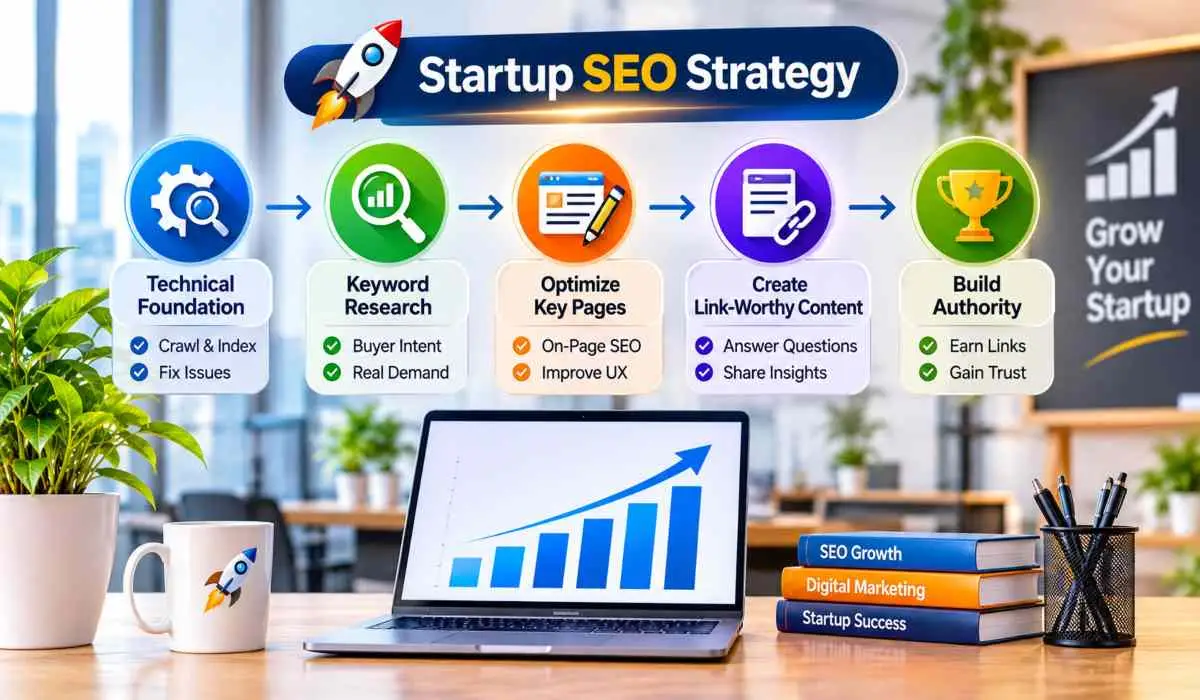
A startup SEO strategy should run in a fixed order: fix how search engines crawl and index the site, research what buyers actually search for, optimize the pages that sell, publish content that earns links and citations, then build authority. Skipping ahead wastes the budget, because content on a site that can’t be indexed, or links pointing at pages that don’t convert, produce little.
Technical Foundations and Indexing
The first job is making sure search engines can find, crawl and index every page that matters. Technical SEO comes first because nothing else counts if pages are blocked, slow or duplicated. A competent agency starts with a full audit covering crawl errors, indexing status, XML sitemaps, redirect chains, mobile usability, page speed and site structure, then fixes the problems in order of impact.
Startups often launch on fast-built sites that carry hidden issues, such as staging pages left open to crawlers, missing canonical tags or JavaScript that hides content from search engines. Catching these early is cheap, while catching them after months of publishing is not. The agency should also set up Search Console and analytics at this stage so every later result can be measured.
Keyword Research Built on Buyer Intent
Keyword research for a startup should target searches that signal a buying problem, not the highest-volume terms. A new site cannot compete for broad head terms, and traffic that never converts does little for a young business. The agency should map the questions buyers ask at each stage, from recognizing a problem to comparing solutions, and prioritize terms where competition is realistic and intent is commercial.
Demand matters as much as ranking. Ahrefs found that 96.55% of the pages in its index get zero traffic from Google, and the study points to topics nobody searches for and a lack of backlinks as the main causes. For a startup with limited resources, that is a warning to validate demand before writing anything.
Landing Page and On-Page Optimization
On-page optimization makes your key pages clear to search engines and persuasive to visitors, starting with the pages closest to revenue. These are usually the homepage, product or service pages and a small set of comparison or use-case pages. On-page SEO covers title tags, meta descriptions, headings, internal links, structured data and copy that answers the searcher’s question quickly.
A good agency treats each page as both a ranking asset and a conversion asset. That means matching the page to one primary intent, placing a clear next step above the fold and linking related pages together so authority flows toward the ones that matter most. Rewriting five strong pages usually beats publishing fifty weak ones.
Content That Earns Links and Citations
Content earns links and citations when it offers something worth referencing: original data, a clear definition, a practical framework or an answer that is easier to quote than the alternatives. Startups gain most from a focused set of articles tied to buyer questions, each written to stand alone so that both readers and AI tools can lift an answer from it directly.
Publishing is only half the work. Pages need regular content updates to keep facts, figures and examples current, because outdated pages lose rankings and are less likely to be cited. An agency should schedule reviews of top-performing pages and refresh them before they decay.
Off-Page Authority Without Spammy Tactics
Authority comes from earning mentions and links from relevant, trustworthy sources, not from buying links in bulk. Off-page SEO for a startup works best through digital PR, expert commentary, partner and industry mentions, useful resources other sites want to cite, and reputable directories relevant to your category.
Avoid agencies that promise hundreds of links a month, run private blog networks or build links on unrelated sites. Those tactics can trigger penalties that are slow and expensive to reverse, and a young domain has little reputation to spare. A handful of strong, relevant links will do more than a pile of weak ones.
First 90 Days Checklist
The first 90 days should move from audit to fixes to early growth. In month one, the agency audits the site, sets up tracking, researches keywords and competitors, and agrees on the five to ten priority pages. That is also the initial SEO setup: Search Console, analytics, sitemaps and a clean crawl.
In month two, the technical fixes ship, the priority pages are rewritten and optimized, and the first content pieces go live. In month three, the agency reviews early data on indexing, impressions and rankings, begins outreach for links and mentions, and plans the next quarter’s content around what is gaining traction.
You should see leading indicators by the end of this period, such as indexed pages, rising impressions and early movement for long-tail terms, even though traffic and leads take longer to arrive.
SEO by Funding Stage Bootstrapped, Seed and Series A
The right SEO plan for a startup depends on its funding stage: bootstrapped teams should focus on foundations and a few revenue pages, seed-stage teams on a content engine and authority, and Series A companies on scaling what works and reporting it clearly. Each stage changes the budget, the risk tolerance and the proof the business needs from search.
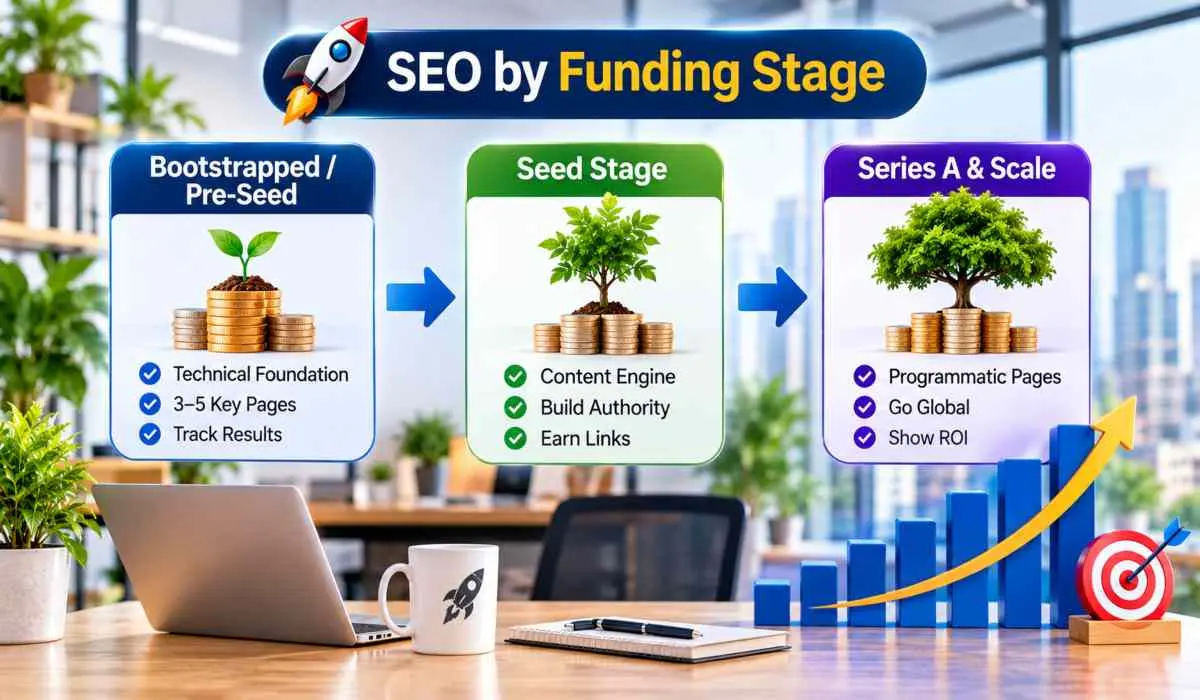
Bootstrapped and Pre-Seed Foundations and a Few Money Pages
A bootstrapped or pre-seed startup should spend its SEO budget on a clean technical foundation and three to five pages that sell. With little cash and no authority, the goal is to be findable for a handful of high-intent searches, not to build a content library. That means a crawlable site, accurate tracking, and well-optimized pages for your core offer, your main use cases and one or two comparison searches.
Keep the engagement narrow and the contract short. A fixed-scope audit plus focused page work gives you something concrete without locking you into a long retainer. Ongoing website maintenance matters here too, because a slow, broken or outdated site undoes optimization work faster than a small team can notice. Expect early signals such as indexing and impressions before leads, and plan the runway accordingly.
Seed Content Engine Plus Authority Building
A seed-stage startup should build a repeatable content engine and begin earning authority, because funding finally allows consistent publishing and outreach. The foundation is already in place, so the work shifts to covering the questions buyers ask across the whole decision process, from the first problem search to the final comparison.
Patience is part of the strategy. Ahrefs reports that 72.9% of pages ranking in Google’s top 10 are more than three years old, which shows how much search rankings reward pages that have had time to accumulate links and engagement. Seed-stage teams therefore benefit from publishing steadily, updating strong pages instead of abandoning them, and pairing content with relevant links and mentions. Choose a small number of topics to own rather than spreading thinly across many.
Series A and Scale-Ups (Programmatic Pages, International Expansion, Reporting to the Board)
A Series A company should scale what already works, using programmatic pages, international expansion and board-level reporting. Programmatic SEO generates many pages from structured data, such as location, integration or use-case variations. It works only when each page offers real value, so an agency should start with a tested template on a small batch and expand once the pages are indexed and performing. Thin or near-duplicate pages can harm the whole site.
International expansion adds complexity. Entering the UK and US, for example, means separate keyword research, correct language and regional targeting, and local proof such as pricing in the right currency. The agency should plan site structure before launching, since changing it later is costly.
Reporting also grows up at this stage. Boards and investors want to see organic pipeline, cost per acquisition and the share of revenue from search, not rankings alone. Look for a monthly report that connects SEO activity to leads and revenue, plus a forward view of what the next quarter should deliver. If you need to search to work alongside other channels as you scale, our guide to a digital marketing agency for startups covers how to build that broader mix.
SEO for AI and Tech Startups
AI and tech startups need SEO that explains a new or technical product in plain language and earns visibility in both search results and AI-generated answers. Buyers often don’t know the category name yet, so the content should define the problem, explain how your approach differs and answer comparison questions clearly. Pages with accurate, consistent facts, clear definitions and structured formatting are easier for AI tools to quote. Layering AI optimization onto your core SEO work helps your startup get cited in those answers without running a separate program.
How Much Do SEO Services for Startups Cost?
SEO services for startups typically cost $1,500 to $5,000 (about £1,200 to £4,000) a month for a focused retainer, with project work and premium programs sitting above or below that depending on scope. The final price depends mostly on how competitive your market is, how many pages need work and how much content the plan includes.
Pricing Models Retainer, Project and Hybrid
Startups usually pay for SEO through a monthly retainer, a fixed-scope project or a hybrid of the two. A retainer buys ongoing work for a set monthly fee and suits the steady, compounding nature of search. A project fee suits one-off needs such as a technical audit, a site migration or a rewrite of your core pages, and it gives a young company a defined cost with a clear end point. A hybrid starts with a project to fix the foundations, then moves into a smaller retainer for content and authority building.
For most early-stage teams, the hybrid is the safest route. It lets you test an agency on a contained piece of work before committing to a long retainer, and it keeps the first spend tied to visible fixes. Be wary of models that tie fees to guaranteed rankings, since no one controls Google’s results.
Typical Ranges in the US ($) and UK (£)
In the US, Ahrefs’ poll of 439 SEO professionals put the average agency retainer at about $3,209 a month, though the most common fee fell between $501 and $2,000. That gap shows how much scope matters: a narrow engagement on a handful of pages costs far less than a broad content and link program. Focused startup scopes typically land between $1,500 and $5,000.
In the UK, published agency benchmarks put serious SEO work at roughly £750 to £5,000 a month, and the UK market tends to sit slightly below the US for equivalent work. London agencies usually charge more than those elsewhere in the country. Treat every figure as a benchmark, and ask for a written quote that lists exactly what is included.
Starter Packages vs Premium and High-Ticket Programs
A starter package covers the essentials: a technical audit, optimization of a few key pages, basic content and monthly reporting. It suits bootstrapped and pre-seed teams that need a solid foundation at a manageable price, and it typically sits at the lower end of the ranges above.
Premium and high-ticket programs add senior strategy, larger content volumes, digital PR, programmatic pages and international targeting, and they are built for funded startups that need faster growth. US national campaigns can run from $2,500 to well over $10,000 a month, with the top end reaching much higher. The extra cost buys capacity and speed, not a guarantee, so a premium program only makes sense when your site, tracking and offer are ready to use that capacity.
What Drives Price Up, and the Hidden Costs
Price rises with competition, site size, content volume, the seniority of the team and the number of markets you target. A crowded category such as finance or software costs more to win than a niche one, and a site with hundreds of pages needs more auditing and upkeep than one with twenty.
The retainer is often not the whole bill. Content production, whether written by the agency or a separate writer, can add a meaningful monthly amount. SEO tools for research and tracking carry subscription fees, and developer time is needed to ship technical fixes, which may fall outside the agency’s scope. Link building and digital PR can also be billed separately. Ask what is included and what is billed on top before signing.
When ROI Shows Up
SEO ROI usually shows up in stages: early signals within a few months, meaningful traffic after six months or so and payback that often takes a year or longer. The first signs are indexed pages, rising impressions and movement on long-tail searches, with qualified leads following as rankings strengthen. Because SEO costs more upfront relative to early traffic, it becomes more cost-efficient as rankings compound, which is why a startup needs enough runway to wait.
To estimate payback, divide your total monthly SEO cost, including content and tools, by the gross profit from each new customer. That tells you how many customers you need to break even, and tracking leads and revenue from organic search shows how many months it takes to get there.
SEO and AI Search (AEO and GEO for Startups)
A startup should treat answer engine optimization (AEO) and generative engine optimization (GEO) as an extension of its SEO, not a replacement. The same fundamentals of clear answers, trusted sources and a crawlable site decide whether your brand is quoted in AI-generated responses, but the work adds a few steps aimed at how AI systems pick their sources.

How AI Engines Choose Which Startups to Cite
AI engines tend to cite sources that answer the question clearly, state facts consistently and are corroborated elsewhere on the web. Ranking well still helps, but it no longer guarantees a mention. Ahrefs’ study of 863,000 keywords found that 38% of pages cited in Google’s AI Overviews also ranked in the top 10 for the same query, down from 76% in its earlier version of the study. The shift suggests that AI systems pull from a wider pool of pages than the traditional results show, partly because they break one question into several related searches.
For a young company, that opens a door. A startup with a small domain can earn citations for a specific question by publishing the clearest answer to it, backed by consistent brand details and mentions on credible third-party sites. Direct definitions near the top of a page, structured headings, accurate schema markup and a visible author or company identity all make a page easier for an AI system to trust and quote.
What an AEO/GEO Add-On Includes, and What It Costs
An AEO/GEO add-on usually includes an audit of how AI tools currently describe your brand, rewrites of key pages for direct-answer extraction, schema and entity cleanup, new content aimed at the questions buyers ask AI assistants, and monthly reporting on mentions and citations. Some agencies also build off-site mentions through PR and partner content, since AI tools lean on what others say about you.
Pricing varies widely because there is no authoritative public benchmark. One agency pricing guide describes layering GEO onto an existing SEO retainer as a 20 to 30% uplift on the monthly fee. Another puts entry-level AEO bundled with traditional SEO at roughly $1,000 to $2,500 a month, rising to $2,000 to $8,000 for dedicated mid-market retainers. AI visibility tracking tools are usually a separate expense, with published vendor plans running from $29 to $489 a month depending on how many prompts are tracked. Treat these as vendor-reported ranges, and be cautious of quotes that promise full AI coverage at a very low price, since they are often relabeled SEO.
Measuring AI Visibility Alongside Rankings
Measure AI visibility by tracking whether your brand is mentioned or cited for a fixed set of buyer questions, then reading those results next to your rankings, traffic and leads. Rankings and organic clicks still show whether pages are being found, while AI measurement shows whether your brand appears in answers where there may be no click at all.
A practical setup starts with a list of the 20 to 50 questions your buyers ask, checked monthly across the main AI assistants and Google’s AI features. Record whether you are mentioned, whether the link is included and which competitors appear instead. Pair this with referral traffic from AI tools in your analytics and any increase in branded search. Expect results to fluctuate from month to month, so judge trends over a quarter instead of reacting to a single check.
How to Choose the Best SEO Agency for Your Startup
The best SEO agency for your startup is one that can show its process before you pay, explains every change it makes, builds links without shortcuts and gives you ownership of your accounts and data. Judge it on how it works and what it will let you see, not on promises of rankings.
SEO-Specific Vetting
Vet an SEO agency by asking to see a sample technical audit, its written link-building policy and the names of the people who will write your content. These three items reveal more than any sales deck, because each one shows how the agency actually works.
A sample audit should show real findings, such as crawl and indexing problems, duplicate pages, slow templates and missing structured data, ranked by impact with an estimate of the work involved. Generic output from a tool, pasted into a report, is a weak sign. Google’s own guidance on hiring an SEO advises granting only read access to Search Console during an audit and notes that you are ultimately accountable for the actions of any company you hire, so the agency should be willing to work within those limits.
The link-building policy should describe where links come from, how relevance is judged and what the agency refuses to do. For content, ask who researches, writes and edits it. Writers with real knowledge of your market produce pages that earn trust, while a pile of lightly edited drafts rarely does.
Questions to Ask on the First Call
The first call should test how an agency thinks about your business, not just what it sells. Start by asking what it would do in the first 90 days and which pages it would prioritize, because a good answer is specific to your site and market. Ask how success will be estimated and what timeframe is realistic, since honest agencies give ranges and explain what could change them.
Then ask for examples of startups at a similar stage, along with references you can contact. Find out who will do the day-to-day work and how often you will speak. Ask whether it will explain every change it makes to your site, and why. Finally, ask what it would not do for a company like yours. An agency willing to say no to a tactic, a keyword or a budget line is usually thinking about your results rather than its invoice.
Red Flags: Guaranteed Rankings, Private Blog Networks and No Access to Your Accounts
Walk away from any agency that guarantees rankings, uses private blog networks or keeps control of your accounts. Each one points to risk that you, not the agency, will carry.
Guaranteed rankings are impossible to deliver honestly, since the agency does not control Google’s results. Private blog networks, which are groups of sites built only to pass links to yours, violate Google’s spam policies and can lead to lost visibility that is slow and expensive to recover. Other warning signs include secrecy about methods, bulk link packages sold by volume, unsolicited sales emails and contracts that bury cancellation terms.
Account control matters just as much. You should own your domain, analytics, Search Console and hosting logins, with the agency added as a user. If an agency insists on holding them, you may lose your data and history the day you leave.
Startup-Focused vs Enterprise-Focused SEO Providers
A startup-focused SEO provider builds from nothing on a lean budget, while an enterprise-focused one manages large sites, many stakeholders and long approval chains. Both can be excellent, but the fit matters.
Startup specialists tend to move faster, scope work tightly and favor a few high-intent pages over broad programs. They expect small teams, changing priorities and limited developer time. Enterprise providers are strong on governance, large-scale technical work and reporting across departments, but their processes and minimum fees can overwhelm a young company. If you are early stage, look for a provider whose clients look like you today. If you are a funded scale-up heading toward enterprise complexity, ask whether its team can grow with you, or whether you would need to switch later.
How IT Leadz Supports Startup SEO
IT Leadz is an SEO agency for startups in the US and UK, with an office in the Netherlands too, and it supports young companies through a four-part process: audit, strategy, execution and reporting. The team has finalised more than 300 projects over ten-plus years, and it scopes each engagement to the startup’s stage, budget and runway.

Audit, Strategy, Execution and Reporting
Every engagement starts with an audit of how search engines see your site, covering crawling, indexing, page speed, site structure, existing content and your competitors’ strengths. The findings are ranked by impact and effort, so the first fixes are the ones most likely to move results.
From the audit, we build a strategy around buyer-intent keywords and a short list of priority pages, not a sprawling plan that a lean team can’t finish. Execution then covers technical fixes, page optimization, content, link and mention building, and AI search optimization where it fits. You receive plain-language explanations of each change and why we made it.
Reporting ties the work to outcomes. Instead of listing rankings alone, we track indexed pages, qualified traffic, leads and the share of revenue coming from search, with a clear view of what happens next. We don’t promise specific rankings, because no one can control Google’s results honestly.
What the First 90 Days Look Like
The first 90 days move from diagnosis to the first visible gains. During the first month, we audit the site, set up tracking, review your market and agree on goals and priority pages. This is also when we confirm that you keep ownership of your analytics, Search Console and hosting accounts.
The second month is for building. Technical fixes are released, key pages are rewritten for search and conversion, and the first content pieces go live. In the third month, we review early data on indexing, impressions and long-tail rankings, begin outreach for relevant links and mentions, and shape the next quarter’s plan around what is gaining traction. By day 90, you should have a cleaner site, stronger core pages and a roadmap you can judge against real numbers.
Free Startup SEO Audit CTA
If you’re weighing where to put your first SEO budget, request a free startup SEO audit from IT Leadz. We’ll review your site, search visibility and competitors, then outline the priorities we’d tackle first and what each is likely to cost. There’s no obligation to work with us afterward, and the findings are yours to use with any provider. Request your free startup SEO audit to get started.
Common Startup SEO Mistakes
The most common startup SEO mistakes are publishing content before fixing the site, chasing keywords that are too broad, expecting results too quickly, buying shortcuts for links and failing to track what the work produces. Each one wastes limited budget, and most are avoidable with the right order of work.
Publishing content on a weak technical foundation. Many startups launch a blog on a site that search engines struggle to crawl or index, so the articles never reach their audience. Technical neglect is widespread: Ahrefs’ 2026 SEO statistics roundup reports that 72.3% of sites have slow pages. Fixing indexing, speed and site structure first means every later page has a fair chance to rank.
Targeting keywords that are too broad. A new domain has little authority, so competing for head terms like “project management software” or “marketing tools” is a losing fight. Startups do better with specific, intent-rich searches where competition is realistic and the visitor is close to a decision. Win those first, then widen the net as authority builds.
Ignoring search intent. A page can rank and still fail if it doesn’t match what the searcher wants. A product page written for someone who is comparing options, or a long guide written for someone ready to buy, loses the visitor quickly. Check what already ranks for each target term and shape the page to the same purpose, then add a clear next step.
Expecting results in weeks. SEO compounds slowly, and teams that judge it after one or two months often cut the budget just before it starts working. Set expectations around leading indicators such as indexed pages, impressions and long-tail rankings, and give the program a full quarter or more before judging it.
Publishing in bursts, then going quiet. A flurry of posts followed by months of silence rarely builds authority. A smaller, steady schedule of well-researched pages, plus regular updates to the ones already performing, works better than a launch-week sprint that can’t be sustained.
Buying links or using shortcuts. Bulk link packages and private blog networks are tempting when a site has no authority, but they violate Google’s spam policies and can erase visibility that took months to earn. Earn links through useful resources, partnerships and relevant press instead, even though it is slower.
Skipping measurement. Without Search Console, analytics and conversion tracking in place from day one, a startup can’t tell which pages bring in leads and which only bring in visits. Set up tracking before any optimization work begins, and review leads and revenue from search, not rankings alone.
Treating AI search as a separate problem. Startups often either ignore AI answers or chase them with tactics unrelated to their SEO. The better approach is to write clear, factual, well-structured pages that serve both traditional results and AI-generated answers, and to check periodically whether your brand is being cited.
Conclusion
The right SEO agency for a startup builds in the right order, charges a fair price for a clear scope and leaves you in control of your site and accounts. Start with technical foundations and a few revenue pages, add content and authority as funding grows, and layer AI search optimization onto the same work instead of running it as a separate project. Budget roughly $1,500 to $5,000 (£1,200 to £4,000) a month for a focused program, give it enough runway to compound, and judge every engagement by indexed pages, qualified traffic and leads rather than rankings alone, walking away from guarantees, shortcuts and anything you can’t verify. Done this way, SEO becomes an asset that keeps bringing in buyers long after the first invoice, and if you’re deciding where to begin, IT LEADZ can review your site, competitors and goals in a free startup SEO audit and recommend what to fix first, with no obligation to continue.
Frequently Asked Questions (FAQs)
What does an SEO agency do for a startup?
An SEO agency helps a startup get found in search results and AI-generated answers by fixing technical issues, researching buyer-intent keywords, optimizing key pages, publishing useful content and building authority through relevant links and mentions. It also tracks leads and revenue from search, so you can see whether the work is paying off.
How much should a startup spend on SEO?
Most startups spend about $1,500 to $5,000 (£1,200 to £4,000) a month on a focused SEO program, depending on competition, site size and content volume. Bootstrapped teams can start lower with a fixed-scope audit and a few key pages, while funded startups often invest more to grow faster. Ask for a written breakdown that includes content, tools and development time.
How long does startup SEO take to work?
Google’s guidance says it typically takes four months to a year from the time you start making transformations until you start to see the benefits. Early signals such as indexed pages and rising impressions often appear within a few months, while steady traffic and leads usually follow later. Competitive keywords and new domains take longer.
When should a startup start SEO?
A startup should start SEO once it has a validated offer and a clear idea of who it serves, and ideally while designing or launching its website. Building search-friendly foundations early costs less than fixing them later. Starting before you have a product or audience, though, wastes budget, because there is nothing yet for search to promote.
Is it better to hire an SEO agency or an in-house person?
An agency is usually better early on because it brings technical, content and link-building skills under one fee, while a single hire rarely covers every discipline. An in-house head of SEO makes sense once organic search is a proven growth channel and you need daily focus. Many startups begin with an agency, then add an in-house lead and keep the agency for specialist work.
Do startups need AEO or GEO as well as SEO?
Startups don’t need a separate program, but they do benefit from AEO and GEO work layered onto their SEO. AI tools tend to cite pages that answer questions clearly, state facts consistently and are mentioned on trusted sites, which strengthens normal search performance too. Start with strong SEO fundamentals, then add AI-focused page structure, schema and monitoring as budget allows.
How do I choose the best SEO agency for my startup?
Choose an agency that shows a sample technical audit, explains its link-building policy, names who will write your content and gives you ownership of your accounts. Check references from similar startups and ask what results and timeframe are realistic. Avoid anyone who guarantees rankings, uses private blog networks or won’t explain the changes it makes to your site.