If you’ve spent any time trying to rank a website, you already know that publishing great content isn’t enough. Google doesn’t just look at what’s on your page; it looks at what the rest of the internet thinks about your page. That’s exactly where off-page SEO techniques come in.
This guide covers everything: what off-page SEO actually means, which techniques drive real results in 2026, and how to build a strategy that compounds authority over time, whether you’re a complete beginner or an experienced SEO looking to sharpen your approach.
What Is Off-Page SEO?
Off-page SEO refers to every action taken outside your own website that influences your rankings in search engines. While on-page SEO focuses on your content, structure, and HTML, off-page SEO focuses on signals of trust, authority, and reputation from the wider web.
Think of it this way: on-page SEO tells Google what your page is about. Off-page SEO tells Google how much it should trust that page.
These external signals include backlinks from other websites, brand mentions across the web, social engagement, reviews, citations, and increasingly, how often people search for your brand by name. Google uses all of these signals to decide whether your site deserves to rank above a competitor.
Why Off-Page SEO Still Dominates Google’s Ranking Signals
Despite every algorithm update over the past decade, backlinks and off-page authority signals have remained among the strongest ranking factors Google uses. The reason is simple: they’re hard to fake at scale. Anyone can optimize a page. Not everyone can earn 200 links from credible, relevant sources.
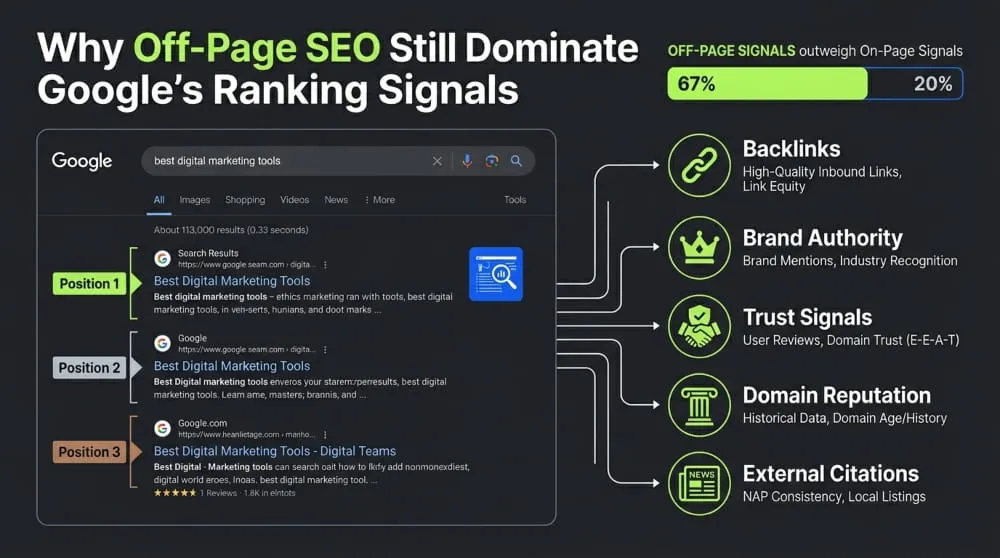
In 2026, the weight given to off-page signals has only deepened, particularly around brand authority, entity recognition, and the quality (not just quantity) of links pointing to your domain.
How Google Evaluates Off-Page Authority in 2026
Google evaluates off-page authority through a combination of link equity, brand signals, and entity associations. A backlink from a respected industry publication carries far more weight than dozens of links from low-quality directories. Beyond links, Google now factors in unlinked brand mentions, review sentiment, and even branded search volume, the frequency with which users search for your brand directly. Together, these signals paint a picture of whether your site is genuinely trusted within its niche.
The Complete List of Off-Page SEO Techniques
There’s no single off-page technique that does everything. A strong strategy layers multiple methods together, each reinforcing the others. Here’s the full picture.
Link Building Techniques (The Foundation)
Link building remains the cornerstone of off-page SEO. When a credible website links to yours, it passes authority, what SEOs call “link equity” or “link juice.” But not all links are created equal.
The most valuable links are editorially placed, meaning another site linked to you because your content genuinely deserved it. Guest posting on relevant industry blogs, creating original research others want to cite, and building relationships with journalists and bloggers are all proven methods for earning these kinds of links.
Resource page link building is another reliable approach. Many websites maintain “useful resources” or “recommended reading” pages in your niche. Getting your content listed on those pages earns you a contextual, relevant link that tends to hold its value over time.
Content Marketing & Digital PR Signals
Content marketing and digital PR are two of the most powerful off-page forces available today, and they work best together. When you publish original data, a compelling study, or a genuinely useful tool, it becomes naturally linkable. Publications, bloggers, and journalists reference it, and each reference builds your authority without any outreach required.
Digital PR takes this further by proactively pitching your expertise or data to journalists and media outlets. A single feature in a high-authority publication can generate dozens of backlinks and a spike in branded search, two powerful signals at once.
Social Signals & Brand Mentions
Social media activity doesn’t directly impact rankings the way backlinks do, but it plays an important supporting role. Content that spreads on social platforms gets seen by more people, including other content creators, bloggers, and journalists who may link to it. The relationship between social signals and SEO is indirect but real.
Brand mentions, even those without a hyperlink, are increasingly recognized by Google as authority signals. If your brand name appears frequently across reputable websites, forums, and publications in a positive context, Google interprets that as a trust signal. It’s one of the clearest signs that your brand exists as a genuine entity in your space.
Forum & Community Participation
Engaging in forums, communities, and Q&A platforms like Reddit and Quora builds both traffic and authority signals when done genuinely. The keyword is genuinely, spamming links in community spaces has long been penalized. But thoughtful, helpful contributions that occasionally reference your content where it’s truly relevant can drive referral traffic, build brand awareness, and earn organic mentions over time.
Influencer Outreach & Co-Citation
When your brand is mentioned alongside other recognized authorities in your niche, what’s known as co-citation, Google begins to associate your entity with that topic space. Collaborating with influencers, industry experts, and thought leaders to create content, appear on podcasts, or participate in roundups achieves exactly this. It’s less about a single link and more about consistently appearing in the right conversations.
Local SEO Signals (Citations, NAP, Reviews)
For businesses targeting local audiences, off-page SEO takes on an additional dimension. Local citations, mentions of your business name, address, and phone number (NAP) across directories like Google Business Profile, Yelp, and industry-specific listings, are a primary ranking factor in local search.
Customer reviews on Google, Trustpilot, and niche review platforms also contribute to local authority. Volume, recency, and sentiment all factor into how Google evaluates your business for local intent queries.
Video & Podcast Distribution as Off-Page Signals
Distributing video content on YouTube and appearing as a guest on podcasts in your industry generate off-page signals that many SEOs overlook. YouTube is the world’s second-largest search engine, and a well-optimized video that links back to your site can drive both traffic and authority. Podcast appearances, meanwhile, build brand recognition, generate mentions across show notes and episode pages, and position you as a recognized voice in your field.
Advanced & Cutting-Edge Off-Page SEO Techniques
Once you have the fundamentals in place, these advanced techniques separate average SEO from genuine topic ownership.
Entity Building & Knowledge Graph Optimization
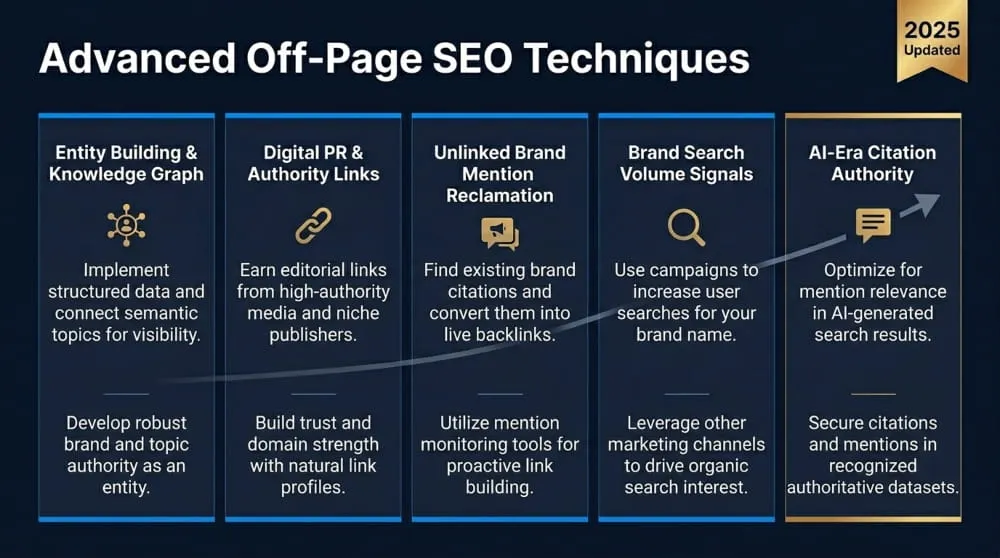
Google no longer just indexes pages; it maps entities. An entity is a real-world thing (a person, business, concept, or place) that Google can identify, verify, and associate with a topic. Building your brand as a recognized entity means ensuring your business information is consistent across the web, that you have a well-structured presence on platforms Google trusts (like Wikipedia, Wikidata, and Crunchbase), and that your content consistently associates your brand with the right topics.
When Google recognizes you as an entity, your off-page authority compounds, because links and mentions start reinforcing an existing entity rather than just pointing to an anonymous domain.
Brand Search Volume as a Ranking Signal
One of the most underrated off-page signals in 2026 is branded search volume, which is how frequently users type your brand name directly into Google. High branded search volume signals to Google that your brand has genuine recognition and demand. It’s a signal you can’t buy or build artificially; it has to be earned through real awareness campaigns, strong content, and audience trust.
Unlinked Brand Mention Reclamation
Every time your brand is mentioned online without a hyperlink, you have a missed link opportunity. Tools like Ahrefs, SEMrush, or Google Alerts can surface these unlinked mentions, allowing you to reach out to the author and request a link. It’s one of the highest-conversion link-building tactics available because the author already knows and endorses your brand; you’re simply asking them to make the mention clickable.
Digital PR & Authority-Driven Link Acquisition
At the advanced level, digital PR becomes less about individual outreach and more about building a systematic pipeline of link-worthy content. This means regularly publishing original research, surveys, data studies, and expert commentary that media outlets want to reference. The goal is to become the go-to source in your niche, the site that journalists bookmark and return to when they need a credible reference.
AI-Era Off-Page Signals: What’s Changed in 2024–2026
The rise of AI-generated content has made authentic off-page signals more valuable than ever. Google’s systems have become increasingly sophisticated at distinguishing between links earned through genuine authority and those manufactured through link schemes. Meanwhile, new signals around AI Overviews and entity prominence have emerged; sites that are consistently cited as sources in AI-generated answers tend to see their visibility compound. Being cited by AI tools is quickly becoming its own form of off-page authority.
Best Off-Page SEO Techniques That Actually Move Rankings
Not all off-page techniques deliver equal ROI. Here’s how to prioritize your effort.
Tier-1 Techniques (Highest ROI)
The techniques that consistently deliver the strongest ranking impact are editorial link building through digital PR, original research and data studies, unlinked mention reclamation, and entity-building through consistent brand presence across trusted platforms. These are harder to execute but produce authority that lasts.
Tier-2 Techniques (Supporting Signals)
Guest posting on relevant niche blogs, community participation, podcast appearances, video distribution, and review generation all play important supporting roles. They may not move the needle as dramatically on their own, but they reinforce your Tier-1 efforts and create a well-rounded off-page profile that looks natural to Google.
Techniques to Avoid in 2026
Link schemes, private blog networks (PBNs), paid link placements disclosed as editorial, and mass directory submissions are all high-risk tactics that Google has become exceptionally good at detecting. The short-term gains aren’t worth the long-term risk of a manual penalty or algorithmic devaluation. In 2026, the safest and most sustainable approach is to build authority the way it was always meant to be built, by being genuinely worth referencing.
Off-Page SEO Techniques for Beginners
If you’re just starting, the landscape can feel overwhelming. The good news is that you don’t need to execute every technique at once. A focused, consistent approach to a few core methods will produce real results.
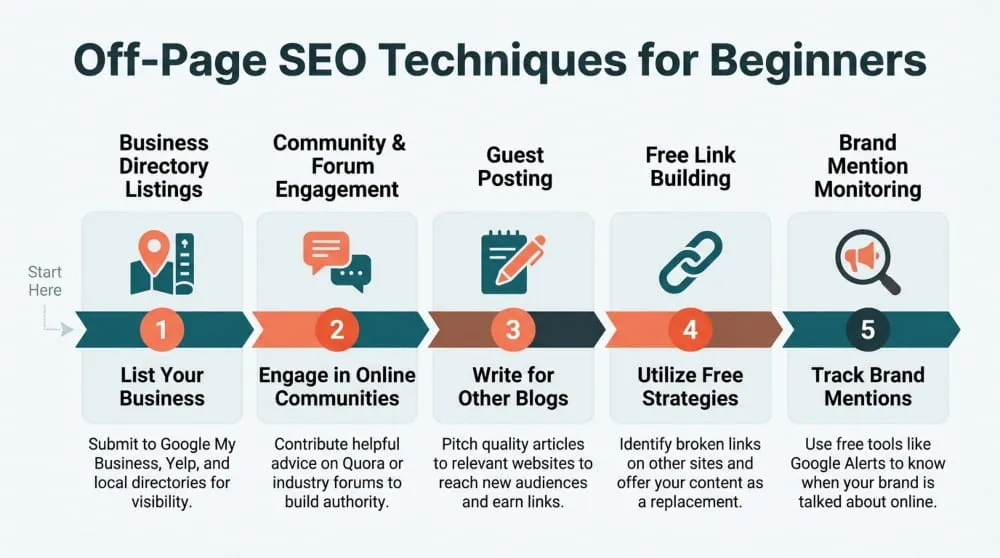
Where to Start: Your First 30 Days of Off-Page SEO
In your first month, focus on three things: making sure your business is listed accurately across key directories (Google Business Profile, Bing Places, relevant niche directories), identifying two or three relevant communities or forums where your audience spends time, and publishing at least one piece of content on your site that is genuinely worth linking to, a comprehensive guide, original insight, or useful tool.
That foundation alone puts you ahead of most new websites.
Free Off-Page SEO Techniques That Work Without a Budget
You don’t need a large budget to build off-page authority. Guest posting, community engagement, responding to journalist queries through platforms like HARO (Help a Reporter Out) or its successors, and simply producing excellent content that earns organic links are all free or near-free methods that have worked for years and continue to work today.
Common Beginner Mistakes and How to Avoid Them
The most common beginner mistake is prioritizing quantity over quality, chasing large numbers of low-value links rather than fewer, more authoritative ones. The second is impatience. Off-page SEO compounds slowly. The links you build today may not fully reflect in your rankings for weeks or months. Consistency over time is what separates sites that eventually dominate their niche from those that plateau early.
Off-Page SEO Techniques for E-commerce Websites
E-commerce SEO has its own off-page dynamics. The scale of products, categories, and the competitive landscape makes authority-building both more complex and more critical.
Why E-commerce Off-Page SEO Is Different
Most e-commerce sites compete in spaces where authority is heavily concentrated among major retailers. Breaking through requires not just links, but the right links. Links from product review blogs, industry publications, comparison sites, and niche communities carry far more weight than generic directory listings.
Product Page Link Building Strategies
Getting links directly to product or category pages is difficult but not impossible. Sending products to bloggers and reviewers, creating buying guides that organically feature your products, and earning media coverage around new product launches are all reliable ways to build deep links into your ecommerce site rather than concentrating all authority on the homepage.
Review Signals, Affiliate Mentions & Shopping Authority
Customer reviews on Google Shopping, Trustpilot, and niche review platforms don’t just build consumer trust; they build off-page SEO signals. Google uses review sentiment and volume as indicators of trust for e-commerce sites. Affiliate content is another powerful off-page driver; when affiliates and comparison sites link to your product pages with commercial intent anchor text, it sends strong relevance and authority signals directly to the pages that need them most.
On-Page vs Off-Page SEO: Building a Combined Strategy
The most effective SEO doesn’t treat on-page and off-page as separate disciplines; it treats them as two halves of the same strategy.
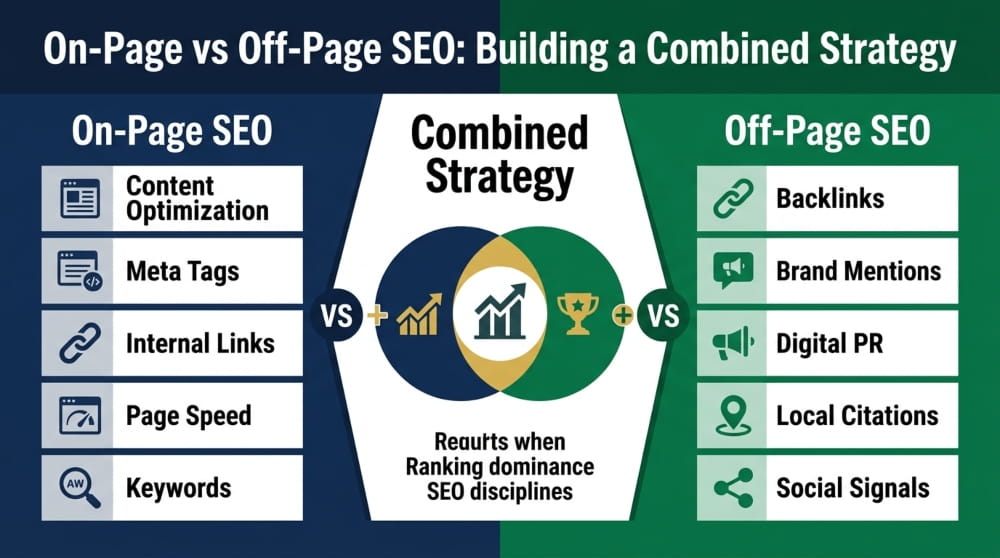
How On-Page and Off-Page SEO Work Together
A page that is perfectly optimized on-page but has no external authority will struggle to outrank a moderately optimized page with strong backlinks. Equally, a page with excellent authority but poor on-page optimization wastes the potential of every link pointing at it. The relationship is multiplicative; improvements in both areas amplify each other.
Balancing Technical SEO With Off-Page Authority Signals
Technical SEO ensures that the authority you earn off-page can actually be crawled, indexed, and credited to the right pages. Broken internal links, redirect chains, and poor site architecture can dilute link equity before it ever reaches your target pages. Before investing heavily in off-page efforts, confirm that your technical foundation is solid.
Building a Full SEO Strategy Around Both Disciplines
A practical combined approach looks like this: use on-page and technical SEO to make your site the best possible destination for your target topics, then use off-page techniques to build the authority that earns you the rankings those pages deserve. Neither works as well without the other.
Off-Page SEO Tools to Amplify Your Techniques
The right tools don’t replace strategy, but they make execution significantly faster and more informed.
Best Free Tools for Off-Page SEO Monitoring
Google Search Console is the most important free tool for understanding how your site is perceived externally. Google Alerts is invaluable for tracking brand mentions as they happen. Ahrefs Webmaster Tools (free tier) and Moz’s Link Explorer offer basic backlink data without a paid subscription.
Paid Tools Worth the Investment
For serious off-page SEO work, Ahrefs and SEMrush are the industry standards. Both offer comprehensive backlink analysis, competitor link-gap identification, mention tracking, and genuinely useful authority metrics to help you prioritize your outreach efforts.
How to Track Your Off-Page SEO Progress
The key metrics to monitor are Domain Rating or Domain Authority (depending on your tool of choice), the growth rate and quality of your backlink profile, branded search volume trends in Google Search Console, and referral traffic from off-page sources. Track these monthly rather than weekly; off-page SEO moves slowly, and short-term fluctuations are less meaningful than consistent directional progress over quarters.
Off-Page SEO Techniques: 2026 Updates & What’s Changed
The off-page SEO landscape has evolved significantly over the past several years. Understanding what’s changed, and what hasn’t, keeps your strategy current.
 What Worked in 2020–2022 That No Longer Works
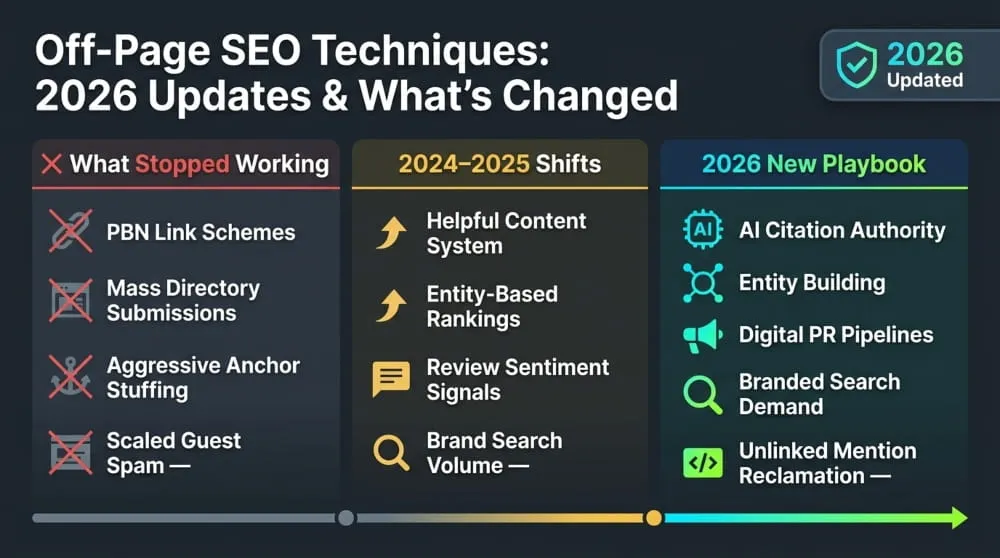 What Worked in 2020–2022 That No Longer Works
Guest posting at scale on low-quality sites, tiered link building via PBNs, and aggressive anchor-text optimization were common practices in the early 2020s. Google’s link spam updates from 2022 onward dramatically reduced the value of these tactics, and in many cases, reversed any gains they’d produced.
New Signals Google Added in 2023–2024
Google’s Helpful Content System and its evolution through 2023–2024 placed increased emphasis on site-wide authority and off-page reputation as quality indicators. The integration of entity signals into core ranking systems meant that brands with a consistent, credible off-page presence began outperforming sites that relied solely on on-page optimization. Review signals, brand search volume, and co-citation patterns all gained measurable weight during this period.
The 2026 Off-Page SEO Playbook
In 2026, the winning off-page strategy is built around three pillars: genuine authority (earned through content quality and digital PR), brand entity recognition (built through consistent presence across trusted platforms), and user demand signals (reflected in branded search volume and engagement). The tactics change year to year, but these pillars don’t.
Frequently Asked Questions
How long does off-page SEO take to show results?
Most off-page efforts begin showing measurable impact within three to six months, though this varies significantly based on your industry, starting authority, and the quality of links you’re earning. Authority compounds: the longer you build consistently, the faster the results accumulate.
How many backlinks do I need to rank?
There’s no universal number. What matters is the quality and relevance of your links relative to your competition. Ten editorial links from genuinely authoritative, niche-relevant sources will outperform a hundred links from generic directories almost every time.
Is off-page SEO still relevant in the AI search era?
More than ever. As AI-generated content floods the web, authentic off-page authority signals become the primary way Google distinguishes trustworthy sources from low-quality ones. Being cited, by humans and increasingly by AI systems, is the new benchmark for authority.
What’s the single most powerful off-page SEO technique?
If forced to choose one, it’s earning editorial backlinks from authoritative, relevant sources through genuinely valuable content. Nothing else signals credibility to Google as clearly or as durably.
Can I do off-page SEO for free?
Absolutely. Guest posting, community participation, HARO-style journalist outreach, and creating link-worthy content all require time rather than money. Budget accelerates the process, but it’s not a prerequisite for building real authority.