The best healthcare digital marketing agency pairs proven patient-acquisition results with a working knowledge of healthcare privacy and advertising rules and can get your practice found in both Google and AI-generated answers. Experience in healthcare matters more than size, awards or a polished pitch deck.
The stakes are higher than in most industries because patients start online. A Patient Pop survey of 1,221 adults found that 77% search online for doctors, either often or sometimes. If your clinic, hospital or healthtech brand isn’t visible at that moment, the patient works with someone else and they usually make the choice before anyone picks up the phone.
Choosing a partner for this work is harder than hiring for a typical digital marketing campaign. A healthcare agency must work within HIPAA in the US and GDPR and ASA rules in the UK, avoid claims regulators or patients won’t trust and measure success by booked appointments rather than clicks.
This guide explains what a healthcare digital marketing agency actually does, how to compare your options, what to expect to pay in 2026 and which warning signs to watch for before you sign a contract.
What Is a Healthcare Digital Marketing Agency?
A healthcare digital marketing agency is a marketing partner that helps medical organizations attract and retain patients online through channels such as search engine optimization, paid search, social media, email and website design, while working within the privacy and advertising rules that govern healthcare. Its output is measured in enquiries and booked appointments rather than traffic or impressions.
The role has become more important because search is where patient decisions start. In a Press Ganey survey of more than 1,000 US adults, Google was the most-used website for finding a healthcare provider, cited by 78.1% of respondents. An agency’s job is to ensure your practice appears, reads as trustworthy and converts visitors into patients at that moment.
How It Differs from a General Digital Marketing Agency
The tactics overlap, but the constraints do not. A general agency optimizes for whatever sells, whereas a healthcare agency must protect patient data, avoid misleading claims and write about health topics that search engines hold to a higher trust standard than most content. Google treats medical information as a category where mistakes can harm people, so credentials, accurate sourcing and clear authorship carry real weight in rankings.
Compliance also shapes the technical work. In the US, tracking tools, forms and retargeting must be set up so protected health information isn’t exposed, a HIPAA concern. In the UK, GDPR governs how patient data is collected and used and ASA advertising codes limit what a clinic can promise about treatments and outcomes. A general agency that treats these as an afterthought can create legal exposure for a client without ever noticing.
The sales cycle differs too. A patient choosing a surgeon or specialist weighs reviews, credentials and reassurance and often takes longer to decide than someone buying a product. Healthcare campaigns are built around that trust-building journey.
Who Needs a Healthcare Digital Marketing Agency
Any organisation that depends on patients finding and choosing it online can benefit, but the need looks different by type. Private practices and clinics usually want steady local enquiries and strong reviews. Hospitals and larger providers tend to need coordinated marketing across many departments and locations, with consistent branding and reporting. Healthtech startups must explain a new product to clinical and commercial audiences at once and mid-sized providers often reach a point where an in-house person can no longer cover SEO, paid media, content and analytics alone.
The common signal is that growth now depends on digital visibility and the team handling it lacks either the time or the specialist knowledge. If you are paying for ads without knowing which ones produce appointments or your site ranks for conditions but not for the services you actually sell, an agency usually pays for itself by fixing that gap.
What “Specializing in Healthcare” Should Actually Mean
Many agencies list healthcare as one of a dozen industries. Real specialization shows up in specifics: case studies from comparable providers, named experience with your market’s regulations and a process for medical review before content goes live. You should be able to ask how the agency handles patient data in tracking and forms and get a clear, confident answer, not a general reassurance.
It also means understanding how patients behave, from searching symptoms to comparing providers and reading reviews and being able to report on outcomes such as calls, bookings and cost per new patient. An agency that can only show rankings and traffic is offering general marketing with a healthcare label. Specialist knowledge, proven results and a compliance-first approach are what separate the two.
Services a Healthcare Digital Marketing Agency Should Offer
A capable healthcare digital marketing agency should cover the full patient journey, from the first search to the booked appointment and follow-up. That means search visibility, paid campaigns, a high-converting website, trustworthy content, reputation management, visibility in AI-generated answers and patient communication, all handled with healthcare compliance in mind. An agency that offers only one or two of these can still help, but you should know which gaps you will need to fill yourself.

Healthcare SEO and Local SEO
Healthcare SEO makes your practice visible when patients search for a condition, treatment or provider and it matters most because those searches carry real intent. The work covers keyword research built around how patients actually phrase their needs, service pages for each treatment and technical fixes that help search engines understand your site.
For clinics and practices that serve a defined area, local SEO is usually where the fastest gains appear. It starts with a complete, accurate Google Business Profile, consistent name, address and phone details across directories and location pages that reflect how people search (“dentist near me,” “physiotherapy in Guildford”). The agency should also track calls, direction requests and bookings from your listing, not just rankings.
PPC and Paid Social for Patient Acquisition
Paid search puts your practice in front of patients who are ready to book, while paid social reaches people earlier in their decision. Professional PPC services for healthcare should include tightly themed campaigns by service and location, call and form tracking tied to real appointments and landing pages written for the specific treatment being advertised.
Healthcare advertising carries extra restrictions. Platforms limit how health-related audiences can be targeted and regulators in both the US and UK restrict claims about outcomes. A good agency designs campaigns around those limits from the start and reports on cost per new patient rather than cost per click.
Website Design and Development for Medical Practices
Your website is where every other channel sends its visitors, so it needs to convert them. Effective website design and development for a medical practice means fast loading on mobile, clear service pages, visible credentials, simple online booking or enquiry forms and accessibility features for patients with different needs.
Privacy has to be built in. Forms, scheduling tools and analytics scripts should be configured so patient information is handled lawfully and cookie consent should be set up properly for UK and EU visitors. A site that looks good but leaks data or fails on mobile will cost you more than it earns.
Content Marketing and E-E-A-T for YMYL Topics
Health content falls under what Google calls “Your Money or Your Life” topics, where inaccurate advice can cause harm, so Google requires higher standards for experience, expertise, authoritativeness and trust (E-E-A-T). Content marketing for healthcare should therefore be written or reviewed by qualified clinicians, name its authors, cite reputable sources and show when it was last checked.
Publishing is only part of the job. Medical guidance changes, so a good agency also schedules regular content updates to keep treatment pages and articles accurate. Outdated information damages both patient trust and search performance.
Reputation Management and Reviews
Reputation management covers how you collect, monitor and respond to patient reviews across Google, directories and social platforms. It matters because reviews shape the final decision: in a Patient Pop survey, 93% of respondents said online reviews were at least somewhat important when choosing a provider.
The agency should establish a compliant process for requesting feedback, respond to reviews without disclosing patient details and flag recurring complaints so you can address the root cause. Professional replies to criticism often reassure prospective patients as much as the positive reviews do.
AI Search Optimization (AEO/GEO) for Healthcare Brands
Patients increasingly ask AI assistants and AI-generated search summaries for recommendations, so healthcare brands now need to be understood and cited by those systems as well. AI optimization focuses on structuring your content so it gives clear, extractable answers, strengthening signals of expertise and consistency across the web and using schema markup to describe your practice, services and clinicians.
Because AI systems are cautious with medical topics, they favor credible, verifiable sources. An agency offering this service should be able to explain how it tracks your brand’s presence in AI answers and which pages are being cited.
Email, CRM and Patient Journey Automation
Many patients enquire, then go quiet. Email and CRM automation closes that gap with appointment reminders, post-visit follow-ups, recall campaigns and educational sequences matched to a patient’s stage. Well-planned email marketing services keep patients engaged between visits and help reactivate those who haven’t returned.
Deliverability and security also deserve attention. Reliable email hosting protects your sending reputation and keeps patient communications on secure infrastructure and any CRM that stores patient details should be set up with the right consent and data-handling controls. Marketing messages should never include sensitive clinical information.
Compliance HIPAA, GDPR and Advertising Rules
A healthcare digital marketing agency must work within patient-privacy laws and advertising regulations in every market it serves. In the US that means HIPAA and FTC rules and in the UK it means UK GDPR, the ASA’s CAP Code and the standards of professional regulators such as the GMC and CQC. Compliance errors rarely show up as a marketing problem. They surface later as complaints, investigations or lawsuits, which is why this should be checked before you hire anyone.
US HIPAA, FTC, Tracking Pixels and Patient Data
HIPAA applies when a covered entity, such as a provider or health plan or its business associate handles protected health information (PHI). For marketing, the sharpest risk is third-party tracking, such as the Meta Pixel or Google Analytics, which can pass visitor data to advertising platforms. In 2022 HHS’s Office for Civil Rights issued a bulletin warning that these tools could breach HIPAA and the guidance sparked a wave of class-action suits and settlements.
The legal position has since shifted, but not disappeared. A Texas federal court vacated the part of the guidance that treated an IP address combined with a visit to a public health-related page as PHI, ruling on June 20, 2024. HHS later dropped its appeal. The remaining guidance still stands, including the need for business associate agreements with vendors that collect PHI and for compliance with the HIPAA Security Rule. Law firms continue to advise clear notice of tracking tools, minimal or no tracking on logged-in pages and regular audits of what data is collected. Those same advisers note that “wiretap” lawsuits over these technologies are unlikely to stop.
The FTC is a separate layer. It polices deceptive or unfair data practices under the FTC Act and enforces the Health Breach Notification Rule for health apps and similar services that fall outside HIPAA. Marketing teams should assume that sharing sensitive health data with advertisers without clear consent can draw FTC scrutiny even when HIPAA does not apply.
UK GDPR, ASA/CAP Code, GMC and CQC Advertising Guidance
In the UK, health information is special category data under UK GDPR and the Data Protection Act 2018, so processing requires a lawful basis and an additional condition and marketing usually relies on explicit consent. Cookies, pixels and email marketing also fall under the Privacy and Electronic Communications Regulations (PECR), which require consent for non-essential tracking and for most marketing emails. The ICO enforces both regimes.
Advertising is governed by a separate set of rules. The ASA enforces the CAP Code, which applies to websites, social media and email and healthcare advertising faces particular scrutiny. Claims about treatments and outcomes must be substantiated and rules on prescription-only medicines are especially strict. CAP prohibits advertising prescription-only medicines to the public and it reads before-and-after photos as efficacy claims for the medicine.
Professional regulators add their own requirements. The GMC expects doctors to ensure that information about their services is honest, accurate and not misleading and responsibility stays with the doctor even when an agency or clinic runs the advertising.
The GMC does not ban testimonials outright, but they must not imply results that are not typical and the CQC expects marketing to reflect the real quality of care delivered. Similar standards apply to dentists (GDC) and nurses (NMC). Because a clinic remains accountable for what is published in its name, an agency’s ability to work within these rules directly protects you.
Questions to Ask Any Agency About Patient Privacy
The quickest way to test an agency’s compliance knowledge is to ask specific questions and listen for specific answers. Vague reassurance is a warning sign.
- Which tracking tools do you use on healthcare sites and how do you configure them to avoid sending patient data to advertising platforms?
- Will you sign a business associate agreement (US) or a data processing agreement (UK) before accessing any patient data?
- How do you handle consent for cookies, forms and email marketing under UK GDPR and PECR?
- Who reviews ad copy, landing pages and testimonials against the CAP Code and relevant professional guidance before they go live?
- How do you keep patient information out of reviews, replies, case studies and ad audiences?
- Can you show a past audit or incident-response process and who on your team is responsible for compliance?
An experienced agency will answer these without hesitation. If it cannot, treat that as a sign it has not worked in regulated healthcare before.
How to Choose the Best Healthcare Digital Marketing Agency
The best healthcare digital marketing agency for you is the one that can show results for providers like yours, handles patient data and advertising rules with confidence and reports on appointments rather than vanity metrics. Size and price matter less than fit. A clinic with one location and a hospital group with twenty need different strengths, so start by deciding what you want the agency to achieve, then test every candidate against that goal.
10-Point Evaluation Checklist
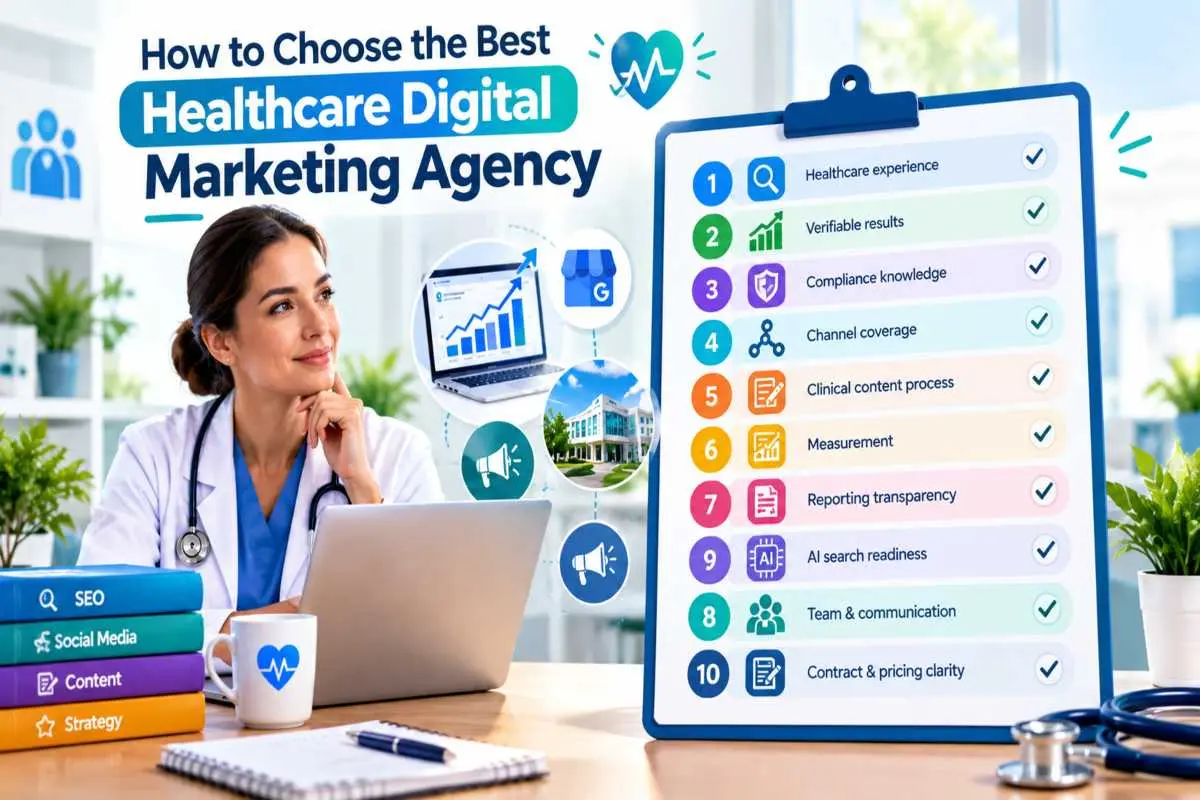
A structured checklist keeps the decision objective and makes agencies easier to compare side by side. Score each one from 1 to 5 against the following points.
- Healthcare experience. Look for clients of a similar type and size, in your market (US, UK or both).
- Verifiable results. Ask for case studies showing booked appointments, new patients or cost per acquisition and ask whether you can speak to a past client.
- Compliance knowledge. The agency should be able to explain how it handles HIPAA, UK GDPR, PECR and the CAP Code without hesitation.
- Channel coverage. Check that SEO, local SEO, paid media, content and your website are either handled in-house or coordinated properly with partners.
- Clinical content process. There should be a clear step for medical review and named authorship on health content.
- Measurement. Track calls, forms and bookings back to the channel that produced them.
- Reporting transparency. You should get plain-language reports and full access to your own analytics, ad accounts and Google Business Profile.
- AI search readiness. The agency should have a plan for visibility in AI-generated answers as well as traditional search.
- Team and communication. Know who will work on your account, how often you will speak and how quickly they respond.
- Contract and pricing clarity. Look for defined deliverables, reasonable notice periods and no lock-in on assets you should own.
An agency that scores well across all ten is rare. Weight the points that matter most to you, usually compliance, results and measurement and treat a low score on any of those three as a reason to walk away.
Red Flags Guaranteed Rankings, No Healthcare Case Studies and Vague Reporting
The clearest warning sign is a guaranteed ranking. Google itself has long advised site owners that no one can guarantee a number-one position, because rankings depend on factors outside any agency’s control. An agency that promises first-page results in a fixed number of weeks is either overselling or using tactics that risk a penalty.
A lack of healthcare case studies is the second red flag. Many agencies list healthcare among their industries without having delivered meaningful results for a provider. If every example comes from retail or software, you would be paying for their learning curve while handling sensitive patient information.
Vague reporting is the third. Reports that lead with impressions, traffic and keyword counts, but never mention appointments, enquiries or cost per patient, make it impossible to judge whether the spend is working. Other warning signs include refusing to sign a data processing or business associate agreement, owning your ad accounts or website on your behalf, pressure to sign a long contract before an audit and an unwillingness to explain which tools track your patients and where that data goes.
In House vs Agency vs Hybrid
An in-house team gives you deep knowledge of your own practice, fast turnaround and tight control, but it is limited by the skills of the people you can afford to hire. One marketing manager rarely has expertise across technical SEO, paid media, content, design and analytics and replacing them means losing everything they know.
An agency gives you a broader range of specialists for a predictable monthly cost, plus experience from other healthcare clients. The trade-off is less day-to-day familiarity with your clinical services and a dependence on how well you brief and manage the relationship.
A hybrid model is often the most practical for mid-sized providers. An internal marketing lead owns brand, patient experience and clinical sign-off, while an agency delivers specialist work such as SEO, paid campaigns, web development and reporting. Single-location practices with limited budgets usually do best with an agency alone, while large health systems tend to need an internal team supported by an agency.
Specialist vs Full Service vs Integrated Agencies
The three types of agency suit different needs and the label matters less than whether the team can prove it has done similar work.
| Specialist agency | Full-service agency | Integrated agency |
| One channel or niche, such as healthcare SEO or paid media | Wide range of digital services under one roof | Digital plus brand, PR and creative, run as one strategy |
| Providers that need expert help in one area | Clinics and mid-sized providers wanting one partner for most channels | Hospitals, large groups and brands with a broad marketing function |
| Deep expertise, often strong results in its niche | Simpler management, shared reporting, coordinated campaigns | Consistent messaging across every touchpoint |
| Gaps in other channels, so you may need several suppliers | Spread too thin, with uneven quality across services | Higher cost and slower decision-making |
| Lower to mid | Mid | Mid to high |
Choose a specialist when you already know your biggest gap, a full-service agency when you want one accountable partner and an integrated agency when brand and reputation are as important as lead generation. Whichever you pick, ask for healthcare-specific proof and confirm who will actually handle your account.
Healthcare Digital Marketing Agency Pricing in 2026
Healthcare digital marketing agency pricing in 2026 typically runs from about $500 to $5,000 a month (roughly £500 to £2,000) for a small practice, rising to $10,000 or more (£5,000+) for multi-location groups and hospitals. Where you land depends on how many channels you need, how competitive your market is and how senior the team working on your account will be. Ad spend is almost always billed on top of the agency’s fee.
Retainer vs Project vs Performance Models
A monthly retainer is the most common structure and it gives you a fixed fee for a defined scope such as SEO, content, reporting and campaign management. It suits ongoing work where results build over time. For multi-location groups, one pricing guide reports that strategic retainers typically start around $10,000 a month, scaling with the number of locations, competition and level of senior involvement.
Project pricing is a one-off fee for a defined deliverable, such as a website rebuild, a rebrand or a service-line launch. Fees for these at the mid and upper tiers commonly land between the mid-five and six figures and they are usually added on top of a retainer rather than replacing it. Projects suit work with a clear start and finish and they make budgeting easy, but they don’t cover the ongoing optimisation that most channels need.
Performance-based pricing, where fees depend on leads or revenue, is far less common in healthcare than in other sectors. One guide calls it rare at the mid and enterprise levels because of long decision cycles, regulatory constraints and attribution complexity and notes it can be risky and often illegal. Where it does appear, it usually pairs a smaller base retainer, around $3,000 to $10,000 a month, with bonuses tied to targets such as cost per lead. Check with your legal adviser before agreeing to any fee tied to patient referrals, because healthcare has specific rules on payment for patient referrals that other industries don’t face.
Typical Monthly Ranges by Practice Size
The table below summarises indicative ranges for agency fees, excluding ad spend and VAT or sales tax. These are guide figures drawn from published 2026 pricing guides rather than quotes and healthcare-specific data is thinner in the UK than in the US, so treat them as a starting point for comparing proposals.
| Practice size | US (per month) | UK (per month) | Typical scope |
| Solo or small practice (1–2 locations) | 500–5,000 | £500–£2,000 | Local SEO, website upkeep, review management, basic content or a single paid channel |
| Growing practice or small group (2–5 locations) | 5,000–10,000 | £2,000–£5,000 | SEO and content, managed PPC, reporting, conversion tracking |
| Multi-location group, hospital or health system | $10,000+ (high five figures at enterprise level) | £5,000+ | Strategy leadership, multi-channel campaigns, reputation, analytics, specialist projects |
For the smallest practices, the same US source puts total vendor spend roughly between $500 and $5,000 a month. In the UK, a recent pricing guide reports that most businesses pay £500 to £2,000 a month for SEO. Another puts typical single-channel retainers, such as SEO or PPC, at £1,250 to £3,500 a month. A UK guide to private healthcare SEO lists enterprise-level retainers, for large private hospitals and multi-location practices, from £5,000 a month.
What Affects Cost and What is a Reasonable ROI Timeline
Several factors move the price. Scope is the biggest, since one channel costs far less than an integrated programme. Competition matters too, because ranking for “dentist” or “cosmetic surgery” in a major city takes more effort than in a smaller town. Location of the agency, team seniority and contract length play a part and regulated industries such as healthcare cost more because the agency needs compliance knowledge. Committing to a 12-month term can also be 10 to 15% cheaper per month than a rolling agreement. Watch for costs outside the retainer, including ad spend, management fees on that spend, content production, tools, call tracking and one-off development work.
Return on investment depends on the channel. Paid search can generate enquiries within weeks of launch, although it takes a few months of optimisation to bring the cost per patient down. SEO is slower. UK agencies commonly ask for a six to twelve month initial commitment because meaningful results take time to materialise. A reasonable expectation is early movement in rankings and local visibility within the first three to six months, with compounding returns in the second half of the year and beyond.
The most useful test of value is cost per new patient measured against what a new patient is worth over time. If a new patient brings in $1,500 across their treatment, a campaign that generates ten extra patients a month for a $7,000 total spend is clearly working, whatever the headline fee looks like. Ask any agency you are considering to model that calculation for your practice before you sign.
Best Agencies by Healthcare Type
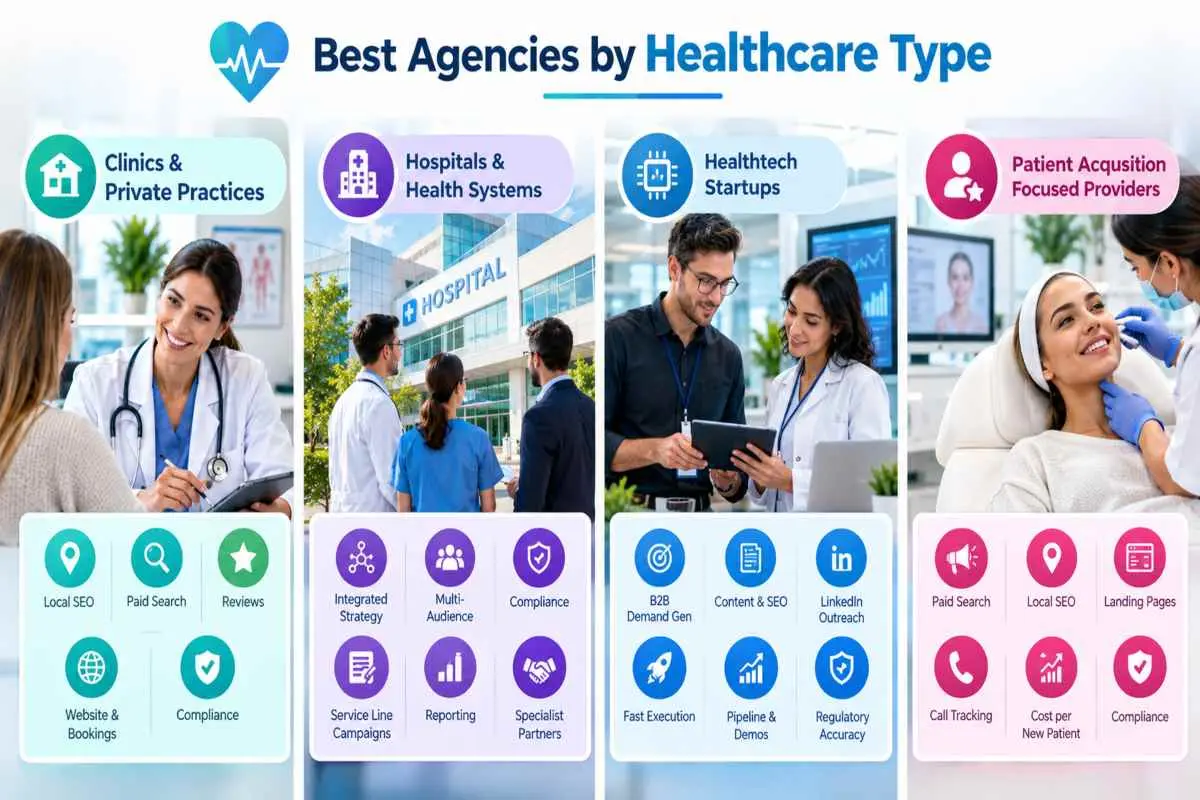
The best type of agency depends on what kind of healthcare organisation you run. Clinics and private practices usually do best with a local-focused specialist or full-service partner, hospitals and health systems with a lead integrated agency supported by specialists and healthtech companies with an agency that understands both clinical credibility and B2B sales cycles. The sections below explain why each pairing works and what to look for.
Clinics and Private Practices
Clinics and private practices need patients from a defined local area, so the best-fit agency is one that is strong in local search, paid search, reviews and website conversion. A full-service agency or a healthcare-focused local specialist usually works best, because a single team can coordinate your Google Business Profile, service pages, ads and reputation without you managing several suppliers.
Search is where these patients start. In Patient Pop’s survey, 58% of patients began their search for a provider on Google. That makes local visibility and a fast, easy booking journey the priorities. Look for an agency that can show results for practices of a similar size and specialty, builds online booking and call tracking into your site and knows the advertising rules for your profession, such as GMC and CAP Code requirements in the UK or HIPAA-safe tracking in the US. If you only have one or two locations, avoid agencies that need a large retainer to justify a senior team, since you will pay for capacity you won’t use.
Hospitals and Health Systems
Hospitals and health systems encounter a different challenge. They market many service lines, locations and audiences at once, including patients, referring physicians, employers and the local community. The best-fit model is usually an integrated agency or a lead agency of record, that owns brand and overall strategy, supported by specialist partners for areas such as SEO, paid media, web development and physician outreach. Large health systems frequently work with several agencies at once, including a lead strategic agency and specialist digital firms.
For this type of organisation, governance matters as much as creative ability. Look for an agency that can work with committees, clinical reviewers and legal teams, report across departments and keep messaging consistent across dozens of pages and campaigns. Compliance experience is non-negotiable, as is the ability to run service-line campaigns, such as cardiology or orthopaedics, without your brand message splintering. A small specialist agency can be an excellent partner for one service line, but it is rarely enough to carry the whole system alone.
Startups and Mid-Sized Healthtech Companies
Healthtech companies sell to a mix of clinicians, administrators, procurement teams and sometimes patients, with longer decision cycles than a clinic’s. The best-fit agency understands B2B demand generation as well as healthcare credibility and can handle content, SEO, paid campaigns and LinkedIn outreach aimed at people who need evidence before they buy. A specialist or full-service agency with software and healthcare experience tends to suit startups, since it can move quickly on a limited budget.
As a company grows into the mid-sized range, a hybrid approach often works better, with an internal marketing lead who owns product messaging and sales alignment and an agency that supplies specialist execution. Look for case studies that show pipeline or qualified demos rather than traffic alone, plus experience explaining clinical or regulatory claims accurately. Messaging in this sector is scrutinised closely, so an agency that overstates what your product does can damage trust with the very buyers you are trying to win.
Patient Acquisition-Focused Providers
Providers whose growth depends on winning new patients, such as cosmetic and cash-pay clinics, dental and orthodontic groups, fertility centres and elective surgery practices, are best served by a performance-minded full-service agency. The agency should treat paid search, local SEO, landing pages and call handling as one connected funnel and report on cost per new patient rather than clicks or rankings.
These providers rely on conversion speed as much as visibility. In the 2021 Kyruus Patient Access Journey survey, 40% of respondents said they preferred to book appointments online, up 15% from the year before. A prospective patient who finds a clinic but cannot book easily will move on to the next result, so the agency needs to own the whole path from ad or search listing to confirmed appointment, including landing page design, online scheduling, form and call tracking and follow-up.
Look for an agency that can show how it connects marketing spend to booked patients, with call recording or lead-source tracking tied to your practice management system where privacy rules allow. It should be comfortable with high-intent paid search, remarketing within the platforms healthcare restrictions and regular testing of landing pages and offers. Ask how it handles lead quality as well as lead volume and how quickly it recommends cutting spend on campaigns that fill the calendar with the wrong enquiries.
Compliance matters even more here, because acquisition-led marketing tends to push claims harder. Before-and-after imagery, treatment promises, limited-time offers and testimonials are all areas where UK clinics can fall foul of the CAP Code and professional guidance and where US providers must keep tracking tools from sending patient data to ad platforms. The best agencies for this type of provider build those checks into campaign approval rather than fixing problems after an ad is flagged.
Be cautious of pricing models that promise a fixed number of patients or tie fees to referrals, since regulations on payment for patient referrals vary and can make these arrangements risky. A retainer plus transparent ad spend, with clear targets for cost per acquisition, is usually the safer structure.
What the Best Healthcare Marketing Agencies Have in Common (2026 Rankings Criteria)
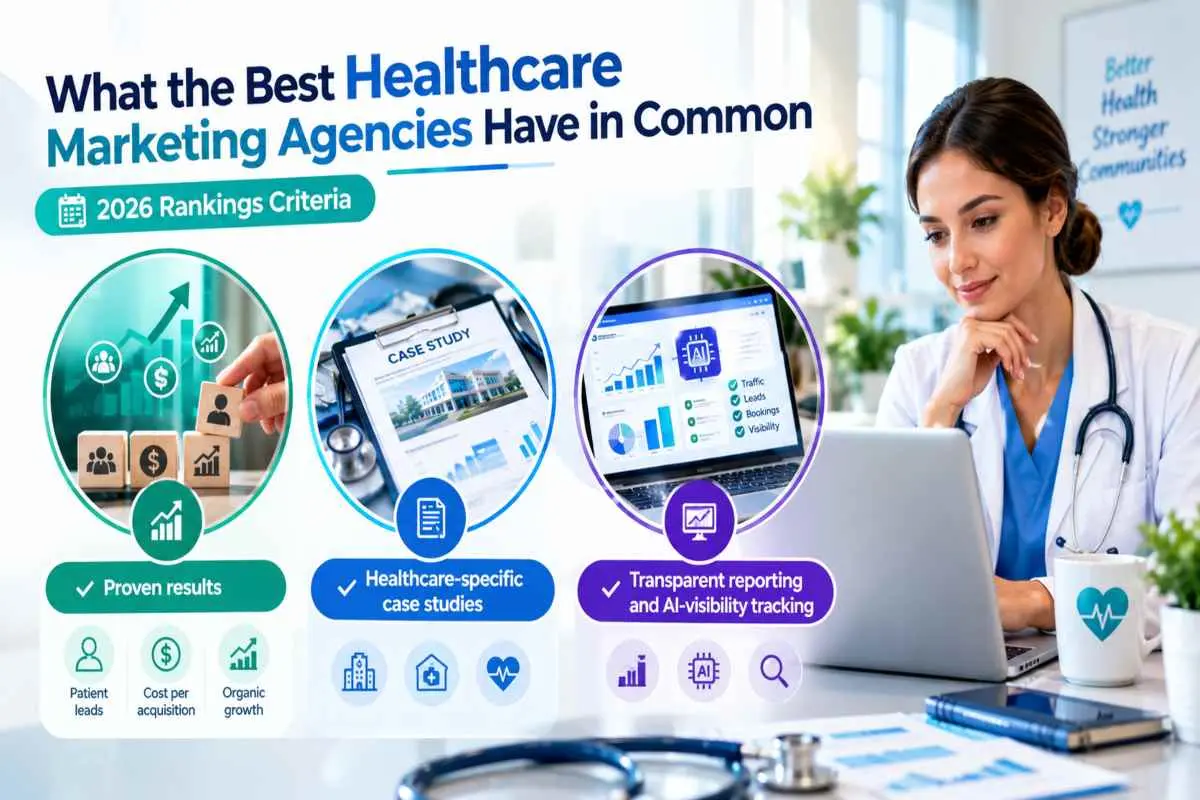
The best healthcare marketing agencies share four traits, they can prove results in patient terms, they have case studies from healthcare rather than other industries, they report openly on what is working and they track visibility in AI search as well as Google. These criteria are what we would use to rank any agency, including ourselves, because each one can be checked before you sign a contract.
Proven Results Patient Leads, Cost per Acquisition and Organic Growth
Results in healthcare should be measured in patients, not impressions. The numbers worth asking for are new patient enquiries, booked appointments, cost per acquisition and organic growth in the searches that matter to your services, such as branded and non-branded visibility, local map pack rankings and clicks on treatment pages.
This matters because the patient journey starts in search. In a Press Ganey survey of more than 1,000 US adults, 51.1% turned to the web when choosing a new primary care provider. If an agency’s reporting stops at traffic and rankings, it cannot show whether that visibility is turning into patients. Ask for before-and-after figures over a defined period, the baseline they started from and how they separate the effect of their work from seasonality or changes in your own business. An agency that is honest about what is attributable to its work is more trustworthy than one that claims every improvement.
Healthcare Specific Case Studies
A strong case study names the type of provider, the problem, the work done and the outcome, with figures. The best ones come from healthcare organisations similar to yours in size, specialty and market, because a result for a national retailer says little about how an agency handles a regulated, trust-driven decision such as choosing a surgeon or dentist.
Look for evidence that the agency understands the constraints as well as the results: how it handled patient data in tracking, how clinical content was reviewed and how claims were kept within advertising rules. If the examples are anonymised for confidentiality, ask whether you can speak to a past client or see a sample report. An agency that has genuinely worked in healthcare can usually describe the compliance decisions it made along the way and those details are the difference between real experience and a logo on a slide.
Transparent Reporting and AI-Visibility Tracking
Transparent reporting means you can see the same numbers the agency sees. You should have access to your own analytics, ad accounts and Google Business Profile, receive regular reports in plain language and be able to trace enquiries back to the channels that produced them. Monthly reports should explain what changed, why and what happens next, rather than listing metrics without interpretation.
In 2026 that also means tracking how your brand appears in AI-generated answers. Patients increasingly use AI assistants and AI search summaries to compare providers and a practice that ranks well in classic search can still be missing from those answers. Good agencies monitor which questions mention your brand, which pages are cited and how you compare with competitors. If you want to understand the approach, our guide on how to track brand visibility in AI mode explains what to measure and why. Ask any agency you are considering how it measures AI visibility today, because those that have no method yet will be learning on your budget.
Where IT Leadz Fits Services, Markets (US, UK) and Approach
IT Leadz Digital Solutions is a digital agency that works across SEO, AI optimization, link building, social media and search marketing, web design and development, website maintenance and hosting and domain services. That range matters for healthcare providers, because patient acquisition depends on several parts working together, a fast, compliant website, content that earns trust, strong local and organic visibility and a presence in AI-generated answers.
We serve clients in the United States, with a base in California and in the United Kingdom, with a base in Surrey. Working in both markets means we are used to the different privacy and advertising frameworks that apply on each side of the Atlantic, from HIPAA-conscious tracking in the US to UK GDPR, PECR and CAP Code requirements in the UK.
Our approach begins with an audit of your current visibility, website performance and tracking, then builds a plan around the services patients actually search for. We prioritise measurable outcomes such as enquiries, bookings and cost per patient, report in plain language and keep you in control of your own accounts and data. If you are comparing agencies, we would encourage you to test us against the same ten-point checklist in this guide and to ask for a free audit so you can judge our work before committing.
How to Work With an Agency The First 90 Days
The first 90 days with a healthcare digital marketing agency should move through three stages: an audit and tracking setup in the first month, a launch and content push in the second and optimization against clear KPIs in the third. Expect foundations rather than final results in this window. UK agencies commonly ask for a six to twelve month initial commitment because meaningful SEO results take that long to appear, so the early months are about building a base that makes later growth faster and cheaper.
Audit, Strategy and Tracking Setup (Days 1-30)
The first month is for understanding where you stand before spending serious money. A good agency audits your website’s technical health and speed, your search visibility for the treatments you want to be known for, your Google Business Profile and directory listings, your reviews and your competitors’ presence. In healthcare it should also audit privacy and compliance, covering which tracking tools are installed, what data they send, how forms and booking tools handle patient information and whether your cookie consent and advertising claims meet the rules in your market.
Tracking setup is the most important task of this stage, because every later decision depends on it. Calls, form submissions and online bookings should be tied back to the channel that produced them, with call tracking and analytics configured so they do not expose protected patient data. You should leave this month with a written strategy that names priority services and locations, a keyword and content plan, agreed targets and a clear picture of what you will be sent each month. Make sure you hold admin access to your analytics, ad accounts and listings from day one.
Launch, Content and Campaign Optimization (Days 31-60)
The second month is when work becomes visible. Technical fixes go live, priority service and location pages are published or rewritten and your Google Business Profile is completed and kept active. If paid search is part of the plan, campaigns launch with tightly themed ad groups and landing pages matched to each treatment. Content aimed at patient questions starts to go out, written or reviewed by qualified clinicians, with named authors and sources so it meets the higher trust standards for health topics.
Expect an approval workflow at this stage. Clinical, legal and brand sign-off will slow things down at first, but a smooth process is a sign the agency understands regulated work. Early campaign data will be thin, so a sensible agency avoids big conclusions and focuses on getting the conversion path right, including mobile page speed, a visible booking option and a quick response to enquiries. The speed at which your team answers calls and forms often decides whether new leads turn into patients, so agree on response times together.
KPIs Appointments Booked, Cost per Lead, Rankings and AI Citations (Days 61-90)
By the third month there is enough data to start judging performance and tuning the plan. Agree on a short list of KPIs and review them together in a monthly meeting. The most important is appointments booked, followed by cost per lead and cost per new patient, which show whether spend is efficient. Rankings and organic traffic for priority services and locations are leading indicators, as are map pack visibility, review volume and rating and the share of enquiries from each channel.
Visibility in AI-generated answers belongs on the same dashboard. Patients increasingly ask AI assistants and AI search summaries for recommendations, so ask your agency to report on whether your brand is mentioned or cited for your main services and how that compares with competitors. Early gains in this area are usually modest, so look for a clear baseline and a direction of travel rather than dramatic change.
On day 90, you should expect a review that covers what worked, what did not, what the agency will change next and how the next quarter’s budget will be used. Early results can vary widely by channel and market, so judge the agency on the quality of its tracking, communication and decisions as much as on the first numbers. If it cannot show you where each lead came from or explain its next move, that is a stronger warning sign than slow rankings.
Get a Free Healthcare Marketing Audit
The best way to choose a healthcare digital marketing agency is to see how it thinks about your practice before you commit. A free healthcare marketing audit from IT Leadz shows where your website, local visibility, tracking and AI search presence stand today, which gaps are costing you patient enquiries and what we would fix first. There is no obligation and you keep the findings whether or not you decide to work with us.
The audit covers the same areas this guide has walked through. We look at how your site performs and converts on mobile, how visible you are for the treatments and locations that matter to you, how your reviews and listings compare with nearby competitors and whether your tracking and cookie setup respect the privacy rules in your market, whether that is HIPAA-conscious practice in the US or UK GDPR, PECR and CAP Code requirements in the UK. We also check whether your brand appears when patients ask AI assistants and AI search tools for recommendations. You receive a plain-language summary with priorities, not a pile of technical reports.
Frequently Asked Questions (FAQs)
What does a healthcare digital marketing agency do?
A healthcare digital marketing agency helps medical providers attract and retain patients online through SEO, paid search, website design, content, reputation management and email. It also handles patient privacy and advertising rules and reports on appointments booked rather than traffic alone.
How much does a healthcare marketing agency cost?
Small practices typically pay about $500 to $5,000 a month (roughly £500 to £2,000 in the UK), while multi-location groups and hospitals often pay $10,000 or more (£5,000+). Ad spend is usually billed separately and scope and competition drive the final price.
Is it worth hiring a specialist agency over a general one?
Usually yes, because healthcare marketing carries privacy, advertising and clinical-accuracy requirements that general agencies often overlook. With 93% of patients in one survey saying online reviews matter at least somewhat when choosing a provider, an agency that understands patient trust and reputation can protect both your results and your compliance.
How do agencies stay HIPAA/GDPR compliant?
They configure tracking tools, forms and ad audiences so patient data is not shared without a lawful basis, sign business associate agreements (US) or data processing agreements (UK) and use proper cookie consent. Good agencies also review ad copy and testimonials against advertising rules before launch.
How long until healthcare SEO shows results?
Most practices see early movement in local visibility within three to six months, with stronger gains in the second half of the year. UK agencies commonly ask for a six to twelve month initial commitment because meaningful SEO results take that long to appear.
How do I know which agency is the best for my practice?
Choose the one that can show healthcare case studies similar to yours, explain its compliance process clearly and report on booked appointments and cost per patient. Score each shortlisted agency against the ten-point checklist in this guide and ask for a free audit before you commit.