An ecommerce digital marketing agency grows an online store’s revenue by running SEO, paid media, conversion optimization and email as one connected system, instead of as separate campaigns. As an ecommerce digital marketing agency , we measure success by profit, meaning return on ad spend, customer acquisition cost and lifetime value, not by clicks or impressions.
Specialization matters because online stores lose sales at every stage of the funnel, not only at the top. Baymard Institute’s research puts the average cart abandonment rate at around 70%, so more traffic alone rarely fixes a revenue problem. Brands grow faster when the same team that brings shoppers in also improves the product pages, checkout and follow up that turn them into buyers and repeat customers. That is the idea behind our approach to digital marketing for online brands, every channel is planned against one revenue target and every report ties back to it.
What Is an Ecommerce Digital Marketing Agency?
An ecommerce digital marketing agency is a specialist firm that plans and runs the marketing an online store needs to attract shoppers, convert them into buyers and bring them back to buy again. Unlike a generic marketing vendor, it works from store level numbers such as conversion rate, average order value, margin and customer lifetime value and it builds every campaign around them.
How an ecommerce digital marketing agency differs from a general agency
The difference is the metric each one is built to move. A general agency typically reports on reach, traffic and leads, which suit service businesses and brand awareness campaigns. An ecommerce digital marketing agency reports on revenue and profit, because an online store lives or dies on what happens after the click: whether the product page persuades, whether the checkout holds and whether the customer returns.
That focus shapes the work itself. Ecommerce specialists manage product feeds for Google Shopping, optimize category and product pages for search, test checkout flows and connect ad spend to repeat-purchase behavior. They also know the platforms, from Shopify and WooCommerce to custom builds, so technical fixes do not wait on a separate developer. A general agency can do pieces of this, but it rarely connects them into one plan tied to store economics.
What a digital marketing agency for ecommerce business actually delivers
A digital marketing agency for an ecommerce business delivers a coordinated growth program, not a bundle of unrelated services. In practice that means search engine optimization for category and product pages, paid media across search, shopping and social, conversion rate optimization and email and SMS retention, all managed against shared targets such as return on ad spend and customer acquisition cost.
The value is in how those pieces interact. Paid campaigns bring in fast traffic while organic rankings build, email recovers abandoned carts and conversion testing makes every visitor more valuable, which in turn lets the brand bid more confidently for new customers. Good agencies back this with clear reporting, so owners see what was spent, what it returned and what changes next. This integrated approach is also why many brands choose digital marketing partners that cover the full funnel rather than a single channel.
Who needs an ecommerce digital marketing agency
Three kinds of brands benefit most: stores that have stalled, stores that are scaling faster than their team and new stores that want to avoid expensive early mistakes. Stalled brands often have decent traffic but weak conversion or rising ad costs with flat revenue. Scaling brands need channel expertise and testing capacity that a small in-house team cannot cover and the usual signal is when the founder is still managing ads personally.
Early-stage companies gain from structure. A new store has limited budget and no historical data, so a clear channel plan prevents wasted spend. Founders weighing this stage can read more on digital marketing for startups, where priorities differ from those of an established brand. Whatever the stage, the test is simple: if marketing performance is now limiting growth and the team cannot fix it alone, a specialist agency is worth considering.
Our Ecommerce Digital Marketing Services
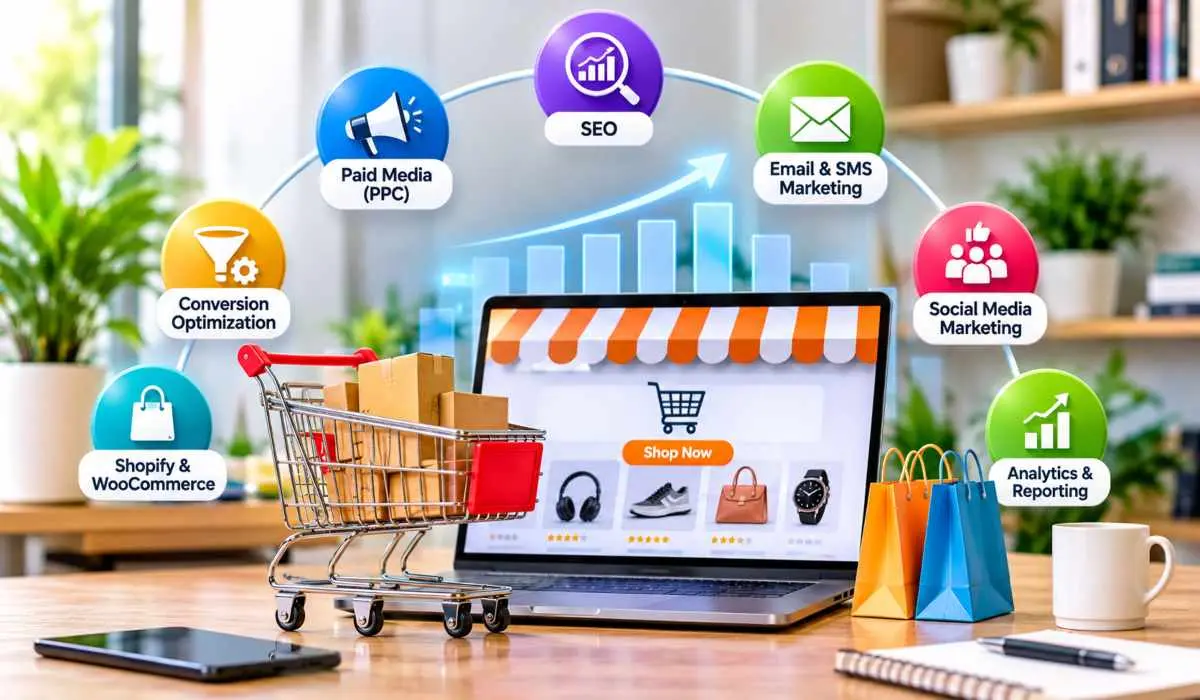
Our ecommerce digital marketing services cover the seven areas that decide whether an online store grows profitably, search visibility, paid acquisition, conversion, retention, social reach, platform health and measurement. Each service works on its own, but they are planned together so that spend, content and testing all point at the same revenue target.
Ecommerce SEO (category, product and technical)
Ecommerce SEO makes a store’s category pages, product pages and site structure easy for search engines to find, understand and rank, so shoppers arrive without paying for every click. Our ecommerce SEO work starts with category pages, because they usually capture the highest-value commercial searches, then moves to product page copy, structured data, internal linking and the handling of filters, faceted URLs and out-of-stock items.
The technical layer keeps those gains from leaking away. Crawl budget, page speed, duplicate URLs and indexation errors quietly suppress large catalogs, so we audit them against a technical SEO checklist and fix issues in order of revenue impact. For stores built on that platform, specialist Shopify SEO services address its particular quirks, such as duplicate collection paths and theme-level markup.
Paid media and PPC for ecommerce (Google Shopping, Meta, performance max)
Paid media brings qualified shoppers to a store quickly and for ecommerce it works best when product data, creative and bidding are managed together. Our PPC services cover Google Shopping, Performance Max, search campaigns and Meta advertising, with budgets allocated by profit margin and not by platform-reported revenue alone.
Most wasted spend traces back to the product feed. Titles, categories, GTINs and pricing data determine which searches a Shopping ad appears for, so we clean and enrich the feed before scaling spend. From there we separate prospecting from retargeting, test creative on a regular cycle and track results against return on ad spend and blended customer acquisition cost, so a campaign that looks strong inside one platform cannot hide a weak overall margin.
Conversion rate optimization (CRO) for ecommerce
Conversion rate optimization raises the share of store visitors who buy, which lowers the cost of every sale without adding traffic. Cart abandonment shows how much is at stake: Baymard Institute’s research puts the average at around 70%, which means most shoppers who show clear intent still leave.
We find the causes through session recordings, funnel analytics and customer surveys, then test fixes on product pages, cart and checkout. Typical changes include clearer shipping and returns information, faster load times, guest checkout, stronger product imagery and reduced form friction. Each change runs as a controlled test, so decisions rest on measured results instead of design opinion.
Email, SMS and retention marketing
Email and SMS marketing turn one-time buyers into repeat customers through messages sent at the moments shoppers are most likely to act. For most online stores this is the most cost-efficient channel, because it reaches people who already know the brand. Our email marketing services build the core automated flows first, welcome series, abandoned cart, browse abandonment, post-purchase and win-back.
Segmentation then separates the average campaign from the profitable one. We group customers by purchase history, product interest and value and tailor offers accordingly, so loyal buyers are not trained to wait for discounts. SMS is added selectively for time-sensitive messages such as back-in-stock alerts and delivery updates, with consent and frequency handled carefully to protect both deliverability and compliance.
Social media and creator marketing
Social media and creator marketing build product awareness and trust in the places shoppers already browse and they feed demand that search and email later capture. Our social media marketing services combine organic content, paid social and creator partnerships on the platforms where a brand’s customers actually spend time, rather than defaulting to every network.
Creator content is especially useful for ecommerce because it shows products in real use, which answers questions a product page cannot. We brief creators around specific products and offers, secure usage rights so their content can also run as ads and track outcomes through unique codes and landing pages. That keeps social tied to sales and not only to likes and follower counts.
Shopify, WooCommerce and multi-platform support
Platform expertise means marketing recommendations can actually be built and shipped on the system a store runs on. We work across Shopify, WooCommerce and custom or headless setups and we adjust our approach to each platform’s strengths, theme structure, app ecosystem and technical limits.
In practice this covers tracking implementation, schema markup, feed integrations, speed fixes and the connection between the store, ad platforms and email tools. Brands that sell on several channels, such as their own site plus marketplaces, also need consistent product data and inventory signals across them. Handling this inside one team removes the delays that occur when marketers and developers work in separate vendors’ queues.
Analytics, attribution and reporting
Analytics and attribution show which marketing activity produces profit, so budget moves toward what works and away from what only looks busy. We set up reliable tracking first, using server-side tagging where appropriate, because browser privacy limits and consent rules now cause platforms to under-report conversions.
Reporting then focuses on a short set of metrics owners can act on: revenue, margin, return on ad spend, marketing efficiency ratio, customer purchase cost, average order value and customer lifetime value. We pair platform data with blended and post-purchase survey data to get a fuller picture of attribution and share it through a live dashboard with a plain-language monthly review of what changed and what we will do next.
End to End Ecommerce Growth
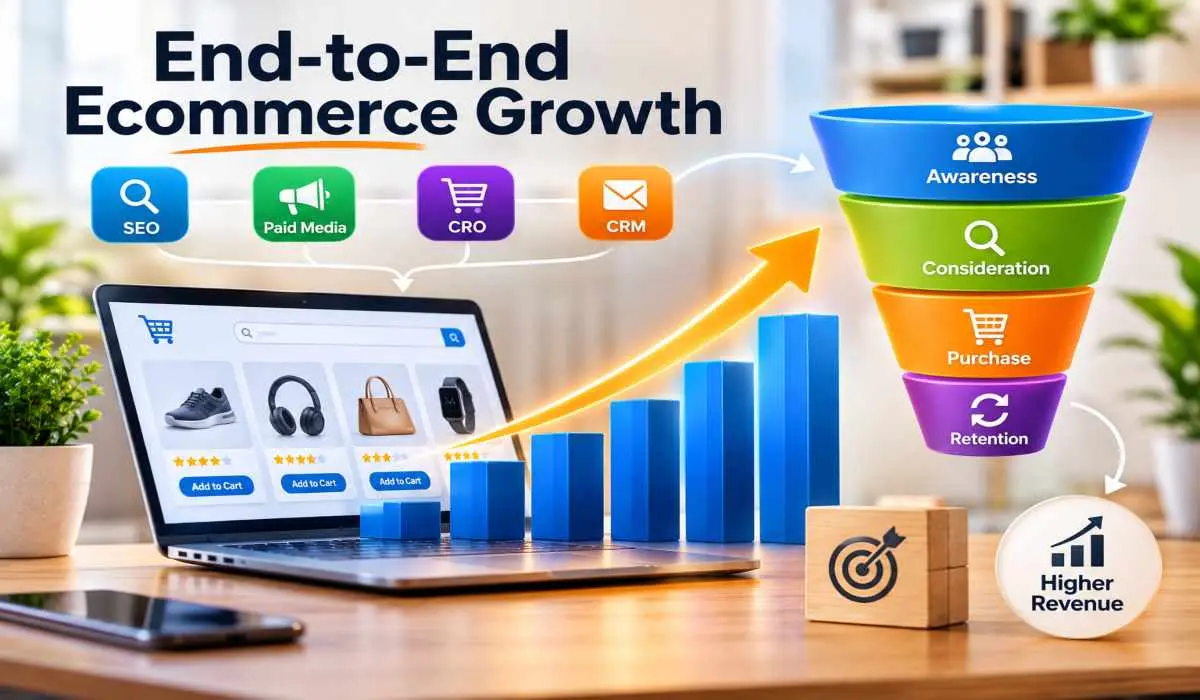
End-to-end ecommerce growth means one team plans and runs every channel that touches a shopper, from the first search or ad to the fifth purchase, against a single revenue and margin target. Our cross-channel approach connects SEO, paid media, conversion optimization and customer retention so that each channel strengthens the others instead of competing for budget and credit.
One strategy across SEO, paid, CRO and CRM
A single strategy means SEO, paid media, conversion optimization and CRM share one plan, one set of data and one definition of success. Without that, each channel optimizes for its own dashboard: paid chases platform-reported revenue, SEO chases rankings and email chases open rates, while the store’s actual profit goes unmanaged.
We start by setting the numbers that matter at store level, such as target margin, acceptable customer acquisition cost and the lifetime value we expect from each customer segment. Every channel then gets a role against those numbers. Paid search and shopping capture existing demand quickly, SEO builds lower-cost demand over time, CRO increases what each visit is worth and CRM raises how often customers come back. Insights move between them constantly: search terms that convert in paid campaigns inform which category pages SEO prioritizes and best-selling products from email data guide ad creative.
Full-funnel growth, from acquisition to retention
Full-funnel growth means investing in every stage of the customer journey, awareness, consideration, purchase and repeat purchase. Many stores overspend on the bottom of the funnel, bidding on brand and retargeting terms that capture buyers who were already coming, while the top stays thin and growth plateaus.
We map spend and effort to each stage. At the top, social, creator content and prospecting campaigns introduce the brand to new audiences. In the middle, category pages, product content, reviews and comparison information help shoppers decide. At purchase, a faster checkout and clear delivery terms reduce drop-off. After the sale, post-purchase flows, loyalty offers and replenishment reminders drive the second order, which is typically where profit improves most because the acquisition cost has already been paid. Measuring each stage separately shows where the funnel leaks, so fixes go where they return the most.
Why cross channel beats single channel agencies
Cross-channel beats single-channel because shoppers rarely buy after one interaction and a single-channel agency can only optimize the piece it controls. Research from Google and Ipsos on shopping behavior has repeatedly found that consumers use a mix of touchpoints before purchase, which is why a result that looks strong in one platform often hides a weak or inflated contribution to the whole.
A specialist in one channel has a built-in incentive to push more budget into it, even when that channel has reached diminishing returns. A cross-channel team can see when an extra pound of spend would do more in email, on-site testing or organic content and move it there. It also avoids the handoff problems that appear when three vendors work in parallel: duplicated reporting, conflicting tracking and nobody accountable for the blended result. For the brand, the practical benefits are a lower blended acquisition cost, cleaner attribution and one team to hold responsible for growth.
Ecommerce Marketing ROI How We Measure and Deliver It
Ecommerce marketing ROI is the profit a store earns from its marketing compared with what it spends and we measure it at the level of the whole business, not inside any single ad platform. We deliver it by tracking a short set of profit-linked metrics, testing against them continuously and reporting results in terms an owner can check against their own bank balance.
KPIs that matter (ROAS, MER, CAC, LTV, AOV and conversion rate)
The KPIs that matter most are the ones that connect marketing spend to profit: return on ad spend (ROAS), marketing efficiency ratio (MER), customer acquisition cost (CAC), customer lifetime value (LTV), average order value (AOV) and conversion rate. Each answers a different question and none is reliable alone.
ROAS shows how much revenue a campaign returns per unit of ad spend, but platforms tend to claim credit generously, so we pair it with MER, which divides total store revenue by total marketing spend and cannot be inflated by attribution overlap. CAC tells you what it costs to win a new customer and LTV shows what that customer is worth over time, the ratio between them decides how aggressively a brand can afford to grow. AOV and conversion rate are the two levers inside the store: raising either increases revenue from the same traffic, which improves every other number on the list. We set target ranges for each metric against the brand’s gross margin, since a ROAS that looks healthy at a 60% margin can lose money at 25%.
Typical timelines and what ROI to expect
Most ecommerce brands see early movement from paid media and conversion fixes within the first one to three months, while SEO and organic growth typically take four to six months or longer to compound. Email and retention flows usually pay back quickly, because they work on customers the store already has.
A realistic pattern runs in phases. The first month goes to audit, tracking repair and quick wins such as feed fixes and abandoned-cart flows. Months two and three bring optimized campaigns and the first conversion test results. From month four onward organic rankings, a growing email list and compounding test wins begin to lower blended acquisition cost. Actual ROI depends on margin, product category, competition and starting condition, so we avoid promising a universal figure. Instead, we agree on target ranges for MER, CAC and payback period at the outset and review progress against them every month.
How Digital Marketing Agencies Help Scale Ecommerce Businesses
Digital marketing agencies help scale ecommerce businesses by finding what limits growth at the current stage, fixing it and then adding spend and channels only once the economics hold. A good agency does not simply raise budgets. It builds the tracking, testing and customer data that let a store grow revenue without growth eating into profit.
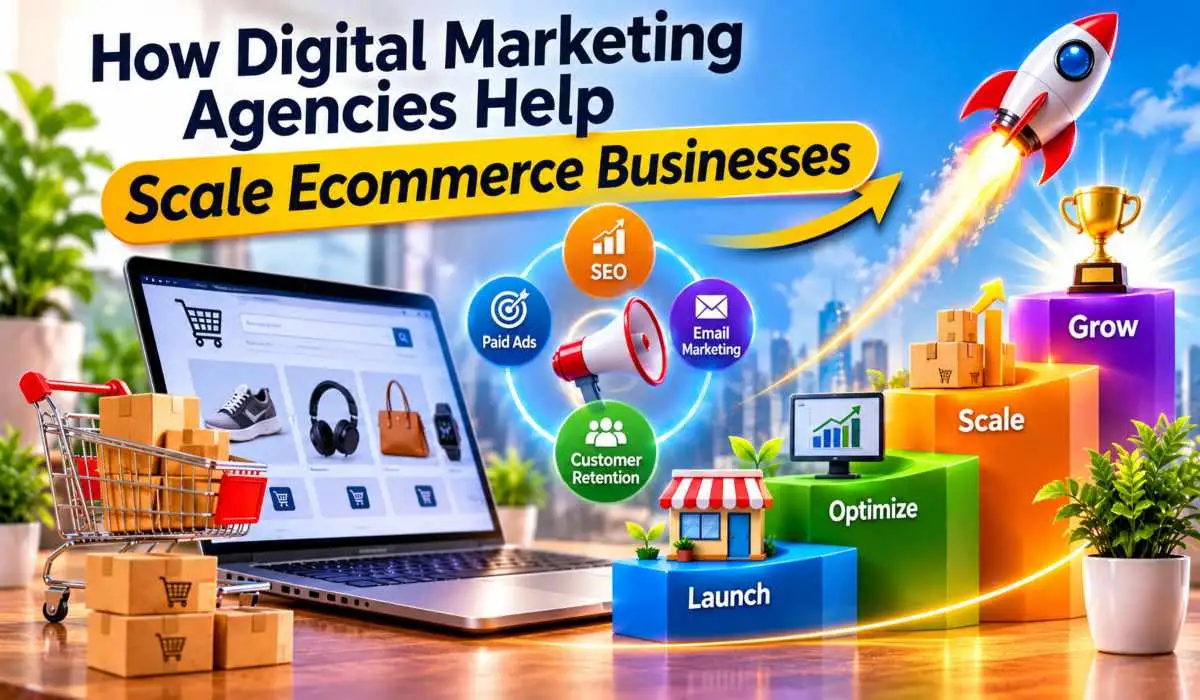
From stagnant to scaling the growth stages we support
Ecommerce brands usually move through four stages and each one has a different bottleneck: launch, stagnation, scaling and maturity. Treating them alike is the most common reason growth stalls, because the tactic that works at one stage can waste money at the next.
At launch, the problem is demand and data. A new store needs a focused channel plan, clean tracking and a small number of products or audiences to test, so early budget produces learning instead of noise. At stagnation, traffic is often decent but revenue is flat and the cause usually sits in conversion, product-market messaging or rising ad costs, so we audit the funnel before adding spend. At scaling, the work shifts to capacity: more creative, more channels, stronger feeds and inventory-aware campaigns. At maturity, the priority becomes protecting margin, raising customer lifetime value and reducing reliance on any single platform. We diagnose the stage first, then build the roadmap around it.
Scaling paid spend profitably
Scaling paid spend profitably means increasing budget in steps while watching marginal returns, not average ones. A campaign returning a strong ROAS at a modest budget will often return less at ten times the spend, because the best audiences and searches are reached first and each additional dollar buys a colder shopper.
We raise budgets gradually, commonly in increments of 15% to 30% every few days on campaigns that hold their targets and we judge each increase against marginal MER and contribution margin, not platform-reported revenue. Before scaling, we make sure the foundations can carry the load: a clean product feed, a steady supply of fresh creative and landing pages that convert at higher volumes. We also set pullback rules in advance, so a campaign that drifts below its break-even point is reduced quickly instead of being defended. This discipline is what separates growth that compounds from a spike that fades.
Compounding organic traffic and owned channels
Organic search and owned channels such as email, SMS and a loyalty program compound because their results build on each other and do not reset when ad spend stops. Paid media rents attention; these channels build an asset the brand keeps.
SEO grows from category pages, product content and a technically healthy site and each ranking page keeps bringing shoppers at no extra cost per click. Owned channels do the same for repeat revenue: every customer added to the email or SMS list can be marketed to again, which lowers blended acquisition cost over time. As a reference point, repeat customers generate a disproportionate share of revenue for most stores and Shopify’s own data on returning customers is a useful benchmark to cite once verified. We therefore pair paid acquisition with a steady investment in content, search and retention, so that each month’s growth makes the next month cheaper to achieve.
Who We Work With
We work with ecommerce brands that have a real product, a clear customer and a need for marketing that is tied to profit. That includes mid-market retailers, direct-to-consumer (DTC) brands and fast-scaling startups, across the main ecommerce platforms and a focused set of product categories.
Mid-market and mid-sized ecommerce brands
Mid-market ecommerce brands are established stores with proven demand, often between a few million and tens of millions in annual revenue, that have outgrown a small in-house team or a generalist agency. Our ecommerce digital marketing agency work for these brands focuses on efficiency and control: reducing blended acquisition cost, tightening attribution and spreading risk across more than one channel.
At this size, the common problems are channel dependence, fragmented reporting and a marketing team stretched across too many tasks. We typically step in as an extension of the in-house team, taking on specialist work such as feed management, paid media, CRO testing and lifecycle marketing, while the internal team keeps ownership of brand and merchandising. Reporting is built for finance and leadership as well as marketers, so the numbers hold up in a budget meeting.
DTC brands
DTC brands own the customer relationship end to end, which makes customer lifetime value, repeat purchase rate and first-party data the center of their marketing. Without a retailer in between, every part of the journey, from the first ad to the delivery experience, is the brand’s own to improve.
We build DTC programs around that advantage. Paid social and creator content drive discovery, search captures intent and email and SMS turn first orders into subscriptions and repeat purchases. We also help DTC brands reduce their dependence on paid platforms by building owned audiences, since rising ad costs and tracking limits make a brand with a large email list and strong organic presence far more resilient than one that relies on ads alone.
Startups and fast-scaling stores
Startups and fast-scaling stores need speed with discipline: quick learning on a limited budget and a structure that does not break when volume grows. Early on, the aim is to find which products, audiences and messages work before committing larger spend, so the first months are built around testing and clean tracking.
As a store accelerates, the demands shift to operations. Stock levels, shipping times, creative volume and customer service can all become bottlenecks and marketing has to be paced around them. We help these brands scale in controlled steps, adding channels once the previous one is stable and we plan with the founder around cash flow and payback periods, not just revenue targets. Teams looking for a broader view of early-stage support can also see our guidance on digital marketing for startups.
Platforms and categories we specialize in
We specialize in stores built on Shopify and WooCommerce, along with custom and headless builds and in categories where visual appeal, repeat purchase or considered buying drive results. Platform knowledge matters because tracking, site speed, schema and feed setup differ across systems and getting them right is often the quickest route to better performance.
The categories we work in most include fashion and attire, health and beauty, home and lifestyle and consumer goods that depend on repeat orders. Each has different economics: fashion faces high return rates and seasonality, beauty depends on retention and reviews and home goods involve longer research cycles and higher order values. We adjust the strategy to those patterns instead of applying one template. Brands outside these categories are welcome, provided they sell physical or digital products online and have the margin to support growth.
Best Ecommerce Digital Marketing Agencies in 2026 How to Choose
The best ecommerce digital marketing agency for a brand is the one that can show proven results in its category, measures success by profit and fits the store’s size, budget and platform. Rankings and “top 10” lists rarely settle that question, so a clear set of criteria and the right questions will do more to protect your decision than any league table.
Criteria for choosing best digital marketing agency for ecommerce
The best digital marketing agency for ecommerce passes five tests: relevant experience, profit-based measurement, channel breadth, transparent reporting and cultural fit. Start with experience in your own situation, meaning similar product categories order values and platforms, since a team that has solved your type of problem will move faster than one learning on your budget.
Next, check how the agency defines success. Agencies worth hiring talk about margin, marketing efficiency ratio, customer acquisition cost and lifetime value, not impressions or traffic. Then look at breadth: can they connect SEO, paid media, conversion testing and email or will you be coordinating several vendors yourself? Finally, test transparency and fit. You should own your ad accounts, analytics and data, receive reports you can verify and feel comfortable with the people who will actually do the work, not only the ones who pitched it.
Boutique vs full-service vs performance-based agencies
Boutique agencies offer senior attention and deep specialism, full-service agencies offer breadth and coordination and performance-based agencies tie their fees to results. None is better in all cases; the right model depends on the brand’s stage and complexity.
A boutique agency usually has a small team, so founders work directly with experienced people and it often concentrates on one platform or niche. The trade-off is limited capacity if you need many channels at once. A full-service agency covers search, paid, CRO, email and creative under one plan, which suits brands that want one accountable partner, though junior staff may handle day-to-day work. Performance-based models, which charge a percentage of revenue or ad spend, align incentives well but can push an agency toward short-term, easily tracked sales over brand building, so check what exactly the fee is based on and how revenue is attributed.
Red flags to avoid
The clearest red flags are guaranteed rankings or returns, vague reporting, refusal to share account access and long lock-in contracts with no exit terms. No honest agency can promise a position on Google or a fixed ROAS, because both depend on factors outside its control.
Watch also for case studies with no baseline or timeframe, a pitch that is identical regardless of your business and a team that cannot explain its own methods in plain language. Agencies that hold your ad accounts or data in their own name create dependence and make leaving costly. Pressure to sign quickly or heavy emphasis on vanity metrics such as followers and clicks, usually signals a weak understanding of ecommerce economics.
In-house vs freelancer vs agency
An in-house team offers control and deep brand knowledge, a freelancer offers flexibility at a lower cost and an agency offers a full range of specialists and tools. The right choice depends on budget, workload and how many channels need managing.
| In-house team | Freelancer | Agency | |||
| Cost | Highest fixed cost (salaries, benefits, tools) | Lowest, usually hourly or per project | Mid to high, usually a monthly retainer | ||
| Expertise | Narrow unless several roles are hired | Strong in one or two skills | Broad, with specialists per channel | ||
| Speed to start | Slow (hiring and onboarding) | Fast | Fast to moderate | ||
| Scalability | Limited by headcount | Limited by one person’s time | High, capacity can flex | ||
| Brand knowledge | Deepest | Moderate
| Builds over time | ||
| Risk | Turnover, skill gaps | Availability, single point of failure | Dependence on provider | ||
| Best for | Mature brands with steady workload | Small stores with a defined task | Brands needing multi-channel growth |
Many successful brands combine models, keeping brand and merchandising in-house while an agency handles specialist channels.
Questions to ask before you hire
Before hiring, ask questions that reveal how an agency thinks, who does the work and how it handles results. The answers matter more than the pitch deck.
Ask which metrics they will be accountable for and how they will measure them. Ask to see case studies from brands similar to yours, with baseline numbers and timeframes. Find out who will run the account day to day, how often you will meet and what the reporting looks like. Confirm that you will own all ad accounts, analytics properties and data. Ask how they handle a campaign that underperforms, what happens in the first 90 days and what the contract terms and exit conditions are. Finally, ask for references from current clients and speak to at least one.
Our Process How We Work With You
Our process runs in four stages: audit, strategy, launch and optimization and scale. Each stage has a defined output and a clear decision point, so you always know what we are doing, why and what happens next.
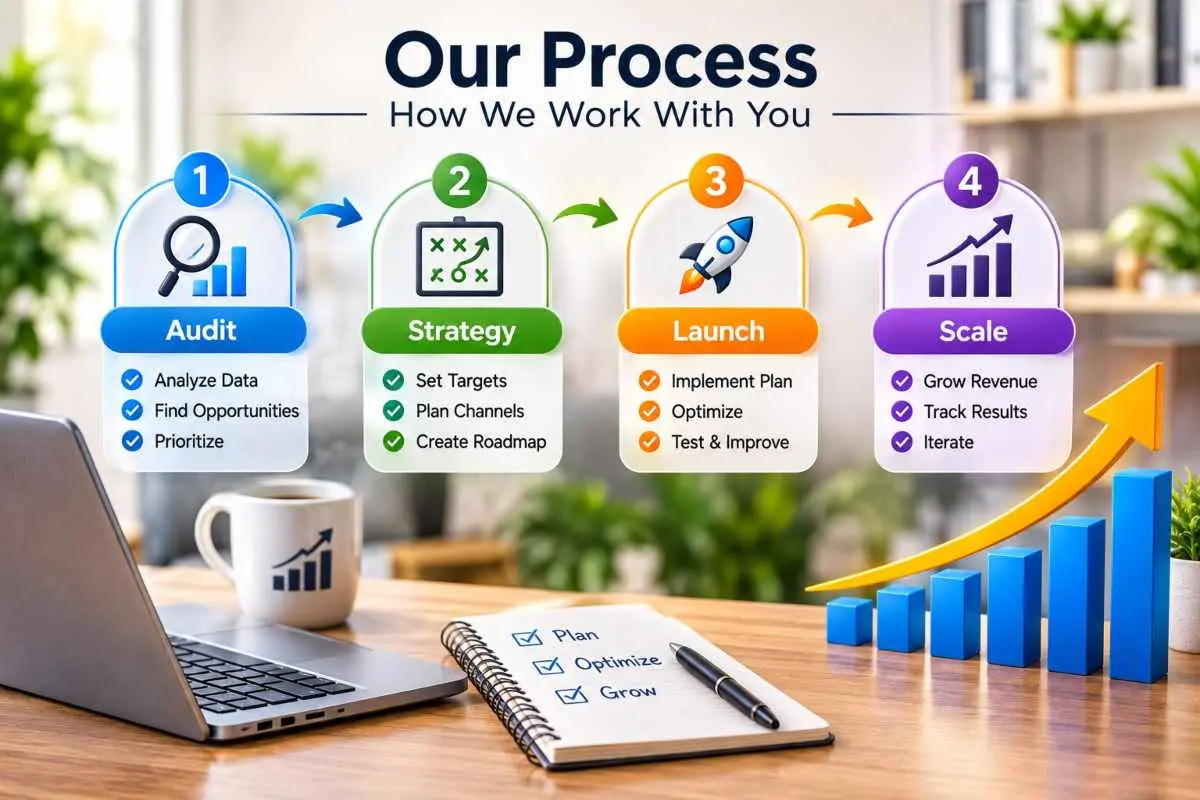
Step 1 Audit and opportunity analysis
The audit is a structured review of your store’s tracking, traffic, funnel, product data and existing campaigns, completed before any budget is changed. Its purpose is to find where revenue is leaking and where the fastest gains sit, so the plan starts from evidence and not assumptions.
We begin with measurement, because every later decision depends on it. That means checking that purchases, revenue and margin are tracked accurately across your analytics, ad platforms and email tools. We then review site speed and technical health, category and product page quality, conversion rate at each funnel stage, product feed quality, ad account structure and customer data. Competitor and market analysis shows where demand exists and where rivals are weak. You receive a prioritized findings report that ranks each opportunity by expected revenue impact and effort and we walk through it together on a call.
Step 2 Strategy and channel roadmap
The strategy stage turns audit findings into a written plan that assigns each channel a role, a budget and a target. It answers three questions: where to invest first, what to expect and how success will be judged.
We agree on the business-level targets first, such as marketing efficiency ratio, customer acquisition cost, payback period and margin floor. Channels are then sequenced against those numbers. A store with strong demand but poor conversion might start with CRO and email before raising ad spend, while a store with healthy conversion but limited reach might lead with paid acquisition and content. The roadmap sets out a 90-day plan with milestones, owners and the specific tests we will run, so nothing depends on guesswork. Nothing launches until you have approved the targets and the budget.
Step 3 Launch and optimization
Launch is the phase where the plan goes live in controlled steps and optimization is the steady cycle of testing and refinement that follows. We start with foundations and quick wins: fixing tracking, cleaning the product feed, building abandoned-cart and welcome flows and launching campaigns with a limited budget to confirm they perform before scaling.
From there the work runs in weekly and monthly cycles. Each week we review campaign data, adjust bids and budgets, retire weak creative and introduce new variations. Each month we assess larger tests on landing pages, checkout and offers. Every experiment has a hypothesis, a success measure and a stop rule, which keeps results honest and prevents money from being spent on ideas that are not working. Our regular monitoring and reporting keeps you informed throughout, with live dashboard access and a plain-language summary of what changed and why.
Step 4 Scale, report and iterate
Scaling begins once a channel has proven it can hit its targets and it continues as a loop of reporting, learning and adjustment. We increase budgets in measured steps, add new channels and audiences only when the previous layer is stable and watch marginal returns so growth does not erode profit.
Reporting is part of the loop, not an afterthought. Each month we review results against the targets set in Step 2, explain what drove the changes and recommend what to do next, including what to stop. Every quarter we revisit the roadmap, since seasonality, competitors, stock levels and platform changes alter the best plan. The outcome is a program that improves over time and that you can understand at every stage.
Pricing and Engagement Models
Ecommerce marketing agency pricing typically runs from about $2,000 to $5,000 a month for small stores, $5,000 to $15,000 for growing brands and $15,000 or more for mid-market and enterprise programs, excluding ad spend. The right model depends on how much work the store needs, how fast it wants to grow and how much risk each side is willing to share.
Retainer vs performance-based vs project pricing
A retainer is a fixed monthly fee for an agreed scope of ongoing work, a performance-based model ties fees to results and project pricing is a one-time fee for a defined deliverable. Each suits a different need and many brands use more than one at different stages.
Retainers are the most common model for ecommerce, because SEO, paid media, email and testing all compound over time. Typical ranges are $2,000 to $5,000 a month for a focused scope, $5,000 to $15,000 for a multi-channel program and $15,000 to $50,000 or more for large catalogs and heavy channel mix. Performance-based pricing usually charges a percentage of ad spend, often 8% to 20% or a share of revenue or profit, often 5% to 15%, sometimes combined with a lower base fee. It aligns incentives but needs clean attribution and a clear definition of what counts as a result. Project pricing suits audits, site migrations, CRO sprints and platform builds, with audits commonly costing $1,500 to $7,500 and larger projects $5,000 to $30,000 or more.
What affects ecommerce marketing agency cost
Ecommerce marketing agency cost is driven mainly by scope, ad spend, catalog size, platform complexity and the seniority of the team. Pricing rises as more channels, more products and more creative are added, because each requires more specialist hours.
Ad spend is a major factor, since managing $100,000 a month across several platforms takes more work than managing $10,000 on one. Catalog size affects SEO and feed management, as thousands of SKUs mean more pages to optimize and more data to maintain. Custom or headless platforms need more technical work than a standard Shopify setup. Creative demands, such as video production or creator partnerships, add cost, as do location, agency size and contract length. Ad budgets and software subscriptions are normally separate from agency fees, so confirm what the quoted price includes. Cheaper is not always better: a low fee with weak tracking can cost far more in wasted spend than a well-run program at a higher price.
What is included at each tier
Agency packages usually fall into three tiers, with scope and depth increasing at each level. The ranges below are estimates and exact inclusions vary by agency.
| Starter | Growth | Scale | |
| Estimated fee (per month) | $2,000 to $5,000 | $5,000 to $15,000 | $15,000 and above |
| Best for | New or small stores with limited budget | Established stores ready for multi-channel growth | Mid-market brands with large catalogs and spend |
| Channels | One or two, such as paid search or email | Three to four, including SEO, paid, email and CRO | Full cross-channel program, including social and creator marketing |
| Strategy and reporting | Monthly report and call | Live dashboard, monthly review, quarterly roadmap | Dedicated strategist, weekly calls, custom dashboards and attribution modeling |
| Testing and creative | Basic ad and email creative | Regular CRO tests and creative refreshes | Continuous experimentation, video and creator content |
Every tier should begin with an audit and tracking setup, which may be billed as a one-time fee. Moving up a tier makes sense when marketing performance is limited by capacity, not strategy.
Get a Free Ecommerce Marketing Audit
A free ecommerce marketing audit shows you where your store is losing revenue and which fixes will return the most, with no obligation to hire IT Leadz. In a few days you receive a prioritized review of your tracking, funnel, product feed, ad accounts and organic visibility, so you can act on it with us or on your own.
Most online stores lose the majority of their shoppers before checkout, with Baymard Institute putting average cart abandonment at around 70%. That makes the gap between traffic and revenue the first place to look and an audit is the quickest way to measure it.
Frequently Asked Questions (FAQs)
What does an ecommerce digital marketing agency do?
An ecommerce digital marketing agency plans and runs the SEO, paid media, conversion optimization and email marketing that bring shoppers to an online store and turn them into repeat buyers. It manages these channels as one program, measured against revenue, margin and customer acquisition cost.
How much does a digital marketing agency for ecommerce cost?
Most agencies charge about $2,000 to $5,000 a month for small stores, $5,000 to $15,000 for growing brands and $15,000 or more for mid-market programs, excluding ad spend. Final cost depends on scope, catalog size, platform and the number of channels managed.
How do I choose the best ecommerce digital marketing agency?
Choose an agency with proven results in your category that measures success by profit, not clicks or impressions. Check that it gives you ownership of your ad accounts and data, shares transparent reporting and offers clear contract terms with references you can speak to.
How long before I see ROI?
Paid media, email flows and conversion fixes often show early gains within one to three months, while SEO typically takes four to six months or longer to compound. Exact timing depends on your margins, competition and starting condition.
Do you work with Shopify and WooCommerce?
Yes, we work with both Shopify and WooCommerce, as well as custom and headless builds. We adapt tracking, feeds, schema and site speed work to each platform so recommendations can be implemented without delay.
Is a specialist ecommerce agency better than a general one?
For online stores, usually yes, because a specialist optimizes for revenue, margin and repeat purchase and understands product feeds, checkout and store platforms. A general agency often focuses on traffic and leads, which suit service businesses better.