A digital marketing agency is an outside team of marketing specialA digital marketing agency is an outside team of marketing specialists that a business hires to plan, run and measure its online digital marketing. It covers channels such as SEO, paid ads, social media, content, email and website design, so you get expert execution without recruiting a full in-house department.
The CMO Survey 2026 report found that 33.6% of digital marketing activity is now performed by external agencies, partners and services, which shows how normal it has become to share this work with specialists. The real question is no longer whether to use an agency, but what one actually does for the money and how to pick one worth keeping.
What Is a Digital Marketing Agency?
A digital marketing agency is a service business that takes responsibility for how other companies are found, chosen and remembered online. Instead of one employee juggling everything, you get a team of specialists, such as an SEO lead, a paid media buyer, a writer, a designer and an analyst, all working toward shared goals.
Digital marketing agency meaning in plain English
In plain English, a digital marketing agency is a hired team that puts your business in front of the right people online and helps turn them into customers. It works through search engines, social platforms, email, paid advertising and your website, and it reports on what is working so your budget goes where it earns a return.
The word “digital” separates it from agencies built around print, billboards, TV and radio, though many modern agencies blend both. You will also see the same idea called a digital agency, a digital marketing firm or a digital marketing company. In everyday use these labels mean much the same thing. Any real difference usually comes down to size, specialism or how the business chooses to describe itself.
How agencies differ from in house marketing teams and freelancers
An agency differs from an in house team and a freelancer mainly in breadth, capacity and accountability. An in house team knows your business inside out but is limited to the skills you can afford to hire. A freelancer is flexible and often cost-effective for one defined job, such as copywriting or ad management, but one person’s time only stretches so far, and your cover disappears when they are ill or fully booked.
An agency sits between the two. It brings several specialists, tested processes and paid tools under one contract, which makes it easier to run SEO, ads, content and web work as a single joined-up plan. The trade off is that you share the team’s attention with other clients and usually pay a monthly retainer. That makes an agency the strongest fit when you need several skills at once, or want to scale activity up or down without going through a hiring cycle.
Who actually hires a digital marketing agency
Businesses of almost every size hire digital marketing agencies, but for different reasons. Startups use them to gain early traction without hiring full-time staff, and a digital marketing agency for startups typically focuses on rapid testing and lean budgets.
Small and medium-sized businesses want professional marketing but cannot justify a whole department. Ecommerce brands lean on agencies for shopping ads, conversion optimisation and email. B2B companies bring them in for lead generation and content that supports long sales cycles, while local businesses such as clinics, trades and restaurants use them to win nearby searches through local SEO and reviews.
What Does a Digital Marketing Agency Do?
A digital marketing agency plans your online marketing, runs the campaigns across channels such as search, social, email and paid ads, then measures the results and keeps improving them. In short, it takes responsibility for getting your business found online and turning that attention into enquiries and sales.
Strategy and planning
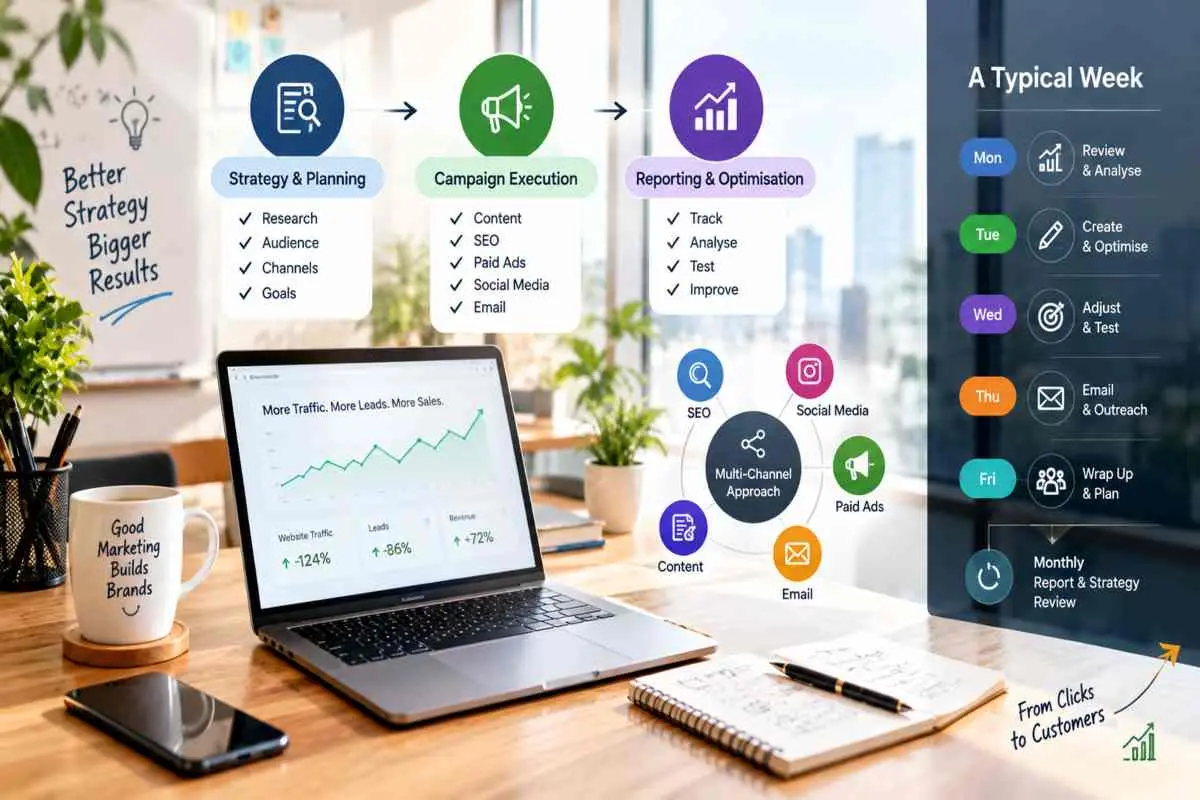
Strategy and planning is where an agency decides what to do, in what order and why. It starts with research into your customers, your competitors and the keywords and platforms where your audience is active, then turns that into a plan with channels, budgets, timelines and targets. A good plan connects each activity to a business goal, such as more booked calls or a lower cost per sale, so you can tell afterwards whether it worked. Planning is not a one-off task. Agencies revisit it as results come in, as competitors move and as search engines and platforms change.
Campaign execution across channels
Execution is the hands-on production and management of the work. Depending on the plan, that can include writing and publishing content, fixing technical SEO issues, setting up and managing paid search and social ads, building landing pages, designing email sequences, posting and engaging on social media, and earning links from trusted sites. The value of using an agency is that these channels are coordinated. Your content supports your SEO, your ads send visitors to pages built to convert, and your emails follow up with people who have already shown interest, instead of each activity running on its own.
Reporting, analytics and optimisation
Reporting and analytics show whether the work is paying off, and optimisation uses that evidence to improve it. The agency sets up tracking so that calls, form submissions and sales are recorded, then reviews performance regularly and tests changes to ads, pages, emails and targeting.
This is what separates an active programme from a set-and-forget one, and it is what clients increasingly demand. In the 2026 AgencyAnalytics benchmarks report, based on a survey of 494 agency professionals, 55% said the question they hear most from clients is whether the agency can connect marketing performance to revenue. A competent agency should be able to answer that with data, not impressions and follower counts.
A typical week inside an agency
A typical week mixes planning, production and review, and the exact rhythm depends on the client and the channels. Here is a short, concrete example for an account running SEO, paid search and email.
On Monday, the team reviews the weekend’s performance, checks that ad budgets are pacing correctly and looks for any drop in traffic or leads that needs investigating. Tuesday is usually production day, writers draft a new article or update an older page, a designer prepares assets, and the SEO specialist fixes technical issues flagged in the latest site crawl. On Wednesday, the paid media manager reviews search terms, pauses poor performers, adjusts bids and launches a new ad variation to test against the current best.
Thursday focuses on email and outreach, with a campaign or automation reviewed and scheduled, and link-building outreach sent to relevant publications. On Friday, the account manager pulls the week’s results together, notes what worked and what did not, and prepares the next week’s priorities, plus a call or written update for the client. Once a month, that rolling work is wrapped into a fuller report and a strategy review, so the plan keeps pace with what the numbers are showing.
Digital Marketing Agency Services Explained
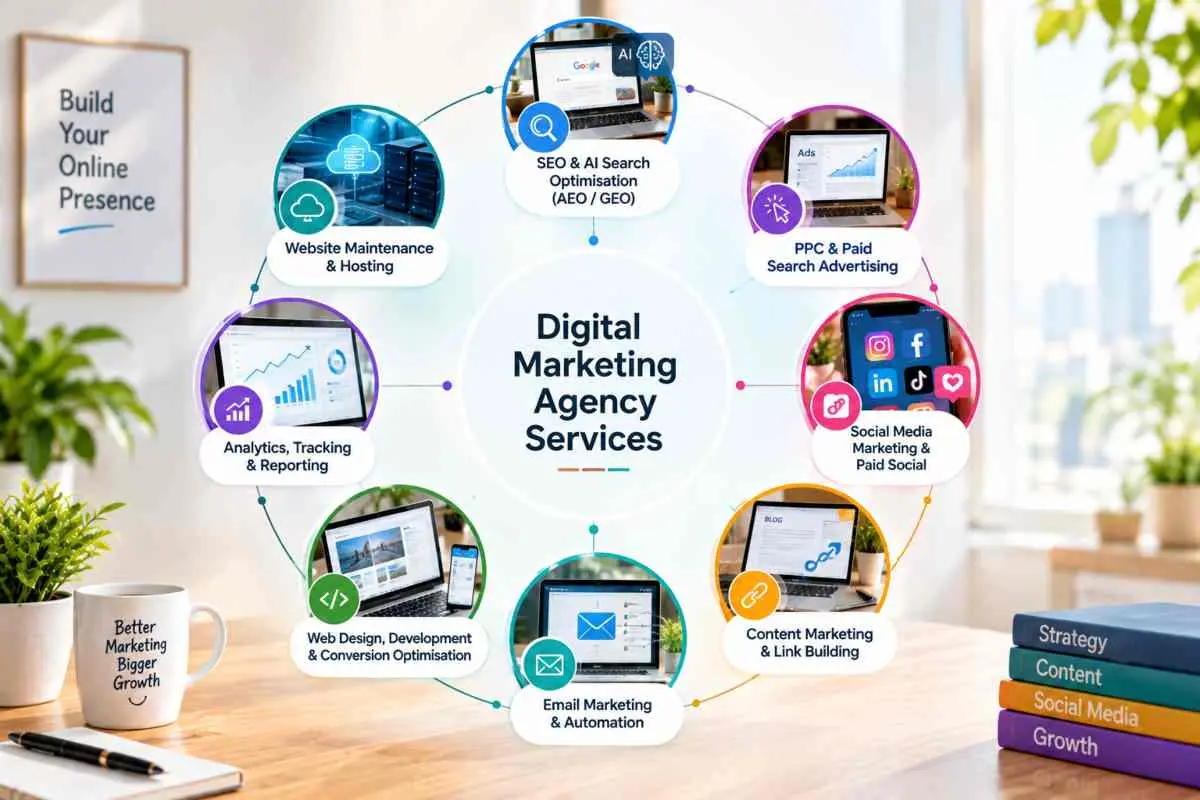
Digital marketing agencies typically offer eight core services, SEO and AI search optimisation, paid search, social media, content and link building, email marketing, web design, analytics and reporting, and website maintenance. Most agencies bundle several of these into one plan, so the table below shows what each service is, who it suits and what it usually delivers.
| Service | What it is | Who it suits | Typical outcome |
| SEO and AI search optimisation | Improving your visibility in Google results and in AI-generated answers | Businesses that want lasting, compounding traffic | More qualified organic visits and citations in AI answers over time |
| PPC and paid search | Paying for ads that appear when people search for your offer | Businesses that need leads quickly or want to test demand | Fast, measurable enquiries and sales |
| Social media and paid social | Building an audience and running targeted ads on social platforms | Consumer brands, ecommerce and service businesses that benefit from visibility | Awareness, engagement and a steady stream of leads |
| Content marketing and link building | Publishing useful content and earning links from trusted sites | Companies with considered purchases or long sales cycles | Stronger authority, rankings and trust |
| Email marketing and automation | Sending timed, relevant messages to subscribers and customers | Ecommerce, subscription and B2B businesses with a contact list | Repeat purchases and warmer leads |
| Web design, development and conversion optimisation | Building and improving a site so more visitors take action | Any business whose site looks dated or converts poorly | Higher conversion rates and a better user experience |
| Analytics, tracking and reporting | Measuring what marketing produces and reporting it clearly | Anyone spending money on marketing who wants proof of return | Clear data for better decisions and budget use |
| Website maintenance and hosting | Keeping a site secure, fast, updated and online | Businesses that rely on their website to trade | Fewer outages, better security and steady performance |
SEO and AI search optimisation (AEO / GEO)
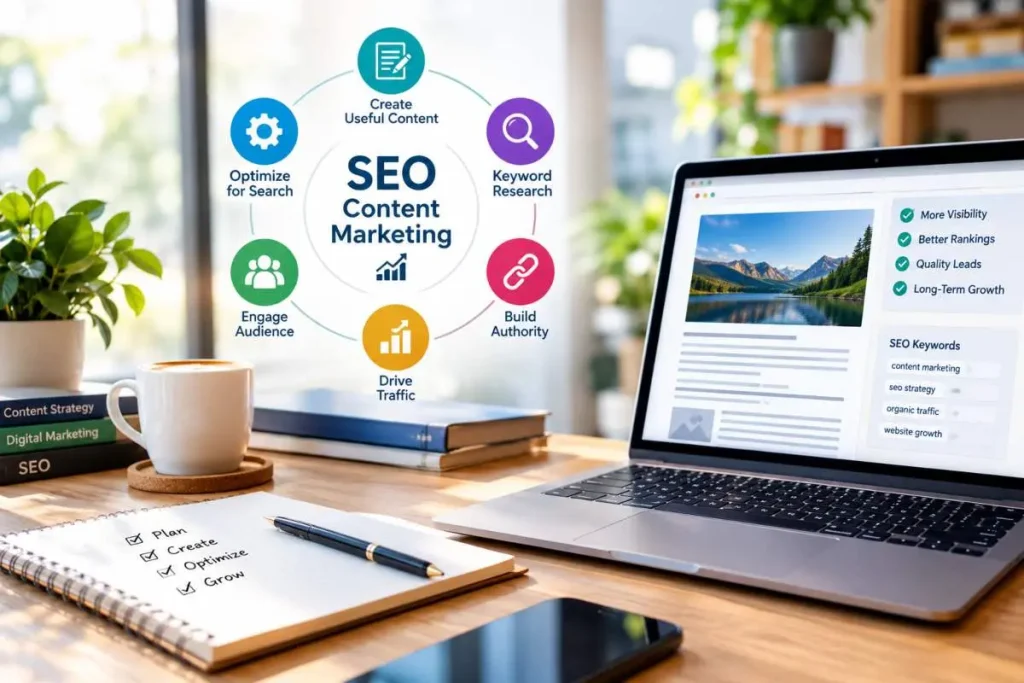
SEO and AI search optimization make your business easier to find in Google results and in answers written by AI tools such as ChatGPT, Google’s AI Overviews and Perplexity. Traditional SEO services combine on page SEO, which fixes your titles, content and site structure, with off page SEO, which earns the links and mentions that build authority. AI optimization extends that work by shaping your content so AI systems can understand, extract and cite it. The shift is already under way, The CMO Survey 2026 report found that 41.5% of marketing teams are already working on their visibility inside AI search answers.
PPC and paid search advertising
Pay-per-click advertising places your business at the top of search results the moment someone searches for what you sell, and you pay only when they click. A good agency running PPC services handles keyword research, ad copy, bidding, landing pages and ongoing testing across platforms like Google Ads and Microsoft Advertising. It suits businesses that want leads quickly, or that want to test a market before committing to slower channels such as SEO.
Social media marketing and paid social
Social media marketing builds an audience and keeps your brand visible on platforms like Instagram, Facebook, LinkedIn and TikTok, while paid social ads target advertising to reach people who do not yet follow you. The right mix depends on where your customers spend time. A B2B firm will usually prioritise LinkedIn, while a consumer brand may lean on Instagram and TikTok.
Content marketing and link building
Content marketing creates articles, guides and pages that answer the questions your customers ask, and link building earns the trusted mentions that help those pages rank. The two work best together, because strong content gives other sites a reason to link to you. Keeping older pages accurate matters as well, which is why regular content updates are part of any serious content plan.
Email marketing and automation
Email marketing keeps you in touch with people who already know your business, and automation sends the right message at the right moment, such as a welcome series, an abandoned basket reminder or a follow-up after enquiry. Professional email marketing is one of the cheaper ways to drive repeat sales, since you are talking to an audience that has already shown interest.
Web design, development and conversion optimisation
Web design and development shape how your site looks and works, and conversion optimisation improves how many visitors become customers. A site can attract plenty of traffic and still lose sales if it loads slowly, confuses visitors or hides the next step. Agencies fix this through layout testing, clearer calls to action and website customization services that adapt your site to how your customers actually behave.
Analytics, tracking and reporting
Analytics and reporting show what your marketing is producing, so you can keep what works and drop what does not. This means setting up tools like Google Analytics 4, tracking calls, form fills and sales, and turning the numbers into plain-language reports. Our approach to regular monitoring and reporting is built around one idea, you should always be able to see where your money went and what it returned.
Website maintenance and hosting
Website maintenance and hosting keep your site secure, fast and online, which protects both your rankings and your customers’ trust. Website maintenance covers updates, backups, security checks and fixes, while hosting and domain management keep the site reachable. Many agencies treat this as an add-on, but we include it in our service mix alongside SEO, AI optimization, link building, social media and search marketing, and web design and development, so one team looks after the whole of your online presence.
How Do Digital Marketing Agencies Work?
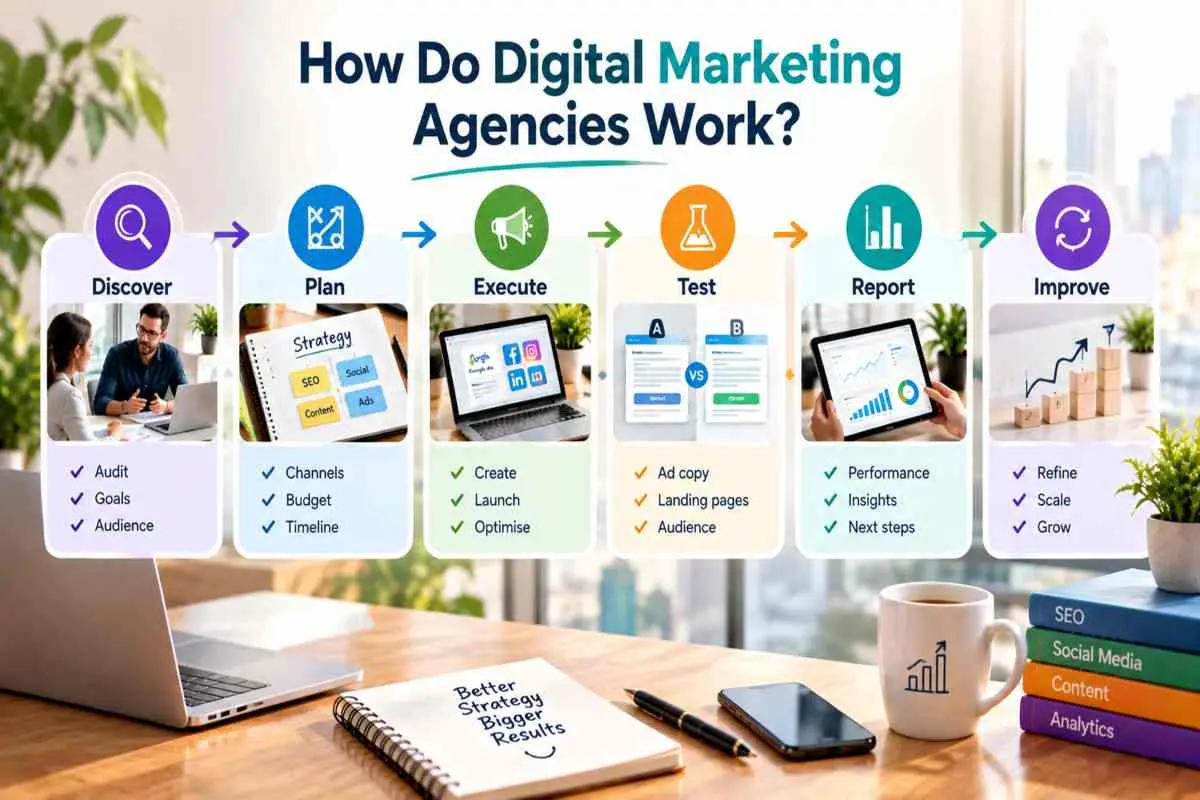
Digital marketing agencies work in a repeating cycle, they learn your business, set goals, build a plan, run campaigns, test what happens and report the results. Each stage feeds the next, so the work gets sharper over time rather than staying fixed to a plan written in month one.
Discovery, audit and goal setting
An agency begins by finding out where your business stands and what you want to achieve. That usually means a kickoff conversation about your products, customers, margins and competitors, followed by an audit of your website, search visibility, ad accounts, social profiles and analytics setup.
The audit shows what is working, what is broken and what you are missing entirely, such as tracking that never recorded your enquiries. Goal setting turns the findings into targets tied to the business, like more qualified leads, lower cost per sale or higher repeat purchases, rather than vanity numbers like followers or impressions.
Strategy, roadmap and KPIs
Strategy turns the audit into a plan, which channels to use, in what order, with what budget and for which audiences. The roadmap sets out the work month by month, so you can see when fast-moving activity such as paid ads will run and when slower channels like SEO and content are expected to start paying back.
The agency then agrees on a small set of key performance indicators (KPIs), the handful of figures that show whether the plan is succeeding. Good KPIs link to revenue, for example booked calls, sales or cost per lead, and each one has a baseline from your audit so progress can be measured honestly.
Execution and testing
Execution is the hands-on work, building and optimising pages, writing content, setting up and managing campaigns, earning links, designing emails and publishing posts. Testing runs alongside it, because no agency can predict precisely what will resonate with your audience. Teams compare two versions of an ad, headline, landing page or email, keep the one that performs better and test again. This steady loop of small improvements is what separates an agency that compounds results from one that simply keeps campaigns running.
Reporting cadence and communication
Most agencies report on a monthly rhythm, with lighter weekly or fortnightly check-ins for fast-moving work like paid campaigns. A useful report explains what happened, why it happened and what happens next, using plain language and tied back to your agreed KPIs rather than a pile of charts. Communication matters as much as the numbers.
In a survey of 500 US small business owners, 40% of the SMBs that outsource their marketing to an agency churn, and more than half of those who leave do so within 6 to 12 months. Clear expectations, regular conversations and honest reporting are the simplest defences against that kind of early breakdown, so ask any agency how usually you will meet and who your day to day contact will be.
Retainer, project-based and performance-based models
Agencies charge in three main ways. A retainer is a specified monthly fee for ongoing work, which suits channels that need continuous attention such as SEO, paid media, social and email. A project-based model sets a fixed price for a defined piece of work, like a website build, a brand refresh or a one-off audit, and ends when the work is delivered. A performance-based model ties some or all of the fee to results, such as leads generated or revenue won, which can feel appealing but works only when results can be tracked cleanly and the incentives are clear.
Many businesses combine models, for instance a project fee to rebuild a website followed by a retainer to grow traffic to it. The right choice depends on whether your need is ongoing or one-off, how easily results can be measured, and how much flexibility you want to scale spend up or down.
Types of Digital Agencies
Digital agencies fall into a few main types based on how much they cover and what they specialise in, full-service agencies, specialist agencies, digital ad agencies, digital media agencies and digital marketing firms. Knowing the differences helps you match the agency to the problem you want solved rather than paying for services you do not need.
Full-service digital marketing agency
A full-service digital marketing agency handles most online marketing under one roof, typically SEO, paid advertising, social media, content, email, web design and analytics. Because one team plans and runs everything, the channels support each other, your content feeds your SEO, your ads send traffic to pages built to convert, and one set of reports shows how it all fits together.
This type suits businesses that want a single point of contact and a joined-up strategy, and do not have the time or in-house skills to manage several suppliers. The trade-off is that a broad agency may be less deep in any one channel than a dedicated specialist.
Specialist agencies (SEO, PPC, social and content)
A specialist agency focuses on one channel or discipline, such as SEO, pay-per-click advertising, social media or content, and aims to be among the best at that one thing. Specialists tend to bring sharper technical knowledge, more experience with edge cases and a narrower, more focused service.
They suit businesses that already have an in-house team and need expert help in one area, or that want to prove a single channel before widening the budget. The demand is real, in a US survey of 500 small business owners, the services most often outsourced to agencies were social media management, email marketing and paid search advertising. The main drawback is coordination, since you may need to manage several specialists and make sure their efforts point the same way.
What is a digital ad agency / digital advertising agency?
A digital ad agency, also called a digital advertising agency, specialises in paid online promotion, planning, creating, buying and optimising advertisements across channels such as search, social platforms, display networks and video. Its work centres on the full life of a campaign, from the creative idea and ad copy through targeting, bidding, testing and performance tracking.
It differs from a broader digital marketing agency in focus, because it concentrates on paid reach rather than earned channels like SEO and organic content. A digital ad agency is the natural choice when your priority is fast, measurable visibility and your main question is how to turn ad spend into leads or sales.
What is a digital media agency?
A digital media agency plans and buys the online space where your message appears, and measures how well that exposure performs. It focuses on audience research, media planning and buying, and ongoing optimisation across channels such as programmatic display, online video, connected TV, audio and social.
The line between a digital media agency and a digital ad agency is blurry, since the two overlap heavily. In general, an ad agency leans toward the creative and campaign side, while a media agency leans toward audience data, placement and buying at scale. Media agencies are most common with larger advertisers running sizeable, multi-channel budgets, though smaller businesses sometimes use the term loosely for agencies that run paid and social campaigns.
What is a digital marketing firm?
A digital marketing firm is another name for a digital marketing agency, a company that plans and runs online marketing for clients. In everyday use the words “firm” and “agency” are interchangeable, and which one a business uses is mostly a branding choice. If a provider calls itself a firm, it may suggest a consultancy-style approach with more emphasis on strategy and advice, but that is a tendency rather than a rule. The more useful questions are what services the company offers, which industries it knows well and how it measures results, not what it calls itself.
Marketing Agency vs Marketing Firm vs Marketing Company
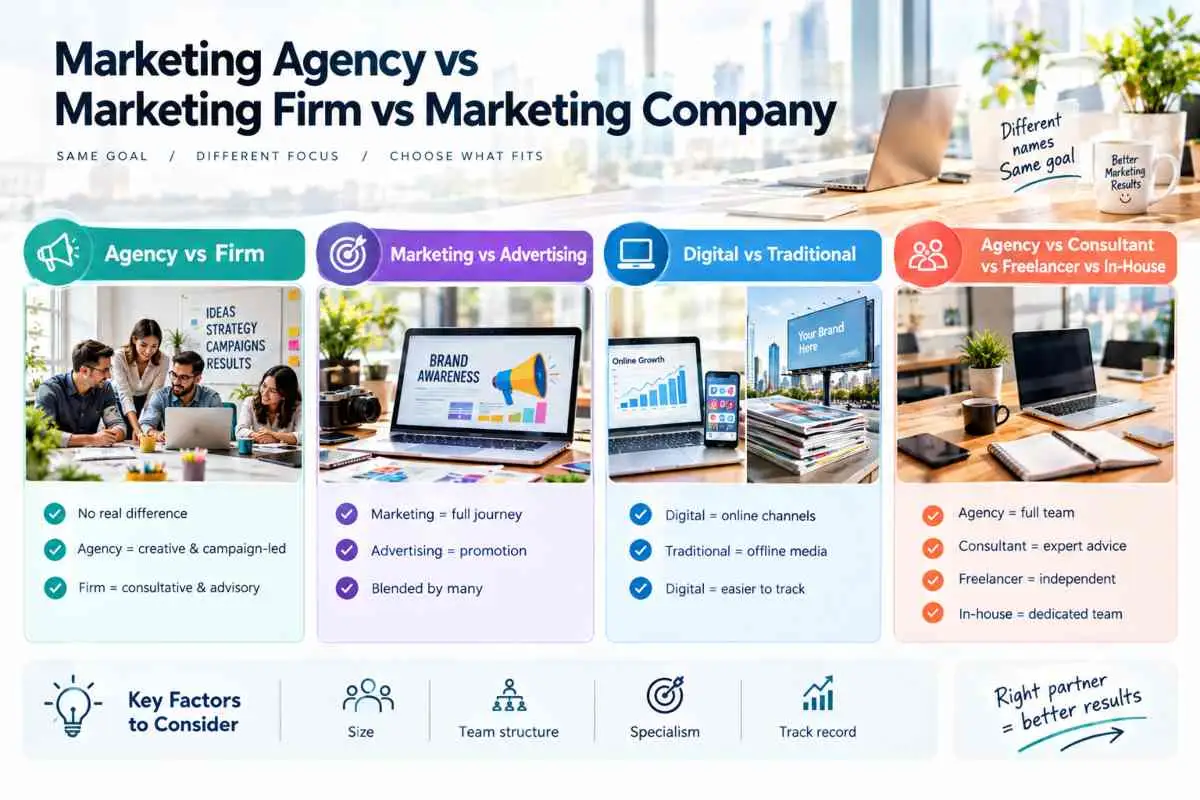
A marketing agency, a marketing firm and a marketing company are, in everyday use, the same thing, a business that plans and delivers marketing for other businesses. The words overlap so heavily that most providers use them interchangeably, and the real differences lie in size, structure, specialism and whether the work is digital or traditional.
Marketing agency vs marketing firm
There is no meaningful difference between a marketing agency and a marketing firm. Both describe an outside business that handles marketing on behalf of clients, and the label is usually a branding choice. Where a distinction exists, “agency” tends to suggest a creative, campaign-led team that produces and runs the work, while “firm” can suggest a more consultative, advisory style. “Marketing company” is the broadest and loosest term of the three, and it can cover anything from a one-person studio to a large multi-service group.
When you compare providers, look past the label. Size, team structure, specialism and track record tell you far more than whether a business calls itself an agency, a firm or a company. A small specialist agency and a large full-service firm can both be excellent. They are simply built for different jobs.
Marketing agency vs advertising agency
A marketing agency covers the whole journey from attracting a customer to keeping one, while an advertising agency focuses on promotion, the ideas, creative work and media that get your message in front of an audience. Marketing includes research, positioning, pricing advice, content, email, SEO, social, events and more. Advertising is one part of that mix, built around paid placements and campaign creative.
In practice the line has blurred. Many advertising agencies now offer content and social services, and many marketing agencies run paid campaigns. If you need a brand campaign with strong creative, an advertising agency may be the natural fit. If you need an ongoing plan that connects several channels, a marketing agency is usually the better match.
Digital marketing agency vs traditional marketing agency
A digital marketing agency works mainly through online channels such as search engines, social platforms, email and websites, while a traditional marketing agency works through offline media such as print, television, radio, billboards and direct mail. The biggest practical difference is measurement. Digital campaigns can be tracked click by click, so you can see what drove each enquiry and adjust quickly.
Traditional campaigns are harder to attribute, though they can still build broad awareness and local presence. Many businesses now use both, and plenty of agencies blend the two. For most small and mid-sized businesses, digital channels offer the clearest link between spend and results, which is why they often form the core of the plan, with traditional media added where it suits the audience.
Agency vs consultant vs freelancer vs in-house
An agency, a consultant, a freelancer and an in-house team all do marketing work, but they differ in who does it, how deep the expertise goes and how you pay. The right choice depends on how much work you have, how many skills you need and how much control you want.
| Option | What it is | Best for | Main strength | Main limit | Typical cost model |
| Agency | A team of specialists delivering ongoing marketing | Businesses needing several skills at once | Breadth, capacity and joined-up delivery | Shared attention across clients | Monthly retainer or project fee |
| Consultant | An expert who advises and plans, usually without running the work | Businesses with a team that needs direction | Senior strategic insight | Limited hands-on delivery | Day rate or fixed project fee |
| Freelancer | An individual contractor for a defined task | One-off or narrow needs, such as copy or ad management | Flexibility and value for a single skill | One person’s capacity and range | Hourly, day or per-project rate |
| In-house team | Employees who work only for your business | Larger or steady workloads | Deep brand knowledge and full control | Salaries, hiring time and skill gaps | Salary plus benefits |
Most businesses end up using a mix rather than choosing one option. The CMO Survey’s 2026 report found that companies build marketing capability in-house 59.5% of the time and work with partners 38.5% of the time, with agencies making up 15.5% of that effort. The pattern suggests a hybrid approach is the norm, an internal team keeps hold of brand and strategy, while agencies and other partners supply the specialist skills and extra capacity.
How Much Does a Digital Marketing Agency Cost in the UK and US?
Most digital marketing agencies charge a monthly retainer, and in the UK a single-channel retainer typically lands between £1,250 and £3,500, while US small-business engagements more often fall between $5,000 and $10,000. Costs climb steeply with scope, so a broad, multi-channel programme can run well past those figures in either market.
| What you’re buying | UK (£ per month) | US ($ per month) |
| Single-channel retainer (SEO, PPC or social) | £1,250 to £3,500 | $1,500 to $5,000 for most small and mid-market SEO campaigns |
| Typical small-business agency spend | £1,000 to £10,000 for digital marketing overall | $5,000 to $10,000 for most small-business retainers |
| Broad or full-service retainer | £3,500 to £16,750 | $2,500 to $30,000 across the wider market |
These ranges come from different sources with different methods, and they are not currency conversions of each other, so treat them as market benchmarks rather than quotes. Exchange rates move, and it is worth confirming whether a quote includes VAT or sales tax.
Monthly retainers vs one-off project pricing
A retainer is a fixed monthly fee for ongoing work, while project pricing is a single fee for a defined deliverable such as a website build or a campaign launch. Retainers suit channels that need steady attention, like SEO, paid media and email. A survey of more than 220 agencies cited by Swydo found that nearly 80% of agencies use some form of retainer-based model.
Project pricing fits one off needs. A basic small business website rebuild in the US typically runs $5,000 to $25,000, and a campaign launch with creative landing pages and ad setup is often $10,000 to $30,000 as a one time fee. Many businesses start with a project to test an agency quality before committing to a retainer, which lowers the risk of a long contract with the wrong partner.
What affects the price (scope, channels, competition and agency size)
Four things drive agency pricing, how much work you want done, how many channels it spans, how competitive your market is and the size and seniority of the agency. Each one changes how many hours of expert time your plan needs.
Scope and channels The number of channels in your digital marketing strategy is one of the biggest drivers of cost. One channel with monthly reporting costs far less than a coordinated plan covering SEO, paid ads, content, email and social.
Competition Ranking for a crowded keyword such as “personal injury lawyer” takes more content, links and effort than ranking for a niche local term, so competitive sectors pay more. Sectors that are subject to regulation, including finance, healthcare, and the legal field also cost more, because the agency needs compliance knowledge.
Agency size and location Larger agencies and those in expensive cities charge more. A retainer that costs £2,000 a month from a Manchester agency might be £3,500 from an equivalent in central London. In the US the geographic gap appears to be narrowing, and one 2026 pricing guide notes that location matters less than it did five years ago.
New AI-related services Work that includes AI search optimization is priced higher in many quotes. The Digital Agency Network reports that AI enhanced services command 20% to 50% higher rates than their manual counterparts.
Red flags in agency pricing
The biggest pricing red flag is not a high price but a price you cannot explain. Watch for these warning signs:
- Vague scope A retainer that does not list deliverables, hours or channels makes it impossible to judge value. A £2,000 or $2,500 retainer can mean light on-page work and a report at one agency and a full programme at another.
- Guaranteed rankings or results No honest agency can promise a position on Google or a fixed return, because search engines and ad auctions are outside anyone’s control.
- Long lock-in with no exit Be cautious about 12-month contracts without a break clause, particularly if you have not worked with the agency before.
- Prices far below market A quote far under the typical range for the work often means junior staff, automated output or corners cut. The market is a barbell, with 64% of agencies in one survey of 260 charging under $1,000 a month, so a rock-bottom price tells you little about quality.
- Hidden extras Ask whether ad spend, software, reporting and creative are included or billed separately.
- Pure performance deals with no baseline Fees tied to results sound attractive, but they only work when outcomes can be tracked cleanly and the starting point is agreed in writing.
Pricing transparency is rare, so some opacity is normal. When one research team checked 50 UK marketing agency websites in July 2026, 47 published no price at all. Ask for a written scope, a clear list of what is and is not included and the reporting you will receive before you compare quotes. Agencies that answer plainly are usually the ones worth shortlisting.
What to Expect From a Marketing Firm The First 90 Days
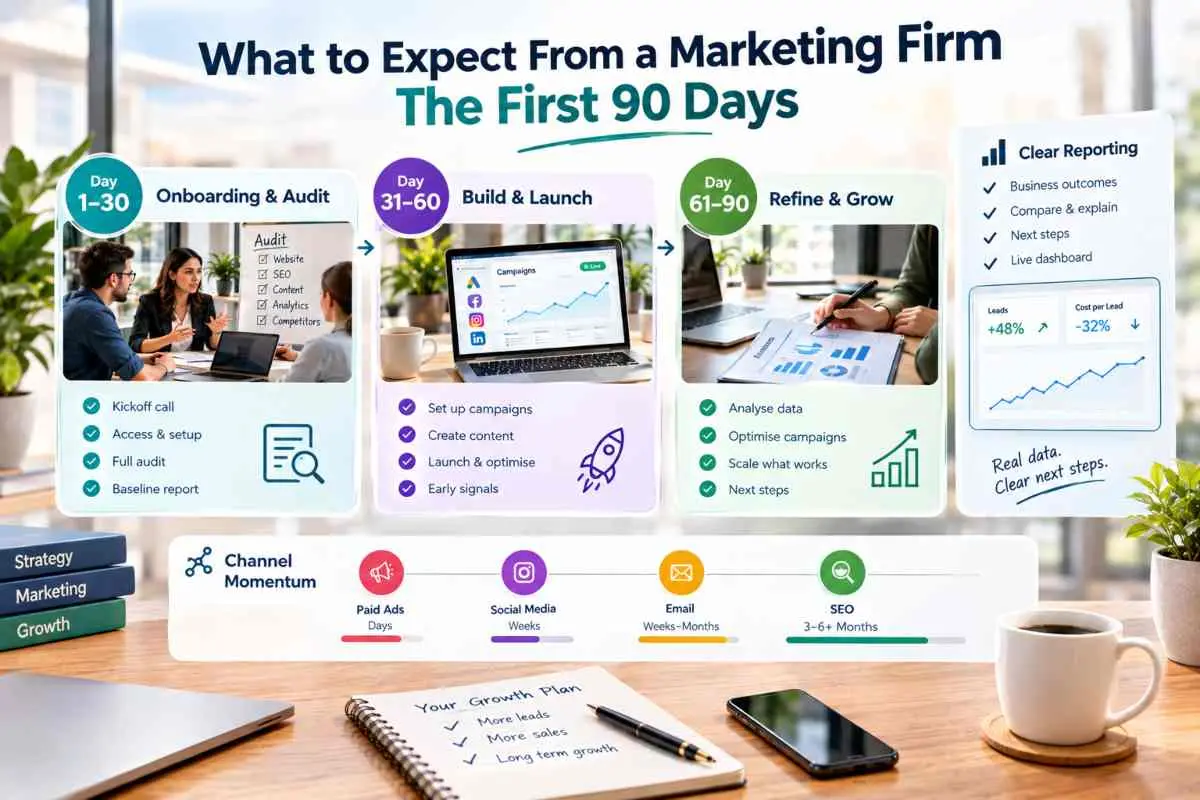
In the first 90 days, a good marketing firm will spend the first month learning your business and auditing your accounts, the second building and launching, and the third refining based on early data. You should see activity and clear communication straight away, early signals from faster channels such as paid ads, and the foundations for slower channels such as SEO, but not the full payoff yet.
Onboarding and audit
Onboarding is the first two to four weeks, when the firm gathers access, learns your business and checks the state of everything it will be working on. Expect a kickoff call about your customers, products, margins, competitors and goals, followed by requests for access to your website, analytics, search console, ad accounts and social profiles. The firm then audits what it finds, technical health and speed of your site, how you currently rank, the quality of your content, how well your tracking records enquiries and sales, and how your competitors are performing.
The audit should end in a written summary of what is working, what is broken and what the biggest opportunities are, along with the baseline numbers your progress will be measured against. This is also where honest firms flag problems that sit outside marketing, such as a slow website or a checkout that loses customers. If a firm skips the audit and starts spending your budget in week one, treat that as a warning sign.
First results timeline by channel (SEO takes longer than paid ads)
Results arrive at different speeds depending on the channel. Paid advertising is the fastest, campaigns can start generating clicks and enquiries within days of launch, though the first few weeks are usually a learning period in which the firm tests audiences, ads and bids. Email and social media can show early engagement within the first month or two, particularly if you already have a list or following to work with.
SEO is the slowest, because search engines need time to crawl, assess and trust your changes. In a poll of more than 3,600 SEO professionals by Ahrefs, 58% said it takes three to six months to see meaningful progress, while 19% said seven to twelve months. In the first 90 days of an SEO programme, expect technical fixes, improved pages, new content and early signs of movement, such as more impressions and better positions for lower-competition keywords, rather than a flood of new customers. New websites and highly competitive keywords take longer than established sites and niche terms.
A realistic picture at day 90 looks like this, paid campaigns are running and being optimised against actual cost per lead, email and social are building momentum, and SEO foundations are in place with early upward movement. Anyone promising top rankings in 30 days is selling something other than honesty.
What good reporting looks like
Good reporting tells you what happened, why it happened and what the firm will do next, in plain language that links back to the goals you agreed at the start. It leads with business outcomes such as enquiries, bookings, sales and cost per lead, and treats vanity numbers like impressions and follower counts as supporting detail rather than the headline.
In the first 90 days, expect a clear rhythm, a baseline report early in the engagement, a short update every week or two for fast-moving channels such as paid media, and a fuller monthly report with a call to talk it through. Each report should compare current results with the baseline and the previous period, explain anything that moved up or down, and end with specific next steps. You should also have direct access to your own data through a live dashboard or shared analytics account, so you are never relying only on the firm’s version of events.
Be wary of reports that are mostly screenshots with no context, that use the first month’s “average position improved” as proof of success, or that never mention what did not work. A firm that reports honestly on setbacks early is far more likely to tell you the truth when it matters.
How to Select the Right Digital Marketing Agency
The best digital marketing agency is one that has proven results in your industry, explains its pricing and scope in writing, reports honestly against goals you agree with and fits the way your team likes to work. Start with those four tests, then check the details below before you sign anything.
The choice is wide, which is why careful vetting matters. One 2026 guide counts 8,509 digital marketing agencies competing in a £35.5 billion UK market. With that many options, a polished website tells you little, and evidence tells you a lot.
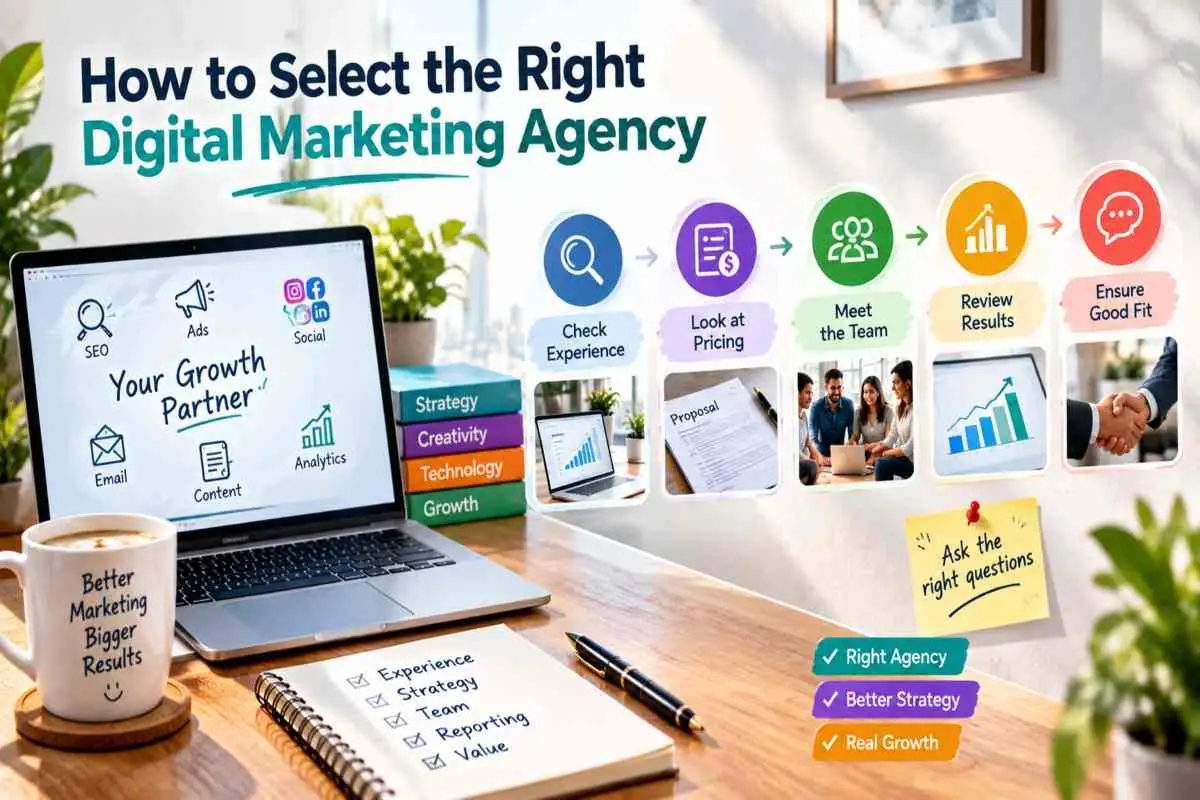
Questions to ask before you sign
The best questions force an agency to show how it works rather than what it claims. Ask them to describe a client similar to you, what they did for that client and what the numbers looked like before and after. Ask who will actually work on your account, how senior they are and how many other clients each person handles, because the people in the sales meeting are often not the people doing the work.
On scope and cost, ask exactly what the monthly fee includes, what is billed separately (ad spend, software, creative, extra revisions) and how scope changes are handled. On measurement, ask which goals they would track for you, how they set a baseline and how often you will see reports. On the relationship itself, ask about the contract length, the notice period and what you keep if you leave, including your accounts, content and data. Finally, ask what they would not recommend for your business. An agency willing to say no to a bad idea is usually one worth trusting.
Red flags (guaranteed rankings, no transparency and long lock ins)
The clearest red flag is a guarantee of rankings or results, because no agency controls Google’s algorithm or ad auctions. Anyone promising position one, or a fixed return in a fixed time, is either misleading you or using tactics that risk penalties later.
A lack of transparency is the second. Warning signs include refusing to name past clients, showing traffic graphs with no site attached, keeping ownership of your ad accounts or analytics in the agency’s name, and vague reports that never mention what did not work. Be cautious about pricing that is far below the market range or quoted with no written scope.
Long lock-ins are the third. A 12-month contract with no break clause for a business you have not worked with before shifts all the risk onto you. A fair agreement has a clear scope, a sensible notice period and full access to your own data and accounts throughout. Pressure to sign quickly, such as a “discount ends today” offer on a multi-month commitment, is a final sign to slow down.
what to look for and why it matters
| What to look for | Why it matters |
| Relevant case studies with named clients and real numbers | Shows the agency has solved problems like yours, not just made claims |
| Clear written scope and pricing | Lets you compare quotes fairly and avoid surprise charges |
| Named team and a single point of contact | Tells you who is accountable and how senior the people on your account are |
| Reporting tied to business goals | Keeps focus on leads and sales, not vanity metrics |
| You own your accounts, data and content | Protects you if you ever switch agencies |
| Fair contract terms and notice period | Limits your risk if the fit turns out to be wrong |
| Channel expertise that matches your needs | Ensures you pay for skills you will actually use |
| Honest timelines for results | Sets realistic expectations, especially for SEO |
| Transparent working process | Makes communication, approvals and turnaround predictable |
| Client references you can contact | Lets you hear directly how the agency behaves when things get difficult |
Local vs remote agency, and why working across UK and US time zones matters
A local agency gives you in-person meetings, local market knowledge and an easier relationship, while a remote agency widens your choice, often at lower cost and with deeper specialism. Neither is better by default. Location matters most for local SEO, regional advertising and businesses that value face-to-face planning, and matters least for channels such as content, paid media and technical SEO, which are delivered the same way from anywhere.
Time zones deserve a real conversation if you serve both the UK and the US. London is typically eight hours ahead of California and five ahead of New York, so the usable overlap for live calls can shrink to a few hours a day. Clock changes happen on different dates in each country, so the gap shifts for a few weeks each spring and autumn, which can quietly break a standing meeting time.
Ask any agency how it handles this, whether it has staff in or near your main market, what hours are covered for urgent issues, whether reporting is written and asynchronous or depends on live calls, and how quickly it responds to messages. An agency that is used to serving clients across both regions will already have clear answers. It should also understand regional differences in language, privacy rules and buying habits, so your campaigns feel natural to a British audience and an American one alike.
How IT Leadz Digital Solutions Helps
IT Leadz Digital Solutions is a digital marketing agency that provides SEO, AI optimisation, link building, social media and search marketing, web design and development, and website maintenance and hosting for businesses in the UK and US. Those are the same services described earlier in this guide, delivered by one team so your channels work together instead of competing for attention.
In practice, that means your SEO and link building build authority while AI optimization makes your content easier for tools like ChatGPT and Google’s AI Overviews to find and cite. Social media and search marketing bring in demand quickly, and a well-built website converts that traffic into enquiries. Ongoing maintenance and hosting keep the site fast, secure and online, so the work above is never undone by a technical failure.
Every engagement starts with an audit, as described in the first 90 days section, so recommendations are based on your site, your market and your goals rather than a standard package.
Frequently Asked Questions (FAQs)
What is a digital marketing agency in simple words?
In simple words, a digital marketing agency is a team you hire to promote your business online. It handles things like search engine optimization, paid ads, social media, email and website improvements, then reports on the results, so you can attract more customers without hiring and managing a full marketing department yourself.
What do digital marketing agencies do day to day?
Day to day, an agency researches keywords and audiences, creates content and ads, builds and tests landing pages, manages campaigns, earns links, monitors analytics and adjusts plans based on the data. Account managers keep you updated, and specialists handle each channel, with reporting at agreed intervals showing what is working and what comes next.
What is the difference between a marketing agency and a marketing firm?
There is no real difference. Both are outside businesses that plan and run marketing for clients, and the choice of word is mostly branding. Some use “agency” for creative, campaign-focused teams and “firm” for advisory, strategy-led providers, but this is a tendency, not a rule. Judge providers on services, experience and results instead.
What is a digital ad agency?
A digital ad agency specialises in paid online advertising. It plans, creates, buys and optimises ads across search engines, social platforms, display networks and video, then tracks performance to improve return on spend. It differs from a broader digital marketing agency by focusing on paid reach rather than organic channels like SEO and content.
Is hiring a digital marketing agency helpful for a small business?
Often, yes, when you lack the time or skills to run marketing yourself. An agency can cost less than a full-time hire and brings several specialists. It is less worthwhile if your budget is very small or your goals are unclear. Clutch research found 34% of small businesses outsource their digital marketing.
How long before an agency delivers results?
It depends on the channel. Paid ads can bring clicks and enquiries within days or weeks, while email and social often show early engagement in the first couple of months. SEO is slower, with most businesses seeing meaningful progress after three to six months, and competitive markets or new websites taking longer.
What is the difference between a digital agency and a marketing agency?
A digital agency typically builds and runs online products and experiences, such as websites, apps and ecommerce, and may also market them. A marketing agency covers promotion across any channel, online or offline. In practice the terms overlap, and many agencies offer both, so check the actual services offered rather than the name.
ists that a business hires to plan, run and measure its online digital marketing. It covers channels such as SEO, paid ads, social media, content, email and website design, so you get expert execution without recruiting a full in-house department.
The CMO Survey 2026 report found that 33.6% of digital marketing activity is now performed by external agencies, partners and services, which shows how normal it has become to share this work with specialists. The real question is no longer whether to use an agency, but what one actually does for the money and how to pick one worth keeping.
What Is a Digital Marketing Agency?
A digital marketing agency is a service business that takes responsibility for how other companies are found, chosen and remembered online. Instead of one employee juggling everything, you get a team of specialists, such as an SEO lead, a paid media buyer, a writer, a designer and an analyst, all working toward shared goals.
Digital marketing agency meaning in plain English
In plain English, a digital marketing agency is a hired team that puts your business in front of the right people online and helps turn them into customers. It works through search engines, social platforms, email, paid advertising and your website, and it reports on what is working so your budget goes where it earns a return.
The word “digital” separates it from agencies built around print, billboards, TV and radio, though many modern agencies blend both. You will also see the same idea called a digital agency, a digital marketing firm or a digital marketing company. In everyday use these labels mean much the same thing. Any real difference usually comes down to size, specialism or how the business chooses to describe itself.
How agencies differ from in house marketing teams and freelancers
An agency differs from an in house team and a freelancer mainly in breadth, capacity and accountability. An in house team knows your business inside out but is limited to the skills you can afford to hire. A freelancer is flexible and often cost-effective for one defined job, such as copywriting or ad management, but one person’s time only stretches so far, and your cover disappears when they are ill or fully booked.
An agency sits between the two. It brings several specialists, tested processes and paid tools under one contract, which makes it easier to run SEO, ads, content and web work as a single joined-up plan. The trade off is that you share the team’s attention with other clients and usually pay a monthly retainer. That makes an agency the strongest fit when you need several skills at once, or want to scale activity up or down without going through a hiring cycle.
Who actually hires a digital marketing agency
Businesses of almost every size hire digital marketing agencies, but for different reasons. Startups use them to gain early traction without hiring full-time staff, and a digital marketing agency for startups typically focuses on rapid testing and lean budgets.
Small and medium-sized businesses want professional marketing but cannot justify a whole department. Ecommerce brands lean on agencies for shopping ads, conversion optimisation and email. B2B companies bring them in for lead generation and content that supports long sales cycles, while local businesses such as clinics, trades and restaurants use them to win nearby searches through local SEO and reviews.
What Does a Digital Marketing Agency Do?
A digital marketing agency plans your online marketing, runs the campaigns across channels such as search, social, email and paid ads, then measures the results and keeps improving them. In short, it takes responsibility for getting your business found online and turning that attention into enquiries and sales.
Strategy and planning
Strategy and planning is where an agency decides what to do, in what order and why. It starts with research into your customers, your competitors and the keywords and platforms where your audience is active, then turns that into a plan with channels, budgets, timelines and targets. A good plan connects each activity to a business goal, such as more booked calls or a lower cost per sale, so you can tell afterwards whether it worked. Planning is not a one-off task. Agencies revisit it as results come in, as competitors move and as search engines and platforms change.
Campaign execution across channels
Execution is the hands-on production and management of the work. Depending on the plan, that can include writing and publishing content, fixing technical SEO issues, setting up and managing paid search and social ads, building landing pages, designing email sequences, posting and engaging on social media, and earning links from trusted sites. The value of using an agency is that these channels are coordinated. Your content supports your SEO, your ads send visitors to pages built to convert, and your emails follow up with people who have already shown interest, instead of each activity running on its own.
Reporting, analytics and optimisation
Reporting and analytics show whether the work is paying off, and optimisation uses that evidence to improve it. The agency sets up tracking so that calls, form submissions and sales are recorded, then reviews performance regularly and tests changes to ads, pages, emails and targeting.
This is what separates an active programme from a set-and-forget one, and it is what clients increasingly demand. In the 2026 AgencyAnalytics benchmarks report, based on a survey of 494 agency professionals, 55% said the question they hear most from clients is whether the agency can connect marketing performance to revenue. A competent agency should be able to answer that with data, not impressions and follower counts.
A typical week inside an agency
A typical week mixes planning, production and review, and the exact rhythm depends on the client and the channels. Here is a short, concrete example for an account running SEO, paid search and email.
On Monday, the team reviews the weekend’s performance, checks that ad budgets are pacing correctly and looks for any drop in traffic or leads that needs investigating. Tuesday is usually production day, writers draft a new article or update an older page, a designer prepares assets, and the SEO specialist fixes technical issues flagged in the latest site crawl. On Wednesday, the paid media manager reviews search terms, pauses poor performers, adjusts bids and launches a new ad variation to test against the current best.
Thursday focuses on email and outreach, with a campaign or automation reviewed and scheduled, and link-building outreach sent to relevant publications. On Friday, the account manager pulls the week’s results together, notes what worked and what did not, and prepares the next week’s priorities, plus a call or written update for the client. Once a month, that rolling work is wrapped into a fuller report and a strategy review, so the plan keeps pace with what the numbers are showing.
Digital Marketing Agency Services Explained
Digital marketing agencies typically offer eight core services, SEO and AI search optimisation, paid search, social media, content and link building, email marketing, web design, analytics and reporting, and website maintenance. Most agencies bundle several of these into one plan, so the table below shows what each service is, who it suits and what it usually delivers.
| Service | What it is | Who it suits | Typical outcome |
| SEO and AI search optimisation | Improving your visibility in Google results and in AI-generated answers | Businesses that want lasting, compounding traffic | More qualified organic visits and citations in AI answers over time |
| PPC and paid search | Paying for ads that appear when people search for your offer | Businesses that need leads quickly or want to test demand | Fast, measurable enquiries and sales |
| Social media and paid social | Building an audience and running targeted ads on social platforms | Consumer brands, ecommerce and service businesses that benefit from visibility | Awareness, engagement and a steady stream of leads |
| Content marketing and link building | Publishing useful content and earning links from trusted sites | Companies with considered purchases or long sales cycles | Stronger authority, rankings and trust |
| Email marketing and automation | Sending timed, relevant messages to subscribers and customers | Ecommerce, subscription and B2B businesses with a contact list | Repeat purchases and warmer leads |
| Web design, development and conversion optimisation | Building and improving a site so more visitors take action | Any business whose site looks dated or converts poorly | Higher conversion rates and a better user experience |
| Analytics, tracking and reporting | Measuring what marketing produces and reporting it clearly | Anyone spending money on marketing who wants proof of return | Clear data for better decisions and budget use |
| Website maintenance and hosting | Keeping a site secure, fast, updated and online | Businesses that rely on their website to trade | Fewer outages, better security and steady performance |
SEO and AI search optimisation (AEO / GEO)
SEO and AI search optimization make your business easier to find in Google results and in answers written by AI tools such as ChatGPT, Google’s AI Overviews and Perplexity. Traditional SEO services combine on page SEO, which fixes your titles, content and site structure, with off page SEO, which earns the links and mentions that build authority. AI optimization extends that work by shaping your content so AI systems can understand, extract and cite it. The shift is already under way, The CMO Survey 2026 report found that 41.5% of marketing teams are already working on their visibility inside AI search answers.
PPC and paid search advertising
Pay-per-click advertising places your business at the top of search results the moment someone searches for what you sell, and you pay only when they click. A good agency running PPC services handles keyword research, ad copy, bidding, landing pages and ongoing testing across platforms like Google Ads and Microsoft Advertising. It suits businesses that want leads quickly, or that want to test a market before committing to slower channels such as SEO.
Social media marketing and paid social
Social media marketing builds an audience and keeps your brand visible on platforms like Instagram, Facebook, LinkedIn and TikTok, while paid social ads target advertising to reach people who do not yet follow you. The right mix depends on where your customers spend time. A B2B firm will usually prioritise LinkedIn, while a consumer brand may lean on Instagram and TikTok.
Content marketing and link building
Content marketing creates articles, guides and pages that answer the questions your customers ask, and link building earns the trusted mentions that help those pages rank. The two work best together, because strong content gives other sites a reason to link to you. Keeping older pages accurate matters as well, which is why regular content updates are part of any serious content plan.
Email marketing and automation
Email marketing keeps you in touch with people who already know your business, and automation sends the right message at the right moment, such as a welcome series, an abandoned basket reminder or a follow-up after enquiry. Professional email marketing is one of the cheaper ways to drive repeat sales, since you are talking to an audience that has already shown interest.
Web design, development and conversion optimisation
Web design and development shape how your site looks and works, and conversion optimisation improves how many visitors become customers. A site can attract plenty of traffic and still lose sales if it loads slowly, confuses visitors or hides the next step. Agencies fix this through layout testing, clearer calls to action and website customization services that adapt your site to how your customers actually behave.
Analytics, tracking and reporting
Analytics and reporting show what your marketing is producing, so you can keep what works and drop what does not. This means setting up tools like Google Analytics 4, tracking calls, form fills and sales, and turning the numbers into plain-language reports. Our approach to regular monitoring and reporting is built around one idea, you should always be able to see where your money went and what it returned.
Website maintenance and hosting
Website maintenance and hosting keep your site secure, fast and online, which protects both your rankings and your customers’ trust. Website maintenance covers updates, backups, security checks and fixes, while hosting and domain management keep the site reachable. Many agencies treat this as an add-on, but we include it in our service mix alongside SEO, AI optimization, link building, social media and search marketing, and web design and development, so one team looks after the whole of your online presence.
How Do Digital Marketing Agencies Work?
Digital marketing agencies work in a repeating cycle, they learn your business, set goals, build a plan, run campaigns, test what happens and report the results. Each stage feeds the next, so the work gets sharper over time rather than staying fixed to a plan written in month one.
Discovery, audit and goal setting
An agency begins by finding out where your business stands and what you want to achieve. That usually means a kickoff conversation about your products, customers, margins and competitors, followed by an audit of your website, search visibility, ad accounts, social profiles and analytics setup.
The audit shows what is working, what is broken and what you are missing entirely, such as tracking that never recorded your enquiries. Goal setting turns the findings into targets tied to the business, like more qualified leads, lower cost per sale or higher repeat purchases, rather than vanity numbers like followers or impressions.
Strategy, roadmap and KPIs
Strategy turns the audit into a plan, which channels to use, in what order, with what budget and for which audiences. The roadmap sets out the work month by month, so you can see when fast-moving activity such as paid ads will run and when slower channels like SEO and content are expected to start paying back.
The agency then agrees on a small set of key performance indicators (KPIs), the handful of figures that show whether the plan is succeeding. Good KPIs link to revenue, for example booked calls, sales or cost per lead, and each one has a baseline from your audit so progress can be measured honestly.
Execution and testing
Execution is the hands-on work, building and optimising pages, writing content, setting up and managing campaigns, earning links, designing emails and publishing posts. Testing runs alongside it, because no agency can predict precisely what will resonate with your audience. Teams compare two versions of an ad, headline, landing page or email, keep the one that performs better and test again. This steady loop of small improvements is what separates an agency that compounds results from one that simply keeps campaigns running.
Reporting cadence and communication
Most agencies report on a monthly rhythm, with lighter weekly or fortnightly check-ins for fast-moving work like paid campaigns. A useful report explains what happened, why it happened and what happens next, using plain language and tied back to your agreed KPIs rather than a pile of charts. Communication matters as much as the numbers.
In a survey of 500 US small business owners, 40% of the SMBs that outsource their marketing to an agency churn, and more than half of those who leave do so within 6 to 12 months. Clear expectations, regular conversations and honest reporting are the simplest defences against that kind of early breakdown, so ask any agency how usually you will meet and who your day to day contact will be.
Retainer, project-based and performance-based models
Agencies charge in three main ways. A retainer is a specified monthly fee for ongoing work, which suits channels that need continuous attention such as SEO, paid media, social and email. A project-based model sets a fixed price for a defined piece of work, like a website build, a brand refresh or a one-off audit, and ends when the work is delivered. A performance-based model ties some or all of the fee to results, such as leads generated or revenue won, which can feel appealing but works only when results can be tracked cleanly and the incentives are clear.
Many businesses combine models, for instance a project fee to rebuild a website followed by a retainer to grow traffic to it. The right choice depends on whether your need is ongoing or one-off, how easily results can be measured, and how much flexibility you want to scale spend up or down.
Types of Digital Agencies
Digital agencies fall into a few main types based on how much they cover and what they specialise in, full-service agencies, specialist agencies, digital ad agencies, digital media agencies and digital marketing firms. Knowing the differences helps you match the agency to the problem you want solved rather than paying for services you do not need.
Full-service digital marketing agency
A full-service digital marketing agency handles most online marketing under one roof, typically SEO, paid advertising, social media, content, email, web design and analytics. Because one team plans and runs everything, the channels support each other, your content feeds your SEO, your ads send traffic to pages built to convert, and one set of reports shows how it all fits together.
This type suits businesses that want a single point of contact and a joined-up strategy, and do not have the time or in-house skills to manage several suppliers. The trade-off is that a broad agency may be less deep in any one channel than a dedicated specialist.
Specialist agencies (SEO, PPC, social and content)
A specialist agency focuses on one channel or discipline, such as SEO, pay-per-click advertising, social media or content, and aims to be among the best at that one thing. Specialists tend to bring sharper technical knowledge, more experience with edge cases and a narrower, more focused service.
They suit businesses that already have an in-house team and need expert help in one area, or that want to prove a single channel before widening the budget. The demand is real, in a US survey of 500 small business owners, the services most often outsourced to agencies were social media management, email marketing and paid search advertising. The main drawback is coordination, since you may need to manage several specialists and make sure their efforts point the same way.
What is a digital ad agency / digital advertising agency?
A digital ad agency, also called a digital advertising agency, specialises in paid online promotion, planning, creating, buying and optimising advertisements across channels such as search, social platforms, display networks and video. Its work centres on the full life of a campaign, from the creative idea and ad copy through targeting, bidding, testing and performance tracking.
It differs from a broader digital marketing agency in focus, because it concentrates on paid reach rather than earned channels like SEO and organic content. A digital ad agency is the natural choice when your priority is fast, measurable visibility and your main question is how to turn ad spend into leads or sales.
What is a digital media agency?
A digital media agency plans and buys the online space where your message appears, and measures how well that exposure performs. It focuses on audience research, media planning and buying, and ongoing optimisation across channels such as programmatic display, online video, connected TV, audio and social.
The line between a digital media agency and a digital ad agency is blurry, since the two overlap heavily. In general, an ad agency leans toward the creative and campaign side, while a media agency leans toward audience data, placement and buying at scale. Media agencies are most common with larger advertisers running sizeable, multi-channel budgets, though smaller businesses sometimes use the term loosely for agencies that run paid and social campaigns.
What is a digital marketing firm?
A digital marketing firm is another name for a digital marketing agency, a company that plans and runs online marketing for clients. In everyday use the words “firm” and “agency” are interchangeable, and which one a business uses is mostly a branding choice. If a provider calls itself a firm, it may suggest a consultancy-style approach with more emphasis on strategy and advice, but that is a tendency rather than a rule. The more useful questions are what services the company offers, which industries it knows well and how it measures results, not what it calls itself.
Marketing Agency vs Marketing Firm vs Marketing Company
A marketing agency, a marketing firm and a marketing company are, in everyday use, the same thing, a business that plans and delivers marketing for other businesses. The words overlap so heavily that most providers use them interchangeably, and the real differences lie in size, structure, specialism and whether the work is digital or traditional.
Marketing agency vs marketing firm
There is no meaningful difference between a marketing agency and a marketing firm. Both describe an outside business that handles marketing on behalf of clients, and the label is usually a branding choice. Where a distinction exists, “agency” tends to suggest a creative, campaign-led team that produces and runs the work, while “firm” can suggest a more consultative, advisory style. “Marketing company” is the broadest and loosest term of the three, and it can cover anything from a one-person studio to a large multi-service group.
When you compare providers, look past the label. Size, team structure, specialism and track record tell you far more than whether a business calls itself an agency, a firm or a company. A small specialist agency and a large full-service firm can both be excellent. They are simply built for different jobs.
Marketing agency vs advertising agency
A marketing agency covers the whole journey from attracting a customer to keeping one, while an advertising agency focuses on promotion, the ideas, creative work and media that get your message in front of an audience. Marketing includes research, positioning, pricing advice, content, email, SEO, social, events and more. Advertising is one part of that mix, built around paid placements and campaign creative.
In practice the line has blurred. Many advertising agencies now offer content and social services, and many marketing agencies run paid campaigns. If you need a brand campaign with strong creative, an advertising agency may be the natural fit. If you need an ongoing plan that connects several channels, a marketing agency is usually the better match.
Digital marketing agency vs traditional marketing agency
A digital marketing agency works mainly through online channels such as search engines, social platforms, email and websites, while a traditional marketing agency works through offline media such as print, television, radio, billboards and direct mail. The biggest practical difference is measurement. Digital campaigns can be tracked click by click, so you can see what drove each enquiry and adjust quickly.
Traditional campaigns are harder to attribute, though they can still build broad awareness and local presence. Many businesses now use both, and plenty of agencies blend the two. For most small and mid-sized businesses, digital channels offer the clearest link between spend and results, which is why they often form the core of the plan, with traditional media added where it suits the audience.
Agency vs consultant vs freelancer vs in-house
An agency, a consultant, a freelancer and an in-house team all do marketing work, but they differ in who does it, how deep the expertise goes and how you pay. The right choice depends on how much work you have, how many skills you need and how much control you want.
| Option | What it is | Best for | Main strength | Main limit | Typical cost model |
| Agency | A team of specialists delivering ongoing marketing | Businesses needing several skills at once | Breadth, capacity and joined-up delivery | Shared attention across clients | Monthly retainer or project fee |
| Consultant | An expert who advises and plans, usually without running the work | Businesses with a team that needs direction | Senior strategic insight | Limited hands-on delivery | Day rate or fixed project fee |
| Freelancer | An individual contractor for a defined task | One-off or narrow needs, such as copy or ad management | Flexibility and value for a single skill | One person’s capacity and range | Hourly, day or per-project rate |
| In-house team | Employees who work only for your business | Larger or steady workloads | Deep brand knowledge and full control | Salaries, hiring time and skill gaps | Salary plus benefits |
Most businesses end up using a mix rather than choosing one option. The CMO Survey’s 2026 report found that companies build marketing capability in-house 59.5% of the time and work with partners 38.5% of the time, with agencies making up 15.5% of that effort. The pattern suggests a hybrid approach is the norm, an internal team keeps hold of brand and strategy, while agencies and other partners supply the specialist skills and extra capacity.
How Much Does a Digital Marketing Agency Cost in the UK and US?
Most digital marketing agencies charge a monthly retainer, and in the UK a single-channel retainer typically lands between £1,250 and £3,500, while US small-business engagements more often fall between $5,000 and $10,000. Costs climb steeply with scope, so a broad, multi-channel programme can run well past those figures in either market.
| What you’re buying | UK (£ per month) | US ($ per month) |
| Single-channel retainer (SEO, PPC or social) | £1,250 to £3,500 | $1,500 to $5,000 for most small and mid-market SEO campaigns |
| Typical small-business agency spend | £1,000 to £10,000 for digital marketing overall | $5,000 to $10,000 for most small-business retainers |
| Broad or full-service retainer | £3,500 to £16,750 | $2,500 to $30,000 across the wider market |
These ranges come from different sources with different methods, and they are not currency conversions of each other, so treat them as market benchmarks rather than quotes. Exchange rates move, and it is worth confirming whether a quote includes VAT or sales tax.
Monthly retainers vs one-off project pricing
A retainer is a fixed monthly fee for ongoing work, while project pricing is a single fee for a defined deliverable such as a website build or a campaign launch. Retainers suit channels that need steady attention, like SEO, paid media and email. A survey of more than 220 agencies cited by Swydo found that nearly 80% of agencies use some form of retainer-based model.
Project pricing fits one off needs. A basic small business website rebuild in the US typically runs $5,000 to $25,000, and a campaign launch with creative landing pages and ad setup is often $10,000 to $30,000 as a one time fee. Many businesses start with a project to test an agency quality before committing to a retainer, which lowers the risk of a long contract with the wrong partner.
What affects the price (scope, channels, competition and agency size)
Four things drive agency pricing, how much work you want done, how many channels it spans, how competitive your market is and the size and seniority of the agency. Each one changes how many hours of expert time your plan needs.
Scope and channels The number of channels in your digital marketing strategy is one of the biggest drivers of cost. One channel with monthly reporting costs far less than a coordinated plan covering SEO, paid ads, content, email and social.
Competition Ranking for a crowded keyword such as “personal injury lawyer” takes more content, links and effort than ranking for a niche local term, so competitive sectors pay more. Sectors that are subject to regulation, including finance, healthcare, and the legal field also cost more, because the agency needs compliance knowledge.
Agency size and location Larger agencies and those in expensive cities charge more. A retainer that costs £2,000 a month from a Manchester agency might be £3,500 from an equivalent in central London. In the US the geographic gap appears to be narrowing, and one 2026 pricing guide notes that location matters less than it did five years ago.
New AI-related services Work that includes AI search optimization is priced higher in many quotes. The Digital Agency Network reports that AI enhanced services command 20% to 50% higher rates than their manual counterparts.
Red flags in agency pricing
The biggest pricing red flag is not a high price but a price you cannot explain. Watch for these warning signs:
- Vague scope A retainer that does not list deliverables, hours or channels makes it impossible to judge value. A £2,000 or $2,500 retainer can mean light on-page work and a report at one agency and a full programme at another.
- Guaranteed rankings or results No honest agency can promise a position on Google or a fixed return, because search engines and ad auctions are outside anyone’s control.
- Long lock-in with no exit Be cautious about 12-month contracts without a break clause, particularly if you have not worked with the agency before.
- Prices far below market A quote far under the typical range for the work often means junior staff, automated output or corners cut. The market is a barbell, with 64% of agencies in one survey of 260 charging under $1,000 a month, so a rock-bottom price tells you little about quality.
- Hidden extras Ask whether ad spend, software, reporting and creative are included or billed separately.
- Pure performance deals with no baseline Fees tied to results sound attractive, but they only work when outcomes can be tracked cleanly and the starting point is agreed in writing.
Pricing transparency is rare, so some opacity is normal. When one research team checked 50 UK marketing agency websites in July 2026, 47 published no price at all. Ask for a written scope, a clear list of what is and is not included and the reporting you will receive before you compare quotes. Agencies that answer plainly are usually the ones worth shortlisting.
What to Expect From a Marketing Firm The First 90 Days
In the first 90 days, a good marketing firm will spend the first month learning your business and auditing your accounts, the second building and launching, and the third refining based on early data. You should see activity and clear communication straight away, early signals from faster channels such as paid ads, and the foundations for slower channels such as SEO, but not the full payoff yet.
Onboarding and audit
Onboarding is the first two to four weeks, when the firm gathers access, learns your business and checks the state of everything it will be working on. Expect a kickoff call about your customers, products, margins, competitors and goals, followed by requests for access to your website, analytics, search console, ad accounts and social profiles. The firm then audits what it finds, technical health and speed of your site, how you currently rank, the quality of your content, how well your tracking records enquiries and sales, and how your competitors are performing.
The audit should end in a written summary of what is working, what is broken and what the biggest opportunities are, along with the baseline numbers your progress will be measured against. This is also where honest firms flag problems that sit outside marketing, such as a slow website or a checkout that loses customers. If a firm skips the audit and starts spending your budget in week one, treat that as a warning sign.
First results timeline by channel (SEO takes longer than paid ads)
Results arrive at different speeds depending on the channel. Paid advertising is the fastest, campaigns can start generating clicks and enquiries within days of launch, though the first few weeks are usually a learning period in which the firm tests audiences, ads and bids. Email and social media can show early engagement within the first month or two, particularly if you already have a list or following to work with.
SEO is the slowest, because search engines need time to crawl, assess and trust your changes. In a poll of more than 3,600 SEO professionals by Ahrefs, 58% said it takes three to six months to see meaningful progress, while 19% said seven to twelve months. In the first 90 days of an SEO programme, expect technical fixes, improved pages, new content and early signs of movement, such as more impressions and better positions for lower-competition keywords, rather than a flood of new customers. New websites and highly competitive keywords take longer than established sites and niche terms.
A realistic picture at day 90 looks like this, paid campaigns are running and being optimised against actual cost per lead, email and social are building momentum, and SEO foundations are in place with early upward movement. Anyone promising top rankings in 30 days is selling something other than honesty.
What good reporting looks like
Good reporting tells you what happened, why it happened and what the firm will do next, in plain language that links back to the goals you agreed at the start. It leads with business outcomes such as enquiries, bookings, sales and cost per lead, and treats vanity numbers like impressions and follower counts as supporting detail rather than the headline.
In the first 90 days, expect a clear rhythm, a baseline report early in the engagement, a short update every week or two for fast-moving channels such as paid media, and a fuller monthly report with a call to talk it through. Each report should compare current results with the baseline and the previous period, explain anything that moved up or down, and end with specific next steps. You should also have direct access to your own data through a live dashboard or shared analytics account, so you are never relying only on the firm’s version of events.
Be wary of reports that are mostly screenshots with no context, that use the first month’s “average position improved” as proof of success, or that never mention what did not work. A firm that reports honestly on setbacks early is far more likely to tell you the truth when it matters.
How to Select the Right Digital Marketing Agency
The best digital marketing agency is one that has proven results in your industry, explains its pricing and scope in writing, reports honestly against goals you agree with and fits the way your team likes to work. Start with those four tests, then check the details below before you sign anything.
The choice is wide, which is why careful vetting matters. One 2026 guide counts 8,509 digital marketing agencies competing in a £35.5 billion UK market. With that many options, a polished website tells you little, and evidence tells you a lot.
Questions to ask before you sign
The best questions force an agency to show how it works rather than what it claims. Ask them to describe a client similar to you, what they did for that client and what the numbers looked like before and after. Ask who will actually work on your account, how senior they are and how many other clients each person handles, because the people in the sales meeting are often not the people doing the work.
On scope and cost, ask exactly what the monthly fee includes, what is billed separately (ad spend, software, creative, extra revisions) and how scope changes are handled. On measurement, ask which goals they would track for you, how they set a baseline and how often you will see reports. On the relationship itself, ask about the contract length, the notice period and what you keep if you leave, including your accounts, content and data. Finally, ask what they would not recommend for your business. An agency willing to say no to a bad idea is usually one worth trusting.
Red flags (guaranteed rankings, no transparency and long lock ins)
The clearest red flag is a guarantee of rankings or results, because no agency controls Google’s algorithm or ad auctions. Anyone promising position one, or a fixed return in a fixed time, is either misleading you or using tactics that risk penalties later.
A lack of transparency is the second. Warning signs include refusing to name past clients, showing traffic graphs with no site attached, keeping ownership of your ad accounts or analytics in the agency’s name, and vague reports that never mention what did not work. Be cautious about pricing that is far below the market range or quoted with no written scope.
Long lock-ins are the third. A 12-month contract with no break clause for a business you have not worked with before shifts all the risk onto you. A fair agreement has a clear scope, a sensible notice period and full access to your own data and accounts throughout. Pressure to sign quickly, such as a “discount ends today” offer on a multi-month commitment, is a final sign to slow down.
what to look for and why it matters
| What to look for | Why it matters |
| Relevant case studies with named clients and real numbers | Shows the agency has solved problems like yours, not just made claims |
| Clear written scope and pricing | Lets you compare quotes fairly and avoid surprise charges |
| Named team and a single point of contact | Tells you who is accountable and how senior the people on your account are |
| Reporting tied to business goals | Keeps focus on leads and sales, not vanity metrics |
| You own your accounts, data and content | Protects you if you ever switch agencies |
| Fair contract terms and notice period | Limits your risk if the fit turns out to be wrong |
| Channel expertise that matches your needs | Ensures you pay for skills you will actually use |
| Honest timelines for results | Sets realistic expectations, especially for SEO |
| Transparent working process | Makes communication, approvals and turnaround predictable |
| Client references you can contact | Lets you hear directly how the agency behaves when things get difficult |
Local vs remote agency, and why working across UK and US time zones matters
A local agency gives you in-person meetings, local market knowledge and an easier relationship, while a remote agency widens your choice, often at lower cost and with deeper specialism. Neither is better by default. Location matters most for local SEO, regional advertising and businesses that value face-to-face planning, and matters least for channels such as content, paid media and technical SEO, which are delivered the same way from anywhere.
Time zones deserve a real conversation if you serve both the UK and the US. London is typically eight hours ahead of California and five ahead of New York, so the usable overlap for live calls can shrink to a few hours a day. Clock changes happen on different dates in each country, so the gap shifts for a few weeks each spring and autumn, which can quietly break a standing meeting time.
Ask any agency how it handles this, whether it has staff in or near your main market, what hours are covered for urgent issues, whether reporting is written and asynchronous or depends on live calls, and how quickly it responds to messages. An agency that is used to serving clients across both regions will already have clear answers. It should also understand regional differences in language, privacy rules and buying habits, so your campaigns feel natural to a British audience and an American one alike.
How IT Leadz Digital Solutions Helps
IT Leadz Digital Solutions is a digital marketing agency that provides SEO, AI optimisation, link building, social media and search marketing, web design and development, and website maintenance and hosting for businesses in the UK and US. Those are the same services described earlier in this guide, delivered by one team so your channels work together instead of competing for attention.
In practice, that means your SEO and link building build authority while AI optimization makes your content easier for tools like ChatGPT and Google’s AI Overviews to find and cite. Social media and search marketing bring in demand quickly, and a well-built website converts that traffic into enquiries. Ongoing maintenance and hosting keep the site fast, secure and online, so the work above is never undone by a technical failure.
Every engagement starts with an audit, as described in the first 90 days section, so recommendations are based on your site, your market and your goals rather than a standard package.
Frequently Asked Questions (FAQs)
What is a digital marketing agency in simple words?
In simple words, a digital marketing agency is a team you hire to promote your business online. It handles things like search engine optimization, paid ads, social media, email and website improvements, then reports on the results, so you can attract more customers without hiring and managing a full marketing department yourself.
What do digital marketing agencies do day to day?
Day to day, an agency researches keywords and audiences, creates content and ads, builds and tests landing pages, manages campaigns, earns links, monitors analytics and adjusts plans based on the data. Account managers keep you updated, and specialists handle each channel, with reporting at agreed intervals showing what is working and what comes next.
What is the difference between a marketing agency and a marketing firm?
There is no real difference. Both are outside businesses that plan and run marketing for clients, and the choice of word is mostly branding. Some use “agency” for creative, campaign-focused teams and “firm” for advisory, strategy-led providers, but this is a tendency, not a rule. Judge providers on services, experience and results instead.
What is a digital ad agency?
A digital ad agency specialises in paid online advertising. It plans, creates, buys and optimises ads across search engines, social platforms, display networks and video, then tracks performance to improve return on spend. It differs from a broader digital marketing agency by focusing on paid reach rather than organic channels like SEO and content.
Is hiring a digital marketing agency helpful for a small business?
Often, yes, when you lack the time or skills to run marketing yourself. An agency can cost less than a full-time hire and brings several specialists. It is less worthwhile if your budget is very small or your goals are unclear. Clutch research found 34% of small businesses outsource their digital marketing.
How long before an agency delivers results?
It depends on the channel. Paid ads can bring clicks and enquiries within days or weeks, while email and social often show early engagement in the first couple of months. SEO is slower, with most businesses seeing meaningful progress after three to six months, and competitive markets or new websites taking longer.
What is the difference between a digital agency and a marketing agency?
A digital agency typically builds and runs online products and experiences, such as websites, apps and ecommerce, and may also market them. A marketing agency covers promotion across any channel, online or offline. In practice the terms overlap, and many agencies offer both, so check the actual services offered rather than the name.