SEO content marketing is the practice of creating helpful content built around what people search for, so your pages earn visibility in Google and AI search, attract qualified visitors and turn them into customers. Instead of treating SEO and content as separate jobs, it uses search demand to decide what to publish.
This guide is written for marketers, founders and business owners in the UK and US who want a repeatable strategy rather than guesswork. You’ll learn how the two disciplines work together within a wider digital marketing plan, what benefits to expect, how to build a strategy step by step, which best practices matter most, how to prepare content for AI search and how to measure results.
What Is SEO Content Marketing?
SEO content marketing definition
SEO content marketing is a strategy that plans, creates and publishes content around what people actually search for, so your pages rank in search engines and get cited in AI generated answers. Instead of writing first and hoping for traffic, you start with the questions your audience asks, match the depth and format they expect and optimize each page to be found, understood and trusted.
The payoff is measured in organic visits, leads and revenue. The channel matters because BrightEdge research found organic search supplied 53% of all trackable website traffic, ahead of every other channel. That figure comes from 2019 data, so treat it as a benchmark of search’s long standing weight rather than a 2026 measurement.
What does SEO stand for in content marketing?
SEO stands for search engine optimization (spelled “optimisation” in the UK). In content marketing, it means shaping each piece of content so search engines and AI systems can find it, interpret it and consider it worth showing. That covers matching search intent, choosing clear titles and headings, structuring answers so they are easy to extract, linking related pages together and building the credibility signals that make a page trustworthy. SEO is not a trick applied after writing. It is a set of decisions made before, during and after a piece is published.
What is the role of SEO and content in digital marketing?
Content gives your brand something worth ranking and SEO makes sure the right people can find it. Together they act as the foundation of a wider digital marketing plan, a single well optimized guide can attract search traffic, supply material for email and social posts, support paid landing pages and answer questions that sales teams hear every week.
Unlike paid ads, which stop delivering when the budget does, strong content keeps earning visibility and can compound over time. If you’d rather have specialists handle the technical and strategic side, professional SEO services can build that foundation alongside your content.
SEO content marketing vs content marketing vs SEO
Content marketing is the broader practice of creating valuable material to attract and retain an audience and it can live on any channel, social media, email, video, podcasts or events. SEO is the technique of improving visibility in search results and it includes work that has nothing to do with writing, such as site speed, crawlability, structured data and link building.
SEO content marketing is where the two overlap. It uses search demand to decide which content to create and it uses content to give SEO something valuable to rank. A business can do content marketing without SEO or technical SEO without much content, but combining them is what produces lasting organic growth.
How SEO and Content Marketing Work Together
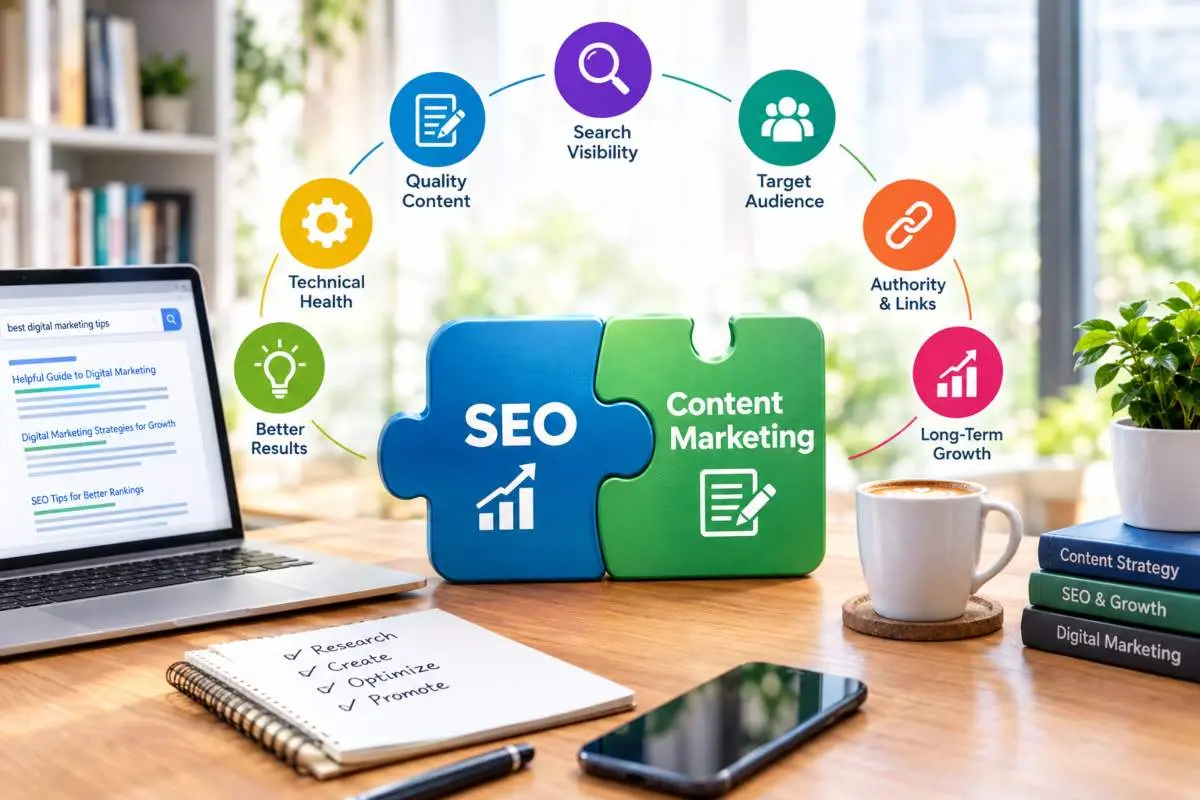
The relationship between content marketing and SEO
Content marketing and SEO depend on each other, content gives search engines something worth ranking and SEO gets that content in front of people who are looking for it. Without SEO, even excellent articles can sit unseen.
The scale of that problem is large. Ahrefs found that 96.55% of the pages in its index get zero traffic from Google. Without strong content, SEO has nothing to work with beyond technical housekeeping. When the two are planned together, every page starts with a real search need and a clear way to meet it.
Is content marketing part of an SEO strategy?
Yes. Content is one of the core pillars of a modern SEO strategy, alongside technical health and authority building. Search engines rank pages and pages need substance, answers, expertise, examples and a structure that matches what the searcher wants.
Technical SEO makes a site crawlable and link building adds credibility, but neither can create relevance on its own. That is why most effective SEO plans include a content roadmap covering the topics to publish, the intent each page serves and how pages connect through internal links.
Content marketing vs SEO, which strategy is better?
Neither is better on its own, because they solve different problems. If you publish helpful content that nobody can find, you have a visibility problem that SEO fixes. If your site is technically sound but has nothing valuable to say, you have a relevance problem that content fixes.
For most businesses, the sensible choice is to fix whichever gap is bigger first, then combine them. A new site with no content usually benefits from publishing targeted pages early, while an established blog with weak rankings often needs optimization, restructuring and better internal links.
Why “content is king” is only half true
“Content is king” is true only when the content is findable, relevant and trusted. Quality writing does not rank by default. It has to match search intent, target topics people actually search for, load quickly and earn signals of credibility such as links and brand mentions.
The same Ahrefs research shows that having content does not guarantee traffic, which is why distribution and optimization matter just as much as the writing itself. A better version of the saying is that useful content is king and SEO is how it reaches the throne room.
Where SEO fits in a broader marketing strategy
SEO works best as a long term foundation that supports other channels rather than competing with them. Search captures people who already have a need, so it feeds sales, email lists, retargeting and social campaigns with warm, high intent visitors.
The insights it produces are also useful elsewhere, keyword research reveals customer language and top performing pages show which messages resonate. Treat it as the part of your marketing that compounds over time, while paid ads and social campaigns deliver faster, shorter bursts of attention.
Benefits of SEO Content Marketing
SEO content marketing earns qualified visitors by publishing pages that answer what your buyers search for and it pays off through lasting visibility, falling acquisition costs, credibility, better leads and a clear link to revenue. The five benefits below each stand on their own.
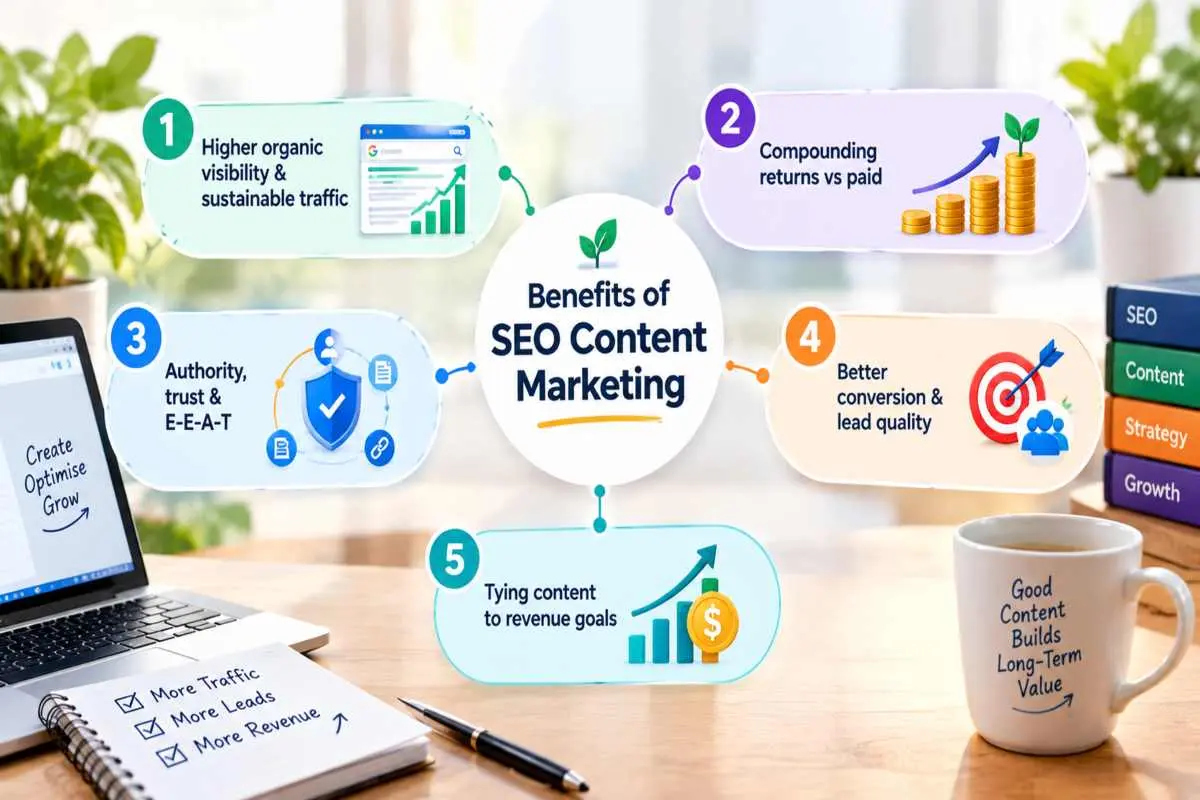
Higher organic visibility and sustainable traffic
SEO content marketing puts your business in front of people at the moment they are looking for a solution, without paying for each visit. Search remains the largest single source of site visits, BrightEdge research found that organic search drives about 53% of trackable website traffic. A page that matches a searcher’s intent and ranks well keeps sending visitors for months or years, which makes traffic far more stable than campaign driven spikes.
Compounding returns compared with paid channels
Paid advertising stops delivering the moment the budget stops, while a well built article keeps working after it is published. Each page can attract new visitors, collect backlinks and strengthen the pages it links to, so results build on each other over time. The upfront effort is higher and the payoff slower than with ads, but the average cost of each lead typically falls as your library of ranking content grows.
Authority, trust and E-E-A-T
Consistently publishing accurate, experience based content shows both search engines and buyers that your business knows its field. Google’s quality guidelines assess experience, expertise, authoritativeness and trustworthiness and content written by named practitioners, supported by real examples and kept current, meets those signals far better than generic copy. Trust built this way also shortens sales conversations, because prospects often arrive already convinced of your competence.
Better conversion and lead quality
Searchers who find you through a specific question tend to be further along in their decision than people who see an interruptive ad. Content that matches intent, such as a comparison page for buyers weighing options or a pricing guide for those ready to budget, attracts people with a real need. Pairing each page with a relevant next step, like a consultation request or audit offer, turns that interest into leads that need less qualifying.
Tying SEO content to revenue goals
SEO content marketing becomes a growth channel, not just a traffic source, when each page is mapped to a stage of the buying journey and a measurable outcome. Start from revenue targets and work backward: decide how many leads you need, which services drive the most profit and which search topics those buyers use. Then track conversions, pipeline value and closed deals by page, not rankings alone, so you can invest more in what produces revenue and retire what does not.
How to Build an SEO Content Marketing Strategy (Step by Step)
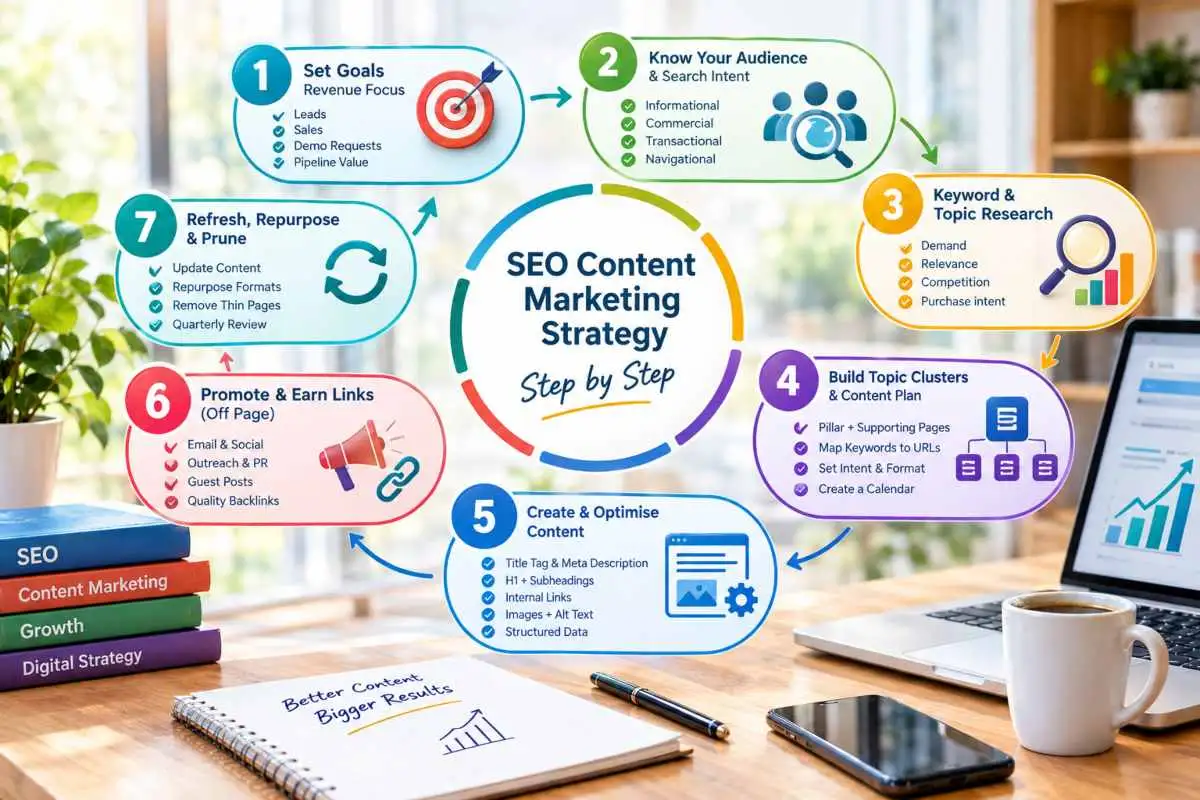
Step 1, Set goals tied to revenue
Start by defining what the content must achieve for the business, such as qualified leads, sales, demo requests or pipeline value, rather than chasing traffic alone. Traffic is a means, not the outcome. Work backwards from a revenue target, if you need a set number of customers, estimate the leads required, the share that can realistically come from organic search and the conversion rate your pages must reach. Then choose a few measurable indicators, such as organic conversions, rankings for priority topics and assisted revenue, so every later decision can be judged against something concrete.
Step 2, Understand your audience and search intent
Understanding your audience means learning who is searching, what problem they have and what kind of answer they expect. Search intent is usually informational (learn something), commercial (compare options), transactional (buy or sign up) or navigational (find a specific site). Check the search results for each target topic, if Google shows step by step guides, a sales page will struggle to rank. Talk to customers and sales teams, read support questions and review on site search data. The language people use there often reveals the exact phrases and concerns your content should address.
Step 3, Keyword and topic research
Keyword and topic research identifies the searches worth targeting, based on demand, relevance, competition and how close they sit to a purchase. Begin with seed topics from your products and customer problems, expand them with keyword tools and “People also ask” questions and then prioritise by realistic opportunity rather than raw volume.
Choose one primary keyword per page and group related phrases beneath it to avoid competing with yourself. Ahrefs advises choosing topics with organic traffic potential, matching search intent and building backlinks if you want to be among the pages that get search traffic. Research is where that advice becomes a working list.
Step 4, Build topic clusters and a content plan
A topic cluster is a set of interconnected pages created around one broad subject, with a central guide linking to focused supporting articles and each supporting article linking back. This structure displays search engines that your site covers a subject in depth and helps visitors move naturally between pages.
Map each keyword group to one URL, assign an intent and format (guide, comparison, how to, case study) and set a publishing order that starts with the topics closest to revenue. Put the plan in a simple calendar with owners and deadlines so publishing stays consistent.
Step 5, Create and optimise content (on page essentials)
Creating SEO content means answering the searcher’s question clearly, accurately and in more useful detail than the pages already ranking, then optimising the page so it can be understood. The essentials of on page SEO include a clear title tag and meta description, a single H1, logical subheadings, descriptive URLs, internal links, optimised images with alt text and structured data where relevant.
Lead each section with a direct answer, back claims with evidence or first hand experience and write for readers first. Pages that are easy for people to scan are also easier for AI systems to quote.
Step 6, Promote and earn links (off page content marketing)
Promotion makes sure good content gets seen and earning links gives it the authority to compete. Share each page with your email list, social audience and partners and pitch it to journalists, bloggers and industry communities who would find it genuinely useful. Original research, practical tools, expert commentary and clear data tend to attract links more naturally than general articles.
Digital PR, guest contributions and mentions in trusted publications also help, as brand mentions increasingly influence how search and AI systems judge credibility. Focus on relevance and quality, since a handful of respected links outweighs many weak ones.
Step 7, Refresh, repurpose and prune content
Content maintenance keeps your pages accurate and competitive over time. Review performance regularly, refresh pages that are slipping by updating facts, examples and internal links; repurpose strong pieces into formats such as video, email series or social posts; and merge, redirect or remove thin, outdated or overlapping pages that compete with better ones. Show a clear “last updated” date when changes are substantive. A quarterly review is enough for most sites and it often delivers faster gains than publishing something new.
SEO Content Marketing Best Practices
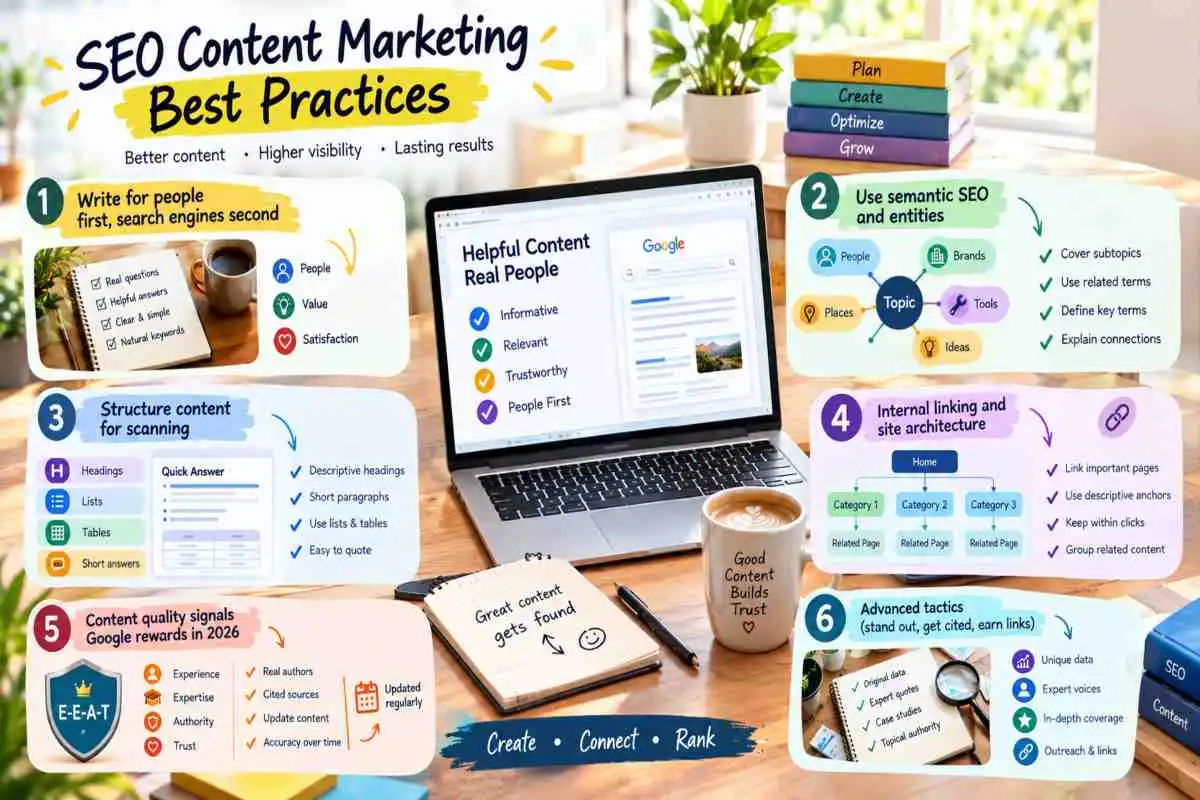
Write for people first, search engines second
Write for the reader first, then optimize, because Google states that its ranking systems prioritize helpful, reliable information created to benefit people rather than to manipulate rankings. Google also says SEO is useful when it is applied to people first content, not content made mainly to gain rankings. In practice, that means starting every piece with a clear question, who is this for, what do they need to decide or do and would they leave satisfied? Use keywords where they fit naturally, explain things plainly and cut anything that exists only to pad length or repeat a phrase.
Use semantic SEO and entities
Semantic SEO means covering a topic by its meaning, concepts and relationships instead of repeating one keyword. Search engines and AI systems recognise entities, such as people, brands, tools, places and ideas and judge how well a page explains how they connect.
To apply this, include the subtopics a knowledgeable person would expect, use consistent terminology, define key terms the first time they appear and mention related entities in context. A guide that explains the concept, its parts, its uses and its limits will usually match more searches than one fixated on a single phrase.
Structure content for scanning (headings, lists, tables)
Structure content so a reader or an AI system can find a specific answer in seconds. Use descriptive headings that signal what each section answers, open each section with a one or two sentence answer and keep paragraphs short.
Lists suit sequences and checklists and tables suit comparisons with several attributes, but prose should carry most of the explanation. Avoid decorative formatting that adds nothing. A well organised page is also easier to quote, which improves your chances of appearing in featured snippets and AI generated summaries.
Internal linking and site architecture
Internal links suggest search engines which pages matter and how topics relate and they guide visitors toward the next useful step. Link from high traffic or high authority pages to important ones, use descriptive anchor text that reflects the destination and keep key pages within a few clicks of the homepage. Group related content under logical sections so the structure mirrors how people think about the subject. Review links whenever you publish or update a page, so new content is not left isolated and old pages point to the best current resources.
Content quality signals Google rewards in 2026
Google rewards content that shows real experience, expertise, authority and, above all, trust. Its guidance says trust is the most important of these qualities, so accuracy, transparent authorship, clear sourcing and honest claims carry more weight than polish. Practical signals include named authors with relevant credentials, first hand examples, cited evidence, a clear purpose for each page and no misleading headlines. Accuracy over time matters too, so keep a record of content updates and display an update date when you make meaningful changes, not cosmetic ones.
Advanced tactics (original data, expert quotes, topical authority)
Advanced tactics make your content difficult to replace. Original data, such as a survey, benchmark or analysis of your own results, gives others something to cite and gives AI systems a unique fact to reference. Expert quotes and first hand case studies add credibility that rewritten summaries cannot match.
Topical authority comes from covering a subject thoroughly and consistently over time, so search engines learn to associate your site with it. Pair these tactics with outreach and, where needed, professional link building services so strong pages also earn the links that help them compete.
SEO Content Marketing for AI Search (AEO and GEO)
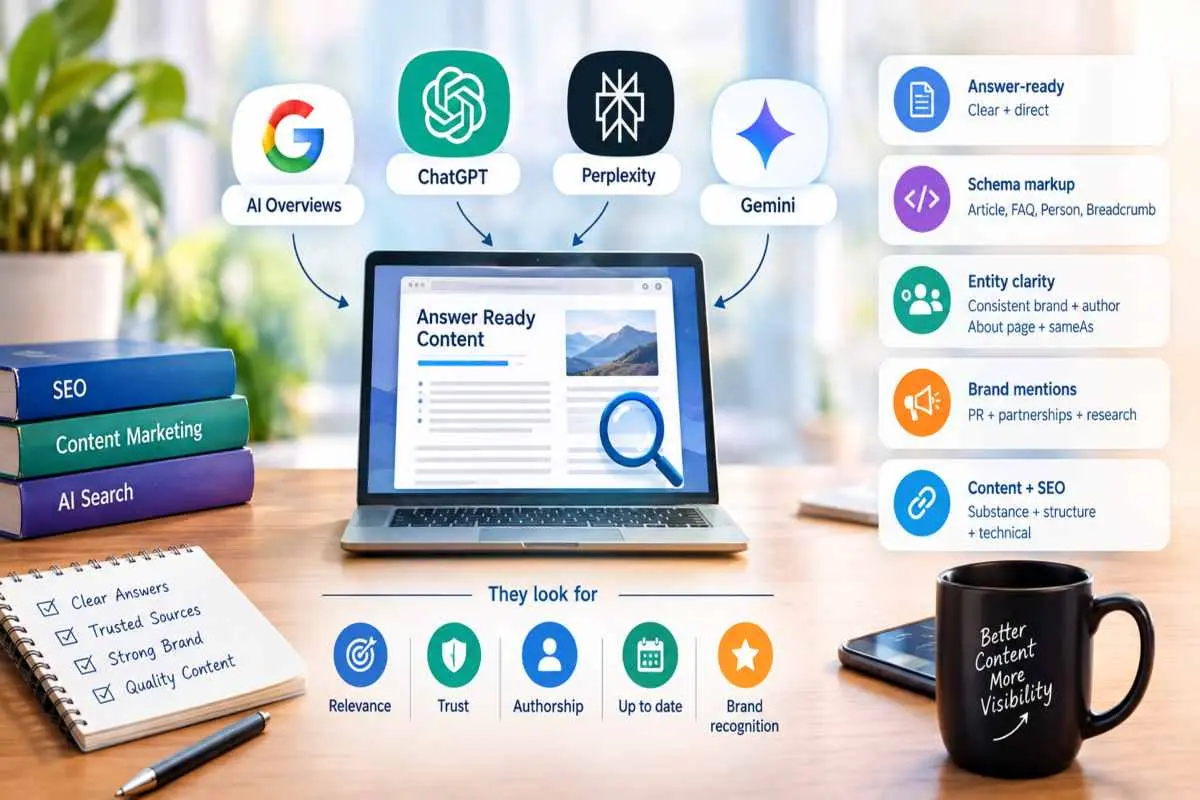
How AI Overviews, ChatGPT, Perplexity and Gemini choose sources
AI search tools generally pick sources that are relevant to the question, easy to extract an answer from and trusted across the web. Google’s AI Overviews and Gemini draw on Google’s index and ranking signals, while ChatGPT and Perplexity retrieve live results from their own search partners and crawlers, then summarise what they find.
Exact selection rules are not published, so treat any formula with caution. What holds across platforms is that pages with a clear answer, credible authorship, up to date facts and wider recognition of the brand are more likely to be used. Pages blocked from crawlers, slow to load or vague in their answers are easy to skip.
Writing answer ready, quotable passages
An answer ready passage resolves a question in its first sentence or two and then adds context, so it can be lifted out without losing meaning. Write each section around one question, state the answer directly and follow with the reason, an example or a qualification.
Keep sentences concrete, name the subject instead of relying on “it” or “this” and include one verifiable fact where possible. Avoid openings that delay the point, such as long scene setting or rhetorical questions. A passage that makes sense on its own is more likely to be quoted, whether it appears in a snippet or an AI generated summary.
Schema markup and entity clarity
Schema markup is structured data that tells machines what a page is about, who wrote it and which organisation stands behind it. Useful types for content include Article, FAQPage organization, Person (for authors) and BreadcrumbList. It does not guarantee inclusion in AI answers, but it removes ambiguity and supports rich results.
Entity clarity goes beyond code, use your brand and author names consistently, keep an About page and author bios that match your profiles elsewhere and link to authoritative profiles with the sameAs property. The goal is for any system to recognise exactly who you are and what you are credible about.
Brand mentions and citations as ranking signals
Brand mentions and citations act as signals of recognition, the more trusted sources discuss your brand in relation to a topic, the more confident AI systems are in naming it. Ahrefs’ study of 75,000 brands found that branded web mentions had the strongest correlation with brand visibility in AI Overviews, at 0.664 and that the top three correlations were all off site factors.
Correlation does not prove causation, but the pattern suggests that being discussed elsewhere matters as much as optimising your own pages. Earn mentions through original research, expert commentary, partnerships and PR and learn how to track brand visibility in AI mode so you can see where you appear.
Is content marketing the new SEO?
Content marketing is not replacing SEO, but the two are merging into one discipline. Search engines and AI assistants both need credible, well structured content to draw on and both reward brands that are widely recognised for a topic.
Traditional SEO still handles crawlability, relevance and links, while content marketing supplies the substance, expertise and reputation that AI systems increasingly rely on. The practical shift is that rankings are no longer the only goal, being cited, quoted and recommended counts too. A strategy that combines both, measured by visibility as well as traffic, is the safest approach.
The SEO Content Marketing Process, From Idea to Published Page
Briefs, drafting, editing and optimisation checklist
A reliable SEO content process moves a page through four stages, brief, draft, edit and optimise. The brief comes first, because it fixes the target keyword, search intent, audience, angle, required subtopics, competing pages to beat, internal links and the action you want readers to take. Drafting then follows the brief, leading each section with a direct answer. Editing checks accuracy, clarity and tone.
Optimisation comes last. Google encourages creators to assess content by asking who created it, how it was made and why it exists and it says evaluating your content against its questions helps you judge whether it is helpful and reliable. A short pre publication checklist keeps those standards consistent,
The page answers the main question in its opening lines.
- Title, meta description, H1 and URL reflect the primary keyword naturally.
- Facts, figures and claims are verified and sourced.
- Internal links, image alt text and schema are in place.
- The author is named and the page has a clear next step.
Roles and workflow
A small team can run this process with four roles, even when one person covers several. A strategist or SEO lead chooses topics and writes briefs, a writer creates the draft, an editor checks accuracy and quality and a technical or web owner handles publishing, schema and performance.
Subject matter experts add first hand insight and review claims, which strengthens trust. Work moves in a fixed order, brief approved, draft written, expert review, edit, optimisation, final sign off, publish. Setting deadlines and a single owner for each stage prevents pages from stalling and a shared content calendar shows what is in progress, what is blocked and what is due for an update.
Publishing and promotion routine
Publishing is the start of a page’s performance, not the end of the process. After launch, request indexing in Google Search Console, confirm the page renders correctly and check that internal links from related pages point to it. Then run a repeatable promotion routine, share it with your email list and social audience, send it to partners or experts quoted in the piece and pitch it to publications or communities where it adds value. Review early results after a few weeks, looking at impressions, rankings, clicks and conversions and adjust titles, headings or internal links where the page underperforms. Record what worked so the next brief starts from evidence.
How to Measure SEO Content Marketing Success
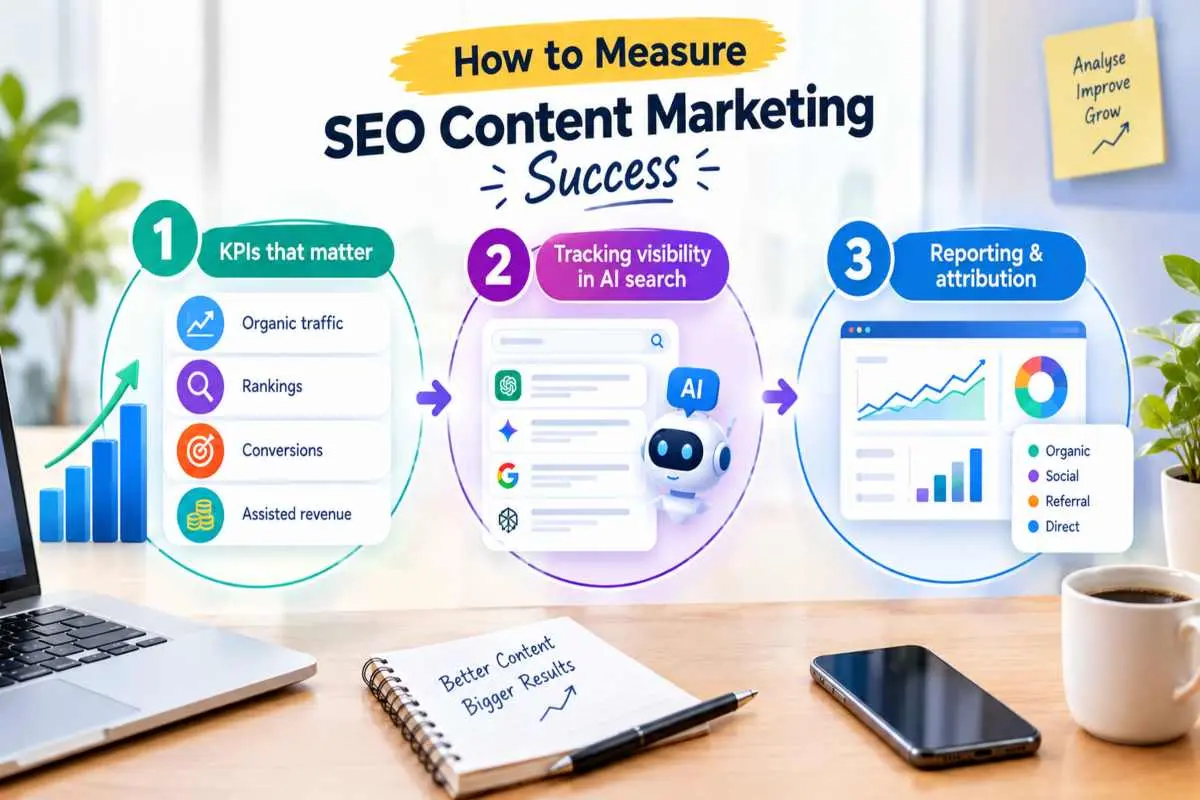
KPIs that matter (organic traffic, rankings, conversions, assisted revenue)
The most useful KPIs for SEO content marketing connect search visibility to business results, organic traffic, rankings for priority topics, conversions from organic visits and assisted revenue. Organic traffic shows whether content is being found, but it should be segmented by page type and intent, so a spike on irrelevant topics does not look like progress. Rankings show momentum for the keywords you chose to target.
Conversions, such as enquiries, sign ups and purchases, show whether the right people arrived. Assisted revenue credits pages that influenced a sale without being the last click, which is often how informational content works. Together these explain why content marketing is important to growth, it earns attention that turns into a measurable pipeline.
Tracking visibility in AI search
Tracking AI search visibility means measuring how often your pages and brand appear in AI generated answers, not only in traditional results. Google gives a starting point, in June 2026 it launched Search Generative AI performance reports in Search Console, with dedicated views of impressions in AI Overviews and AI Mode, rolled out first to a subset of websites.
Availability and metrics may have changed since launch, so check what your property shows. At the time of the launch, the reports focused on impressions rather than clicks. Supplement them with manual checks of target questions in ChatGPT, Perplexity and Gemini, noting whether your brand is mentioned, cited or recommended and log the results monthly to spot trends.
Reporting and attribution
Good reporting answers one question, what did our content contribute to the business and what should we do next? Build a monthly report that starts with outcomes (conversions and assisted revenue), then supports them with visibility and engagement data from Search Console, your analytics platform and your CRM.
Use consistent attribution rules and say which model you use, since first touch, last touch and multi touch views tell different stories. Expect SEO to compound over months, so compare periods year on year and track content cohorts by publication date. Finish each report with decisions, pages to refresh, topics to expand and experiments to run.
SEO Content Marketing Examples
Example 1, Educational guide that earned links (B2B)
A B2B software company might publish a thorough guide on a problem its buyers face, such as how to choose and implement a procurement process and win links because it is the most useful resource on that topic. The approach works like this, research the questions buyers ask, build a single in depth guide with original diagrams or a short survey of customers, then share it with industry newsletters, partners and associations.
Links matter here because Ahrefs’ large scale study found that pages with more referring domains tend to get more Google traffic. The guide also feeds the sales process, as prospects arrive already informed and sales teams can send it during evaluation.
Example 2, Comparison or data led content (e commerce or SaaS)
Comparison and data led pages capture shoppers who are close to a decision, so they suit online stores and software products. An online retailer might publish a buying guide that compares product types by use case, materials, price range and care, with clear recommendations and honest trade offs. A SaaS company might publish an alternatives page or a benchmark report drawn from its own anonymised usage data.
Both formats work because they answer a commercial question directly and give AI systems a clear, quotable summary. To support them, align the content with your product and category pages, following ecommerce SEO fundamentals such as clean category structure, product schema and internal links to relevant items.
Example 3, Local intent content (UK and US)
Local intent content helps a business appear when people search for a service in or near a specific place. A UK accountancy firm might publish a guide to Making Tax Digital requirements for small businesses, while a US home services company might explain permit rules or seasonal maintenance for a particular state. In both cases the content shows local knowledge that a generic national article cannot.
Pair it with a complete, consistent Google Business Profile, accurate name, address and phone details across directories, local business schema and genuine reviews. Use the right terminology for each market, for example “VAT” in the UK and “sales tax” in the US and avoid duplicating the same page across regions with only the place name swapped.
Common SEO Content Marketing Mistakes to Avoid
The most common SEO content marketing mistakes are mismatched intent, thin content, keyword stuffing, skipping promotion, ignoring measurement and cannibalising your own pages. They matter because most published content never gets found, Ahrefs reported that 96.55% of the pages in its index receive zero traffic from Google. Avoiding the errors below puts a page in a much better position.
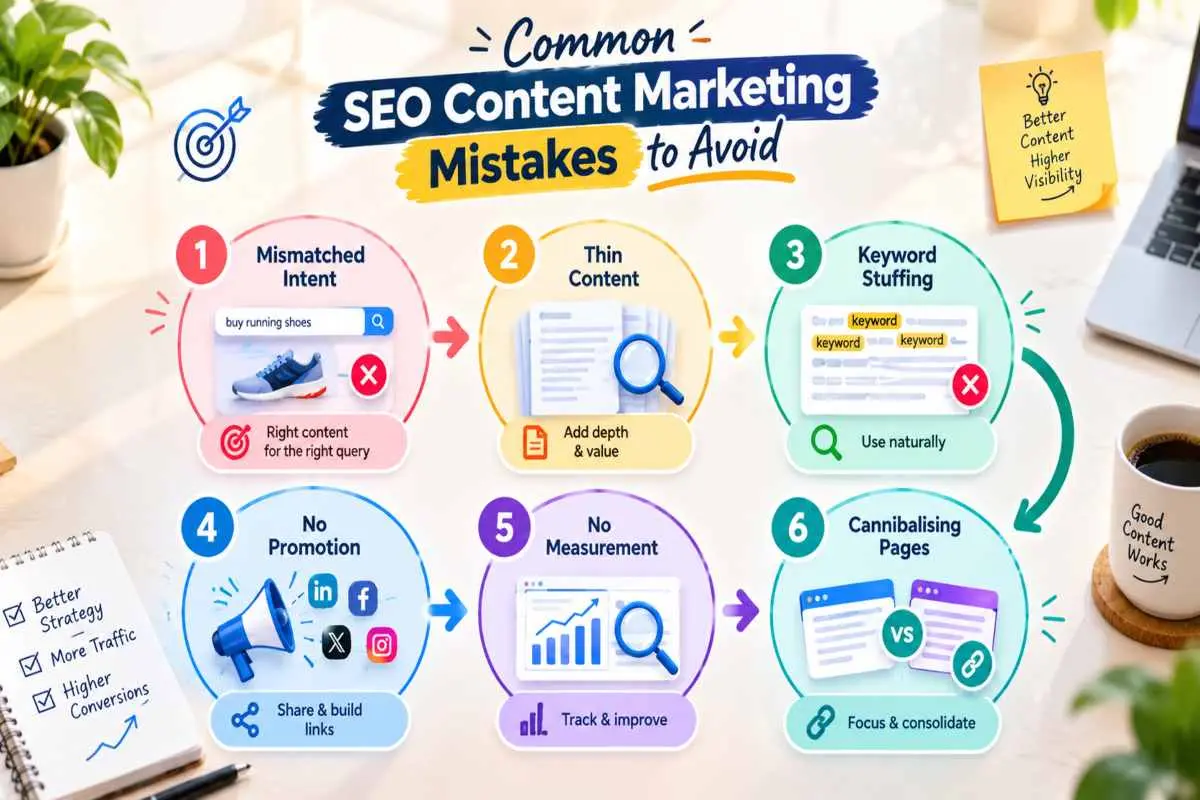
Mismatched intent
Mismatched intent happens when a page answers a different question from the one searchers are asking. A sales page aimed at a keyword where Google shows how to guides or a long essay for a query that wants a quick comparison, will struggle however well it is written. Fix it by reviewing the results already ranking for your target phrase, noting the format, depth and angle they share and building a page that fits the same need while adding something better.
Thin content
Thin content offers little original value, short pages, rewritten summaries of other articles or sections that repeat obvious points without examples. Search engines and AI systems have no reason to prefer it over stronger sources. Avoid it by covering the subject more completely than competing pages, adding first hand experience, data or practical examples and removing filler. Length alone is not the goal; usefulness per section is.
Keyword stuffing
Keyword stuffing means forcing a phrase into headings, paragraphs or alt text far more often than natural writing would. It makes content awkward to read and Google’s guidance favours content created for people over content made to manipulate rankings. Use the primary keyword where it fits, such as the title, the H1 and an early sentence, then rely on related terms, synonyms and clear explanations to cover the topic naturally.
No promotion
Publishing without promotion assumes search engines will discover and rank a page on their own, which rarely happens for new or competitive topics. Pages need internal links from related content, a place in your email and social channels and outreach to people who would value the piece. Even a simple routine, repeated for every page, helps content earn the visits, mentions and links that support rankings.
No measurement
Without measurement, you cannot tell which content drives results, so you repeat what fails and abandon what works. Set goals before publishing and track the metrics that connect to them, organic traffic, rankings, conversions and assisted revenue. Review performance monthly, then update, expand or retire pages based on evidence rather than assumptions.
Cannibalising your own pages
Keyword cannibalisation happens when several pages on your site target the same query and intent, so they compete with each other and split rankings, links and clicks. Prevent it by assigning one primary keyword and intent to each URL, keeping a content map and checking it before commissioning new articles. If overlap already exists, merge the weaker pages into the strongest one and redirect the old URLs.
SEO Content Marketing for Beginners, Quick Start Checklist
If you are new to SEO content marketing, start with a small, repeatable routine, pick topics people search for, answer them better than existing pages and measure what happens. The channel is worth the effort, since BrightEdge research found organic search supplied 53% of trackable website traffic. That figure comes from 2019 data, but it shows how much search matters. Work through this checklist for every page,
- Set one clear goal, such as leads, sales or sign ups.
- Pick one primary keyword and check what kind of results Google shows for it.
- Define who the page is for and what they need to know.
- Write a direct answer in the first one or two sentences.
- Cover the related questions and subtopics a reader would expect.
- Optimise the title, meta description, headings, URL and image alt text.
- Add internal links to related pages and a clear next step.
- Publish, share it with your audience and request indexing in Search Console.
- Review results after a month, then update the page based on what you learn.
Conclusion
SEO content marketing works when search research, useful writing and promotion are planned together, choose topics people actually search for, answer them clearly, earn trust through evidence and mentions and measure results against business goals. It also now supports visibility in AI search, so the same discipline serves both traditional rankings and AI answers. Start with one well researched page, improve it using what the data shows, then repeat. If you would like expert help building the strategy, explore our SEO services on IT Leadz or get in touch to talk through a content review for your site.
Frequently Asked Questions (FAQs)
What is SEO content marketing?
SEO content marketing is the practice of creating content around what people search for, so your pages rank in Google and appear in AI answers. It uses keyword and intent research to decide what to publish, then turns visitors into leads and customers.
How do content marketing and SEO work together?
Content gives search engines useful pages to rank and SEO helps people find those pages. Planning them together means each article targets a real search need, is structured clearly and links to related pages, so content earns visibility and visibility brings qualified visitors.
Does content marketing help SEO?
Yes. Content gives your site pages that can rank for more searches, attract links and demonstrate expertise. It only helps when it matches search intent and is high quality, because publishing more pages without usefulness or promotion rarely improves rankings on its own.
Is content marketing part of SEO?
Content is a core part of SEO, but content marketing is broader. SEO also covers technical health and link building, while content marketing includes channels such as email, social and video. SEO content marketing is where the two overlap, using search demand to guide what you create.
What is the difference between content marketing and SEO?
Content marketing aims to attract and retain an audience with valuable content across any channel. SEO aids to enhance visibility in search results, including technical and link work. One is about creating value for people, the other is about being found. Together they reinforce each other.
How long does SEO content marketing take to work?
Most sites see early movement within three to six months, with stronger results after six to twelve. Timing depends on competition, site authority, content quality and publishing consistency. New sites usually take longer, while updating existing pages can deliver faster gains than starting from scratch.
What is SEO in digital marketing?
In digital marketing, SEO is the practice of improving a website so it seems higher in unpaid search results for relevant queries. It brings in people who are already looking for what you offer and it supports other channels such as email, social and paid campaigns.
Is SEO still worth it with AI search?
Yes. AI search tools draw on web content and brands that rank, are cited and are widely mentioned tend to appear more often. SEO now includes clear answers, structured data and authority signals, so the work still supports both traditional rankings and AI visibility.