If you run a local business, you already know the hardest part isn’t offering a great service; it’s staying visible in a world where customers search, compare, and decide in minutes. Someone nearby needs what you sell right now, but if your business doesn’t show up when they look, they’ll call the competitor who does.
That’s exactly why digital marketing for local businesses isn’t optional anymore. It’s the system that helps you get discovered in your area, earn trust faster, and turn attention into real outcomes, phone calls, bookings, walk-ins, quote requests, and repeat customers. And unlike broad digital marketing, local marketing has its own rules. You’re not trying to reach everyone. You’re trying to reach the right people in the right place at the right moment, often on mobile, often in Google, often with high intent.
This guide is built to be your complete roadmap. You’ll learn what local business digital marketing actually is, why it works so well when it’s done correctly, and how to build a strategy that doesn’t rely on guesswork. We’ll walk through the core channels that drive local growth, local SEO, Google Business Profile, website conversion, paid ads, content, social, and retention, then show you how to measure results, run audits, fix what’s holding you back, and scale what’s working.
Whether you’re starting from zero or trying to improve existing efforts, the goal is simple: create a repeatable digital marketing strategy that consistently generates leads and sales for your local business, without wasting budget, chasing trends unthinkingly, or competing with yourself across multiple pages.
Let’s start by defining what local digital marketing means, and what makes it different from regular digital marketing.
What Is Local Business Digital Marketing?
Local business digital marketing is the set of online strategies that help a business attract customers within a specific geographic area, such as your city, neighborhood, or service radius. Instead of chasing broad reach, digital marketing for local businesses focuses on visibility where it matters most: in the moments people nearby are actively searching for a solution you provide.
In simple terms, digital marketing for local businesses means showing up when local customers are ready to choose, then making it easy for them to call, visit, book, or request a quote. It blends discovery (getting found), trust (getting chosen), and conversion (getting contacted), all tied to location-based intent.
If you’ve ever wondered what local business in digital marketing is, the answer is this: it’s not a different version of marketing, it’s marketing shaped by proximity, urgency, and real-world outcomes. The local business meaning in digital marketing is about turning online attention into offline action.
Local vs Regular Digital Marketing (What Changes and Why)
Traditional digital marketing often aims for scale, more impressions, broader audiences, national or global reach, and long buying cycles. But local business digital marketing plays by different rules because your customers are close, and their decision window is shorter.
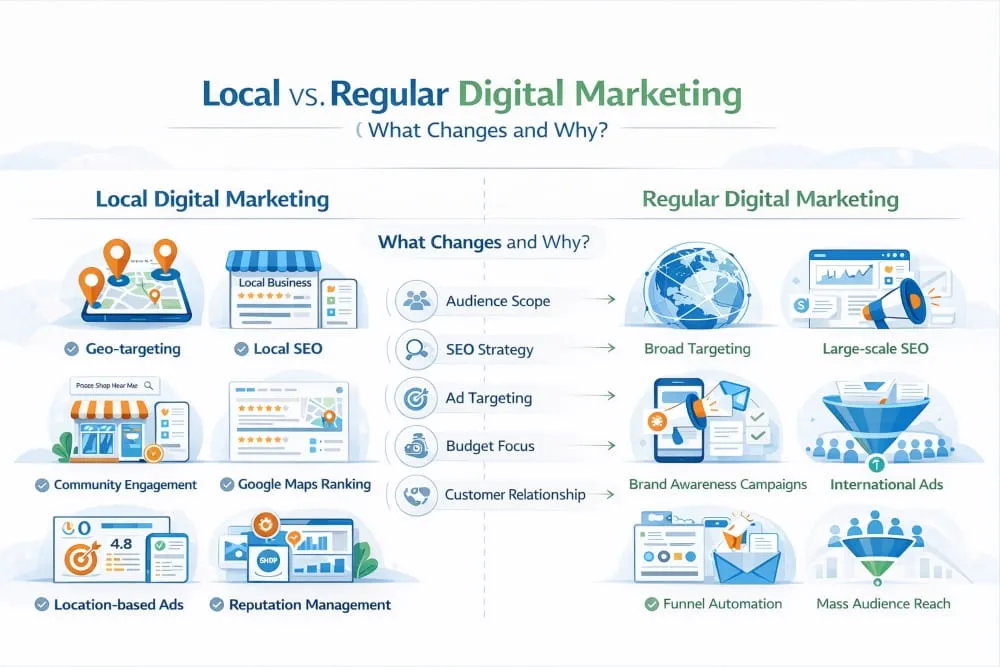
Local customers don’t usually spend weeks researching. They search, scan results, compare a few options, and act fast. That means the most important assets aren’t always fancy campaigns; they’re the basics done exceptionally well: strong local visibility, clear service information, credibility signals like reviews, and an easy way to contact you.
So the biggest change is the goal. Regular digital marketing can measure success in clicks and awareness. Digital marketing success for local businesses is measured by leads, calls, bookings, store visits, and revenue, because local marketing is closer to the moment of purchase.
How Customers Search Locally (Maps, “near me,” Mobile-first Behavior)
Local search behavior is high-intent and location-driven. People rarely type long, detailed queries when they need a local solution. They use quick phrases, near me searches, and map results, especially on their phones.
Most local decisions happen across three places:
First, Google Search, where people look for a service or product and compare the top results.
Second, Google Maps (and map packs), where proximity, reviews, categories, and business information heavily influence who gets chosen.
Third, mobile browsing, where speed and clarity matter because users are trying to solve a problem fast, often while on the move.
This is why digital marketing for local businesses isn’t just about being online. It’s about being visible at the exact point of local intent, then removing friction so the customer can take action immediately.
The Core Channels That Matter for Local Businesses
A strong local strategy doesn’t require doing everything at once. It requires mastering the channels that consistently drive local demand and support each other.
At the center is local SEO, which helps you appear in search results and map listings when people nearby are looking. Alongside that is your Google Business Profile, which often becomes the first impression customers get; your photos, reviews, hours, services, and credibility all live there.
Your website then does the heavy lifting of conversion. It’s where customers decide if you’re trustworthy, relevant, and easy to contact. Paid ads can add speed and scale by putting you in front of high-intent local searches immediately. And social platforms help you build familiarity and community trust, especially when people want to check you out before calling.
Together, these make up the foundation of digital marketing for local businesses: show up locally, build trust quickly, and turn attention into real-world action, consistently.
Why Digital Marketing Matters for Local Businesses
Local businesses don’t lose customers because their service isn’t good. They lose customers because people can’t find them at the exact moment they’re searching, or they find them, but don’t feel confident enough to choose them.
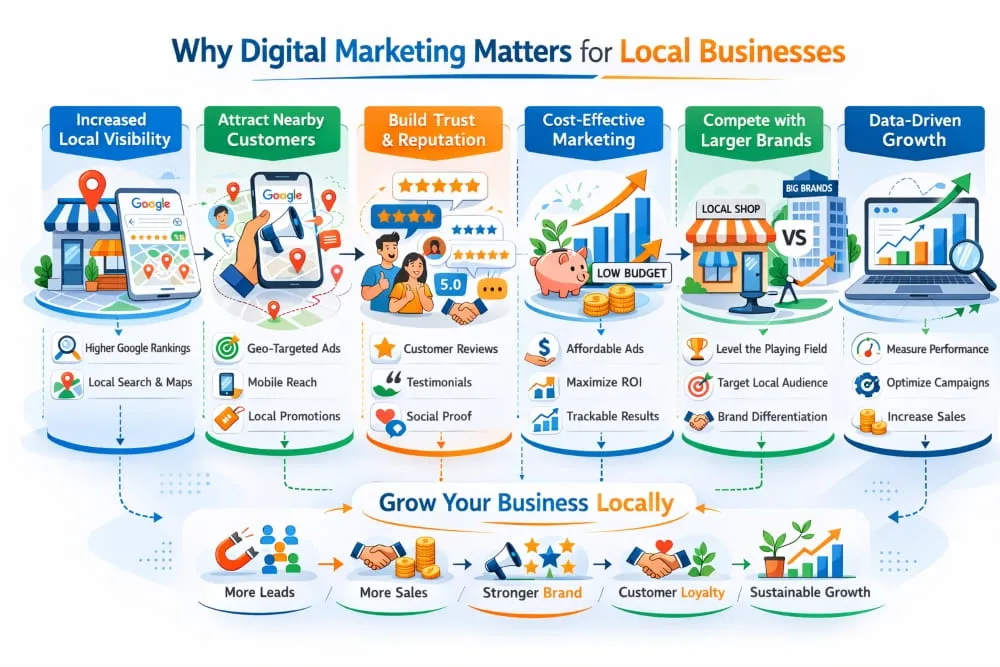
That’s the real importance of digital marketing for local businesses: it puts your business in front of nearby customers when intent is highest, then helps you earn trust quickly and convert that attention into calls, visits, bookings, and sales. In other words, it’s the bridge between someone needs you and someone chooses you.
Impact on Visibility, Trust, and Foot Traffic
The first and biggest impact of digital marketing on local businesses is visibility. If you’re not showing up in local search results, map listings, or even social proof moments, you’re invisible to the people most likely to buy.
But visibility alone isn’t enough. Local customers make quick decisions and are cautious. They look for signals, reviews, photos, clear services, professional branding, accurate business details, and a website that feels credible. Digital marketing packages all of that into a consistent presence, so customers don’t have to take a chance on you. They feel safe choosing you.
And when visibility and trust come together, foot traffic follows, whether that means walk-ins to a storefront or inbound leads for service-area businesses. Strong local visibility doesn’t just boost awareness. It drives real actions in the real world.
Benefits Predictable Leads, Repeat Customers, Stronger Reputation
One of the most valuable benefits of digital marketing for local businesses is predictability. Instead of relying solely on referrals, seasonal luck, or slow Word of mouth, digital marketing gives you controllable systems to generate demand consistently and adjust when things change.
That predictability shows up in three big areas:
First, lead flow. You get more calls and inquiries from people actively looking for what you offer.
Second, repeat business. With follow-up, remarketing, and retention strategies, you stay top of mind and keep customers coming back.
Third, reputation strength. Reviews, consistent messaging, and an active presence build a halo effect that makes you the obvious choice.
This is where the benefits of local digital marketing expertise for businesses become clear. It’s not about doing more marketing; it’s about doing the right marketing for local intent. When your strategy is built around how local customers actually search and decide, you stop wasting budget and start building momentum.
Over time, these systems compound. That’s what local business growth through digital marketing looks like: not a one-time spike, but a steady climb, more visibility, more trust, more leads, and better customers.
Common Myths That Hold Local Businesses Back
Many local businesses delay digital marketing because they believe things that feel true, but aren’t.
A common myth is My business is mostly word-of-mouth. Word of mouth is powerful, but digital marketing often validates it. Even referrals check reviews, search your name, and compare options before they call.
Another myth is I don’t need a website if I have social media. Social helps with awareness, but search intent happens on Google. And when people are ready to take action, a fast, clear website often becomes the deciding factor.
Some assume digital marketing is only for big companies with big budgets. In reality, local digital marketing is often more efficient because targeting is tighter and intent is higher. You don’t need to reach everyone; you need to reach the right people nearby.
And finally, there’s I tried it before, it didn’t work. Most of the time, that isn’t a failure of digital marketing; it’s a failure of strategy, tracking, or execution. Without clear goals, proper measurement, and a focus on local intent, even good tactics can appear not to be working.
When you understand why it matters and how it works, you can build a system that makes your local business easier to find, easier to trust, and easier to choose.
The Local Digital Marketing Framework (Step-by-Step Strategy)
Most local marketing fails for one simple reason: it’s a pile of tactics with no system behind it. A few posts here, a boosted ad there, maybe a website that hasn’t been updated in years, and then frustration when leads don’t show up consistently.
A digital marketing strategy for a local business works differently. It’s a repeatable framework built around local intent: people nearby searching, comparing, and choosing quickly. When you build the right system, your results become more predictable, your budget becomes more efficient, and your marketing becomes easier to improve over time.
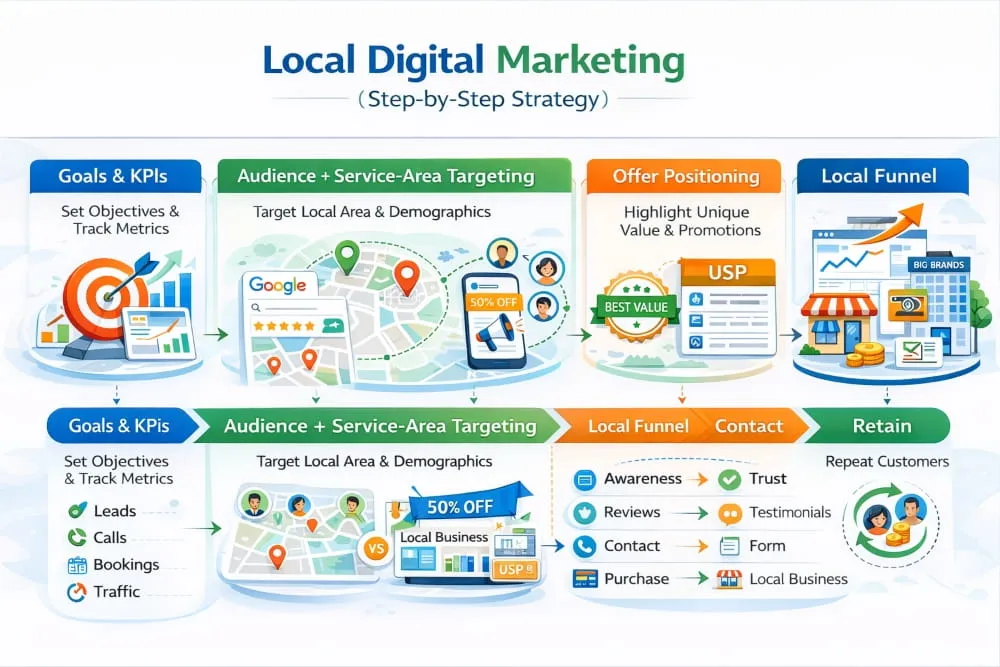
Think of this section as the backbone of your plan, the key elements of a digital marketing plan for local businesses that turns scattered effort into sustained growth.
Goals and Kpis (Calls, Bookings, Store Visits and Form Fills)
Before you change anything, decide what winning means. For local businesses, success isn’t vanity metrics like likes or impressions. It’s measurable outcomes tied to revenue.
The most useful KPIs are usually simple: phone calls, booking requests, direction clicks, quote forms, appointment confirmations, and walk-ins (when you can track them). These numbers tell you whether your marketing is actually moving the business forward.
This is also the first step in fixing local business digital marketing. If you’re not tracking the actions that matter, you can’t tell what’s working, what’s wasting money, or what needs improvement. The goal is clarity: every channel should connect to a business result you can measure.
Audience + Service-area Targeting (Who You Serve, Where You Serve)
The fastest way to waste marketing budget is to market to everyone. The fastest way to scale local results is to market to the right customer in the right area with the right message.
Start by defining who you serve: the problems you solve, the type of customer you get the best results for, and the situations that trigger buying behavior. Then define where you serve: your city, neighborhoods, service radius, and any boundary lines that matter (because local intent is tied to location).
This is the foundation of targeted digital marketing for local businesses. When you tighten targeting, your messaging becomes clearer, your ads become cheaper, your content becomes more relevant, and your conversions rise, because the customer feels like you’re speaking directly to them.
For small teams and smaller budgets, this matters even more. The most effective digital marketing strategies for small local businesses are rarely about doing more; they’re about doing less, but doing it with precision.
Offer Positioning (What Makes You the Obvious Local Choice)
Local customers compare quickly. They don’t just ask, Who is near me? They ask, Who feels safest? Who seems best? Who looks most trustworthy?
That’s where positioning comes in. Your offer isn’t just your service; it’s the reason someone chooses you over the other options on the screen.
Positioning can come from many angles: specialized expertise, faster turnaround, transparent pricing, stronger guarantees, better reviews, clearer communication, superior customer experience, or simply making the next step easier. The winning approach is the one that matches what your best customers care about most.
This is a core part of crafting a winning digital marketing plan for local businesses. Your marketing doesn’t need to sound clever. It needs to make the decision feel easy. When your offer is clear and credible, everything else converts better: your website, Google listing, ads, and content.
The Local Funnel (Awareness → Trust → Contact → Purchase → Retain)
Local marketing works best when you stop thinking in isolated channels and start thinking in terms of the customer journey. A strong local strategy moves people through a simple funnel:
Awareness: they discover you through Google, Maps, ads, social media, or referrals.
Trust: they check your reviews, photos, website, and proof.
Contact: they call, book, message, or request a quote.
Purchase: You deliver a great experience that lives up to the promise.
Retain: you earn repeat business, referrals, and reviews that fuel the next cycle.
This is what effective digital marketing for local businesses actually looks like: a connected system where each step supports the next. And it’s also how you avoid the most common marketing gap in local businesses, getting attention but not getting leads, or getting leads but not building a reputation.
When you run your marketing through this funnel, enhancing local business digital marketing strategies becomes straightforward. You can see exactly where you’re leaking results, visibility, trust, conversion, or retention, and fix it with intention rather than guesswork.
It also creates room for growth. Once the funnel is working, you can think about scalability in digital marketing for local businesses: increasing what’s already converting, expanding service areas carefully, adding new channels without chaos, and improving ROI instead of increasing workload.
And as platforms evolve, the strategy still holds. Innovations in digital marketing for local businesses, whether that’s new ad formats, AI tools, or shifting search behavior, are easiest to adopt when your fundamentals are strong. That’s ultimately how local businesses can stay ahead of digital marketing trends: not by chasing every new tactic, but by building a framework that can adapt and scale.
How to Do Digital Marketing for a Local Business (Implementation Playbook)
Knowing the strategy is helpful. Implementing it in the real world, week after week, is what actually creates leads, calls, and sales.
If you’re wondering how to do digital marketing for a local business without getting overwhelmed, the answer is to build a simple, repeatable system. You don’t need to do everything at once. You need to lay the foundations, launch channels that drive local intent, and then improve what’s working based on results.
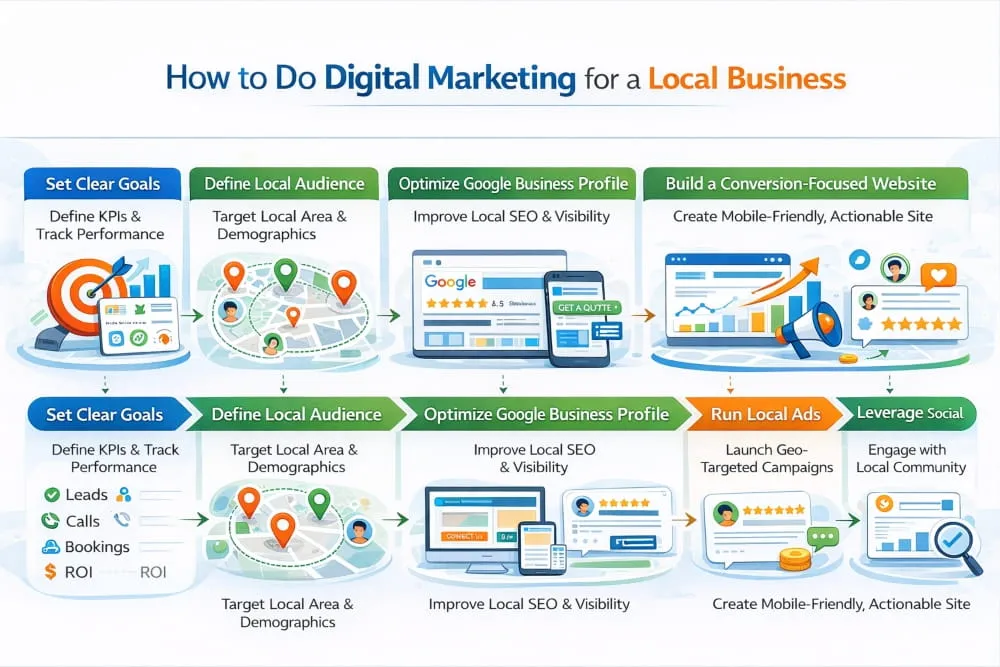
This section breaks that process into a practical playbook you can follow whether you’re doing it yourself or managing a small team.
Step 1: Build a Strong Foundation That Customers Can Trust
Before you spend time on ads or content, make sure your online presence is consistent and credible. Local customers make quick decisions, and trust signals matter immediately.
Start with your basics: your business name, address (if applicable), service areas, phone number, hours, and services should match everywhere your business appears online. Then ensure you have clear proof, real photos, accurate descriptions, and reviews that reflect the experience you deliver.
Your goal here is simple: when a customer finds you, nothing feels confusing or risky.
Step 2: Set Up Local Visibility (Search + Maps)
Most local growth starts with search intent, people actively looking for a solution. That’s why local SEO and your Google Business Profile are core to digital marketing for local businesses.
Optimize your listing to clearly communicate what you do, where you serve, and why you’re the best option. Add service categories thoughtfully, upload quality photos, and keep your details up to date. Then support it with a website that includes clear service pages that match what local customers are searching for.
This is the part many local businesses skip: they try to market without making themselves easy to find. Visibility first. Then everything else performs better.
Step 3: Make Your Website Convert (Not Just Exist)
A local website isn’t a brochure; it’s a conversion tool. It should answer the customer’s questions quickly and make the next step obvious.
This is where web design and digital marketing for local businesses connect. Design is not just about looking good; it’s about reducing friction. Pages should load quickly, read well on mobile, and naturally lead people to call, book, or submit a form. Trust signals should be visible without having to hunt for them: reviews, guarantees, service coverage, and proof of work.
A great local website doesn’t feel fancy. It feels clear, confident, and easy to act on.
Step 4: Choose 1–2 Growth Channels and Launch Intentionally
Once your foundation is solid, choose the channels that align with your business model.
If you need immediate leads, paid search can get you in front of high-intent customers quickly. If you want compounding growth, content, and local SEO, build long-term visibility. If your business relies heavily on trust and familiarity, social proof and consistent community engagement can lift conversion rates across every channel.
The mistake is launching everything. The smart move is to launch a few things well, measure results, and expand from a position of strength.
Step 5: Track Results and Improve Every Month
Implementation becomes powerful when you measure and optimize. Track the actions that matter: calls, bookings, direction clicks, quote requests, and form fills. Then review performance monthly: what brought leads, what converted, what didn’t, and where customers dropped off.
This is how digital marketing becomes predictable for a local business. You stop trying things and start running a system. Over time, the small improvements stack up: better visibility, higher conversion rates, lower cost per lead, and a stronger reputation.
Local SEO Foundations (Visibility That Compounds)
Local SEO is the most valuable evergreen asset a local business can build. Paid ads can generate leads fast, but the moment you pause spending, the visibility stops. Local SEO works differently. When you optimize the right foundations, your business keeps showing up for local searches month after month, often at the exact moment someone is ready to call, book, or visit.
This is why local SEO isn’t just a marketing channel. It’s a visibility engine. It compounds because every improvement strengthens the next: better listings lead to more clicks, more clicks lead to more calls, more calls lead to more customers, and more customers lead to more reviews, making your local presence even stronger.
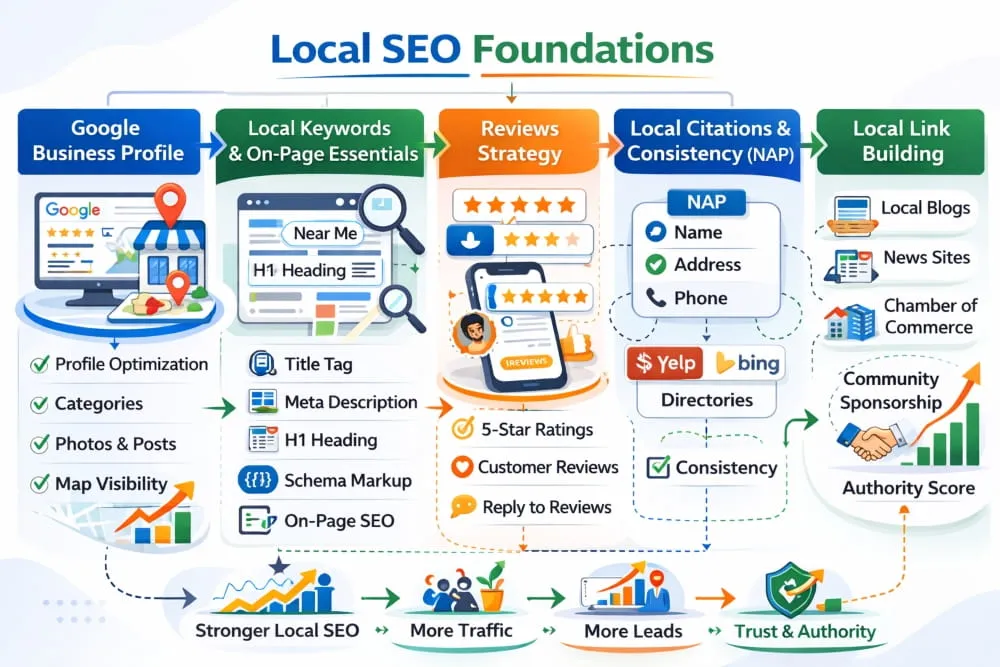
Google Business Profile Optimization Checklist
For many local businesses, Google Business Profile is the first impression, sometimes even before your website. When someone searches your service, the map results show businesses side by side. The one with the clearest information and strongest credibility wins attention.
Start by treating your profile like a storefront. Every detail should remove doubt and make the next step easy. Your primary category must match your core service, and your secondary categories should reflect real offerings without stretching relevance. Your service areas should be accurate and aligned with where you can actually deliver.
Photos matter more than most businesses realize. Local customers want proof. Add high-quality images of your location (if you have one), your work, your team, and the customer experience. Keep them current. A profile that looks active signals reliability.
Then build completeness. Add services, descriptions, business hours, and attributes. Post updates when appropriate, not to game Google, but to show customers that your business is active and responsive. Finally, ensure your phone number and website link work perfectly. Small errors here quietly drain leads every week.
Local Keywords and On Page Essentials (Service + Location Modifiers)
Local SEO rankings don’t come from stuffing city names everywhere. They come from relevance and clarity. Google needs to understand what you do, where you do it, and why your business deserves to appear for those searches.
Local keywords usually follow a pattern: service + location. Sometimes the location is explicit (plumber in [city]), and sometimes it’s implied through maps and proximity. Your job is to align your website so it supports both.
On-page essentials start with your service pages. Each core service you offer should be explained clearly, in a way that matches what customers are looking for: what the service is, who it’s for, what results they can expect, and how to take the next step. Then you naturally support local relevance by referencing your coverage area, the neighborhoods you serve, and the types of local customers you help, without turning the page into a list of locations.
The best local pages feel written for humans first. They answer questions quickly, build confidence, and make it easy to contact you. When your pages do that, they tend to rank because they satisfy intent.
Reviews Strategy (How to Earn, Respond, and Improve Ratings)
Reviews are one of the strongest local ranking and conversion signals because they influence two things at once: how visible you are and how trustworthy you appear.
The goal isn’t to get a few reviews. The goal is to build a review system. That means consistently earning reviews from real customers, not in bursts, but steadily.
Timing is everything. Ask when the customer is happiest, right after a successful job, a great appointment, a smooth delivery, or a positive outcome. Make it frictionless. Provide a direct link. Keep the request short and polite. The easier you make it, the more consistent your results will be.
Responses matter too. Reply to positive reviews with appreciation and specificity. Reply to negative reviews calmly and professionally, focusing on resolution rather than defensiveness. This isn’t just reputation management; it’s trust-building for every future customer reading your profile.
Over time, ratings improve when you treat feedback like a business asset. Reviews don’t just reflect your service; they shape how customers perceive your reliability before they ever contact you.
Local Citations and Consistency (NAP)
Citations are mentions of your business across the web, directories, platforms, local listings, and industry sites. They matter because consistency builds credibility.
NAP stands for Name, Address, and Phone number. If those details are inconsistent across listings, it creates confusion for both customers and search engines. Even small differences, like St. vs. Street, old phone numbers, or outdated addresses, can weaken trust signals.
The priority is accuracy. Ensure the same core details appear consistently across all listings for your business. Then keep them updated anytime something changes. This is one of the most overlooked areas of local SEO because it’s not glamorous, but it’s foundational.
Think of citations as the background evidence that your business is real, established, and located where you claim to be.
Local Link Building (Community, Partnerships, Local PR)
Local links are like endorsements. When reputable local sites link to your business, it signals authority and relevance in your area. The best part is that local link building doesn’t require SEO tricks. It often comes from real-world relationships.
Start with community involvement. Sponsoring a local event, supporting a charity, partnering with neighboring businesses, or joining local associations can lead to legitimate mentions and links.
Partnerships are another strong path. If you collaborate with complementary businesses, like a photographer partnering with a wedding venue or a contractor partnering with a supplier, you can earn links naturally through partner pages, resource lists, and shared promotions.
Local PR also works well for service businesses. If you have a unique story, a milestone, a community initiative, or expert commentary, local publications and blogs can feature your business. Those mentions build both visibility and trust.
The key is to focus on links that make sense for real customers, not links for the sake of links. When your local link profile grows organically through credibility and community presence, rankings tend to follow.
Local SEO is not a one-time task. It’s a system you strengthen over time. When you combine a fully optimized Google Business Profile, clear local keyword alignment, steady review growth, consistent citations, and genuine local authority signals, your visibility becomes harder for competitors to displace, and your lead flow becomes more reliable each month.
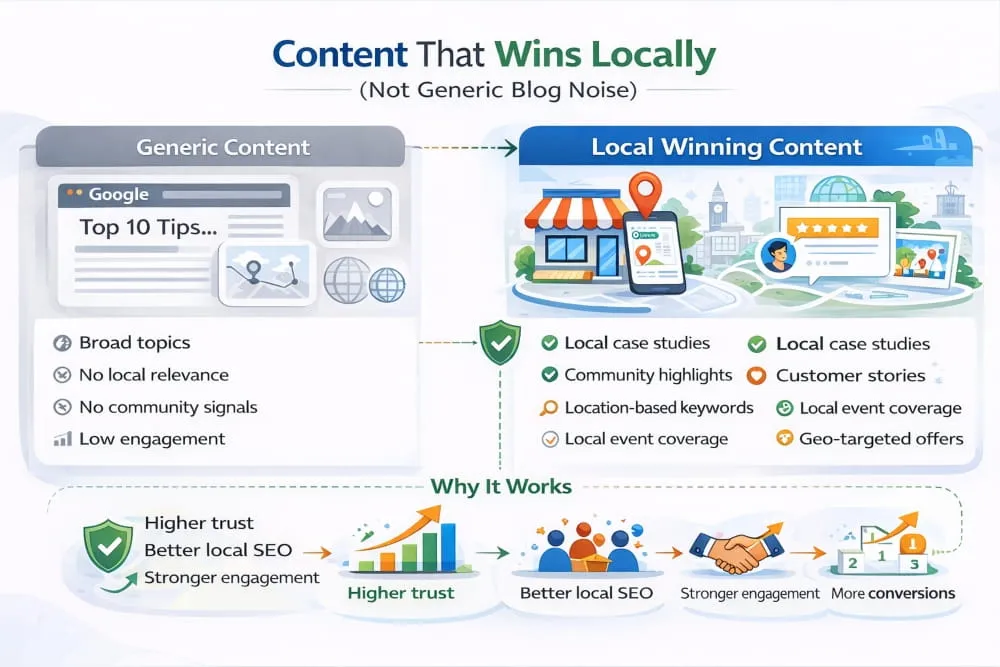
Content That Wins Locally (Not Generic Blog Noise)
Most local businesses don’t have a content problem. They have a relevance problem. They publish generic posts that could apply to any city, any customer, any business, and then wonder why traffic doesn’t turn into calls.
Local content should do one job: help nearby customers choose you. That means your content has to match real local intent, reduce uncertainty, and build confidence fast. When it does, it doesn’t just attract clicks; it supports rankings, improves conversions, and gives people a reason to contact you instead of the business next door.
Service Pages vs Educational Content (When to Use Each)
If your goal is leads, service pages are non-negotiable. A strong service page is where high-intent visitors land when they search for exactly what you offer. It should clearly explain the service, who it’s for, what results to expect, and the next step: call, book, or request a quote.
Educational content serves a different role. It captures earlier-stage searches and builds trust before someone is ready to buy. It also answers the questions people ask before choosing a provider, pricing factors, timelines, what to expect, how to prepare, and how to avoid costly mistakes.
The key is knowing when to use which. If someone searches for a service directly, they want a service page. If someone searches for a question, they want education. You win locally when both exist and support each other: education builds credibility, and service pages convert demand.
Proof Content Case Studies, Before/after, Testimonials
In local markets, trust is the deciding factor. Customers may only see you for a few seconds, and they’ll judge whether you feel legitimate, experienced, and safe.
That’s why proof content performs so well. Case studies show real outcomes. Before-and-after galleries demonstrate capability without lengthy explanations. Testimonials add emotional certainty; people want to know someone like them had a good experience.
The most effective proof content is specific. Instead of vague claims like great service, show the challenge, the solution, and the result. Instead of generic praise, highlight what mattered: speed, cleanliness, communication, pricing transparency, professionalism, or the quality of the outcome.
Proof content also strengthens everything else you do. It improves conversion rates on service pages, provides social media assets, supports your Google Business Profile, and makes ads more convincing. In local marketing, proof is fuel.
Neighborhood/service-area Content Done Safely (No Thin Duplicates)
Service-area content can work when it’s done responsibly. The mistake many businesses make is creating dozens of near-identical pages that swap one neighborhood name for another. That’s thin duplication, and it rarely performs long-term.
Done safely, service-area content is about clarity and usefulness, not volume. If you genuinely serve multiple areas, you can create content that helps people in those areas understand what working with you looks like, your service availability, response time expectations, local considerations, common problems in those areas, and examples of work completed nearby.
The goal is to avoid creating pages that exist only for search engines. Each page should feel like it was written because real customers in that area need it. If it doesn’t add unique value, it shouldn’t exist.
Seasonal + Event-driven Content for Local Demand Spikes
Local demand isn’t steady; it moves with seasons, weather, holidays, school calendars, and community events. Smart local businesses create content that aligns with these shifts, so they show up exactly when demand peaks.
This could be seasonal guides, limited-time service tips, preparation checklists, or timely offers tied to real local needs. For example, certain services surge before holidays, during extreme weather, at the start of school seasons, or around major local events that increase foot traffic.
Seasonal content wins because it matches urgency. People aren’t casually browsing; they’re trying to solve a problem right now. If your content anticipates that moment, your business becomes the obvious choice.
Winning locally isn’t about publishing more. It’s about publishing smarter. When your content strategy is built around service intent, trust-building proof, genuinely helpful service-area relevance, and seasonal demand, you stop creating blog noise and start creating assets that generate real leads.
Website + Conversion (Turn Traffic Into Calls and Bookings)
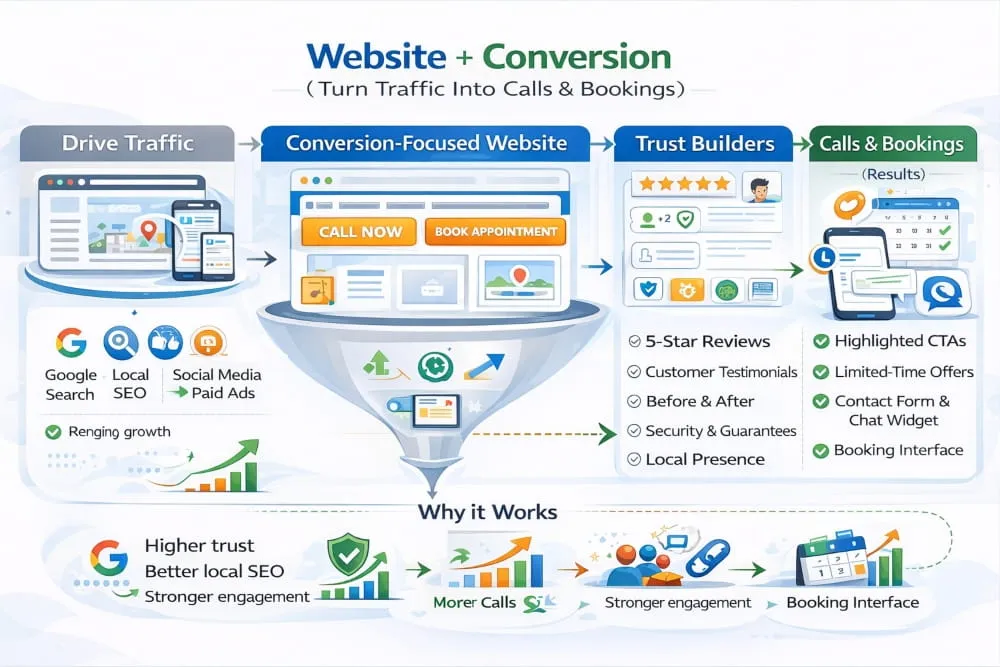
Getting found is only half the game. The real win happens after the click, when a customer lands on your site and decides, in seconds, whether to contact you or bounce to the next option.
For local businesses, your website isn’t just online presence. It’s your digital front desk. It should answer the customer’s biggest questions quickly, reduce hesitation, and make action feel effortless. When you treat your website as a conversion tool, not a brochure, you turn traffic into the outcomes that matter: calls, bookings, quote requests, and walk-ins.
Local Trust Signals (Reviews, Badges, Photos, Guarantees)
Local customers are cautious because the cost of choosing wrong is high: wasted time, wasted money, poor service, or a bad experience. That’s why trust signals often matter more than clever copy.
Start with reviews. Feature them prominently, not hidden on a separate page. Use real customer language, highlight star ratings, and show volume when available. If you have third-party platforms (Google, Facebook, industry sites), integrate those signals to make the trust feel verified.
Then add credibility cues that make decisions easier: licenses, certifications, insurance, awards, memberships, years in business, and recognizable badges, only the ones that are real and relevant. Photos are equally powerful. Local customers want proof you’re legit. Real images of your team, work, location, vehicles, and results build confidence faster than stock imagery ever will.
Guarantees also reduce risk, especially for services. Even a simple promise, clear pricing, satisfaction commitment, on-time arrival, and clean worksite can become the difference between maybe and let’s do it.
High converting Pages (Home, Service, Location and Contact)
Most local websites fail because the key pages don’t do their jobs. High-converting pages don’t try to impress; they guide.
Your homepage should instantly communicate three things: what you do, where you do it, and why you’re the best choice. It’s not about telling your entire story. It’s about removing confusion and moving people toward the next step.
Service pages are where conversions happen for high-intent searches. Each core service should have its own page that clearly explains the problem, your solution, the process, and what the customer gets. Add proof, address common questions, and keep your call to action visible throughout the page.
Location or service-area pages (when needed) should make it obvious where you operate and what customers in that area can expect. The best ones include local context, service details, and real proof of work, not recycled paragraphs with swapped city names.
Your contact page should be frictionless. A tap-to-call phone number, a short form, clear hours, and a clear expectation of response time. Don’t make people work to become your customer.
Web Design Essentials for Local Businesses (Speed, Mobile, CTA and Clarity)
Design isn’t decoration, it’s performance.
Speed is non-negotiable. Local customers are often on mobile and in a hurry, and they will leave if your site takes too long to load. A fast site doesn’t just improve the user experience; it also boosts search visibility and conversion rates.
Mobile clarity matters just as much. Your site should feel effortless on a phone: readable text, easy navigation, and buttons that are actually thumb-friendly. If your layout forces people to pinch, zoom, or hunt for the number, you’re losing leads.
CTA clarity is where most websites quietly underperform. Every page should make the next step obvious: call now, book now, request a quote, get directions. Avoid vague CTAs like learn more when someone is ready to act. Use action language, and repeat it naturally across the page so the user never has to search for what to do.
Booking/Call Tracking Setup (So ROI is Measurable)
If you can’t measure results, you can’t improve results. And for local businesses, tracking is often the difference between marketing feels random and marketing is predictable.
Start with the basics: track phone calls, form submissions, bookings, and direction clicks. Use call tracking whenever possible to see which channels drive leads: Google Business Profile, organic search, paid ads, social, referrals, and email.
Then connect that data to outcomes. Not every call becomes a customer, so measure the pipeline: how many leads came in, how many converted, and what the average customer value is. When you can see your true cost per lead and cost per acquisition, you stop guessing. You can confidently invest more in what works, and cut what doesn’t.
A high-performing local website does one thing exceptionally well: it turns interest into action. When you combine strong trust signals, conversion-focused key pages, fast mobile-first design, and clean tracking, your site stops being a passive online asset and becomes an active lead machine.
Paid Ads for Local Businesses (Fast Growth Without Waste)
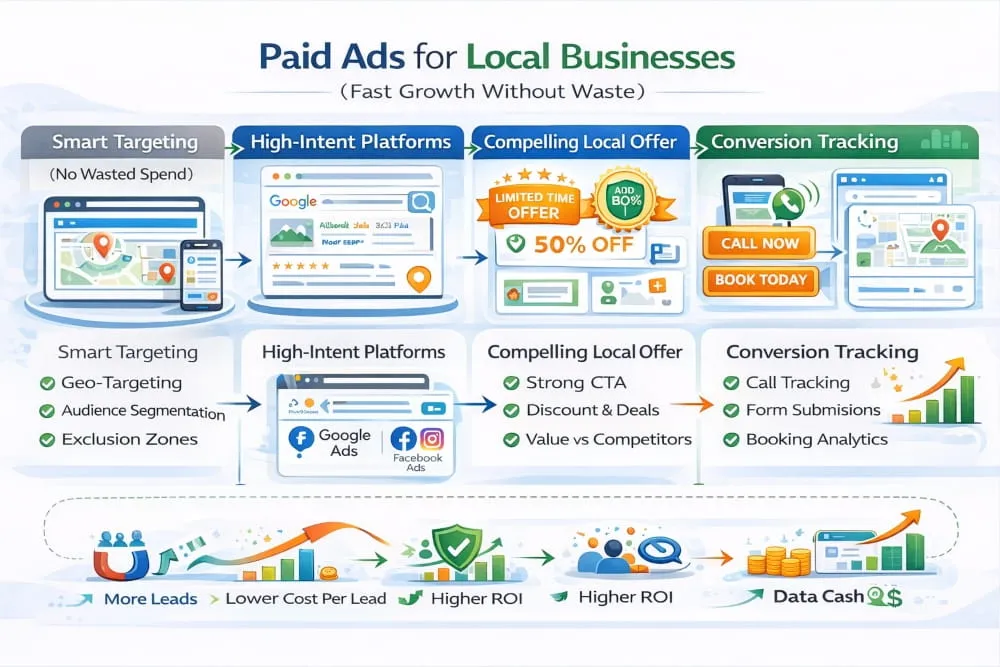
Paid advertising can be one of the fastest ways to grow a local business when it’s used with intention. But it’s also one of the fastest ways to burn money when the targeting is loose, the message is generic, or the traffic lands on a page that doesn’t convert.
The goal of paid ads isn’t more clicks. It’s more qualified local leads: calls, bookings, quote requests, and store visits from people who are already looking for what you offer. When you build your campaigns around local intent, paid ads become a controllable growth lever instead of a costly experiment.
When Paid Makes Sense and When It Doesn’t
Paid ads make sense when you need speed. If you’re launching a new service, entering a busy season, trying to fill your calendar, or competing in a market where organic rankings take time, ads can put you in front of high-intent customers immediately.
They also work well when the math supports it. If one new customer is worth enough to cover your cost per lead and still leave a margin, paid can scale reliably. And if your business has clear conversion actions, calls, appointments, and bookings, tracking becomes straightforward, and optimization becomes easier.
Paid doesn’t make sense when your foundation is weak. If your Google Business Profile is incomplete, your website is slow, your service pages are unclear, or your reviews are poor, ads won’t fix that. They’ll simply send more people into a leaky bucket. In those cases, you’re better off tightening your offer and conversion experience first, then turning paid on once you can confidently convert the traffic you’re buying.
Search Ads vs Local Service Ads vs Social Ads
Not all local ads do the same job. The smartest campaigns match the platform to the customer’s intent.
Search ads capture direct demand. When someone types a service into Google, they’re already looking for help. That makes search ads one of the most reliable channels for local lead generation, because the intent is high and the action is immediate.
Local Service Ads (where available) are built specifically for certain service categories and can drive calls quickly because they sit in prominent positions and often include trust elements. They’re powerful when you qualify, and they’re especially useful for businesses that win on responsiveness and credibility.
Social ads play a different role. Most people aren’t actively scrolling through social media searching for a service, so the intent is lower. But social is excellent for awareness, retargeting, and trust-building, especially when your offer benefits from proof, visuals, or community presence. Social can also be effective for promotions, seasonal offers, and re-engaging past visitors who didn’t contact you the first time.
The win comes from using each type correctly: search for demand capture, service ads for direct lead flow (when applicable), and social for familiarity and follow-through.
Budgeting, Geo-targeting, and Negative Keywords
Local paid ads become profitable when they’re controlled. That starts with budget discipline and precision in targeting.
You don’t need a massive budget. You need a focused one. Begin with a test budget that you can run consistently long enough to gather real data, then increase spend only when you see predictable cost per lead and quality.
Geo-targeting is where local campaigns either succeed or fail. Target only the areas you actually serve, and be honest about travel radius, response times, and service coverage. Tight targeting doesn’t reduce opportunity; it improves conversion rates by ensuring you’re visible to the people most likely to become customers.
Negative keywords are the quiet hero of paid search. They prevent your ads from showing for irrelevant searches that drain spend. If you don’t add negatives, you’ll pay for clicks that were never meant to convert, people looking for jobs, DIY advice, free services, cheap alternatives, or unrelated meanings of your keywords. Tight negatives don’t limit growth; they protect profitability.
Landing Page Alignment (Ad → Page → Action)
The ad is only the invitation. The landing page is where the decision happens.
A common mistake in local advertising is sending every click to the homepage. That forces the user to figure out what you offer, whether you serve them, and what to do next, all on their own. Most won’t.
Instead, match the page to the ad. If the ad is for a specific service, send traffic to that service page. If the ad targets a certain location or service area, the page should clearly confirm that coverage. The message should feel consistent from start to finish: the search query, the ad copy, the page headline, the proof, and the call to action should all align.
Then make the action effortless. A tap-to-call button on mobile. A simple booking flow. A short form with clear expectations. Strong trust signals near the CTA, reviews, guarantees, and proof of work, so the customer feels confident at the exact moment they’re deciding.
When your funnel is aligned, ad to page to action, paid ads stop feeling unpredictable. You can see where leads come from, what they cost, and how to improve performance without guesswork.
Paid ads are not a replacement for local SEO or reputation. They’re a multiplier. When your foundation is strong and your targeting is tight, paid advertising becomes one of the cleanest ways to accelerate local growth quickly, without waste.
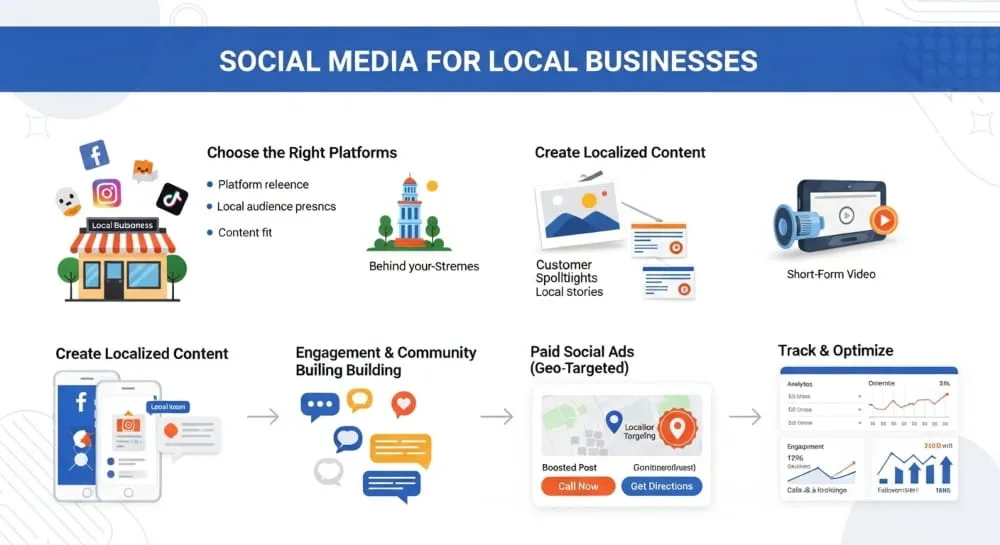
Social Media for Local Businesses (Community + Demand)
For local businesses, social media isn’t just content. It’s trust at scale. It’s where potential customers quietly check you out before they call. They want to see if you’re real, active, professional, and consistent, especially when they’re choosing between several local options that all claim to be the best.
The biggest mistake is treating social like entertainment or chasing viral trends. Local social media works when it supports three outcomes: familiarity, credibility, and action. Done right, it doesn’t just build a following, it builds demand and increases conversions across everything else you do, from Google searches to paid ads to referrals.
What to Post (Local Proof, Behind-the-scenes, Offers and Q&A)
The content that wins locally is simple: it helps people trust you faster.
Local proof is your best performer. Show real work, real outcomes, real customers (with permission), and real results. Before-and-after posts, completed jobs, quick walkthroughs, and customer reactions all reduce uncertainty. People don’t want perfect marketing; they want confidence that you can deliver.
Behind-the-scenes content builds comfort. Introduce your team, show your process, share what happens during a service visit, and explain how you keep things clean, safe, or professional. The more familiar you feel, the easier it is for someone to invite you into their home, business, or schedule.
Offers work when they’re clear and time-relevant. Instead of constant discounts, focus on offers that remove friction: free estimates, limited seasonal packages, first-time customer perks, add-ons, or priority booking windows.
Q&A content is the trust-builder most local businesses ignore. Answer the questions customers ask every day: pricing factors, timelines, what to prepare, common mistakes, what to expect, and how to choose the right provider. When you consistently educate, you stop being “one of the options” and start being the expert.
Local Engagement Playbook (DMs, Comments and Community Groups)
Local social media is won through conversations, not just posts.
Respond quickly to comments and DMs. For local customers, speed signals reliability. If someone messages you and gets no response, they don’t just lose interest; they assume you’ll be hard to work with.
Treat your comment section like a storefront. Be friendly, clear, and helpful. If someone asks a question, answer it fully. If someone compliments your work, acknowledge it. These micro-interactions create trust for everyone watching.
Community groups can be powerful when used respectfully. The goal isn’t to spam promotions, it’s to be present. Share helpful advice, answer questions, recommend solutions, and contribute like a real local. When people see you helping without pushing, they remember you when they need the service.
Also, don’t underestimate local relationships. Engage with nearby businesses, local pages, event organizers, and community leaders. Partnerships and shout-outs build reach, but more importantly, they build credibility within your area.
Short-form Video Ideas for Local Services
Short-form video works for local services because it compresses trust into seconds. People can see your professionalism, your work quality, and your personality, fast.
What performs best is clarity over creativity. Keep it simple, repeatable, and specific to local customer concerns.
Here are a few proven formats that don’t require fancy production:
- A quick “before → during → after” transformation
- A 20–30 second walkthrough of what a service visit looks like
- A common mistake customers make (and how to avoid it)
- A “3 signs you need…” tip video tied to your service
- A pricing explainer: what affects cost and what doesn’t
- A quick FAQ: “Do you serve [area]?” “How fast can you come out?” “What should I prepare?”
- A local trust clip: reviews on screen while you show real work
The goal isn’t to post perfectly. The goal is to post consistently and build familiarity. When people repeatedly see your work, your process, and your professionalism, choosing you becomes the obvious move.
For local businesses, social media is less about reach and more about reassurance. When your content shows proof, your engagement builds relationships, and your short-form videos make trust easy, social becomes a steady demand driver and a powerful conversion booster for every other marketing channel you use.
Email and Retention (The Easiest Revenue Most Locals Ignore)
Most local businesses focus heavily on getting new customers, and almost completely ignore the ones they already paid to acquire.
That’s a costly mistake.
Retention is often the highest-ROI part of digital marketing for local businesses because it turns one-time buyers into repeat customers, referrals, and five-star reviews. When you build simple follow-up systems, you don’t just increase revenue, you stabilize it.
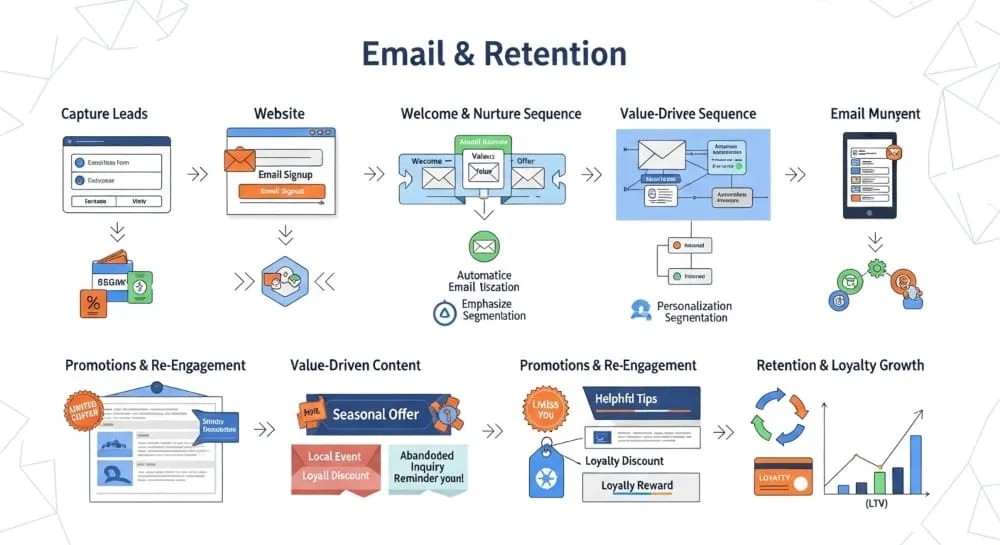
Email and light automation don’t need to be complicated. They just need to be intentional.
Lead Capture Offers That Work Locally
Before you can follow up, you need a way to capture contact information. For local businesses, this doesn’t mean creating complex funnels. It means giving people a practical reason to stay connected.
The most effective local lead capture offers are simple and relevant:
- Free estimates or consultations
- Seasonal checklists or preparation guides
- Maintenance reminders
- First-time customer perks
- Priority booking notifications
- Limited-time local offers
The key is alignment with real local intent. If someone is searching for a service, they’re not looking for a generic ebook; they’re looking for clarity and reassurance. Your lead capture should feel like a natural extension of your service, not a marketing gimmick.
Once captured, that contact becomes an asset. Instead of hoping they come back months later, you now have a direct line of communication.
Follow-up Sequences (Missed Call, Quote Follow-up, Winback)
Follow-up is where most revenue is quietly lost.
Start with missed calls. If someone calls and doesn’t get an answer, a quick automated text or email acknowledging their inquiry can recover leads that would otherwise go to competitors. Speed matters locally, often more than price.
Next is the quote follow-up. Many local businesses send estimates and assume silence means no. In reality, customers get busy or compare options. A structured follow-up sequence, polite, helpful, and spaced appropriately, can significantly increase close rates. Remind them of the value, answer common objections, and make the next step easy.
Winback sequences are just as powerful. If a customer hasn’t returned in 6–12 months (depending on your service cycle), a friendly reminder or check-in can reignite demand. For recurring services, maintenance reminders, and seasonal prompts can generate predictable repeat revenue.
Retention isn’t aggressive selling. It’s a consistent presence.
Review Request Automation and Referral Loops
Reviews and referrals are growth multipliers, but they rarely happen consistently without a system.
After a successful job or completed service, automate a simple review request. Timing matters most. Ask while satisfaction is high. Keep the message short. Include a direct link. The easier you make it, the higher your response rate.
Over time, this steady flow of reviews strengthens both your visibility and your conversion rates. New customers see consistent proof, not outdated testimonials from years ago.
Referrals can also be systematized. A thank-you email after a completed job can include a soft referral invitation. For example, you might remind customers that you appreciate introductions to friends or neighbors who need similar help. In tight-knit communities, this approach compounds quickly.
You can even formalize it with simple referral incentives when appropriate, but even without incentives, asking consistently increases results.
Email and retention strategies don’t feel flashy. They don’t look like big campaigns. But they quietly increase lifetime customer value, strengthen your reputation, and reduce the pressure to chase new leads constantly.
For local businesses, that’s not just easier revenue, it’s smarter growth.
Audit and Fixing Common Local Digital Marketing Issues
When local marketing isn’t working, most businesses do the same thing: they add more. More posts, more ads, more spending, more “new ideas.” But the fastest way to improve results usually isn’t more effort, it’s a smarter diagnosis.
A local business digital marketing audit helps you identify what’s actually broken, what’s underperforming, and what’s leaking leads. It turns “marketing feels random” into a clear action plan. Once you know where the problem is, visibility, conversion, tracking, or content, you can fix the right thing and see results faster.
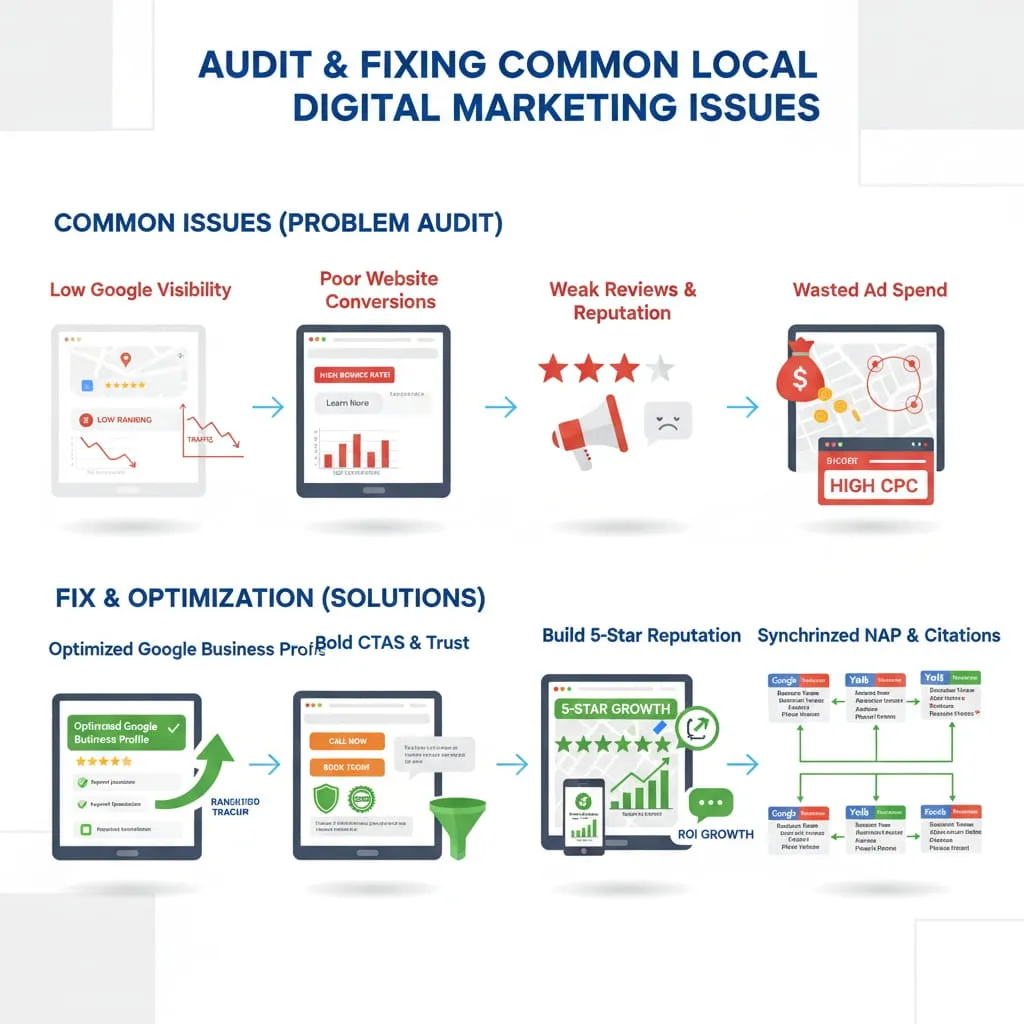
Visibility Issues (Rankings/Maps)
If you’re not showing up in local search results or the map pack, the first problem is visibility. Local customers can’t choose you if they can’t find you.
Visibility issues usually come from one of a few root causes: an under-optimized Google Business Profile, weak category alignment, inconsistent business details across the web, too few (or too old) reviews, or website pages that don’t clearly match what people are searching for.
A good audit looks at the full visibility chain: how your profile appears in Maps, how your business name and services are presented, whether your service areas are accurate, and how your website supports local relevance. The goal isn’t to “trick” Google, it’s to make it obvious what you do and where you serve, then reinforce that with trust signals that local algorithms reward.
If rankings have dropped, your audit should also consider whether competitors have improved, whether your reviews have slowed, or whether your website changes created confusion. Local SEO is competitive, and visibility can slip when the basics aren’t maintained.
Conversion Issues (Traffic But No Calls)
Sometimes the problem isn’t visibility, it’s conversion. You might be getting website visits and profile views, but not getting calls, bookings, or form submissions.
This usually means one of two things: the traffic is mismatched, or the website experience creates friction.
Mismatched traffic happens when your messaging targets the wrong intent, attracting people who are researching, price-shopping, or looking for something you don’t actually offer. Friction happens when the site is slow, mobile-unfriendly, unclear about services or service area, light on proof, or confusing about next steps.
A conversion-focused audit looks at what a real customer sees in the first 10 seconds. Is your phone number obvious? Is there a clear call-to-action? Do you show reviews and proof early? Do your service pages answer the key objections? Does your site make it easy to take action without having to think?
When local conversions are low, small changes often produce big gains, because local customers are already high-intent. They just need clarity and confidence.
Tracking Issues (Can’t Measure ROI)
Marketing becomes expensive when you can’t see what’s working. If you don’t know which channel drives leads, you can’t scale confidently, and you can’t cut waste without guessing.
This is where measuring returns on local business digital marketing matters most. A proper audit checks whether calls, forms, bookings, and direction clicks are being tracked accurately. It also checks if traffic sources are labeled correctly, and whether your reporting connects marketing activity to real business outcomes.
Tracking problems often look like this: calls are coming in, but you don’t know from where, forms submit but don’t show up in analytics, ad campaigns run, but conversions aren’t recorded, or customers say “I found you on Google,” but you can’t attribute it to search, maps, or ads.
The fix is usually straightforward: clean conversion tracking, consistent campaign tagging, and call tracking when needed. Once tracking is solid, your marketing decisions become clear, and ROI becomes measurable rather than assumed.
Content Issues (Thin, Duplicate and Misaligned Intent)
Content issues are silent killers in local marketing because they don’t always look like “a problem.” The site might have plenty of pages and posts, but they don’t rank, convert, or attract the wrong visitors.
Thin content is content that doesn’t actually help the user. Duplicate content often appears on location pages, where the same paragraphs are repeated with swapped city names. Misaligned intent happens when the page doesn’t match what the searcher wants, for example, a generic blog post ranking for a service query, or a service page trying to answer an educational question without depth.
A strong audit checks whether each important page has a purpose: does it target a real local intent, provide unique value, and guide the user toward action? If multiple pages overlap heavily, that can also create internal confusion and weaken performance.
Fixing content issues usually means consolidating, strengthening, and rewriting for intent, so every page earns its place and supports the overall authority of your site.
Testing How to Improve Results Without Guesswork
Once you’ve audited and fixed the biggest leaks, testing is how you grow steadily.
The best test strategies for local business digital marketing campaigns are simple and focused. Test one variable at a time so you can learn what truly moved results for websites, which might be a headline, a call-to-action, a form length, or where reviews appear on the page. For ads, it might be targeting radius, keyword match types, or offer framing. For Google Business Profile, it might be photo cadence, service descriptions, or post types.
The most important rule in all test strategies for local business digital marketing campaigns is this: test what impacts leads, not what looks creative. Local marketing is performance marketing. Prioritize experiments that affect calls, bookings, and conversion rate, not vanity changes that don’t move outcomes.
A local marketing audit gives you leverage. It shows you exactly why your results aren’t where they should be, and what to fix first. When visibility is strong, conversion is smooth, tracking is clean, and content matches intent, your marketing stops feeling unpredictable and starts becoming a measurable growth system.
Testing and Optimization (Improve Results Every Month)
The difference between average and dominant local businesses isn’t budget; it’s optimization. The businesses that grow consistently aren’t constantly reinventing their marketing. They’re improving it, month after month, in small, deliberate ways.
Testing removes emotion from decision-making. Instead of guessing what “feels right,” you use real data to improve calls, bookings, and revenue. Over time, these small improvements compound, turning steady performance into scalable growth.
Optimization doesn’t require complex systems. It requires discipline: test, measure, refine, repeat.
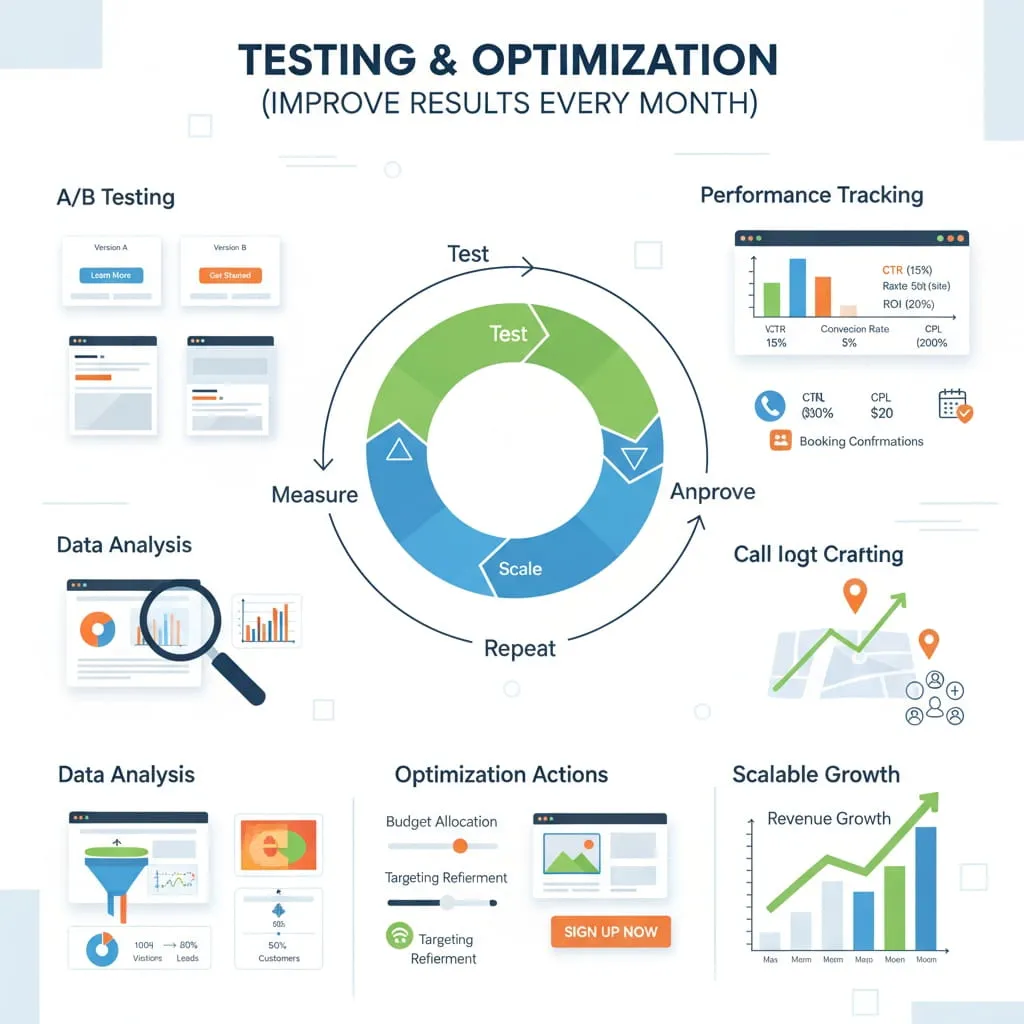
What to a/b Test First (CTAs, Headlines, Offers, Forms)
Start with the elements closest to the conversion. These changes often produce the fastest results.
Headlines are a strong starting point because they shape first impressions. A clearer headline that states exactly what you do and where you do it can increase engagement immediately. Local visitors don’t want clever; they want clarity.
Next, test your calls-to-action. “Contact Us” may underperform compared to “Book Your Free Estimate” or “Call Now for Same-Day Service.” Small wording changes can increase response rates by reducing uncertainty and making the next step feel more specific.
Offers are another high-impact test. If you provide estimates, try framing them differently, offering free consultation, priority booking, limited-time seasonal service, or bundled value. The goal isn’t to discount your work unnecessarily. It’s to remove hesitation.
Forms are often overlooked. Test shorter forms versus longer ones. Test whether asking for fewer fields increases submissions without hurting lead quality. Even repositioning the form higher on the page can improve results.
When testing on a local website, always focus on changes that affect real actions, calls, bookings, and submissions, not just time on page.
Campaign Testing Strategy (Ads, Audiences, Keywords)
For paid campaigns, structure your testing intentionally. Don’t change everything at once. Isolate variables so you know what moved the numbers.
With ads, start by testing messaging angles. For example, compare speed-focused messaging (“Same-Day Service”) with trust-focused messaging (“5-Star Rated & Fully Licensed”). Monitor cost per lead, not just click-through rate.
Next, refine audiences and geography. Tightening your service radius can often increase conversion rate and reduce wasted spend. Expanding too quickly without proof of profitability is a common mistake.
Keyword testing is especially important in local campaigns. Broad terms may bring volume but lower intent. More specific service-based keywords often produce fewer clicks but higher-quality leads. Negative keywords should also be reviewed regularly to prevent irrelevant traffic from draining the budget.
Every month, evaluate what drove actual leads and what didn’t. Scale the campaigns that produce predictable results. Adjust or pause what underperforms.
How to Prioritize Changes by Impact vs Effort
Not all improvements are equal. Some changes take significant time and produce minor gains. Others take minutes and meaningfully increase revenue.
A simple way to prioritize is to evaluate changes based on two questions:
- Will this directly impact conversions or lead quality?
- How difficult is it to implement?
High-impact, low-effort changes come first. For example, clarifying your headline, adding visible reviews near your CTA, or tightening ad targeting often delivers strong returns quickly.
Medium-impact improvements, such as redesigning a service page or building new landing pages, come next after foundational elements are optimized.
Low-impact, high-effort tasks should be put off unless they solve a critical issue. Local businesses often waste time redesigning aesthetics rather than addressing conversion friction.
The most effective local businesses operate on a simple rhythm: audit performance monthly, implement one or two focused improvements, measure the result, and repeat. Over six to twelve months, that steady optimization often outperforms sporadic “big changes.”
Testing and optimization aren’t advanced tactics; they’re growth habits. When you consistently improve the elements that influence calls, bookings, and trust, your marketing becomes more efficient every month. And in competitive local markets, that steady improvement is what creates long-term dominance.
Measuring Returns on Local Business Digital Marketing
Marketing only becomes powerful when it becomes measurable.
Many local businesses invest in digital marketing but don’t clearly connect it to revenue. They know calls are coming in. They see website traffic rising. But they can’t confidently answer the most important question:
Is this actually making money?
Measuring returns on local business digital marketing doesn’t require complicated analytics. It requires a simple model, clean tracking, and consistent review. Once those pieces are in place, you stop guessing and start making strategic decisions based on real numbers.
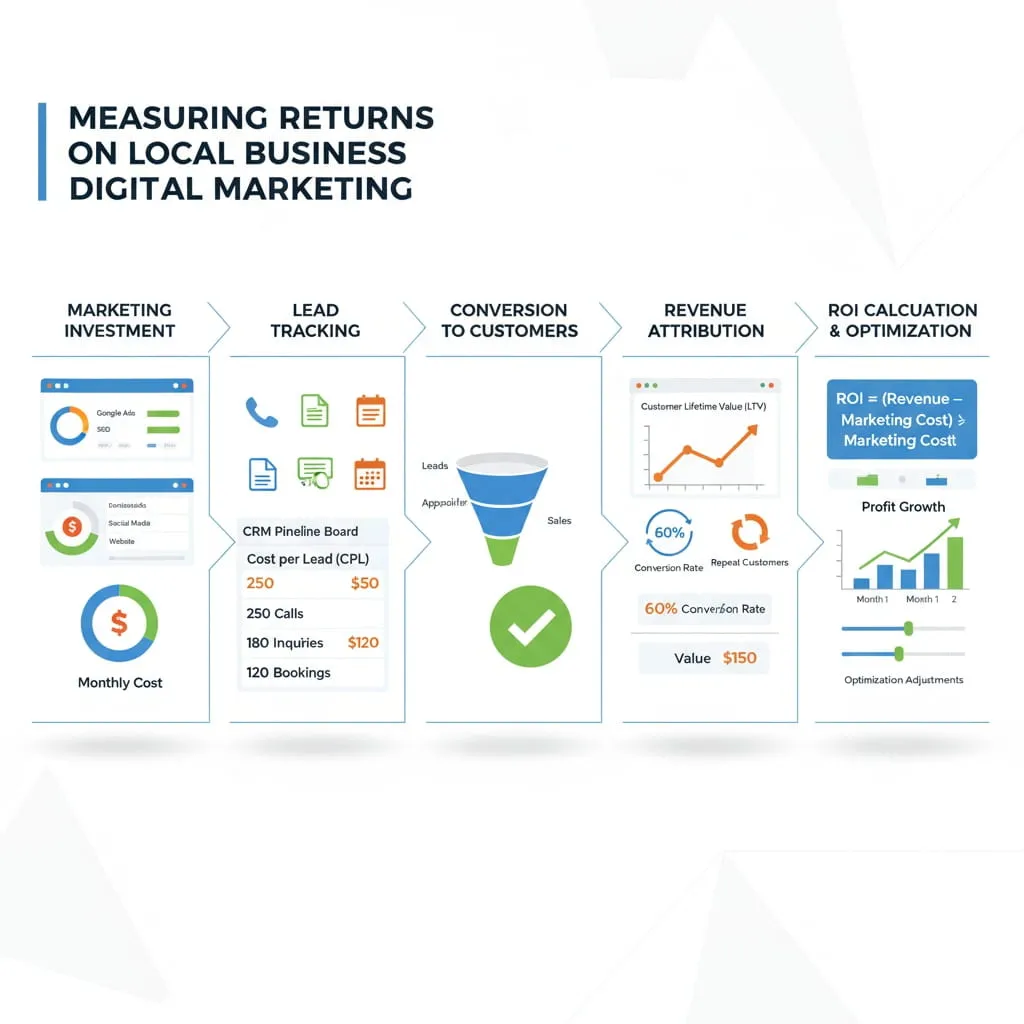
ROI Model for Local Businesses (Lead → Close Rate → Value)
Local marketing ROI is simpler than most people think. It follows a clear path:
Traffic → Leads → Closed Customers → Revenue
But to measure it properly, you need to understand three key numbers:
- Cost per lead – How much you spend to generate one inquiry (call, form, booking).
- Close rate – The percentage of leads that become paying customers.
- Customer value – The average revenue from one customer (including repeat business, if applicable).
Here’s the basic formula in action:
If you generate 50 leads in a month
You close 40% of them (20 customers)
Your average customer value is $800
That equals $16,000 in revenue.
If your marketing cost was $4,000, your return is clear.
This model works for nearly every local service business because local marketing is intent-driven. When someone searches for a service, they are usually closer to purchase than the general online audience.
The key is tracking every step, not just leads, but closed jobs. That’s how you move from “marketing feels expensive” to “marketing is profitable.
Call Tracking, UTM Basics and Simple Reporting Dashboards
You can’t measure returns without tracking where leads come from.
Call tracking lets you see which channels drive phone calls: organic search, Google Business Profile, paid ads, social media, referrals, or email. Without it, you’re relying on customers to remember how they found you, which is unreliable.
UTM parameters help you identify traffic sources in analytics. When properly applied to ads, social links, and email campaigns, they show exactly which campaigns drive conversions. This prevents wasted spend and highlights top-performing channels.
You don’t need complex dashboards. A simple monthly report should show:
- Traffic by source
- Leads by source
- Cost per lead
- Close rate
- Revenue generated
That’s it.
When you review this monthly, patterns become obvious. You’ll see which channel drives the highest-quality leads, which one needs optimization, and where to increase investment.
What “good” Looks Like by Channel
“Good performance” depends on your industry and customer value, but some general benchmarks can guide expectations.
For local SEO and Google Business Profile:
- Steady growth in calls, direction clicks, and website visits
- Increasing review volume and rating consistency
- Strong visibility for core service keywords
For paid search:
- Predictable cost per lead
- High-intent keyword performance
- Conversion rates that justify ad spend
For social media:
- Consistent engagement
- Direct inquiries through DMs
- Retargeting conversions supporting search traffic
For email and retention:
- Repeat bookings
- Winback conversions
- Ongoing review of growth
The real definition of “good” isn’t traffic volume, it’s profitable growth. A smaller channel that produces high-quality leads is more valuable than one generating large numbers of low-intent clicks.
When you consistently measure performance using a clear ROI model, clean tracking, and simple reporting, digital marketing becomes an investment, not an expense.
And once you know exactly what works, scaling becomes a strategic decision, not a gamble.
Trends and AI in Local Digital Marketing
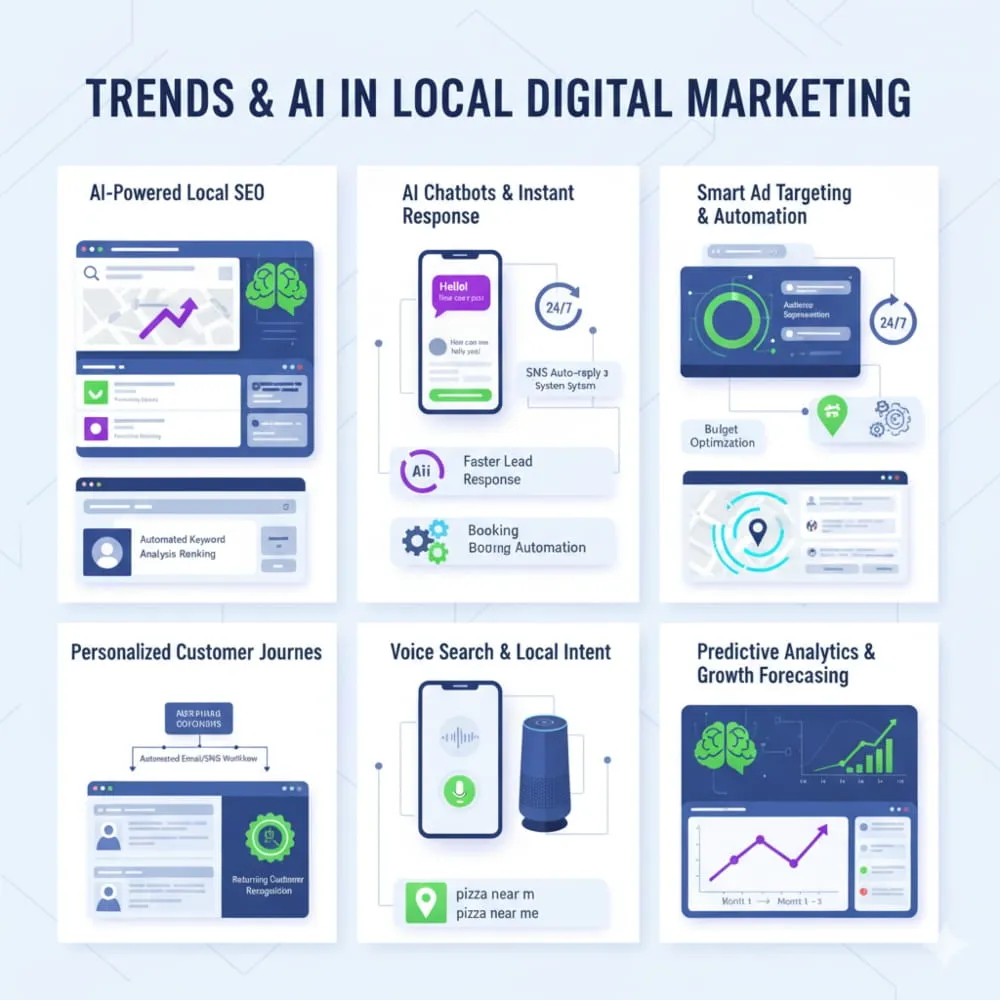
Local digital marketing is still built on fundamentals, visibility, trust, and conversion, but the way customers discover and evaluate local businesses is changing fast. Search behavior is evolving, content formats are shifting toward video and “proof,” and automation is making it easier to follow up consistently without adding workload.
This is where artificial intelligence digital marketing for local businesses becomes a practical advantage. Not as a gimmick or a replacement for strategy, but as a tool to move faster, test more efficiently, and stay consistent across channels.
Even when people reference local marketing trends 2024 small business digital marketing strategies, the real takeaway isn’t “do what’s new.” It’s: adapt to how customers are deciding now, while keeping quality high and trust intact.
What is Changing (Search Behavior, Content Formats and Automation)
Local search is becoming more immediate and more trust-driven. Customers still use Google, but they rely more heavily on signals that reduce risk: recent reviews, strong ratings, real photos, clear service details, and fast response. People also expect quicker answers, pricing ranges, availability, and what happens next, without having to dig through multiple pages.
Content formats are shifting, too. Written content still matters for SEO and education, but short-form video is increasingly becoming the fastest way to communicate credibility. A 20-second clip showing your process or results can build trust faster than a long explanation, especially for services.
Automation is also becoming the standard, not the exception. Customers expect quick replies, follow-ups, reminders, and smooth booking experiences. The businesses that win locally aren’t always the biggest; they’re the ones that feel easiest to work with. Automation helps you deliver that experience consistently.
Practical Ai Use Cases (Content Briefs, Ad Variations and Review Replies)
AI becomes valuable when it saves time on repetitive work and helps you improve performance without lowering quality.
One of the best uses is content planning. AI can help you generate structured content briefs for service pages, FAQs, and educational topics, so you can publish faster while staying aligned with local intent. It can also help you expand your content into different formats: turning one guide into short social posts, email sequences, or video scripts.
For paid ads, AI is useful for creating variation. Instead of guessing which message will convert, you can produce multiple ad angles, speed, trust, pricing clarity, guarantees, and convenience, then test them. The goal isn’t to let AI run your strategy. The goal is to generate options quickly, then choose and refine based on performance.
Review replies are another practical win. AI can draft professional responses that are polite, consistent, and fast, especially when review volume grows. That said, review responses should still feel human and specific. AI should help you respond faster, not sound generic.
The best local use of AI is not “more content.” It’s better consistency: more timely follow-ups, clearer messaging, and faster iteration.
Guardrails Accuracy, Brand Voice and Avoiding Spam Signals
AI can help local businesses move faster, but only if you protect quality.
Accuracy comes first. Local marketing is full of details that must be accurate: service areas, hours, pricing policies, licensing, timelines, and claims. If AI generates inaccurate information, it can erode trust immediately. Every AI-assisted output should be reviewed before publishing, especially anything customer-facing.
Brand voice matters too. Local customers don’t want corporate. They want clear, friendly, professional communication that matches the experience you deliver. If everything sounds templated or robotic, it reduces credibility. Use AI for drafts, then edit to sound like your business, your tone, your values, your way of speaking.
Finally, avoid spam signals. Over-automation can lead to thin content, duplicate pages, or generic posts published at scale. That’s risky for SEO and reputation. The local businesses that win in the long term will be the ones that use AI to improve usefulness, not to flood the internet with low-value output.
A good rule is simple: if the content doesn’t genuinely help a customer decide, don’t publish it.
AI and trends are tools, not a strategy. When you combine strong fundamentals with smart automation, you can respond faster, test more often, and stay consistent across your marketing. That’s how local businesses stay ahead: not by chasing every trend, but by adapting with quality, clarity, and trust at the center.
Conclusion
Digital marketing for local businesses isn’t about doing everything at once; it’s about building a system that makes your business easier to find, easier to trust, and easier to choose.
When your foundations are strong, Google Business Profile, local SEO, a fast conversion-focused website, and clean tracking, you stop relying on luck and start generating consistent leads. When you add smart content, paid ads with tight targeting, social proof that builds familiarity, and simple retention follow-ups, your results compound. And when you audit, test, and optimize monthly, you turn marketing into a predictable growth engine instead of a recurring expense.
The local businesses that win in the long term aren’t the ones chasing every trend. They’re the ones executing the fundamentals with consistency, measuring what matters (calls, bookings, sales), and improving one step at a time.
If you implement what you’ve learned in this guide, you’ll create one dominant advantage in your market: customers will find you faster, trust you sooner, and contact you more often, again and again.
Frequently Asked Questions (FAQ’s)
How do I start digital marketing for my local business?
Start by setting up the basics that drive local leads: optimize your Google Business Profile, build or improve a fast mobile-friendly website with clear service pages, and set up simple tracking for calls and forms. Then focus on one growth channel (local SEO or paid search) and improve monthly based on results.
What are the most effective strategies for small local businesses?
The most effective strategies are those that capture local intent and build trust quickly: a strong Google Business Profile + reviews, local SEO service pages, conversion-focused website design, and targeted paid search for high-intent keywords. Add a simple follow-up (email/SMS) to increase closes and repeat business.
What services do local businesses actually need first?
Most local businesses need four essentials first: Google Business Profile optimization, local SEO setup (service pages + on-page basics), a conversion-ready website (calls/bookings), and lead tracking (call tracking + form tracking). Paid ads and social content work best after these foundations are in place.
How long does local digital marketing take to work?
Paid ads can generate leads within days. Local SEO typically takes 6–12 weeks to show measurable movement, and 3–6 months for stronger traction in competitive areas. Reviews, conversions, and consistent optimization can accelerate results by improving visibility and trust.
How do I measure if it’s working?
Measure outcomes, not vanity metrics. Track calls, bookings, form fills, and direction clicks by channel, then connect leads to closed customers and revenue. A simple ROI model is: leads × close rate × average customer value, compared against your marketing spend.