The automotive industry is one of the most competitive spaces on the internet. Whether you’re running a dealership, managing a chain of repair shops, or marketing an auto parts brand, your customers are searching online before they ever walk through your door. If your business isn’t showing up, your competitors are.
That’s where automotive SEO comes in.
Automotive SEO is the practice of optimising your website, content, and online presence so that your business ranks higher in search engine results when potential customers search for the vehicles, services, or parts you offer. It’s not a single tactic; it’s a full strategy that covers everything from the words on your service pages to the technical health of your website to how consistently your business information appears across the web.
But here’s what makes automotive SEO different from general SEO Services, the stakes are higher, the searches are more specific, and the buyer journey is longer. Someone searching “best SUV under $40,000” is at a very different stage than someone searching “Toyota dealer near me open Saturday.” A well-built automotive SEO strategy accounts for all of it, capturing awareness early and converting intent when it’s highest.
This guide covers everything you need to know: how automotive SEO works, what separates high-performing strategies from average ones, how local search fits in, what dealerships and repair shops need to do differently, and how to evaluate whether your current approach is actually delivering results.
Whether you’re building your strategy from scratch or auditing what you already have, this is the resource to start with.
What Is Automotive SEO?
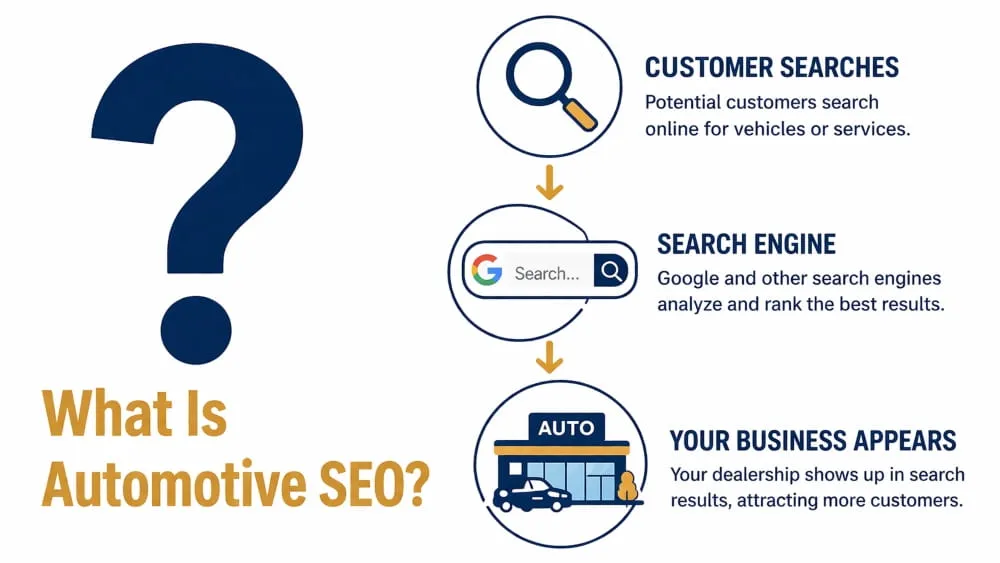
The automotive industry generates billions of search queries every month. People research vehicles, compare service centres, look up parts, read reviews, and locate dealerships, almost entirely through search engines. Automotive SEO is the discipline that puts your business in front of those searches at the right moment.
Automotive SEO Definition and Core Concepts
SEO stands for Search Engine Optimisation. In the automotive context, it refers to improving your website and online presence so that search engines like Google rank your business higher when people search for what you offer, whether that’s a specific vehicle, a repair service, or an auto parts supplier.
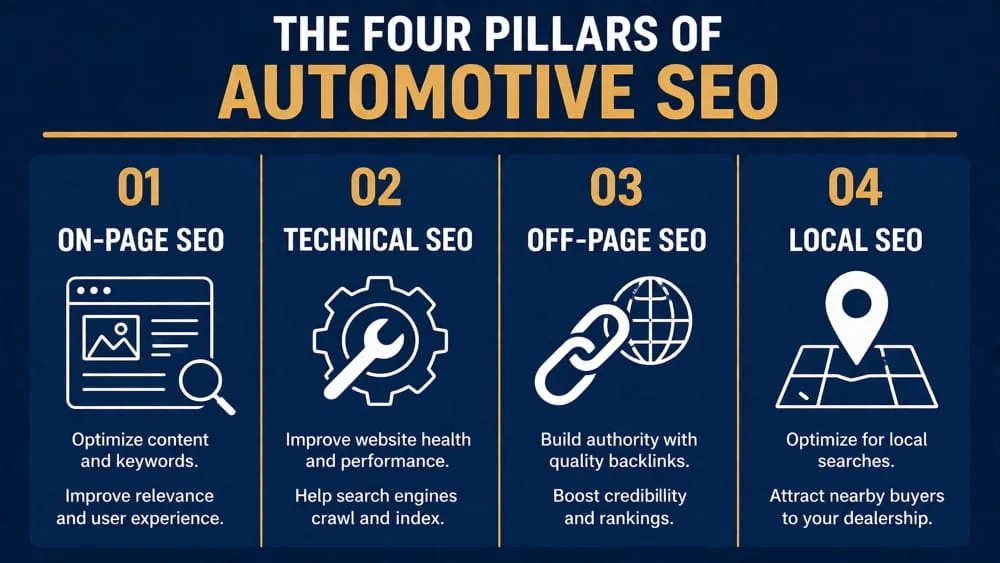
Automotive SEO is not a single action. It’s a layered strategy built across four core disciplines: optimising the content and structure of your website pages (on-page SEO), earning authority through external links and citations (off-page SEO), ensuring your site is technically sound and crawlable (technical SEO), and making sure your business appears prominently in location-based searches (local SEO).
When all four are working together, your website doesn’t just attract traffic, it attracts the right traffic, from people who are actively looking for exactly what your business provides
How Automotive SEO Differs from General SEO
The principles of SEO are universal, but the automotive industry has characteristics that make its SEO demands uniquely complex.
First, inventory changes constantly. A dealership’s website may have hundreds of vehicle listing pages that appear, update, and disappear as stock moves. Each of those pages is an SEO asset, and if they’re not structured correctly, they become a wasted opportunity or, worse, a source of technical debt.
Second, the purchase cycle is long. Automotive buyers research for weeks or months before converting. That means your SEO strategy needs to capture people at every stage, from early-stage research keywords like “best family SUV 2026” to high-intent local searches like “Toyota dealership near me.” A general SEO approach rarely accounts for that full journey.
Third, competition is layered. You’re not just competing with the dealership down the road. You’re competing with manufacturer websites, large automotive marketplaces, review aggregators, and national chains, all of whom have significant SEO budgets. Winning in this environment requires precision, not just effort.
Why Google Treats Automotive Searches Differently
Google classifies different types of searches based on what it calls search intent, the underlying reason behind a query. Automotive searches span a wide range of intent, and Google’s algorithm is sophisticated enough to serve different results depending on where a search sits in the buying journey.
A search like “how does a CVT transmission work” is informational; Google serves articles and explainers. A search like “Honda Civic service centre Birmingham” is local and transactional. Google serves map packs, business listings, and locally optimised pages. A search like “Ford F-150 vs Chevy Silverado” is comparative; Google serves review content and side-by-side guides.
This matters for your SEO strategy because the type of content you create, the way you structure your pages, and the signals you send to Google must all align with the intent behind the searches you’re targeting. Get that alignment right, and Google rewards you with visibility. Get it wrong, and even a well-written page will struggle to rank.
Understanding this is the foundation of effective automotive SEO, and it’s where most businesses without a clear strategy start to fall behind.
Why SEO Is Critical for the Automotive Industry
The automotive industry has undergone a fundamental shift in how customers find and choose businesses. Showroom footfall no longer drives discovery; search engines do. Before a customer calls, books, or visits, they search. And what they find in those first few results shapes every decision that follows.
For dealerships, repair shops, parts suppliers, and auto brands, SEO is no longer a marketing add-on. It’s the infrastructure that determines whether your business is found at all.
How SEO Drives Business Growth Across Automotive
Organic search is consistently one of the highest-converting traffic channels in the automotive industry, and unlike paid advertising, the results compound over time rather than disappearing the moment your budget runs out.
When automotive SEO is done properly, the growth is structural. Your service pages attract customers actively searching for what you offer. Your location pages surface your business in local map results. Your content builds trust with buyers early in their research phase, so that when they’re ready to act, your brand is already familiar. Each layer reinforces the next.
This is why the most successful dealerships and auto businesses don’t treat SEO as a one-time project. They work with automotive SEO specialists who understand the industry’s unique search landscape and build strategies designed for sustained, long-term visibility, not short-term spikes.
The businesses that grow through SEO aren’t just ranking for their brand name. They’re capturing demand at every stage: awareness, consideration, and conversion. That reach, built organically, becomes one of the most valuable assets a business owns.
The Cost of Ignoring SEO for Automotive Businesses
Every time your business doesn’t appear in a search, someone else is winning a customer.
In competitive automotive markets, the gap between page one and page two isn’t a slight disadvantage; it’s the difference between being in the consideration set and being invisible. Studies consistently show that the top three organic results capture the overwhelming majority of clicks. Businesses sitting beyond that threshold, regardless of how good their service is, simply don’t get the traffic.
The cost compounds in ways that aren’t always immediately visible. Businesses without a strong SEO foundation become dependent on paid advertising to generate leads, which is expensive, unsustainable, and delivers no residual value. Meanwhile, competitors investing in SEO are quietly building authority, accumulating backlinks, and strengthening their position with every passing month.
By the time most businesses recognise the gap, it takes significantly more time and resources to close it. That’s not an argument for panic; it’s an argument for starting with the right strategy now, whether that’s building in-house capability or partnering with a reputable automotive SEO agency that has a track record of results in this industry.
ROI of Automotive SEO What the Data Shows (2026)
The return on investment from automotive SEO is well-documented, and the 2026 landscape reinforces what the data has shown for years: organic search delivers a lower cost-per-lead than almost every other digital channel, with significantly stronger long-term returns than paid media.
For dealerships, ranking on the first page for high-intent local searches, such as “[make] dealership [city]” or “used cars near me”, directly correlates with increased enquiries, test drive bookings, and sales appointments. For repair shops, ranking for service-specific searches drives consistent phone calls and online bookings without ongoing ad spend, and for parts and aftermarket businesses, optimised product pages capture purchase-ready buyers at the exact moment of intent.
The businesses seeing the strongest ROI from automotive SEO in 2026 share several common traits. They’ve invested in technical foundations that allow Google to crawl and index their site efficiently. They’ve built location-specific content that dominates local search. And they’ve worked with automotive SEO experts, whether in-house or through a specialist agency, who understand how to align strategy with actual search behaviour in the automotive space.
The question for most automotive businesses isn’t whether SEO delivers a return on investment. The data is clear on that. The question is whether your current strategy is built to capture it.
How Automotive SEO Works
Understanding automotive SEO at a surface level is easy. Actually building a strategy that ranks, converts, and sustains itself over time is where most businesses struggle. The difference almost always comes down to how well the four core pillars are understood and executed, not in isolation, but as an interconnected system.
On-Page SEO for Automotive Websites
On-page SEO is the foundation. It covers everything on your website: the content, the structure, the headings, the metadata, and the way individual pages are optimised to target specific searches.
For automotive businesses, on-page SEO is more complex than it appears. A dealership might have hundreds of vehicle listing pages, dozens of service pages, and multiple location pages, all of which need to be optimised correctly without competing with each other. An auto parts retailer needs product titles and descriptions that are both readable for customers and structured so search engines can interpret and rank them accurately.
Effective on-page SEO for automotive websites means ensuring every important page has a clear primary keyword focus, a well-structured heading hierarchy, descriptive, keyword-relevant meta titles and descriptions, and content that genuinely answers the searcher’s query. It also means avoiding the common mistakes that hold automotive sites back, such as duplicate content across similar vehicle pages, thin service descriptions, and product titles that prioritise internal naming conventions over how customers actually search.
The best practice for automotive product titles, for example, is to lead with the most search-relevant information first: make, model, part type, and compatibility. This simple structural discipline can significantly improve how those pages perform in organic search without changing a single word of the body content.
Technical SEO for Automotive Websites
Technical SEO is what happens beneath the surface, the infrastructure that determines whether Google can find, crawl, understand, and trust your website. Even the best content will underperform if the technical foundations are weak.
For automotive websites, technical SEO carries particular weight because these sites tend to be large, dynamic, and complex. Dealership inventory systems, parts catalogues, and booking integrations introduce technical variables that can create crawlability issues, duplicate content, and page speed bottlenecks if not managed properly.
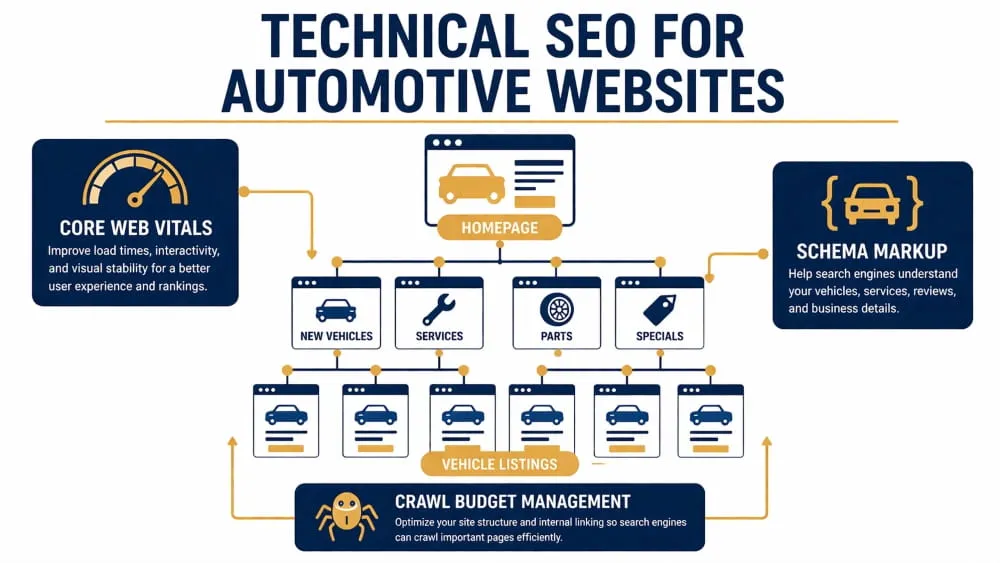
The core technical priorities for automotive websites include site speed and Core Web Vitals, Google’s performance benchmarks that directly influence rankings, structured data markup, which helps search engines understand the specific type of content on each page (vehicle listings, reviews, business locations, FAQs), a logical site architecture that allows link equity to flow efficiently across the site, and a clean crawl environment free of redirect chains, broken links, and indexation errors.
Advanced automotive SEO strategies also include implementing vehicle-specific schema markup, which can generate rich results in search and display vehicle details, pricing, and availability directly in search results before a user even clicks. This kind of technical precision is what separates automotive SEO specialists from generalists.
Off-Page SEO and Authority Building
Your website’s authority, how much Google trusts it relative to competitors, is largely determined by what happens off your website. Off-page SEO is the practice of building authority through external signals, the most significant of which are backlinks from other credible websites.
For automotive businesses, off-page SEO means earning links and mentions from sources that are relevant to your industry and location. Manufacturer websites, automotive publications, local business directories, industry associations, and regional news outlets are all valuable sources of authority. The more credible and relevant the source, the stronger the signal it sends to Google.
Beyond link building, off-page authority for automotive brands is also built through consistent business citations, your name, address, and phone number appearing accurately across directories and data aggregators, as well as review volume and sentiment on platforms like Google, Trustpilot, and industry-specific review sites. These signals collectively tell Google that your business is established, trusted, and relevant to the searches you’re targeting.
An effective automotive SEO strategy doesn’t treat off-page work as an afterthought. It builds authority deliberately and systematically, because without it, even a technically perfect, brilliantly written website will struggle to compete against competitors who have been accumulating trust signals for years.
Local SEO Strategies for Automotive Businesses
For most automotive businesses, customers are local. They’re not browsing nationally, they’re searching for the nearest dealership with the right stock, the most trusted repair shop in their area, or the fastest parts supplier within driving distance. Local SEO is the discipline that puts your business in front of those searches, and in the automotive industry, getting it right is one of the highest-leverage investments you can make.
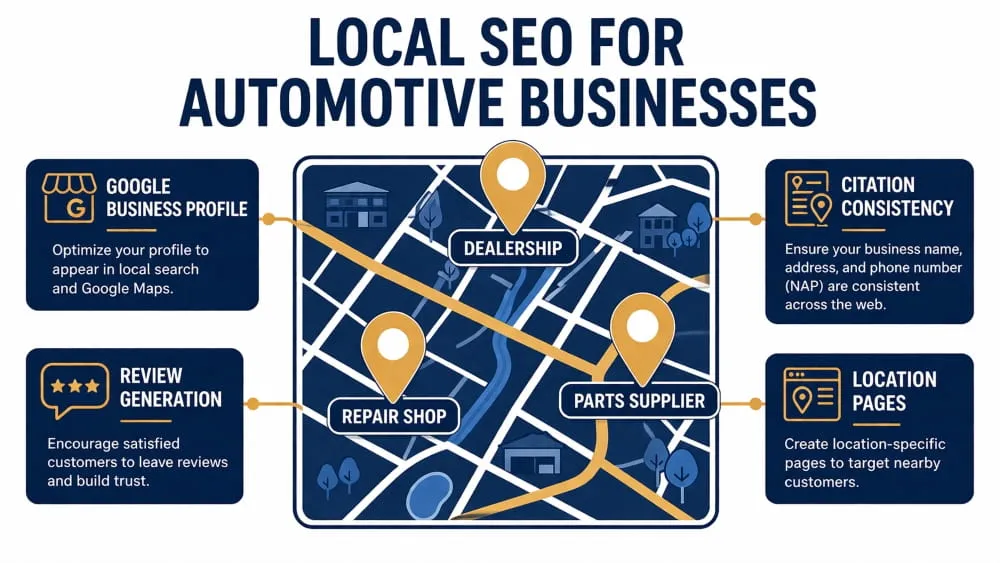
How to Rank in Local Search as a Dealership or Repair Shop
Local search rankings are determined by three core factors: relevance, distance, and prominence. Google weighs all three when deciding which businesses to surface in map pack results and localised organic listings, and understanding how each one applies to automotive businesses is the starting point for any effective local SEO strategy.
Relevance is about how well your online presence matches what someone is searching for. A repair shop that has clearly optimised pages for brake repairs, oil changes, and MOT services will rank more relevantly for those searches than one with a generic “services” page that lists everything in a single paragraph. Specificity wins.
Distance is partly outside your control, but your ability to rank in surrounding areas is not. Dealerships and repair shops that serve multiple locations need dedicated, properly optimised location pages, not duplicated content with the town name swapped out. Still, genuinely useful pages that speak to the local area, reference local landmarks or service zones, and give Google a clear signal that this page is built for that specific geography.
Prominence is built over time through reviews, citations, backlinks from local sources, and overall brand authority. It’s the accumulated signal that tells Google your business is established and trusted within its market, and it’s what separates businesses that sit at position one in the local pack from those that hover just outside it.
Google Business Profile Optimisation for Auto Businesses
Your Google Business Profile is the single most visible asset in local automotive SEO. It’s what drives your appearance in the map pack, populates your knowledge panel, and determines how your business looks the moment a potential customer finds you. An incomplete or poorly managed profile is a direct drag on local rankings and first impressions simultaneously.
For dealerships and repair shops, a fully optimised Google Business Profile means more than just filling in your address and phone number. Your business category should be precise: “car dealer,” “auto repair shop,” or “used car dealer,” rather than a generic umbrella term. Your service list should reflect exactly what you offer, using the language customers actually use to search. Your business description should be informative and naturally include the services and location terms most relevant to your business.
Photos matter more than most businesses realise. Profiles with regularly updated, high-quality images of your premises, team, and vehicles consistently outperform those with a handful of stock images uploaded years ago. Google treats photo activity as a signal of an active, engaged business, and customers respond to it in the same way.
Posts, Q&A responses, and booking links all contribute to profile completeness and engagement signals. The businesses that treat their Google Business Profile as a living asset, updating it regularly, responding to every review, and keeping information current, consistently outrank those that set it up once and leave it.
Local Automotive SEO Strategies That Work in 2026
The fundamentals of local automotive SEO haven’t changed; relevance, authority, and consistency still drive results. But the strategies that separate high-performing businesses from average ones in 2026 have become more refined, and the gap between businesses that apply them and those that don’t is widening.
Review generation is now one of the most significant local ranking factors in the automotive space. Volume alone isn’t enough; recency, response rate, and sentiment within reviews matter. Businesses that have a systematic process for generating reviews after every service or sale, and that respond thoughtfully to both positive and negative feedback, hold a structural advantage in local search that is difficult for competitors to overcome quickly.
Hyperlocal content is increasingly important for automotive businesses that serve multiple areas. Rather than relying on a single homepage to rank across an entire region, the most effective local automotive SEO strategies build out location-specific content that targets suburb-level and neighbourhood-level searches, the kind of ultra-specific queries that signal strong purchase intent and face significantly less competition than broad city-level terms.
Citation consistency across the web remains a non-negotiable baseline. Your business name, address, and phone number need to appear identically across every directory, aggregator, and platform where your business is listed. Discrepancies, even minor ones like abbreviated street names, dilute your local authority and create conflicting signals for search engines.
For automotive businesses without the internal resources to manage all of this effectively, working with a specialist automotive local SEO agency gives you the expertise and systematic execution that local search demands. The businesses consistently appearing at the top of local automotive searches aren’t there by accident; they’re there because someone built and maintained a strategy designed specifically to put them there.
Automotive Dealership SEO A Complete Breakdown
Dealerships operate in one of the most competitive SEO environments in the automotive industry. You’re competing not just with other local dealers, but with manufacturer websites, large automotive marketplaces like AutoTrader and Cars.com, and national chains with significant digital marketing budgets. Winning in that environment requires a dealership SEO strategy that is precise, well-structured, and built around how your specific customers actually search.
SEO Strategy for Car Dealerships
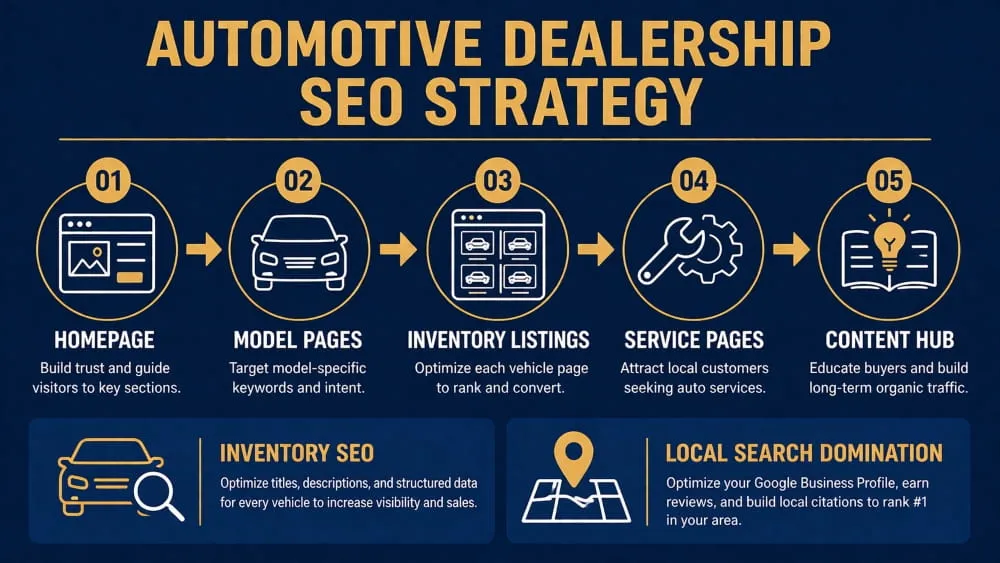
An effective automotive dealership SEO strategy starts with understanding that a dealership website is not a single entity; it’s a collection of distinct page types, each serving a different search intent and requiring a different optimisation approach.
Your homepage carries your brand and establishes your primary location relevance. Your make and model pages target customers in the research phase, people comparing options before they’ve decided what to buy. Your individual vehicle listing pages capture high-intent buyers searching for specific stock. Your service and parts pages serve existing customers and conquest traffic from people searching for maintenance in your area. And your blog or resource content builds topical authority and captures early-stage researchers before they’ve even settled on a make.
Each of these page types needs its own optimisation logic. A dealership SEO strategy that treats all pages the same, or worse, auto-generates content across inventory without any structured approach, will consistently underperform against competitors who have taken the time to build a coherent, intent-matched page architecture.
The strongest dealership SEO strategies also deliberately integrate content marketing. Comparison guides, financing explainers, and model-specific buying guides attract research-phase traffic and build the kind of topical authority that makes Google treat your site as a credible resource rather than just a listing platform.
Inventory Pages and Model-Specific Keyword Targeting
Inventory pages are where most dealership SEO either wins or wastes its potential. These pages represent some of the highest-intent real estate on your entire website; a user landing on a specific vehicle listing is often minutes away from enquiring, yet they are consistently the most poorly optimised pages on dealership sites.
The core problem is that most inventory pages are generated dynamically from dealer management systems, which prioritise stock management over search visibility. The result is pages with thin or duplicated content, auto-populated titles that don’t reflect how customers search, and URL structures that create crawlability issues at scale.
Model-specific keyword targeting solves this by treating each make, model, and variant as its own SEO asset. A page targeting “used BMW 3 Series [city]” needs a title that naturally includes those terms, a page description that speaks to the specific audience searching for that query, and enough unique content to give Google a reason to rank it over a generic inventory listing. When this is applied systematically across your most important stock categories, the cumulative traffic impact is substantial.
Beyond individual listings, dealerships should build evergreen model pages that exist independently of current stock, pages for “BMW 3 Series for sale” that remain live, accumulate authority, and continue attracting traffic whether you have three units in stock or thirty. These pages become long-term ranking assets that no individual listing page can replicate.
How Dealers Win Local Search Against National Competitors
The size of your competitor’s budget doesn’t determine who wins local search, relevance, and localisation do. This is where independent and regional dealerships have a genuine structural advantage over national players, provided they build their strategy around it.
National automotive marketplaces and manufacturer sites rank well for broad, generic searches. They do not rank as well for hyperlocal, high-intent searches, and those are precisely the searches that convert. “Used Ford Focus [specific town],” “[make] dealership open Sunday [city],” “family car under £15,000 [area]”, these are the queries where a well-optimised local dealership can and regularly does outrank national competitors.
Winning those searches requires a combination of strong local SEO foundations, a fully optimised Google Business Profile, consistent citations and active review generation, and location-specific website content that speaks directly to the geography you serve. A dealership serving multiple areas needs dedicated pages for each primary location, not a single page trying to rank everywhere at once.
Dealer-specific schema markup also plays a role here. Implementing the automotive dealer schema correctly means your listings can appear with enhanced information in search results, opening hours, ratings, and vehicle availability indicators, which improves click-through rates even when you’re ranking alongside larger competitors.
The dealerships that consistently win local search against national competition aren’t outspending them. They’re out-localising them, and that’s a strategic advantage that any dealership with the right automotive dealer SEO approach can build and sustain.
SEO for Automotive Repair Shops
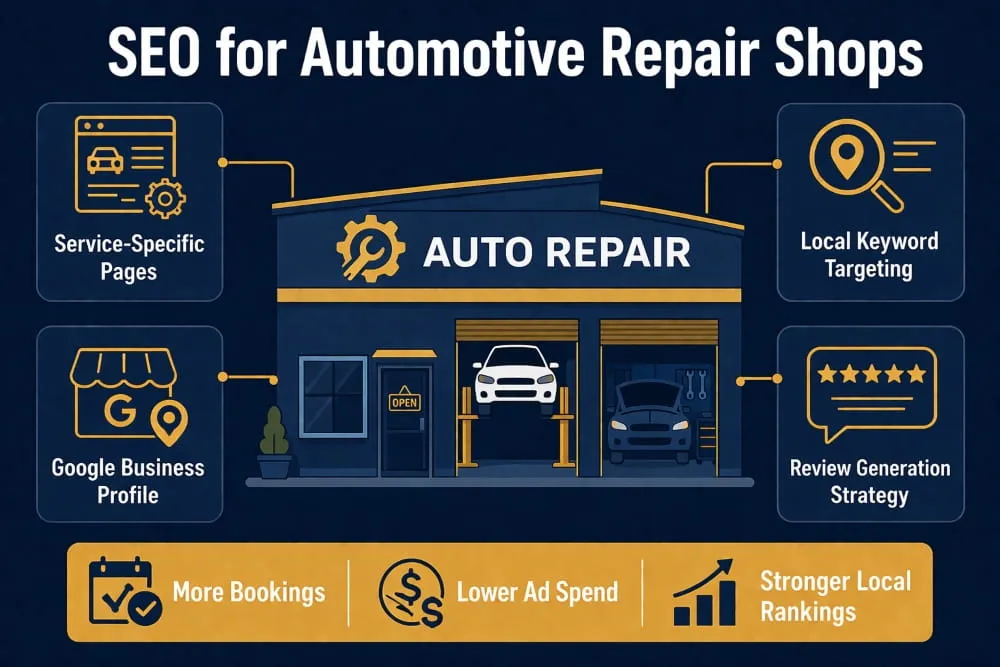
Repair shops face a different SEO challenge than dealerships. The inventory complexity isn’t there, but the local competition is fierce, services are often commoditised in searchers’ eyes, and trust plays a far larger role in the conversion decision. Someone choosing where to take their car for a brake job or an engine diagnostic isn’t just looking for proximity, they’re looking for confidence. Your SEO strategy needs to build both visibility and credibility simultaneously.
Best Keywords for Auto Repair SEO in 2026
The most valuable keywords for automotive repair shops are service-specific and location-modified. Broad terms like “car repair” or “auto mechanic” carry high competition and low conversion rates. The searches that actually drive bookings are far more specific: “brake pad replacement [city],” “timing belt service near me,” “diesel mechanic [area],” “MOT and service [town].”
In 2026, the keyword landscape for repair shops has become more granular, and that granularity works in your favour. Highly specific service searches face less competition, carry stronger purchase intent, and convert at significantly higher rates than broad queries. A repair shop that builds dedicated, optimised pages for its ten most common services, each targeting the specific terms customers use when they need that service, will consistently outperform a shop with a single generic “services” page trying to rank for everything at once.
Vehicle-specific repair keywords are also increasingly valuable. Searches like “BMW oil service [city]” or “VW DSG gearbox repair near me” indicate a searcher who knows exactly what they need and is actively looking for a specialist. If your shop has expertise in specific makes or systems, building content around those terms can capture high-intent traffic that generalist competitors largely ignore.
Seasonal and situational keywords round out a strong automotive repair SEO keyword strategy. “Winter tyre fitting,” “air conditioning regas,” and “pre-MOT check” all spike at predictable times of year, and shops that have optimised content ready before those spikes hit capture the traffic without having to compete for it in real time.
On-Page Tactics That Drive Repair Shop Bookings
The goal of on-page SEO for a repair shop isn’t just to rank, it’s to rank and convert. Traffic that doesn’t turn into bookings has limited business value, and the on-page decisions you make directly influence both outcomes.
Each service needs its own dedicated page. Not a section on a long services list, but a standalone page with a clear URL, a focused title, a descriptive heading, and content that explains the service, signals your expertise, and makes it easy for the reader to take the next step. This structure gives Google a clear, specific page to rank for each service query, and gives the visitor a focused experience that removes friction from the booking decision.
Page titles and meta descriptions carry more weight for repair shops than many businesses realise. When your listing appears in local search results alongside three or four competitors, the title and description are what differentiate you before the click. A meta description that mentions your warranty, your turnaround time, or a specific trust signal, “same-day service available,” “all work guaranteed”, will consistently outperform a generic description that simply restates the page topic.
Calls to action need to be unambiguous and prominent. Repair shop visitors are task-oriented; they have a problem, and they want to book a solution. Every service page should make it immediately clear how to get in touch, book online, or request a quote. Friction at this stage is where bookings are lost, and it’s entirely within your control to eliminate it.
Building Trust Signals for Service-Based Automotive Sites
Trust is the conversion variable that SEO alone cannot manufacture, but your SEO strategy can create the conditions for it to accumulate and compound over time.
Reviews are the most powerful trust signal available to a repair shop, and they operate on two levels simultaneously. They directly influence local search rankings as part of Google’s prominence assessment, and they influence customer conversion decisions after they find you and evaluate whether to book. A repair shop with 200 detailed, recent Google reviews will outrank and out-convert a technically superior website with 15 reviews from three years ago.
Accreditations and trade body memberships, manufacturer approvals, industry certifications, and recognised trade associations should be prominently displayed on your website and referenced in your content. These signals matter to Google as indicators of expertise and legitimacy, and they matter to customers who are trying to assess whether they can trust you with their vehicle.
Case studies and before-and-after content, where appropriate, add a layer of social proof that generic service descriptions cannot replicate. A page explaining your engine diagnostics process, supported by a real example of how you identified and resolved a complex fault, does more for trust than any amount of marketing language.
Finally, your NAP consistency, name, address, and phone number across your website, Google Business Profile, and every directory listing needs to be exact. For service-based automotive businesses, where local trust and local rankings are everything, inconsistency here creates doubt in both Google’s algorithm and potential customers’ minds. It’s a small discipline with a disproportionately large impact on how your business performs in local search.
Automotive Parts and Aftermarket SEO
The automotive parts and aftermarket sector is one of the most search-driven segments of the entire industry. Buyers know exactly what they need, or they’re actively researching to find out, and they’re using search engines to locate it, compare prices, check compatibility, and decide where to buy. For parts retailers and aftermarket suppliers, organic search isn’t just a traffic channel. It’s the primary sales engine, and businesses that have invested in getting their SEO right are pulling ahead of those that haven’t.
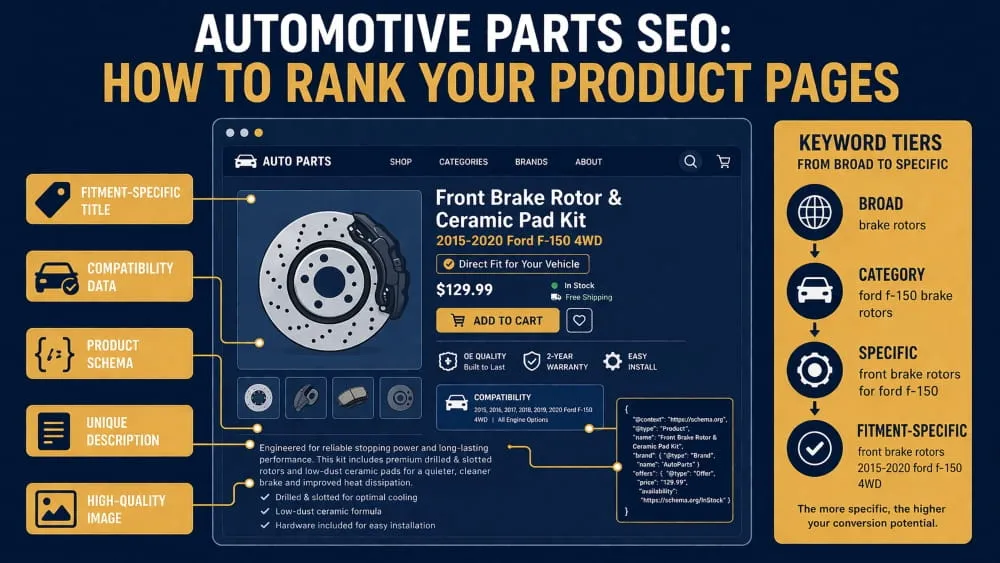
How to Optimise Automotive Parts Product Pages
A product page in the automotive parts space carries far more SEO responsibility than a typical e-commerce page. The searcher isn’t just looking for a product; they’re looking for the right part for a specific vehicle, and your page needs to answer that question with complete confidence before they’ll convert.
The foundation of a well-optimised parts page is specificity. Every page should make immediately clear what the part is, which vehicles it fits, and what condition or specification it meets. This information needs to be present in the page title, the heading, the product description, and the structured data markup, not buried in a compatibility table that requires three clicks to find.
Compatibility data is both an SEO asset and a conversion tool. When your product pages include make, model, year, and engine variant information in a structured, crawlable format, they become eligible to rank for the highly specific queries that parts buyers actually use. “Front brake pads Ford Focus Mk3 1.6 TDCi” is not a broad search; it’s a buyer who knows exactly what they need and is ready to purchase. A product page optimised to match that query precisely will capture that conversion; a generic page will not.
Images, while not a direct ranking factor, influence time on page and conversion rate, both of which Google uses as indirect quality signals. Multiple images showing the part from different angles, alongside fitment diagrams where relevant, reduce uncertainty and increase purchase confidence, which affects both your rankings and your revenue.
Best Keywords for Automotive Parts SEO
Keyword strategy for automotive parts SEO differs from that for service-based automotive businesses. The search volume is distributed across thousands of highly specific, long-tail queries rather than concentrated in a small number of high-volume terms, and that distribution is actually an advantage for businesses that understand how to capture it systematically.
The most valuable keywords in this space combine part type, vehicle compatibility, and condition or specification. “OEM vs aftermarket” modifier searches are particularly valuable; buyers using these terms are in active evaluation mode and convert at high rates. Brand-specific part searches, where a customer is looking for a named manufacturer’s component for a specific vehicle, represent some of the highest-intent traffic in the entire category.
Fitment-based keywords, searches that include year, make, model, and sometimes engine size, are where the real long-tail opportunity lies. Individually, these searches have modest volume. Collectively, across a large parts catalogue, they represent an enormous pool of purchase-ready traffic. The businesses that build their product page optimisation around fitment specificity consistently outperform those targeting broader, more competitive terms with lower conversion intent.
Don’t overlook problem-based keywords either. Searches like “symptoms of worn brake pads [make/model]” or “how to tell if my alternator is failing” capture buyers at the start of their purchase journey. Supporting content that answers these questions and naturally links to the relevant parts pages builds topical authority and creates a funnel from awareness to conversion within your own domain.
SEO-Optimised Product Description Templates for Auto Parts
Product descriptions in the automotive parts space are where many retailers either win or lose the SEO battle. Manufacturer-supplied descriptions, copied across multiple retailers, create duplicate content issues that suppress rankings. Thin descriptions that list specifications without context fail to satisfy search intent. And keyword-stuffed descriptions that read as unnatural damage both user experience and search performance.
An effective SEO optimized product description for automotive parts follows a clear structure. It opens with a concise, plain-language summary of what the part is and what it does, written for the buyer, not the algorithm. It then addresses fitment and compatibility in specific terms, using the make, model, year, and variant language that customers use when searching. It covers key specifications, materials, dimensions, OEM equivalent numbers, and certifications in an easy-to-scan format. And it closes with a brief statement explaining why this particular part or supplier is the right choice, focusing on quality, warranty, or delivery.
This structure serves two purposes simultaneously. It gives Google a rich, unique, crawlable page that matches the specific queries buyers use. And it gives the buyer all the information they need to purchase with confidence, without having to leave your site to verify compatibility or quality elsewhere. Reducing that friction is what turns a well-ranked product page into a high-converting one.
Automotive E-commerce SEO Optimisation Checklist
Automotive ecommerce SEO operates at scale, and that scale introduces complexities that don’t exist on smaller sites. A parts catalogue with tens of thousands of SKUs creates technical challenges, duplicate content, crawl budget management, faceted navigation issues, and URL proliferation, requiring systematic solutions rather than page-by-page fixes.
Crawl budget management is critical. Search engines allocate a finite amount of crawl resources to each site, and large automotive parts catalogues can easily waste that budget on low-value filtered pages, parameter URLs, and duplicate listings. Canonical tags, robots.txt configuration, and a logical faceted navigation structure ensure that Google’s crawl resource is directed toward the pages that matter most.
Structured data implementation across product pages, including schema for product name, price, availability, reviews, and vehicle compatibility, enables rich results in search that improve click-through rates before a user even reaches your site. In a category where multiple retailers are competing for the same query, rich results create a meaningful visual advantage.
Site architecture for parts ecommerce needs to balance discoverability with crawl efficiency. Category pages for part types, subcategory pages for vehicle-specific sections, and individual product pages should form a logical hierarchy that distributes authority from your most trusted pages down to your deepest catalogue entries. Orphaned product pages, those with no internal links pointing to them, accumulate no authority and rank for nothing.
Finally, page speed and mobile performance are non-negotiable in automotive ecommerce. Parts buyers search across devices, often in garages or workshops on mobile, and a slow or poorly formatted mobile experience drives abandonment at precisely the moment of highest purchase intent. Technical performance is not a background concern; it’s a direct revenue variable.
Automotive SEO Content Strategy
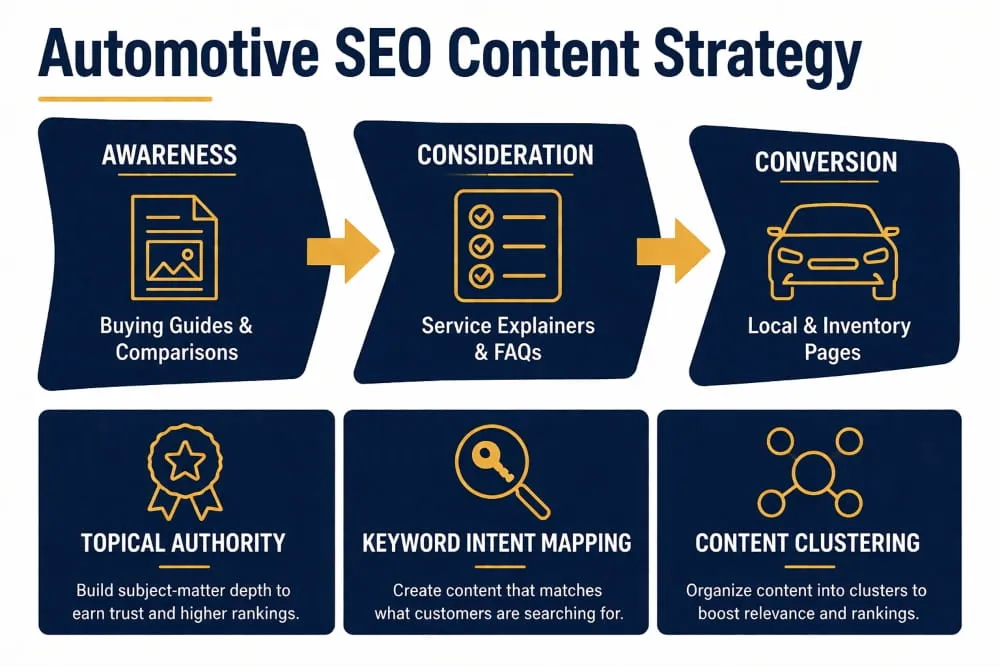
Rankings are earned by relevance, and relevance is built through content. In the automotive industry, where the buyer journey spans weeks of research, multiple comparison searches, and several intent shifts before a conversion, content keeps your business visible at every stage of that journey. A strong automotive SEO content strategy doesn’t just support your rankings, it builds the kind of topical authority that makes Google treat your website as the credible, go-to resource for your corner of the automotive space.
What Content Works Best for Automotive Brands
The content that performs best for automotive brands shares a common characteristic: it answers a specific question that a specific type of buyer is asking at a specific point in their journey. Vague, general content, “we offer great service at competitive prices”, ranks for nothing and converts no one. Content built around genuine search intent, with real depth and practical value, earns rankings and builds trust simultaneously.
For dealerships, the highest-performing content tends to fall into three categories. Buying guides and model comparisons capture early-stage researchers who are still deciding what to purchase, “diesel vs petrol: which is right for you” or “best family SUVs under £30,000 in 2026” attract significant search volume and position the dealership as a trusted advisor before a customer has even considered visiting. Finance and ownership content addresses the practical questions buyers have once they’ve decided on a vehicle, PCP vs HP comparisons, part-exchange guides, and running cost breakdowns. And local content, area-specific pages, community involvement, and location-based buying guides, reinforce local search relevance in a way that generic national content cannot replicate.
For repair shops, service explainer content performs exceptionally well. Pages that explain what an MOT involves, how to identify worn brake pads, or when a timing belt should be replaced attract buyers at the exact moment they’re diagnosing a problem, which is, more often than not, the moment they’re also deciding where to take their vehicle. This content captures search demand and converts it into service enquiries without requiring any paid promotion.
For parts and aftermarket brands, comparison content, compatibility guides, and installation tutorials serve the dual purpose of ranking for high-intent searches and reducing the purchase hesitation that prevents browsers from becoming buyers.
How to Build Topical Authority in the Automotive Space
Topical authority is Google’s assessment of how comprehensively and credibly your website covers a given subject area. It’s not built on a single well-written page; it’s built by systematically covering a topic from multiple angles and at multiple depths, leaving no significant question unanswered within your domain.
For automotive businesses, building topical authority means identifying the full universe of questions, concerns, and searches in your area of specialisation, and creating content that thoroughly addresses them. A dealership specialising in electric vehicles should own the entire EV content landscape relevant to its market: range anxiety guides, charging infrastructure explainers, EV vs hybrid comparisons, tax benefit breakdowns, and model-specific reviews. When Google sees a domain that covers a topic this comprehensively, it treats that domain as an authority, and authority translates directly into rankings across the entire topic cluster.
The practical mechanism for building topical authority is content clustering. A pillar page covers a broad topic at a high level, “the complete guide to buying an electric vehicle”, and links out to a network of supporting pages that each cover a specific subtopic in depth. Those supporting pages link back to the pillar, reinforcing its authority, and link to each other where relevant, creating a content ecosystem that signals comprehensive coverage to search engines.
Internal linking is the connective tissue of topical authority. It distributes authority from your strongest pages to newer or weaker ones, signals to Google how your content is related, and guides visitors naturally deeper into your site, increasing engagement metrics that Google uses as indirect quality signals. An automotive content strategy without a deliberate internal linking framework is leaving significant ranking potential on the table.
Content Marketing for Automotive SEO: A Practical Framework
Understanding what content to create is one thing. Building a repeatable, sustainable process for creating it is another, and it’s where most automotive businesses without a dedicated content strategy fall behind.
The framework starts with keyword and intent mapping. Before any content is written, the target keyword, the search intent behind it, and the type of content best suited to satisfy that intent need to be defined. A how-to query needs a process-led guide. A comparison query needs a balanced evaluation. A local query needs location-specific content with genuine geographical relevance. Matching content format to search intent is the single highest-leverage decision in the content creation process.
From there, content needs to be prioritised by opportunity. Not all topics are equal; some carry higher search volume, some face less competition, and some align more directly with the services or products that generate the most revenue. A content calendar built around these priorities ensures that resources are directed toward the pages most likely to deliver measurable business impact, rather than spread thinly across topics chosen arbitrarily.
Production quality matters more than production volume. A single thoroughly researched, expertly written, well-structured piece of content will outperform ten thin articles every time, both in rankings and in the trust it builds with readers, for automotive brands producing content at scale, maintaining that quality standard requires either skilled in-house writers with genuine automotive knowledge, or a specialist automotive SEO content marketing partner who understands both the industry and the search landscape.
Finally, content is not a set-and-forget asset. Regular auditing, identifying pages that have lost rankings, updating statistics and references that have become outdated, and expanding sections that could cover a topic more comprehensively, is what keeps a content library performing over the long term. The automotive businesses consistently winning in organic search treat their content as a living asset, not a published archive.
Automotive SEO Best Practices for 2026
The automotive SEO landscape is not static. Algorithm updates, shifts in search behaviour, and Google’s growing sophistication in evaluating content quality mean that strategies that delivered results two or three years ago may be underperforming today. What hasn’t changed is the underlying logic: Google wants to surface the most relevant, trustworthy, and useful result for every search. The best practices that work in 2026 are simply a more refined expression of that principle, applied to an industry that is more competitive, more technically complex, and more search-saturated than ever.
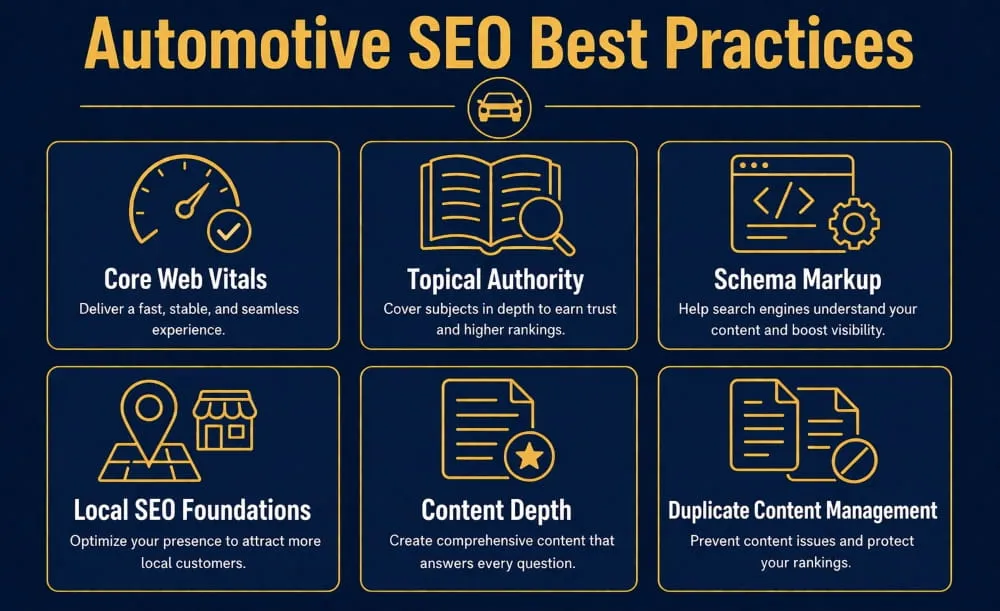
Automotive Brand SEO Best Practices
For automotive brands, whether that’s a manufacturer, a multi-location dealer group, or a national parts retailer, SEO best practices operate at a scale and complexity that demands both strategic clarity and technical discipline.
Brand consistency across the web is foundational. Your business name, location information, and service descriptions need to be identical across your website, Google Business Profile, manufacturer directories, and every third-party platform where your brand appears. Inconsistency at this level sends conflicting signals to search engines and erodes the local authority automotive brands depend on for visibility in their primary markets.
Clear editorial standards should govern page-level optimisation. Every page on an automotive brand’s website needs a defined primary keyword focus, a title tag that reflects how customers search rather than internal naming conventions, a meta description that earns the click rather than simply restating the heading, and content with enough depth to satisfy the intent behind the search. These are not advanced tactics; they are baseline requirements that a surprising number of automotive websites still fail to meet consistently.
Duplicate content management is a brand-level concern that requires a systematic solution. Large automotive websites, particularly those with dynamic inventory systems or multi-location structures, routinely generate duplicate or near-duplicate pages, diluting authority and creating indexation inefficiencies. Canonical tag implementation, parameter handling in Google Search Console, and a clear URL governance policy are the mechanisms that keep this under control as the site scales.
SEO Trends for the Automotive Industry in 2026
Several developments are reshaping how automotive SEO works in 2026, and businesses that understand them early will hold a meaningful advantage over those still operating on last cycle’s assumptions.
AI-generated search experiences are changing how some informational queries are answered. Google’s Search Generative Experience surfaces synthesised answers directly in search results for certain query types, which affects click-through rates on informational content. The automotive businesses best positioned for this shift are those that have built genuine topical authority, because SGE still cites sources, and the sources it cites are the ones Google already trusts most. Depth, credibility, and comprehensive coverage matter more now, not less.
Voice and conversational search continue to grow in the automotive context, particularly for local and service-based queries. “Find a tyre shop open near me now” and “what’s the best oil for a 2019 BMW 3 Series” are the kinds of natural-language searches that are increasing in volume. Content that answers questions in clear, direct language, rather than optimising purely for fragmented keyword strings, is better positioned to capture this traffic.
Google’s quality evaluation systems increasingly weigh first-hand experience signals. For automotive content, this means that pages written with genuine industry knowledge, specific examples, and practical detail consistently outrank pages that cover the same topic at a surface level. For dealerships and repair shops producing their own content, this is actually a structural advantage; no agency or AI tool can replicate the authentic expertise that comes from working in the industry day to day.
What the Automotive SEO Report 2026 Reveals
The data emerging from automotive SEO analysis in 2026 reinforces several patterns that experienced practitioners have observed for some time, while highlighting new areas of opportunity that remain underexploited by the majority of businesses in the space.
Local search dominance remains the highest-ROI opportunity for dealerships and repair shops. The businesses appearing consistently in the top three of local map pack results capture a disproportionate share of clicks and conversions, and the gap between position one and position four in local results is far larger than most businesses realise. Investment in local SEO foundations, Google Business Profile optimisation, review generation, citation consistency, and location-specific content delivers returns that outpace almost every other channel available to automotive businesses operating in defined geographic markets.
Page experience signals, site speed, mobile usability, and Core Web Vitals are increasingly clearly separating high-performing automotive websites from average ones. In markets where multiple competitors produce comparable content and target similar keywords, technical performance has become a meaningful differentiator. Businesses that have invested in resolving their Core Web Vitals issues are seeing sustained ranking improvements over technically weaker competitors, even where content quality is broadly comparable.
Content depth and topical coverage remain the primary factors separating dominant automotive SEO performers from everyone else. The sites ranking at the top of competitive automotive searches in 2026 are not those with the most pages; they’re those with the most comprehensive, authoritative, and well-structured coverage of the topics their customers care about. That finding should shape every content and strategy decision an automotive business makes this year.
How to Choose an Automotive SEO Agency
Choosing the right automotive SEO agency is one of the most consequential decisions a dealership, repair shop, or auto brand can make. Done well, it compounds returns over months and years, building visibility, authority, and a consistent pipeline of organic leads that doesn’t depend on continuous ad spend. Done poorly, it wastes budget, stalls growth, and sometimes causes active damage to rankings that takes significant time and resources to repair. The difference between those two outcomes almost always comes down to how carefully the decision was made before signing a contract.
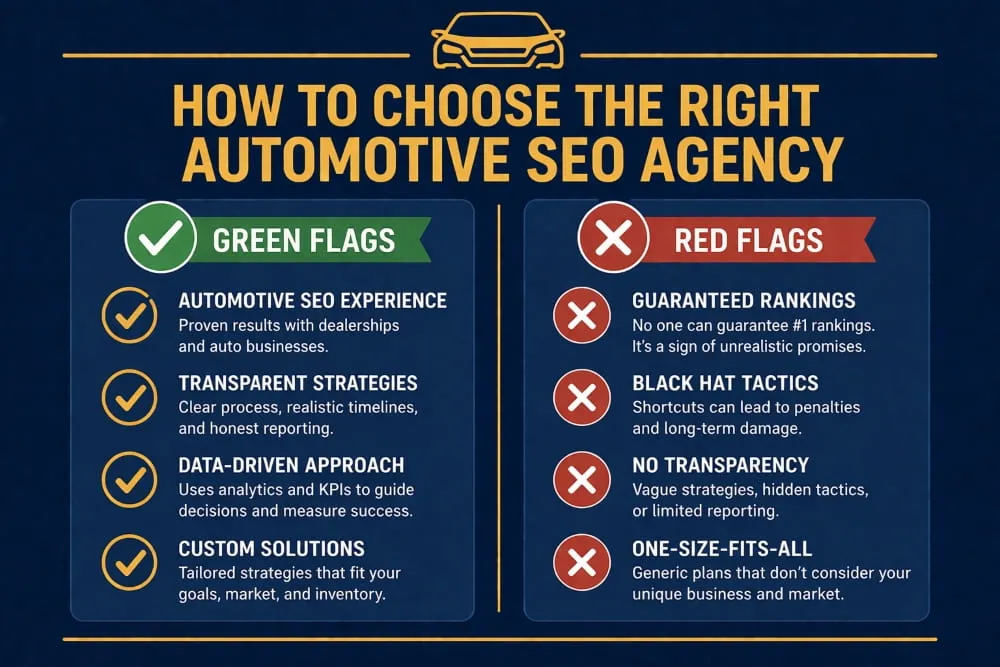
What to Ask Automotive SEO Consultants Before Hiring
The conversation you have with an automotive SEO consultant before engaging them tells you almost everything you need to know about how they work and whether they’re the right fit for your business.
Start with industry experience. Automotive SEO has enough unique complexity, inventory management, local search at scale, dealership schema, parts catalogue architecture, that generalist SEO knowledge is not sufficient. Ask specifically about their experience with businesses like yours. A consultant who has delivered results for a carpet cleaning business or a law firm has not necessarily developed the skills required to manage SEO for a multi-location dealership group or an automotive ecommerce catalogue.
Ask how they approach keyword strategy and how they prevent cannibalization. Any experienced automotive SEO specialist should be able to explain, clearly and without jargon, how they identify the right keywords for each page, ensure that different pages don’t compete with each other, and align content strategy with actual search intent. Vague answers at this stage are a reliable indicator of a surface-level approach.
Ask what their reporting looks like and what metrics they prioritise. Rankings matter, but they are not the end goal; traffic, qualified leads, and revenue impact are. An automotive SEO consultant worth hiring will talk about business outcomes, not just ranking positions. They should be able to show you how they connect SEO activity to the metrics that actually matter to your business.
Finally, ask for case studies or examples of results delivered specifically to automotive businesses. Results in comparable competitive environments, local dealership markets, automotive e-commerce, and local repair shop SEO are far more relevant than general portfolio examples. If they can’t produce them, the risk profile of hiring them is significantly higher.
What the Best Automotive SEO Agencies Do Differently
The gap between an average automotive SEO agency and an exceptional one is not primarily about tools or technology; both have access to the same platforms. The difference is in how they think about strategy, how they communicate, and how disciplined they are in execution.
The best automotive SEO agencies start with a genuine audit before making any recommendations. They don’t arrive with a pre-packaged service offering and fit your business into it; they assess your current technical foundation, your existing content, your competitive landscape, and your keyword opportunities, and build a strategy specifically tailored to what your business needs to win in your market. This distinction matters enormously for seo for automotive businesses, because the strategic priorities for a single-location repair shop are fundamentally different from those for a regional dealership group or a national automotive parts retailer.
They also think in systems, not tasks. Rather than optimising individual pages in isolation, the best agencies build interconnected strategies, where technical SEO creates the foundation for content to rank, content builds the topical authority that amplifies local SEO, and off-page work reinforces the domain trust that makes everything else more effective. This systems-level thinking is what produces compounding results over time rather than short-term ranking fluctuations.
Communication and transparency are consistent differentiators. The top automotive SEO firms don’t obscure their work behind vanity metrics and dense reports; they explain what they’re doing, why they’re doing it, and what impact it’s having in terms that a business owner or marketing manager can understand and act on. If you can’t clearly see the connection between the agency’s activity and your business results, that’s not a reporting problem; it’s a strategy problem.
Red Flags to Avoid When Vetting Automotive SEO Companies
The automotive SEO market contains a significant number of agencies and consultants offering services that range from genuinely excellent to actively harmful. Knowing what to look out for protects both your budget and your rankings.
Guaranteed ranking promises are the most persistent red flag in the industry. No legitimate automotive SEO company can guarantee specific ranking positions, Google’s algorithm is not within anyone’s control, and any agency claiming otherwise is either misleading you or proposing tactics that carry the risk of a Google penalty. Sustainable automotive SEO is built through quality and consistency, not through shortcuts that temporarily inflate rankings before collapsing.
Lack of transparency around methodology is equally concerning. Suppose an agency is reluctant to explain what they’re doing or why, or if their reporting focuses exclusively on ranking movement without connecting it to traffic or business outcomes. In such cases, opacity usually exists for a reason. Effective SEO for automotive companies is explainable; it’s not a black box, and it shouldn’t be presented as one.
Watch for agencies that lead with volume rather than strategy, promising hundreds of backlinks per month, thousands of words of content per week, or technical fixes measured by quantity rather than impact. In automotive SEO, the quality of a single authoritative backlink from a relevant industry publication outweighs 100 low-quality directory submissions. Volume without strategic direction is how budgets are consumed, yielding no meaningful results.
Finally, be cautious of agencies with no demonstrable understanding of the automotive industry specifically. SEO for automotive brands, dealerships, and repair shops requires domain knowledge beyond general digital marketing skills. The technical nuances of inventory management, the local search dynamics of dealership markets, and the e-commerce complexity of parts catalogues all require genuine expertise. An agency that treats your automotive business like any other client will deliver results that reflect that generic approach, and in a competitive industry, generic is not enough.
Ready to Dominate Automotive Search? Work With IT Leadz
Visibility in automotive search doesn’t happen by accident. It’s built deliberately and systematically, with a clear understanding of how your customers search, what Google rewards, and where your biggest growth opportunities actually lie. If you’ve read this far, you already understand what effective automotive SEO looks like. The question now is whether your current strategy is actually delivering it.
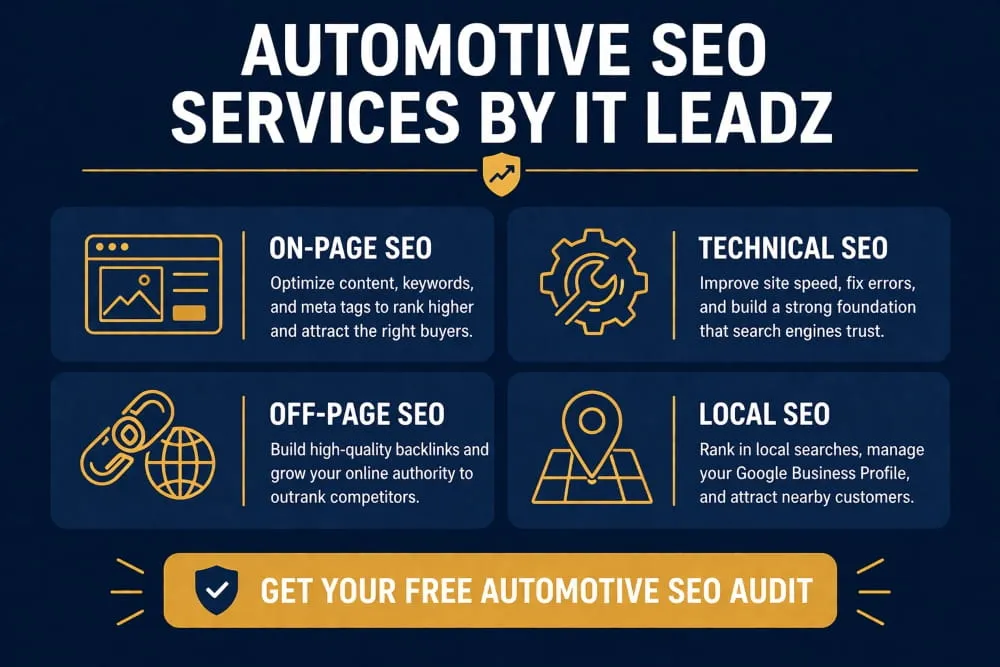
IT Leadz works with automotive businesses that are serious about organic growth, dealerships looking to reduce their dependence on paid advertising, repair shops building a consistent pipeline of local enquiries, and auto brands competing for visibility in markets where the competition is significant and the stakes are high. We don’t offer generic digital marketing with an automotive label. We build strategies specifically tailored to the dynamics of automotive search, and we measure success by business outcomes, not vanity metrics.
Our Automotive SEO Services
IT Leadz delivers automotive SEO across four core disciplines, each one essential to a strategy that performs at the level this industry demands.
On-Page SEO covers everything that lives on your website: keyword strategy, content optimisation, page structure, title tags, meta descriptions, internal linking, and the editorial standards that ensure every page on your site is working as hard as it should. For automotive businesses, this means inventory pages that rank, service pages that convert, and content that builds trust with buyers at every stage of their journey.
Technical SEO addresses the infrastructure your rankings are built on, site speed, Core Web Vitals, crawlability, indexation management, schema markup, and site architecture. For dealerships with large inventory systems, parts retailers with complex catalogues, and automotive brands managing multi-location websites, technical SEO is where significant ranking potential is either unlocked or left unrealised.
Off-Page SEO builds domain authority, making everything else more effective through strategic link acquisition from relevant automotive and local sources, citation building and consistency management, and external trust signals that tell Google your business is credible, established, and worth ranking prominently.
Local SEO is where dealerships and repair shops win or lose the searches that matter most. IT Leadz manages every element of local search performance, Google Business Profile optimisation, review generation strategy, location page development, and hyperlocal keyword targeting, to put your business in front of buyers in your market at the exact moment they’re ready to act.
Why Automotive Businesses Choose IT Leadz
There is no shortage of SEO agencies willing to take on automotive clients. What is in short supply are agencies that genuinely understand the automotive industry, build strategies tailored to its specific complexities, and deliver results that translate directly into business growth.
IT Leadz brings both industry understanding and a results-first approach, keeping every decision anchored in what actually moves the needle for automotive businesses. We don’t believe in opaque reporting, vague deliverables, or strategies that look impressive on paper but produce little in practice. Our clients see clearly what we’re doing, why we’re doing it, and what it’s delivering, because that transparency is the foundation of a partnership that compounds in value over time.
We also understand that no two automotive businesses face the same SEO challenge. A single-location repair shop competing for local service searches needs a fundamentally different strategy than a regional dealership group building model-specific organic presence or a parts retailer managing a catalogue of tens of thousands of SKUs. Our approach is built around your specific situation, your market, and the opportunities that offer the highest return for your business.
The results speak clearly. Organic traffic growth, reduced paid search dependency, higher-quality inbound leads, and sustained ranking improvements in competitive automotive markets are the outcomes our clients experience when a properly built automotive SEO strategy is given the time and execution quality it requires.
Get Your Free Automotive SEO Audit
If you’re unsure whether your current SEO is performing at the level your business needs, or if you already know it isn’t and you’re ready to change that, the right starting point is a clear picture of where you stand.
IT Leadz offers a free automotive SEO audit that gives you exactly that. We’ll assess your website’s technical health, evaluate your current keyword performance and ranking positions, identify the gaps between where you are and where your highest-opportunity searches are being won, and give you a clear, honest view of what a properly built strategy would look like for your business.
No obligation. No generic report generated by a tool and emailed without context. A real assessment, by people who understand automotive search, delivered in a way that’s actually useful to you, regardless of whether you choose to work with us.
The businesses consistently winning in automotive search started making the right decisions earlier than their competitors. The best time to build your strategy was twelve months ago. The second-best time is now.
Contact IT Leadz today and claim your free automotive SEO audit.
Frequently Asked Questions (FAQ’s)
What Does SEO Stand For in Automotive?
SEO stands for Search Engine Optimisation. In the automotive context, it refers to the process of improving a dealership’s, repair shop’s, or auto brand’s online presence so that it ranks higher in search engine results when potential customers search for vehicles, services, or parts.
How Long Does Automotive SEO Take to Work?
Most automotive businesses begin seeing measurable improvements in rankings and organic traffic within three to six months of implementing a properly built SEO strategy. Competitive markets and larger websites may take longer, but results compound over time, unlike paid advertising, which stops delivering once the budget runs out.
How Much Do Automotive SEO Services Cost?
Automotive SEO services vary in cost based on the scope of work, market competitiveness, and website size. Most reputable automotive SEO agencies offer tailored packages rather than fixed pricing, because the investment required to rank a single repair shop locally is fundamentally different from what’s needed to build organic presence for a multi-location dealership group.
Can Small Dealerships Compete with Big Brands Through SEO?
Yes, and local search is precisely where small and independent dealerships hold a structural advantage. National brands and large marketplaces rank well for broad searches but rarely dominate hyperlocal, high-intent queries. A well-optimised independent dealership with strong local SEO foundations can consistently outrank national competitors for the searches that matter most in its specific market.
What Are the Most Important Keywords for Automotive SEO?
The most valuable automotive SEO keywords are those that combine high purchase intent with local or vehicle-specific modifiers, searches like “[make] dealership [city],” “car service near me,” or specific model and part queries. Broad terms carry high competition and lower conversion rates; specific, intent-matched keywords drive the traffic that actually turns into enquiries, bookings, and sales.
What Should I Ask an Automotive SEO Consultant Before Hiring?
Ask about their specific experience with automotive businesses, how they approach keyword strategy and cannibalization prevention, what metrics they prioritise in reporting, and whether they can provide case studies from comparable automotive clients. Any credible automotive SEO consultant should be able to answer these questions clearly, without deflection or vague generalities.
Who Are the Leading SEO Experts in the Automotive Industry?
The top automotive SEO experts are those with a demonstrable track record of delivering measurable organic growth specifically for dealerships, repair shops, parts retailers, and automotive brands, not generalist agencies that occasionally work with automotive clients. Look for specialists who understand inventory SEO, local search dynamics, and the technical complexity unique to automotive websites.
What Automotive SEO Services Should I Consider?
A complete automotive SEO strategy should cover all four core disciplines: on-page optimisation, technical SEO, off-page authority building, and local SEO. Businesses that invest in all four, rather than treating them as optional add-ons, consistently outperform those running partial strategies in competitive automotive search markets.
How Do I Find the Right Automotive SEO Agency for My Business?
The right automotive SEO agency understands your specific business type, whether that’s a dealership, repair shop, or parts retailer, and builds a strategy around your market, your competition, and your growth objectives. IT Leadz specialises in automotive SEO across all four core disciplines and offers a free audit to help you understand exactly where your current strategy stands and what it would take to improve it.