Why is my website not ranking on Google? It usually comes down to one of three root causes, Google has not indexed it yet, technical errors are blocking crawlers or your on page SEO and authority signals simply are not strong enough to compete for your target keywords. The good news is that most ranking failures are diagnosable and fixable within days, not months.
If you have searched why is my website not ranking on Google more than once this week, you are not alone and you are not doing something uniquely wrong. Based on research conducted that more than 1 billion web pages, nearly 91% of content gets zero organic traffic from Google, most often due to indexing gaps, weak backlink profiles or unclear search intent targeting rather than poor writing. In other words, ranking issues are rarely about one big mistake, they are usually a handful of small, identifiable gaps stacking up.
This guide breaks down the 15 most common reasons websites fail to rank, from indexing and crawl errors to content depth and technical performance and pairs each one with a practical fix you can apply right away. Whether your site was never indexed, dropped rankings suddenly or has been stuck despite months of consistent SEO effort, you will find the specific cause and the specific solution, below. And if you’d rather have the technical side handled directly, our Web Solutions team can audit and fix these issues for you.
Quick Check Is Your Website Even Indexed by Google?
Before diagnosing anything else, confirm whether Google has indexed your website at all, if it has not, no amount of content or backlinks will help you rank, because your pages simply do not exist in Google search database yet.

How to Check If Google Has Indexed Your Site
The fastest way to check indexing status is to type “site:yourdomain.com” directly into Google search bar. If your pages appear in the results, Google has crawled and indexed at least part of your site. If nothing shows up or only a handful of unrelated pages appear, indexing is likely your core problem.
For a more reliable read, Google Search Console URL Inspection tool tells you the exact indexing status of any individual page, including whether it is indexed, excluded or queued for crawling. This method is more accurate than the site, search operator, which Google itself has acknowledged can be inconsistent or incomplete.
What It Means If Your Site Is not Indexed at All
An unindexed website usually points to one of a few specific triggers, the site is too new and has been discovered yet, a no index tag is unintentionally blocking pages, the robots.txt file is disallowing crawler access or there is no valid XML sitemap submitted to Google. In some cases, thin or duplicate content across pages can cause Google to deprioritize crawling altogether.
Google processes over 8.5 billion search requests each day but crawling and indexing every new page still takes time and depends on crawl budget, site authority and technical accessibility, none of which happen automatically just because a site is live. Left unresolved, this issue compounds, the longer a site stays unindexed, the further behind it falls against competitors who are already being crawled and ranked.
Reading Google Search Console the Right Way
Google Search Console is the single most reliable source for indexing data, but most site owners misread it. The Coverage report under Indexing > Pages breaks results into four categories, Indexed, Crawled but not indexed, Discovered but not indexed and Excluded. Each category points to a different fix, Discovered but not indexed often signals a crawl budget or server response issue, while Crawled but not indexed usually means Google found the page but judged the content too thin or duplicate to include.
Rather than treating Search Console as a one time check, review it weekly during early SEO efforts, since indexing status can shift as Google recrawls your site. If these reports consistently show unresolved errors, it is worth having a Technical SEO audit performed to identify and fix the underlying crawl or server level issues before investing further in content or link building.
The 15 Real Reasons Your Website Is not Ranking on Google
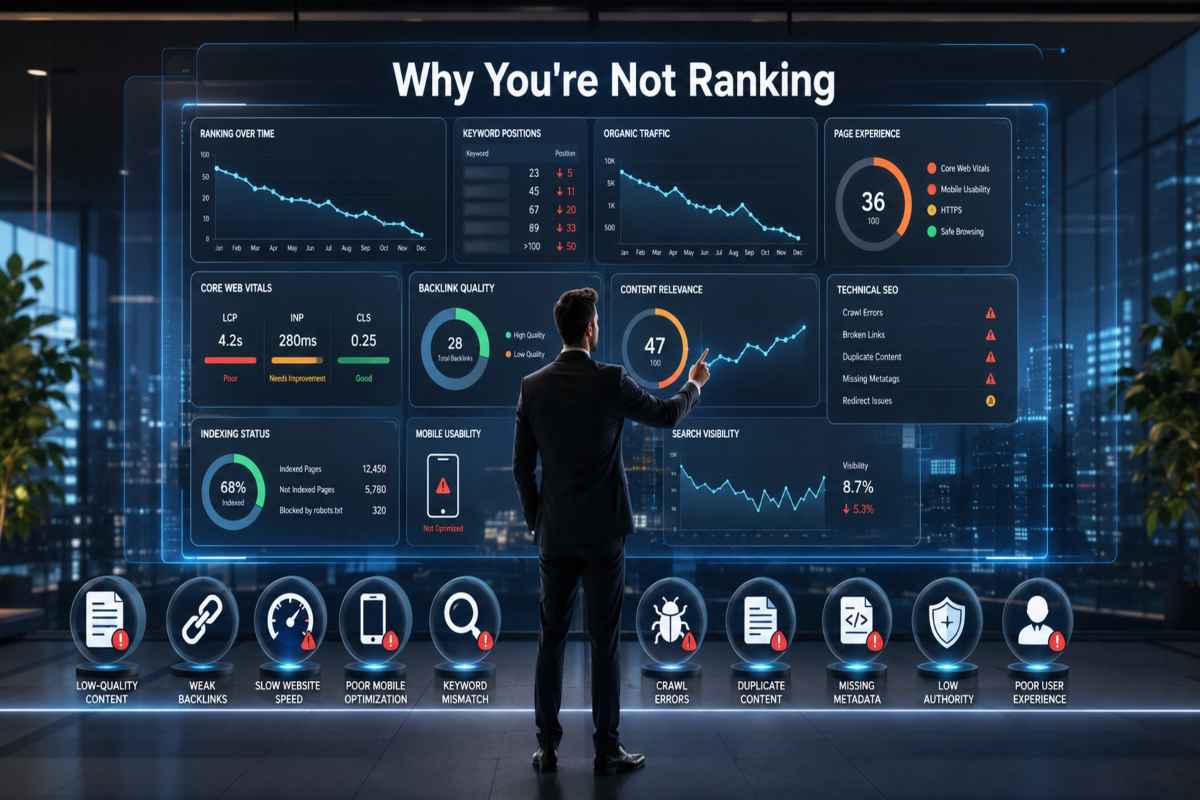
Most ranking failures trace back to one of fifteen specific, identifiable causes, spanning indexing, technical health, content quality and authority signals. Below is each one explained, along with what it typically looks like in practice.
1. Your Site Is not Indexed by Google
If Google has not indexed your pages, they can not appear in search results, regardless of how well optimized your content is. This is the first thing to rule out, since every other fix on this list is irrelevant until indexing is confirmed.
2. Google Can not Crawl Your Site Robots.txt / No index Errors
A misconfigured robots.txt file or an accidental no index tag can block Google crawlers from accessing pages entirely, even if the content itself is strong. This often happens after a site migration or CMS update, where directives meant for a staging environment accidentally carry over to the live site.
3. Your Sitemap Is Not Submitted or Is Broken
An XML sitemap tells Google which pages exist and should be crawled. Without one submitted in Search Console or with one containing broken links and outdated URLs, Google may miss entire sections of your site, especially on larger or newer domains.
4. Your Website Is Too New Ranking Takes Time
New websites rarely rank quickly, since Google needs time to crawl, index and build trust signals around a domain before ranking it competitively. Most new sites take three to six months to show meaningful movement, even with solid SEO fundamentals in place.
5. You Have Been Hit by a Manual or Algorithmic Penalty
A manual penalty, visible in Search Console Manual Actions report, means a human reviewer at Google flagged your site for violating guidelines, such as unnatural links or thin affiliate content. Algorithmic penalties are harder to detect, since they happen automatically and without direct notification, often triggered by spammy backlinks or manipulative content practices.
6. A Recent Google Algorithm Update Dropped Your Rankings
Google rolls out thousands of algorithm updates annually, with several major core updates that can meaningfully reshuffle rankings across entire industries. If your traffic dropped sharply around a known update date, the update, not your content, is the likely cause and recovery often requires realigning with the specific quality signals that update prioritized.
7. Weak or Missing On Page SEO
Title tags, header structure, meta descriptions and keyword placement all signal to Google what a page is about. Without these fundamentals in place, even well written content can struggle to rank because search engines lack clear context. Strengthening your On Page SEO foundation, including internal linking and keyword aligned headers, is often the fastest lever available for pages already indexed but underperforming.
8. Thin or Low Quality Content
Pages with shallow coverage, little original insight or content that mirrors what is already ranking rarely earn a place on page one. Google ranking systems increasingly favor content that demonstrates first hand expertise and answers a query more completely than existing top results.
9. No Backlinks or Low Authority Backlinks
Backlinks continue to be an important indicator of trust, Google uses to evaluate a page authority. A site with no external links pointing to it or links only from low quality directories, struggles to compete against pages with a stronger referral profile. Building a deliberate Off Page SEO strategy, focused on earning links from relevant, authoritative sources, is often what separates stagnant rankings from steady growth.
10. Keyword Targeting Mismatch or Cannibalization
When multiple pages on your site target the same keyword or when a page content does not actually match what searchers expect from that query, Google struggles to determine which page deserves to rank, often suppressing both. Auditing your site for overlapping keyword targets is a quick way to identify this issue.
11. Poor Site Speed or Core Web Vitals
Page speed is a proven ranking factor and slow loading pages tend to underperform even when their content is strong. Google Core Web Vitals specifically measure loading performance, interactivity and visual stability and consistently poor scores can suppress rankings across the entire domain. Investing in Website Speed Optimization is frequently one of the highest impact technical fixes available.
12. Your Site Is not Mobile Friendly
Google uses mobile first indexing, meaning it primarily evaluates the mobile version of your site when determining rankings. A site that is not responsive, has unreadable text on smaller screens or has elements that do not function on mobile devices will be penalized in rankings regardless of desktop performance.
13. Duplicate Content Issues
When identical or near identical content appears across multiple URLs, whether from URL parameters, printer friendly pages or copied product descriptions, Google may struggle to determine which version to index and rank, often choosing none of them prominently.
14. Missing or Incorrect Structured Data
Structured data schema markup helps Google understand the specific type of content on a page, such as articles, products or FAQs. Missing or improperly implemented schema doesn’t always block rankings outright, but it does reduce eligibility for rich results and can weaken how clearly Google interprets page context.
15. High Bounce Rate / Poor Engagement Signals
When visitors consistently leave a page quickly without interacting further, it can signal to Google that the content did not satisfy search intent, even if the page is technically well optimized. Content that grows stale or no longer matches current search intent tends to see engagement decline over time, which is why regular Content Updates are essential to maintaining rankings rather than treating a page as a one time publish.
Why Did My Website Suddenly Stop Ranking or Disappear?
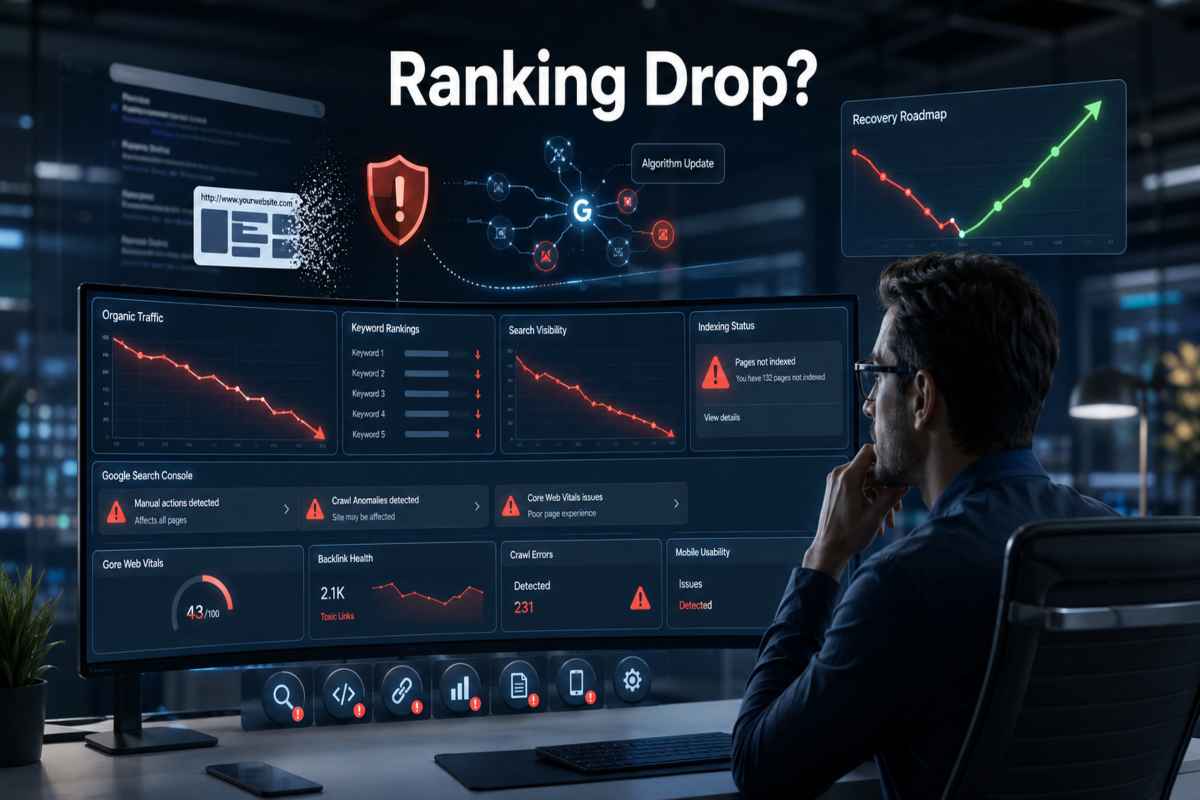
A sudden drop or disappearance from Google search results almost always traces back to one of two causes, a penalty triggered by a guideline violation or an algorithm update that reweighted how Google evaluates quality and relevance. Distinguishing between the two is the first step toward recovery, since each requires a completely different fix.
Signs Your Website Is Penalized by Google
A manual penalty is usually easy to confirm, Google Search Console Manual Actions report will explicitly state the violation, whether it is unnatural links, thin content or cloaking. What is harder to catch is an algorithmic penalty, since there is no direct notification and traffic simply declines without explanation.
Common warning signs include a sharp, sustained drop across most pages rather than a single URL, a timeline that aligns with a known Google update or a history of aggressive link building tactics like purchased backlinks or link exchanges. If your rankings dropped gradually rather than overnight, a penalty is less likely than a slower quality reassessment by Google core systems.
How Algorithm Updates Cause Sudden Ranking Drops
Google runs thousands of algorithm changes each year, but only a handful are significant enough to cause visible ranking shifts and these are usually confirmed through Google’s Search Status Dashboard.
Core updates in particular tend to reassess content quality, expertise signals and user satisfaction at a broad level, which means a site does not need to violate any specific guideline to lose rankings, it simply may no longer meet the bar relative to competitors who’ve improved. Sites built around thin affiliate content, AI generated text without editorial oversight or outdated information are disproportionately affected by these shifts, since core updates are explicitly designed to reward depth and demonstrated expertise over surface level optimization.
Recovering After Your Site Disappears From Search Results
Recovery starts with correctly identifying the cause, since fixing the wrong problem wastes time while rankings continue to suffer. If a manual penalty is confirmed, the required fix is stated directly in Search Console and a reconsideration request can only be submitted after the underlying issue, such as toxic backlinks or spammy content, is fully resolved.
If the cause is an algorithm update, recovery is typically slower and less certain, often taking one to three months and requiring genuine improvements to content depth, page experience and topical authority rather than quick technical patches. In either case, Google has been clear that recovery reflects real, sustained improvement rather than a specific fix applied once, sites that treat the drop as a signal to raise overall quality tend to recover more fully than those chasing isolated technical tweaks.
I am Doing SEO But Still Not Ranking What is Really Going On
If you are actively doing SEO but still not ranking, the issue is usually execution depth, not effort, most sites in this position are checking boxes keywords, meta tags, a few backlinks without addressing the underlying technical or content gaps that actually move rankings. SEO is not a single action, it is a combination of factors that all need to reach a competitive threshold simultaneously.

Why SEO Efforts Do not Always Translate to Rankings
Many site owners focus heavily on one area, like keyword placement or blog frequency, while overlooking technical foundations that quietly undermine everything else. A slow loading WordPress site, for instance, can offset strong content work entirely, since page experience is a confirmed ranking factor regardless of how well optimized the copy is.
This is especially common on WordPress sites running unoptimized themes, bloated plugins or unmanaged hosting, where proper WordPress Performance Optimisation can resolve speed and Core Web Vitals issues that no amount of content editing will fix on its own. SEO also compounds over time rather than delivering immediate results, so effort applied for a few weeks often looks ineffective simply because ranking signals have not fully accumulated yet.
Why Backlinks Alone Would Not Fix a Ranking Problem
Backlinks are a meaningful ranking factor, but they work in combination with relevance, content quality and technical health, not as a standalone fix. A page with strong backlinks but poor on page targeting, thin content or slow load times will still underperform, because Google evaluates dozens of signals together rather than weighting any single one heavily enough to override the rest.
Link building also carries diminishing returns when the destination page does not genuinely satisfy the search intent it is being linked for, which is why sites with aggressive backlink campaigns but weak content often see rankings stall despite growing authority metrics.
Content Quality vs Content Quantity
Publishing frequently does not guarantee rankings if each piece lacks depth, originality or a clear answer to the query it targets. Google own guidance on helpful content emphasizes rewarding pages that demonstrate first hand expertise and comprehensively satisfy user intent, over pages that exist primarily to target a keyword.
A site with twenty thin, generic posts will typically underperform one with five thorough, well researched pages that fully address what searchers are looking for, since ranking systems increasingly filter out content that appears created for search engines rather than for people. Prioritizing depth over volume, especially in competitive niches, tends to produce more sustainable ranking gains.
How Long Should It Really Take to Rank on Google?
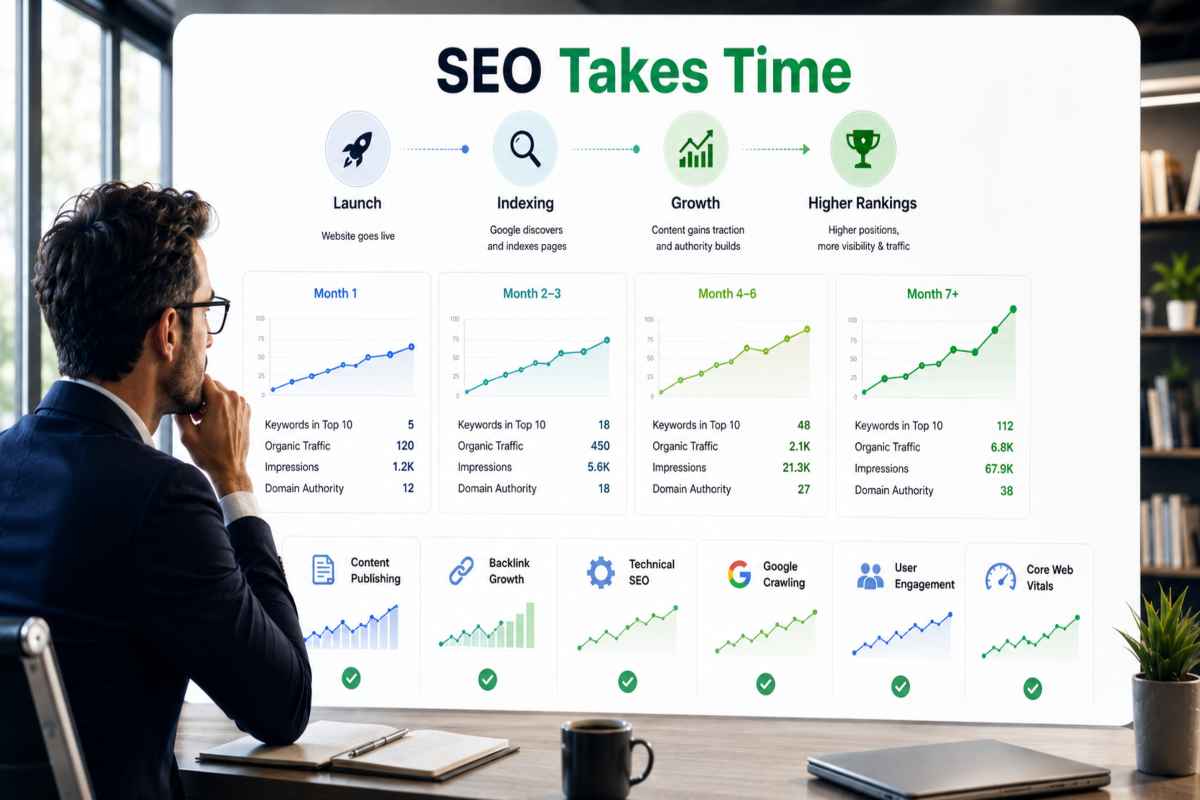
Most websites take three to six months to see meaningful ranking movement and up to a year to reach competitive positions for higher difficulty keywords. There is no fixed timeline, since ranking speed depends on domain age, competition level, content quality and how quickly Google crawls and trusts a site.
Realistic Timelines for New Websites
New websites operate under what is often called a trust building period, during which Google gradually increases how much authority it assigns to a domain as it accumulates crawl history, backlinks and user engagement data. In the first one to three months, indexing and initial crawling typically occur, but rankings are usually unstable or absent for competitive terms.
Research shows that over two million pages found that even top ranking content took an average of two years to reach the first page, though pages targeting lower competition, long tail keywords can rank meaningfully faster, often within a few months. Setting expectations around long tail wins early, rather than competitive head terms, produces more realistic and less discouraging timelines.
Why Your Site Still Is not Ranking After 6 Months
If six months have passed with no ranking progress, the cause is rarely just “time” and usually points to a specific, fixable gap, weak backlink acquisition, thin or under optimized content, unresolved technical issues or targeting keywords that are too competitive for the site current authority level.
It is also common for sites to plateau because content was published once and never updated, while competing pages in the results are actively refreshed and expanded. At this stage, a full audit comparing your top pages against current first page competitors, looking at content depth, backlink profiles and technical health, usually reveals the specific bottleneck rather than a vague needs more time explanation.
When Still Not Ranking After Months Is Actually Normal
Some delay is genuinely expected, particularly in competitive industries like finance, legal or health, where established sites with years of accumulated authority dominate search results regardless of how strong a newer page is. It is also normal for individual pages to rank slowly even on established domains, since Google evaluates each URL relevance and depth somewhat independently.
The distinction that matters is whether metrics are trending upward, even slowly, such as impressions or average position improving in Search Console, versus completely flat with no movement at all, the former suggests patience is warranted, while the latter signals an underlying problem worth investigating now.
Blog and Content Specific Ranking Problems
Individual blog posts often fail to rank even when a website’s overall SEO is solid, because content level issues, like weak search intent alignment or insufficient depth, operate independently of site wide technical health. A well optimized site can still have specific articles that never gain traction if those posts do not fully satisfy what searchers are actually looking for.

Why Individual Blog Posts or Articles Do not Rank
A blog post can fail to rank for reasons entirely separate from the rest of the site, most commonly because it targets a keyword with intent it does not actually fulfill. A post explaining what is X won’t rank for a query where searchers expect a comparison or a how to, regardless of writing quality.
Other common culprits include publishing on a topic already saturated by dominant, high authority competitors, using a title and structure that does not match how people actually search or burying the direct answer several paragraphs deep instead of addressing it immediately. Posts also struggle when they are isolated, without supporting internal links from related content, since this limits how much topical authority Google associates with the page.
Fixing Content That is Not Ranking Despite Good SEO
When a post has solid on page SEO, correct keywords, clean structure, reasonable length, but still does not rank, the gap is usually about depth of answer rather than technical execution. Comparing the post directly against current top ranking competitors often reveals it is missing specific subtopics, data points or practical detail that ranking pages include.
Increasingly, this also means optimizing for how AI driven search and answer engines extract and cite content, since tools like Google’s AI Overviews and other LLM powered search features favor content structured for direct extraction, clear answers, well defined sections and explicit facts, over content written primarily for traditional keyword matching. Investing in Large Language Model Optimization alongside conventional SEO helps ensure content is structured to be both crawlable by traditional search bots and extractable by AI systems, which is increasingly where a meaningful share of search visibility is shifting.
The Complete Fix Checklist for 2026
Fixing a non ranking website comes down to working through issues in the right order, confirming indexing first, resolving technical blockers second, then strengthening content and authority signals. Skipping ahead to content or backlinks while indexing or crawl issues remain unresolved wastes effort, since none of it will be evaluated until Google can actually access the site.

Step by Step Process to Fix a Non Ranking Website
Start by confirming indexing status through Google Search Console Coverage report, since this determines whether the problem is visibility or something deeper. If pages are indexed but not ranking, move to a technical audit covering site speed, mobile usability and crawl errors, as these form the foundation everything else depends on.
From there, review on page elements, title tags, headers, internal linking and keyword alignment, on underperforming pages, followed by a content audit comparing depth and comprehensiveness against current top ranking competitors. Finally, assess the backlink profile for both quantity and quality, since a page can meet every on page standard and still underperform without sufficient external authority signals. Working through these five stages in sequence, rather than jumping between them, prevents wasted effort on fixes that won’t matter until earlier issues are resolved.
How to Get Your Website Ranking Faster
The fastest realistic path to rank website on google involves prioritizing low competition, long tail keywords over broad, high volume terms, since long tail queries face far less competition and can rank within weeks rather than months.
Publishing fewer, more comprehensive pieces that fully answer a query tends to outperform frequent, shallow posting and updating existing content that is already indexed but underperforming often produces faster results than creating new pages from scratch, since the page already carries some crawl history and trust.
Technical fixes, particularly site speed and mobile usability, also tend to show impact faster than content changes, since they affect how Google evaluates every page on the site simultaneously rather than one page at a time.
A Realistic Roadmap to Google First Page
A practical roadmap typically unfolds in phases, the first month focuses on technical health and indexing confirmation, months two through four on content depth and on page optimization across priority pages and months three onward on sustained backlink acquisition and content updates based on performance data from Search Console.
Google has stated that ranking improvements from quality changes can take several weeks to be reflected, since recrawling and reassessment aren’t instant, which is why consistent, incremental progress across all five stages tends to outperform sporadic bursts of effort. Sites that treat this as an ongoing process, rather than a one time fix, are the ones that reach and hold first page positions rather than ranking briefly before dropping again.
A Repeatable Framework to Troubleshoot Any Ranking Issue
Any ranking problem can be diagnosed using a consistent four layer framework, indexing, crawlability, on page relevance and authority, checked in that exact order. Working through issues out of sequence often leads to fixing problems that do not matter yet, since deeper layers are irrelevant until the layers before them are confirmed healthy.

The Diagnostic Order to Follow Indexing → Crawling → On Page → Authority
Indexing comes first because a page that is not indexed can not rank regardless of anything else, so this is always the starting checkpoint. Crawlability comes second, since even indexed pages can lose visibility if crawl errors, broken internal links or server issues prevent Google from consistently accessing and re evaluating them.
On page relevance is third, covering whether the content, structure and keyword targeting actually align with what searchers and Google expect from that specific query. Authority comes last, since backlinks and domain trust only matter once a page is properly indexed, crawlable and relevant, backlinks pointing to a page with none of those fundamentals in place rarely produce meaningful ranking improvement. Following this order consistently turns a vague “why isn’t this ranking” question into a specific, answerable diagnosis at each stage.
Tools to Identify What is Actually Wrong
Google Search Console remains the primary tool for the first two layers, showing indexing status through the Coverage report and crawl health through crawl stats and error logs. For on page relevance, a direct comparison against current top ranking pages, checking word count, subtopics covered and keyword placement, reveals gaps faster than generic SEO checklists.
Authority issues are best diagnosed with backlink analysis tools like Ahrefs or Semrush, which show not just the number of linking domains but their quality and relevance, since a handful of authoritative, topically relevant links often outperforms hundreds of low quality ones. Google has confirmed that content and link signals are evaluated together as part of a broader relevance assessment, which is why running through all four layers, rather than fixating on one, produces a more accurate diagnosis than assuming the problem is purely technical or purely content related.
Conclusion
If your website is not ranking on Google, the cause almost always traces back to a fixable issue, indexing gaps, technical crawl errors, weak on page SEO or insufficient backlink authority, rather than a single mysterious problem, and the fix lies in a sequential process, confirm indexing, resolve crawlability, strengthen content and on page signals, then build genuine authority through quality backlinks. If you would rather skip the trial and error, the team at It Leadz specializes in diagnosing and fixing exactly these issues, helping websites move from invisible to genuinely competitive on Google first page.
Frequently Asked Questions (FAQs)
Why is my website not ranking for the keywords I have targeted?
This usually happens when the content does not fully match search intent, is thinner than competing pages or the site lacks sufficient backlink authority for that keyword’s competition level. Reviewing top ranking pages for the same term often reveals the specific gap.
How long does it take to fix a ranking drop?
Recovery from a manual penalty can happen within weeks once the violation is resolved and a reconsideration request is approved, while algorithm related drops typically take one to three months of genuine quality improvements to reverse.
Can a website recover after disappearing from Google?
Yes, most sites recover once the underlying issue, whether a penalty, technical error or quality gap, is identified and properly fixed. Recovery timelines vary, but Google does re crawl and re evaluate sites continuously.
Is it normal for rankings to fluctuate day to day?
Yes, minor day to day fluctuations are normal and expected, even for well established pages, due to routine algorithm testing and re crawling. Consistent, sustained drops over weeks are the signal actually worth investigating.