How to rank on AI search engines means earning a citation inside the answers that tools like ChatGPT, Perplexity, Google AI Overviews and Gemini generate, not just a position on a results page, but a mention, a link or a direct quote inside the response itself. This shift is already reshaping how visibility gets measured, Google AI Overviews now appear on approximately 48% of all tracked Google queries and research from Bright Edge found that only 17% of AI Overview citations come from pages ranking in the organic top 10, meaning the old assumption that a #1 Google ranking guarantees AI visibility no longer holds.
That gap is exactly why Generative Engine Optimization (GEO) has emerged as its own discipline, distinct from, but built on top of, traditional SEO. If you rank well on Google but AI platforms never mention your brand, you are invisible to the growing share of searchers who now get their answers directly inside a chat window instead of clicking through to a website. Some businesses call this broader practice Artificial Intelligence Optimization and it covers everything from structuring content so LLMs can extract it cleanly to building the topical authority and entity signals that make AI systems trust your site as a source worth citing.
This guide walks through exactly how AI search ranking works, how it differs from traditional Google ranking and the specific tactics, platform by platform, for getting cited by ChatGPT, Perplexity, Google AI Overviews, Bing Copilot, Claude and Gemini in 2026.
What Is Generative Engine Optimization (GEO)?
Generative Engine Optimization (GEO) is the practice of structuring, writing and promoting content so that AI systems like ChatGPT, Perplexity and Google AI Overviews choose to cite it inside their generated answers.
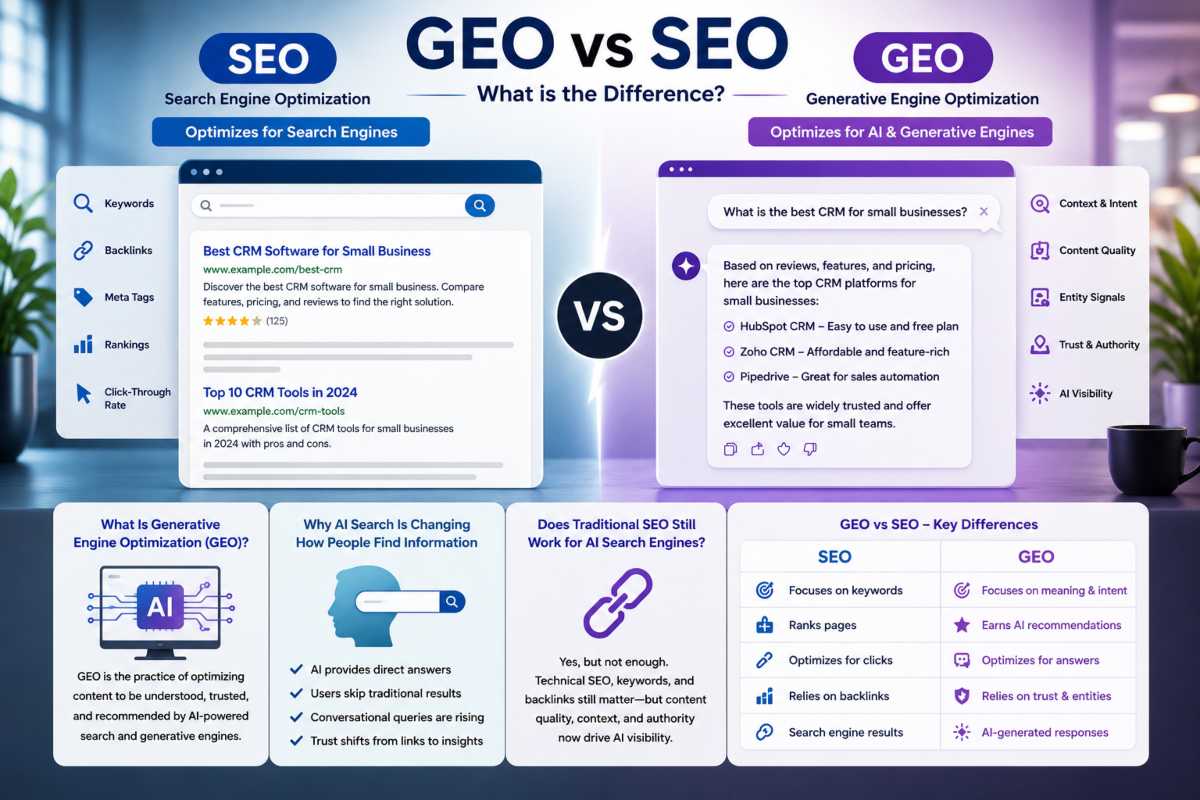
Unlike traditional SEO, which optimizes for a ranked position on a search results page, GEO optimizes for something more specific, being selected as a trusted source that an AI model quotes, summarizes or links to when responding to a user question. The discipline has grown fast enough that industry surveys now show over half of marketers are actively building Generative Engine Optimization into their strategy, a sign that AI citation has moved from experimental to essential.
GEO vs SEO, What is the Difference?
SEO and GEO share a foundation but optimize for different outcomes. SEO focuses on ranking a page as high as possible on a search engine results page so a human clicks through to the website. GEO focuses on getting that same content pulled directly into an AI generated response, where the win is a citation or mention rather than a click.
This distinction matters because the two do not always correlate, a page can rank 1 on Google and still be skipped entirely by an AI Overview or ChatGPT answer, because LLMs weigh different signals, clarity of the direct answer, structural extractability, freshness and how well a passage stands alone without needing the rest of the page for context. In practice, GEO builds on strong SEO fundamentals but adds a layer of content structuring aimed specifically at how language models parse and select information.
Why AI Search Is Changing How People Find Information
AI search is changing user behavior because it collapses the multi step process of searching, clicking and reading into a single conversational answer. Instead of scanning ten blue links, a growing share of users now type a longer, more specific question and receive a synthesized response with sources cited inline.
This shift is measurable at scale, AI Overviews alone now appear on roughly half of all tracked Google searches and platforms like ChatGPT process billions of queries daily, many of them multi turn conversations rather than single keyword searches. For content creators and businesses, this means the front door to information is no longer just a search results page, it is the AI synthesized answer and if your content isn’t structured to be extracted and trusted, it never reaches the user at all.
Does Traditional SEO Still Work for AI Search Engines?
Traditional SEO still works, but it is no longer sufficient on its own. Strong technical SEO, backlinks, and organic rankings remain a real advantage because AI systems tend to draw heavily from established, well linked, authoritative domains. A page with no organic visibility is unlikely to earn AI citations either.
However, ranking well on Google is not a guarantee of AI visibility, since language models apply their own selection criteria around structure, clarity and freshness that do not always match classic ranking factors. The most effective approach in 2026 treats SEO and GEO as complementary layers, SEO builds the authority and discoverability that make a site eligible to be cited, while GEO shapes the content itself so AI systems can actually extract, trust and surface it once they find it.
How AI Search Ranking Works vs Traditional Google Ranking
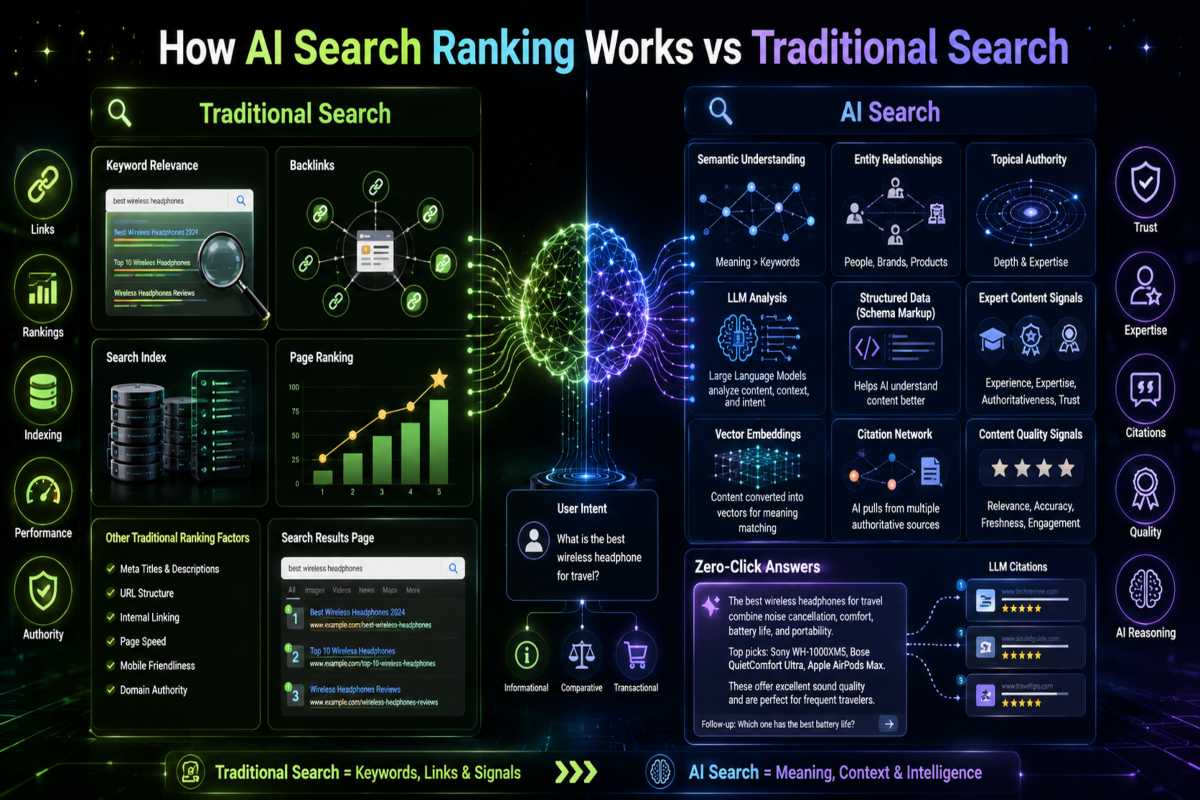
AI search ranking works fundamentally differently from traditional Google ranking because it selects and synthesizes sources into a single answer rather than ordering pages by relevance score. Where Google algorithm ranks pages based on hundreds of signals like backlinks, keyword relevance and page experience, AI search engines evaluate content for how easily it can be extracted, summarized and trusted as a standalone answer, a process closer to research than retrieval.
How LLMs Select and Cite Sources
Large language models select sources by scanning for content that directly answers a query in clear, self contained passages, then weighing signals like domain authority, freshness and how well structured the information is for extraction. This is a different mechanism than traditional crawling and indexing, an LLM is not just checking if a page matches a keyword, it is evaluating whether a specific paragraph or section can be lifted out and used as a trustworthy answer on its own.
This is the core principle behind Large Language Model Optimization, writing content so that individual passages work independently, without requiring the reader to have seen the rest of the page for context. Research on AI Overview citations backs this up, pages ranking organically in position one have roughly a 33% chance of being cited, but that probability drops to around 13% by position ten, showing that structural and content quality signals matter alongside raw ranking position, not instead of it.
What AI Search Engines Look for When Ranking Content
AI search engines look for content that is clear, current and structured in a way that maps cleanly to specific questions. Freshness plays a larger role than many marketers expect, studies show AI platforms tend to cite content that has been updated meaningfully more recently than what traditional search tends to favor, since LLMs are trying to avoid surfacing outdated or superseded information.
Beyond freshness, format matters, comparison content, structured lists, clear definitions and pages using schema markup all see measurably higher citation rates, because these formats are easier for a model to parse and lift into a generated response. Depth and specificity also outperform generic overviews, an AI system is more likely to cite a page that answers a narrow question precisely than one that only covers a topic broadly.
Zero Click Search and Why Citations Matter More Than Rankings
Zero click search, where a user gets their answer without clicking through to any website, has become the dominant behavior in AI powered results, which is exactly why citations now matter more than rankings alone. When an AI Mode or AI Overview response fully satisfies a query, the majority of users never visit the source website at all, meaning a high ranking that never earns a citation produces effectively zero value in an AI first search environment.
This reframes the goal of modern content strategy, instead of optimizing purely to rank and hope for a click, the priority becomes earning the citation itself, since that citation is often the only visibility a brand gets in front of the user, whether or not they ever land on the page.
The Core Principles of Ranking on AI Search Engines
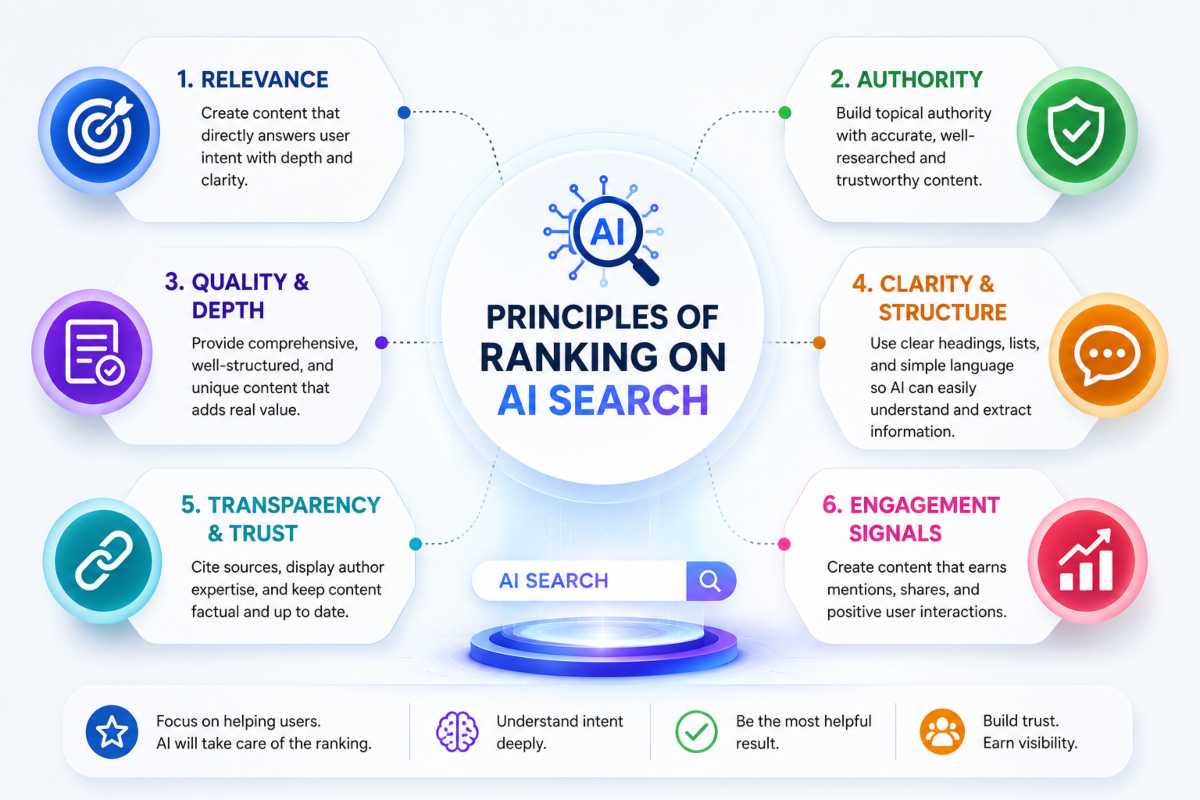
Ranking on AI search engines comes down to four core principles, establishing entity based authority, demonstrating E E A T, implementing structured data and writing content in a format AI crawlers can parse cleanly. These principles work together, none of them alone is enough to consistently earn citations, but combined, they build the kind of trustworthy, extractable content that language models select as sources.
Entity Based SEO and Topical Authority
Entity based SEO means building content around clearly defined concepts, people, products and topics, entities, rather than isolated keywords, so AI systems can connect your site to a specific area of expertise with confidence. Language models do not just match strings of text, they build an internal understanding of what a website is about based on how consistently and comprehensively it covers a topic across multiple pages.
A site with one thin article on a subject looks far less authoritative to an AI system than one with a cluster of interconnected, in depth content covering the topic definitions, use cases, comparisons and edge cases. This is why topical authority, depth and breadth on a subject, not just a single well optimized page, has become a prerequisite for consistent AI citations rather than a nice to have.
E E A T Role in AI Search Visibility
E E A T, Experience, Expertise, Authoritativeness and Trustworthiness, plays a direct role in AI search visibility because language models are trained to favor sources that appear credible and reduce the risk of citing inaccurate information. In practice, this means author bios, cited data, transparent sourcing and evidence of firsthand experience all increase the likelihood that a page gets selected as a citation, since these signals help an AI system judge whether content is safe to trust in a generated answer.
Research on AI citation patterns reinforces this, the large majority of AI citations come from earned or brand managed sources with clear authority markers, not from anonymous or thin content, reinforcing that E E A T is not a ranking factor unique to Google, but a trust filter AI systems apply just as heavily.
Structured Data and Schema Markup for AI Overviews
Structured data and schema markup help AI Overviews and other AI search engines understand exactly what a page is about, which entities it covers and how its content is organized and that clarity translates directly into higher citation rates. Adding schema types like FAQ, How To, Article and Organization markup gives language models explicit, machine readable signals instead of forcing them to infer meaning from unstructured text, which reduces the risk of misinterpretation and increases the odds a passage gets selected accurately. Data from AI SEO studies shows source citation rates improve meaningfully when schema markup is present, making it one of the more reliable technical levers available for AI search visibility.
Writing AI Crawler Friendly Content
Writing AI crawler friendly content means structuring each section so it can stand alone, answer a specific question directly and be understood without requiring the rest of the page for context. Short, direct opening sentences, clear H2/H3 hierarchies and passages that avoid burying the answer under unnecessary setup all make content easier for an AI system to extract cleanly.
Technical accessibility matters just as much as writing style, if crawlers can’t efficiently access and render your content, none of the on page optimization matters. This is especially relevant for WordPress sites, where plugin bloat, poor site speed and inconsistent markup can quietly block AI crawlers from indexing content properly, professional WordPress SEO Services can resolve these technical gaps so that well written, well structured content actually gets seen and cited by AI search engines instead of getting lost behind avoidable technical issues.
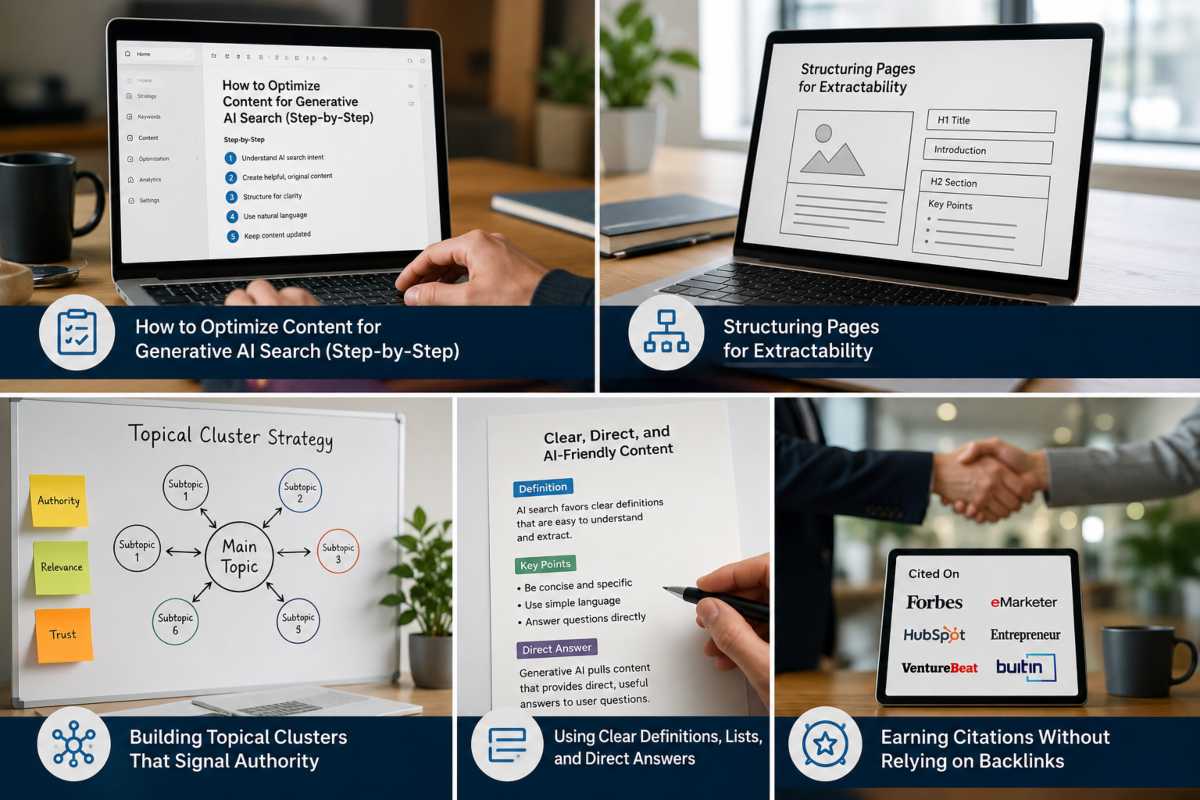
How to Optimize Content for Generative AI Search Step by Step
Optimizing content for generative AI search means restructuring pages so individual passages can be extracted cleanly, building topical depth around your core subject and earning trust signals that do not depend solely on backlinks. The process builds on solid On Page SEO fundamentals but adds a layer of formatting and structuring aimed specifically at how AI models parse and select content.
Structuring Pages for Extractability
Structuring a page for extractability means writing each section so it can be lifted out and understood on its own, without requiring the reader to have seen the rest of the article. This starts with answering the core question of each section in the first sentence or two, followed by supporting detail, the same principle newsrooms use, applied to AI parsing.
Headers should map directly to specific, answerable questions rather than vague topic labels, since AI systems use header hierarchy to identify where a precise answer lives on a page. Pages built this way consistently outperform long, meandering articles where the actual answer is buried several paragraphs into a section, because a model has to do more interpretive work to extract meaning from unstructured prose.
Building Topical Clusters That Signal Authority
Building topical clusters means grouping related content, definitions, comparisons, use cases and FAQs, around a central subject so an AI system sees comprehensive coverage rather than a single isolated page. A cluster typically anchors around one pillar page covering the core topic broadly, supported by interlinked pages that go deep on specific subtopics, comparisons or questions.
This structure signals topical authority because it shows an AI model that a site does not just mention a subject once, but has built out genuine depth across the entity, which increases the likelihood that any page within that cluster gets treated as a trustworthy source when a related query comes in.
Using Clear Definitions, Lists and Direct Answers
Using clear definitions, well formatted lists and direct answers increases citation likelihood because these formats are the easiest for a language model to extract without rewriting or reinterpreting the content. Research on AI citation patterns backs this up directly, listicle style content sees a citation rate more than double that of blog or opinion style writing, largely because the format presents discrete, self contained pieces of information rather than continuous narrative prose.
This does not mean every section should be a bulleted list, but it does mean that wherever a page defines a term, compares options or answers a specific question, presenting that information in a clean, direct format meaningfully improves its odds of being cited.
Earning Citations Without Relying on Backlinks
Earning AI citations without relying solely on backlinks is possible because language models weigh content clarity, structure and topical authority alongside, not exclusively behind, traditional link based signals. That said, backlinks and off page signals still matter for establishing the broader domain authority and third party validation that make a site eligible to be cited in the first place, since AI systems tend to favor sources the wider web already treats as credible.
A balanced strategy pairs strong on page structuring with deliberate Off Page SEO work, earned mentions, digital PR and authoritative third party coverage, because citation worthy content still needs a credible reputation behind it to consistently earn trust from AI search engines.
How to Rank on Specific AI Search Engines
Ranking on specific AI search engines requires adapting the same core GEO principles, clarity, structure, authority and freshness, to each platform’s distinct citation behavior, since ChatGPT, Perplexity, Google AI Overviews, Bing Copilot, Claude and Gemini each pull from different sources and weigh signals differently.
How to Rank on ChatGPT Search
Ranking on ChatGPT search means earning a citation inside its responses, which favors content that loads fast, answers questions directly and comes from sites with established topical authority. Technical performance plays a bigger role here than many marketers assume, pages with a fast First Content ful Paint are measurably more likely to be selected as a source than slower loading pages, since ChatGPT retrieval process favors content it can access and parse quickly.
Beyond speed, ChatGPT tends to cite business and service sites at a higher rate than any other content type, which means companies with clear, well organized service or product information have a genuine structural advantage if that content is written to directly answer common user questions.
How to Rank on Perplexity AI
Ranking on Perplexity AI depends heavily on strong topical relevance and citation style writing, since Perplexity is built around a research and cite model that pulls heavily from sources with clear factual claims and transparent sourcing. Perplexity tends to favor content that reads like a well sourced reference, direct statements backed by data or attribution, over promotional or narrative style writing, because its output format explicitly shows users where each claim comes from. Sites that consistently publish accurate, well cited, up to date information on a specific topic tend to earn repeat citations from Perplexity, since the platform appears to reuse trusted sources across related queries once they have proven reliable.
How to Rank in Google AI Overviews SGE
Ranking in Google AI Overviews starts with strong traditional organic rankings, since the majority of AI Overview citations still come from domains that already rank in Google organic top 10, traditional SEO remains the foundation, not a separate track. Beyond ranking, AI Overviews favor content that directly answers question based and comparison style queries, which trigger AI summaries at a significantly higher rate than short, generic searches. Comparison content in particular, “X vs Y” formats, triggers an AI Overview response in the vast majority of cases, making comparison and decision support content one of the highest leverage formats for this specific placement.
How to Rank on Bing Copilot
Ranking on Bing Copilot benefits from the same foundational SEO work that supports Bing traditional search results, since Copilot draws from Bing’s index and applies similar relevance and authority signals before layering in generative synthesis. Structured, well organized content with clear headers and schema markup tends to perform well here, as Copilot, like other AI systems, favors passages it can extract and present without needing to reinterpret loosely organized prose. Because Bing overall search share is smaller than Google, Copilot visibility often rewards niches and topics where competition for AI citations is lighter, giving well optimized sites a faster path to consistent placement.
How to Get Cited by Claude AI Search
Getting cited by Claude AI search benefits from content that demonstrates depth, precision and professional credibility, since usage data shows Claude is used disproportionately for longer, research oriented queries and professional analysis tasks compared to more casual, general purpose searches.
This means Claude citation behavior tends to favor detailed, well reasoned content over surface level summaries, pages that thoroughly explain a concept, include accurate technical detail and avoid oversimplification are better positioned to be selected as sources for the kind of in depth queries Claude users tend to ask.
How to Optimize for Gemini AI Search
Optimizing for Gemini AI search means aligning content with Google broader entity and authority signals, since Gemini powered AI Overviews reach a massive audience and pull from many of the same trust and relevance indicators used across Google ecosystem.
Because Gemini is deeply integrated with Google Search and other Google products, structured data, clear entity definitions and strong E E A T signals carry significant weight here, much like they do for AI Overviews. Businesses that already invest in comprehensive, well structured, authoritative content aimed at Google organic algorithm are generally well positioned for Gemini visibility too, since the two systems share substantial signal overlap.
How to Increase Your AI Share of Voice
Increasing your AI Share of Voice means growing how often your brand appears, gets mentioned or gets recommended across AI generated answers relative to competitors, a metric that quickly becoming as important to track as traditional keyword rankings.
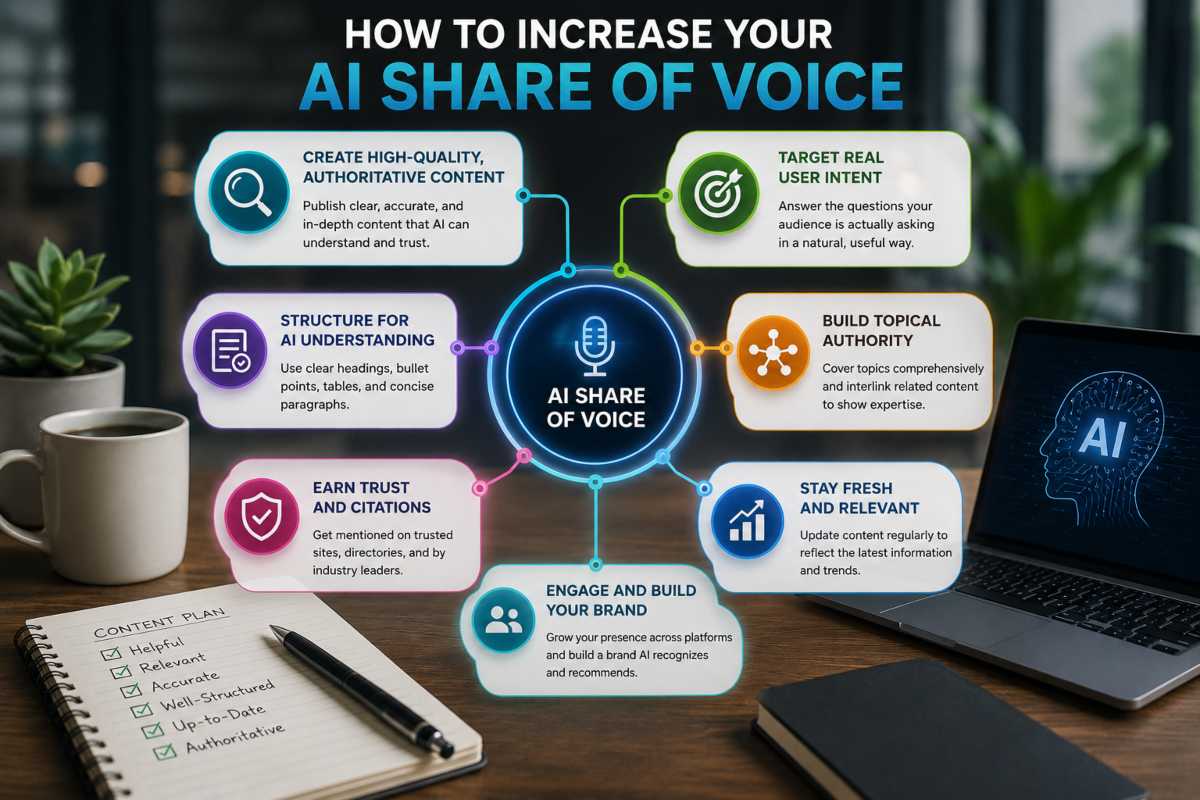
As AI platforms handle a growing share of research and product discovery queries, the brands that show up consistently across ChatGPT, Perplexity and AI Overviews capture disproportionate trust, since users increasingly treat an AI recommendation as a pre vetted shortlist rather than starting their own research from scratch.
Getting Brand Mentions in AI Generated Answers
Getting brand mentions in AI generated answers requires being present in the sources AI models actually trust and pull from, earned media, structured data and authoritative third party coverage, rather than relying solely on owned content. Data on AI citation patterns shows that a large majority of AI citations come from earned media rather than brand owned pages, meaning that being covered, reviewed or referenced by credible third party publications often does more for AI visibility than publishing more content on your own site. This is the core focus of Answer Engine Optimization, structuring both your owned content and your external presence so that when an AI system is compiling an answer, your brand is one of the trusted names it recognizes and includes.
How to Get ChatGPT and Other AI Tools to Recommend Your Business
Getting ChatGPT and similar AI tools to recommend your business comes down to building a consistent, well documented presence across the sources these models pull from, your own site, review platforms, industry publications and structured business listings, so the AI has clear, corroborated information to draw on.
Recommendation style queries tend to favor businesses with clear service descriptions, transparent pricing or process information and positive third party validation, since AI systems are cautious about recommending anything they can not verify across multiple sources.
Notably, users who receive a brand recommendation directly from ChatGPT are significantly more likely to visit that brand website within the following week, which makes earning that recommendation a genuine acquisition channel, not just a visibility exercise.
Monitoring and Measuring AI Search Visibility
Monitoring and measuring AI search visibility means regularly checking how and when your brand appears across AI Overviews, ChatGPT, Perplexity and other platforms, a practice most companies still have not adopted. Industry surveys show that while a large majority of marketers cite AI driven search changes as a top challenge, only a small fraction have actually adapted their reporting to track AI Overview impressions or citation share, meaning that setting up even basic monitoring puts a brand ahead of most competitors. Practical tracking includes running representative queries across platforms on a recurring basis, noting which competitors get cited and where and treating citation frequency as its own KPI alongside traditional organic rankings and traffic.
GEO for Specific Business Types
GEO strategy shifts depending on business type, since small businesses, SaaS companies and B2B organizations each get cited by AI search engines for different kinds of queries and need to prioritize different signals to earn that visibility.
 GEO for Small Businesses
 GEO for Small Businesses
GEO for small businesses centers on local relevance, clear service information and third party validation, since AI systems favor business and service sites at a notably high rate when answering practical, local or recommendation style queries. A local business does not need the content volume of a large publisher to earn AI citations, it needs accurate, well structured information about what it offers, where it operates and what customers say about it, since AI models cross reference owned content against reviews and listings before recommending a business.
Small businesses that keep their website, Google Business Profile and review presence consistent and current tend to outperform larger, less maintained competitors in AI generated local recommendations. Getting the underlying site structure right often starts with solid Web Solutions, fast, well organized, mobile friendly foundations that make it easier for both users and AI crawlers to find and trust the information on the page.
GEO for SaaS Companies
GEO for SaaS companies depends on building deep, comparison rich content around specific use cases and competitor alternatives, since a large share of AI Overview triggers come from comparison style queries, the “X vs Y” searches SaaS buyers rely on heavily during evaluation.
SaaS content earns AI citations most reliably when it goes beyond feature lists and directly addresses buyer decision points, pricing structures, integration specifics and honest trade offs against alternatives, since AI models favor precise, well sourced comparisons over generic marketing copy.
Because SaaS buying cycles involve extensive research, often across multiple AI tools, maintaining consistent, technically accurate documentation and comparison pages gives SaaS brands repeated opportunities to be cited throughout a single buyer’s research journey.
Optimizing B2B Content for AI Search Engines
Optimizing B2B content for AI search engines means prioritizing depth, technical accuracy and demonstrated expertise, since B2B research queries tend to be longer and more specific than consumer searches and AI platforms respond by favoring sources that can support that level of detail.
Usage data shows B2B buyers rely disproportionately on Claude for longer research and professional analysis tasks compared to general consumer usage, which signals that B2B content optimized purely for quick, surface level answers is likely underperforming with professional audiences. Effective B2B GEO content typically includes original data, clearly explained methodologies and content written by identifiable experts, since these signals directly support the trust and credibility factors AI systems weigh heavily before citing a source in a professional or technical context.
Conclusion
Ranking on AI search engines comes down to combining strong SEO fundamentals with GEO specific tactics, clear structure, verifiable authority and content built to be extracted and cited, not just ranked. As AI Overviews, ChatGPT and Perplexity capture a growing share of search behavior, brands that optimize for citations now will hold a lasting visibility advantage over those still focused on rankings alone. If you are ready to build that visibility strategically, It Leadz can help turn this framework into results.
Frequently Asked Questions (FAQs)
Why is my website not showing up in AI search results?
Your website likely is not showing up because it lacks the structural clarity, freshness or authority signals AI systems look for, not necessarily because it ranks poorly on Google. Thin content, outdated pages and missing schema markup are the most common culprits, since these make it harder for AI models to extract and trust your information.
Can you rank on AI Search without backlinks?
You can earn some AI citations without heavy backlink profiles if your content is exceptionally clear, well structured and directly answers specific queries. However, backlinks and earned media still matter for establishing the broader domain authority that makes a site eligible to be cited in the first place.
How long does GEO take to show results?
Most sites start seeing measurable AI citation gains within 3 to 6 months, depending on existing domain authority and how much restructuring the content needs. Established, authoritative sites with strong SEO foundations typically see results faster than newer domains.
Is GEO replacing SEO?
No, GEO builds on SEO rather than replacing it, since AI search engines still favor content from domains with strong traditional organic authority. The two disciplines are increasingly treated as complementary layers of the same visibility strategy, not competing approaches.