AI optimization is the practice of structuring content, data and technical signals so that AI systems, like Google’s AI Overviews, ChatGPT and other large language models, can understand, trust and surface your brand in their generated answers. Unlike traditional SEO, which focuses on ranking a blue link on a results page, AI optimization focuses on becoming the source an AI model chooses to cite, summarize or recommend when someone asks a question.
This shift matters because search behavior itself is changing. ChatGPT alone now drives roughly 87% of all AI referral traffic, meaning the businesses that show up inside AI generated answers, not just search results, are capturing a fast growing share of discovery that traditional SEO tactics were never built to compete for.
AI optimization sits at the intersection of several emerging disciplines, including generative engine optimization (GEO), answer engine optimization (AEO) and large language model optimization (LLMO), all of which share one core objective: making your content machine readable, authoritative and answer ready. In this guide, you will learn exactly what AI optimization involves, how it differs from traditional SEO, how Google AI Overviews work and the step by step tactics you can use to start ranking inside AI generated answers today.
What Is AI Optimization? Definition
AI optimization is the process of shaping your content, structured data and site architecture so that AI systems can accurately understand, trust and surface your brand within their generated responses. Rather than competing for a ranking position on a search results page, AI optimization competes for a citation, a mention or a direct answer slot inside tools like Google AI Overviews, ChatGPT and other AI driven search experiences.
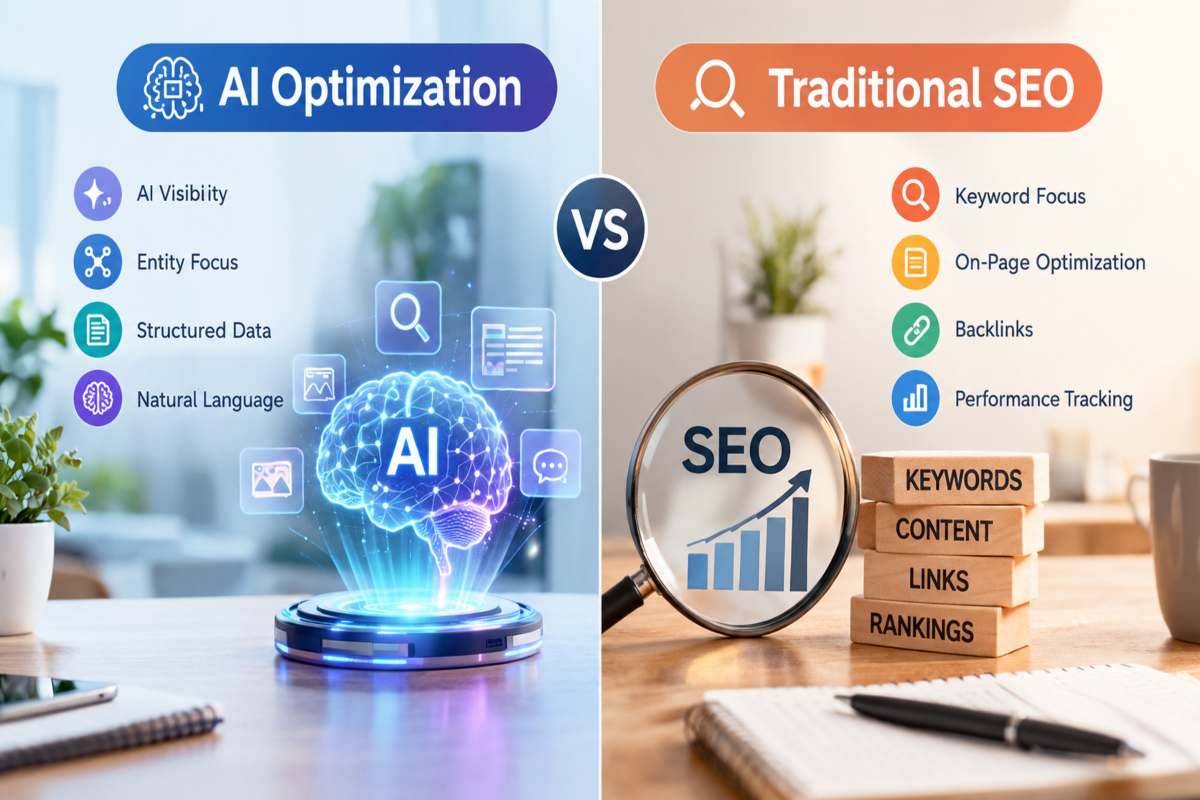
AI Optimization vs Traditional SEO
Traditional SEO is built around ranking a webpage as high as possible on a search engine results page, using signals like backlinks, keyword targeting and on page optimization to earn a top position that users click through to. AI optimization works differently, instead of optimizing for a click, it optimizes for comprehension. AI models scan, synthesize and rewrite information from multiple sources before presenting a single answer, so the goal shifts from “rank number one” to “be the source the AI trusts enough to reference.” This means clear structure, factual accuracy and semantic clarity often matter more than raw backlink volume.
The Three Umbrella Terms, GEO, AEO and LLMO Explained
Most of what falls under “AI optimization” actually breaks down into three related but distinct disciplines. Generative engine optimization (GEO) focuses on improving visibility inside AI generated summaries and overviews, such as Google’s AI Overviews. Answer engine optimization (AEO) focuses on structuring content to directly answer specific questions, making it easier for voice assistants and answer boxes to extract and present.
Large language model optimization (LLMO) goes a layer deeper, focusing on how content is represented, indexed and weighted within the training and retrieval processes of models like GPT and Gemini. Many businesses benefit from combining all three: GEO services to strengthen presence in AI overviews, AEO services to capture direct answer queries and large language model optimization to build long term authority within the models themselves.
What Is AI SEO?
AI SEO is the practical, day to day application of these strategies, the actual work of auditing content, adjusting structure and building authority signals so a brand performs well across both traditional search engines and AI driven platforms. Rather than a separate discipline, AI SEO is best understood as the operational layer that brings AI optimization, GEO, AEO and LLMO together into one coordinated strategy.
Why AI Optimization Matters Now
AI optimization matters now because search behavior has moved past the click and browse model, people increasingly get their answers directly from AI systems and brands that aren’t structured for those systems simply don’t get considered. This makes AI optimization less of an emerging trend and more of a baseline requirement for staying visible.

How ChatGPT and AI Search Are Changing Discovery
Discovery used to start with a search box and end with a scroll through ranked links. Now it often starts and ends with a single conversational exchange. A user asks an AI assistant a question and the assistant returns one synthesized answer pulled from a small set of trusted sources, not ten competing results to weigh manually.
This matters at scale, ChatGPT alone accounts for approximately 87% of all AI referral traffic today, making it one of the most influential discovery channels a business can be visible in. Because AI tools pull from a narrower pool of sources than a traditional search page, the businesses that do get referenced tend to see outsized trust and exposure compared to their competitors who do not.
The Shift from Clicks to AI Generated Answers
Traditional SEO success has always been measured by clicks, a ranking leads to a visit and a visit leads to a conversion. AI search disrupts that chain. When an AI model answers a question directly, the user need may be fully met without ever visiting a website, even if that website was the primary source behind the answer. This changes what “visibility” means, a brand can be extremely influential inside AI generated responses while showing zero traditional traffic to prove it.
As a result, businesses now need to track a different kind of success, not just rankings and click through rates, but whether they’re being mentioned, quoted or recommended inside the answers AI systems generate. That shift is the core reason AI optimization has become essential rather than optional.
Google AI Overviews Explained
Google AI Overviews are AI generated summaries that appear at the top of search results, answering a user’s query directly using information pulled and synthesized from multiple web sources. Understanding how they work and how to appear in them, is now a core part of any modern AI optimization strategy.
What Triggers AI Overviews in Google Search
AI Overviews tend to appear for queries where Google determines a synthesized, multi source answer would serve the user better than a simple list of links, typically informational questions, comparisons, “how to” queries and topics with some complexity or nuance.
They are less likely to appear for highly transactional searches, such as direct brand or product name queries, where users already know exactly what they want. Google system evaluates the query intent, the depth of information needed to answer it well and whether multiple credible sources exist to draw from before deciding whether an AI Overview is the best format for that particular search.
Google AI Overviews vs Traditional Search Results
Traditional search results present a ranked list of links, leaving the user to click through, compare and synthesize information themselves. AI Overviews remove that step by generating a single answer upfront, often citing two to five sources directly within the summary.
This means visibility no longer requires the top organic position, a page ranked fifth or sixth can still be pulled into an AI Overview if its content is clear, well structured and directly answers the query. The competitive advantage shifts from ranking position to content clarity and citation worthiness.
How to Appear in Google AI Overviews
Appearing in an AI Overview depends less on traditional ranking signals and more on how easily a page content can be extracted and repurposed into a direct answer. Content structured with clear headings, concise definitions and direct answers to specific questions performs better than long, unstructured prose.
Using schema markup, answering questions in the first sentence of a section and maintaining strong topical authority around a subject all increase the likelihood that Google’s AI systems select your content as a source. Consistency also matters, pages that reliably provide accurate, well organized answers across a topic tend to earn repeated inclusion in AI Overviews over time, rather than appearing once and disappearing.
How to Optimize for AI Search (Step by Step)
Optimizing for AI search means structuring content so AI systems can easily extract, trust and reuse it as a direct answer, a process that combines clear writing, technical structure and consistent topical authority. The tactics differ slightly depending on the platform, but the underlying principle stays the same, make your content the easiest, most credible source to cite.
 How to Optimize for Google AI Overviews
The most effective way to optimize for Google AI Overviews is to answer the core question of a page within the first one to two sentences, then support that answer with structured detail underneath. Google AI systems favor content that is already organized into clear headings and subheadings, since this format mirrors how the AI itself breaks down and summarizes information.
Adding schema markup, particularly FAQ, HowTo and Article schema, helps Google systems parse the page structure more accurately. It also helps to cover a topic comprehensively on a single page rather than splitting it across several thin ones, since AI Overviews tend to favor sources that address a query fully rather than partially.
How to Optimize for ChatGPT Search
ChatGPT and similar AI assistants rely heavily on content that is well organized, factually precise and easy to summarize without losing meaning. Because ChatGPT alone drives an estimated 87% of all AI referral traffic, optimizing specifically for how it retrieves and cites information has become one of the highest leverage AI optimization tactics available.
This means writing in a way that is naturally extractable, short, direct paragraphs that stand on their own, clear definitions early in a section and language that avoids ambiguity. Building topical depth around a subject, rather than relying on a single isolated article, also increases the likelihood that ChatGPT treats your site as an authoritative reference when generating an answer.
How to Rank in AI Search Results, Core Tactics
Across every AI search platform, a few core tactics consistently improve visibility. Content should directly answer specific questions rather than circling a topic broadly, since AI systems prioritize clarity over cleverness. Structuring pages with descriptive headings, concise summaries and logically ordered sections makes it easier for AI models to lift accurate information without misrepresenting it.
Building genuine topical authority, through comprehensive coverage of a subject rather than scattered, shallow content, signals to AI systems that a site is a reliable source worth citing repeatedly. Finally, keeping information accurate and up to date matters more in AI search than in traditional SEO, since AI models actively filter out sources that appear outdated or inconsistent with more current data.
AI Optimization Checklist
An AI optimization checklist covers the on page, structural and technical elements that determine whether AI systems can accurately find, understand and cite your content. Getting these fundamentals right increases the odds that your pages are pulled into AI Overviews, ChatGPT responses and other AI generated answers.
On Page Checklist for AI Visibility
Strong on page SEO is the foundation of AI visibility, since AI systems still rely heavily on the same signals that make a page useful to human readers. Every page should answer its primary question within the first one to two sentences, use descriptive headings that reflect real user queries and keep paragraphs focused on a single idea rather than blending multiple topics together.
Title tags and meta descriptions should clearly state what the page covers, since AI crawlers use these elements to quickly assess relevance before deciding whether to pull content into a generated answer. Internal linking to related, topically relevant pages also reinforces subject authority, helping AI systems understand how a page fits into a broader knowledge base.
Content Structure Best Practices for LLMs
Large language models extract information most reliably from content that is logically segmented and easy to isolate. This means each section of a page should be able to stand on its own as a complete, self contained answer, rather than depending on surrounding paragraphs for context.
Leading with a direct definition or answer, followed by supporting detail, mirrors how LLMs are trained to summarize information, making that structure far easier to lift accurately. Using consistent terminology throughout a page, rather than switching between synonyms, also helps models associate a page with a specific topic or query with more confidence.
Technical and Schema Considerations
Solid technical SEO ensures that AI crawlers can access, read and index a page in the first place, a step that is often overlooked but foundational to AI visibility. Fast page load times, clean HTML structure and mobile friendly design all affect how easily AI systems can crawl and process content.
Structured data, particularly FAQ, HowTo and Article schema, gives AI systems explicit signals about a page’s content type and format, making it easier to extract information without misinterpretation. Ensuring pages are properly indexed, free of crawl errors and accessible via a clean XML sitemap rounds out the technical groundwork needed for consistent AI visibility.
SEO vs AEO vs GEO How They Compare
SEO, AEO and GEO are three related but distinct disciplines that all aim to improve visibility in search, the key difference is where that visibility happens: traditional search results, direct answer formats or AI generated overviews. Understanding the distinction helps businesses invest in the right strategy rather than treating them as interchangeable.

Key Differences at a Glance
SEO (search engine optimization) focuses on ranking a webpage as high as possible on a traditional search results page, using signals like backlinks, keyword relevance and site authority to earn a top position. AEO (answer engine optimization) narrows that focus to structuring content so it can be directly extracted as an answer, think featured snippets, voice assistant responses and answer boxes that pull a single, concise reply from a page.
GEO (generative engine optimization) goes a step further, optimizing content specifically to be selected, synthesized and cited within AI generated summaries like Google’s AI Overviews or ChatGPT responses. The three overlap significantly, but the core distinction is format: SEO competes for a ranked link, AEO competes for a direct answer and GEO competes for inclusion in a generated response. Notably, GEO currently holds the highest search interest of the three umbrella terms, reflecting how quickly businesses are trying to adapt to AI driven discovery.
Which Term Applies to Your Business
For most businesses, the practical answer is that all three apply simultaneously rather than requiring a choice between them. A business still needs strong traditional SEO to maintain visibility on classic search results, AEO principles to capture voice search and answer box opportunities and GEO tactics to appear inside the AI Overviews and chatbot responses that are increasingly shaping how customers discover brands.
Rather than picking one term to prioritize, the more useful approach is to treat SEO, AEO and GEO as layers of the same overarching strategy, one that ensures visibility across every format search now takes, from a ranked link to a synthesized AI answer.
Tools and Audits
An AI SEO audit evaluates how visible and citation ready a website is across AI search platforms, while an AI optimizer is the tool or process used to act on those findings. Together, they form the practical, ongoing work behind any AI optimization strategy.
How to Run an AI SEO Audit
An AI SEO audit starts by assessing whether existing content directly answers the questions your target audience is asking, since AI systems favor sources that provide clear, complete answers over pages that only circle a topic. This involves reviewing page structure to confirm that headings, definitions and key points appear early enough to be easily extracted and checking whether schema markup is in place to help AI crawlers interpret content correctly.
A thorough audit also looks at topical coverage, identifying gaps where a competitor’s content is more comprehensive or better structured, since AI systems tend to favor the source that covers a subject most fully. Finally, it’s worth checking whether your content is already appearing in AI Overviews or being referenced by tools like ChatGPT, since this baseline data shows exactly where you stand before making changes.
What an AI Optimizer Actually Does
An AI optimizer refers to the tools, workflows or specialists that implement the changes an audit identifies, restructuring content, adding schema, tightening definitions and improving topical depth so a page becomes easier for AI systems to extract and trust. Rather than functioning as a single piece of software, “AI optimizer” often describes a combination of technical fixes, content rewrites and structural adjustments applied consistently across a site.
The goal isn’t a one time fix but an ongoing process, since AI systems continuously reassess which sources they trust, meaning optimization needs to be revisited regularly as both content and AI models evolve. This ongoing refinement is what separates businesses that occasionally appear in AI answers from those that maintain consistent, repeated visibility over time.
Conclusion
AI optimization is no longer a future consideration, it is a present day necessity for any business that wants to stay visible as search shifts from ranked links to AI generated answers. Whether it’s showing up in Google’s AI Overviews, being cited by ChatGPT or building the kind of structured, authoritative content that GEO, AEO and LLMO all depend on, the businesses that adapt now will be the ones AI systems trust and recommend later.
The core takeaway is simple, AI optimization is not a replacement for SEO, it is an extension of it. The same principles that have always mattered, clarity, structure and genuine topical authority, still apply, but the format of success has changed. With ChatGPT alone driving an estimated 87% of all AI referral traffic, the cost of ignoring this shift only grows over time, while the businesses that optimize early stand to capture outsized visibility before the space becomes crowded.
If you are ready to move from understanding AI optimization to actually implementing it, IT LEADZ specializes in building the technical, content and structural foundations that help businesses rank across traditional search, AI Overviews and generative AI platforms alike.
Frequently Asked Questions (FAQs)
What is AI SEO in simple terms?
AI SEO is the practice of optimizing content so it performs well not just on traditional search engines, but also within AI generated answers like ChatGPT responses and Google AI Overviews. It combines classic SEO fundamentals with new structural and clarity requirements that AI systems need to extract information accurately.
How is AI Overviews SEO different from regular SEO?
AI Overviews SEO focuses on getting content selected and cited within Google’s AI generated summary at the top of search results, rather than earning a ranked position further down the page. It prioritizes clear, direct answers and structured content over traditional ranking signals like backlink volume alone.
What is LLM optimization (LLMO)?
LLM optimization is the practice of structuring and presenting content so large language models like GPT and Gemini can accurately understand, index and reference it when generating responses. It focuses on long term authority and representation within AI models, rather than short term ranking positions.
How do I know if my content is already appearing in AI Overviews?
The most reliable way is to search your target queries directly and check whether an AI Overview appears with your site cited as a source. Some SEO audit tools also track AI Overview visibility alongside traditional ranking data, giving a clearer baseline before optimization begins.
Does AI optimization replace traditional SEO?
No, AI optimization builds on traditional SEO rather than replacing it, since strong on page and technical SEO remain the foundation AI systems rely on to find and trust content. Businesses need both to stay visible across ranked search results and AI generated answers.
How long does it take to see results from AI optimization?
Most businesses start seeing early signals, like improved content structure being picked up by AI crawlers, within a few weeks, while consistent inclusion in AI Overviews or chatbot citations typically takes a few months of sustained effort. Because AI systems continuously reassess trusted sources, ongoing optimization tends to produce more durable results than one time fixes.