SaaS SEO is the technique of optimizing a software company website so it appears when buyers search to solve a problem, compare tools or evaluate a purchase, with the aim of turning that visibility into trials, demos and recurring revenue. Unlike traditional SEO, it is built around subscription economics. Success means a steady flow of qualified users who stay, expand and renew, not a single sale.
That difference shapes every decision. SaaS buyers rarely start with a brand name. They describe a pain point, weigh alternatives and read several pages before they begin a trial, so a SaaS SEO program has to put the right page in front of them at each of those moments. It also has to work on a site with unusual demands, product and feature pages, integration listings, documentation and a blog, all of which must be crawlable, connected and clearly focused. Sound web solutions beneath the marketing site, from architecture and page speed to conversion paths, are what make that possible.
The payoff is measurable. First Page Sage analysis of B2B SaaS companies puts the average return on SEO at roughly 702% over three years, with break even arriving around the seven month mark. This guide explains how SaaS SEO works, how it differs from standard SEO and how to build a strategy, content engine and measurement system around it.
What Is SaaS SEO?
SaaS SEO definition in plain language
SaaS SEO is the work of making a software company website easy for search engines to understand and worth recommending to people looking for a solution. It means earning organic visibility for the problems your product solves, the characteristics it offers and the alternatives buyers compare, then guiding those visitors toward a trial, demo or signup.
The “meaning” is simple, it is search optimization designed around a subscription business, where the goal is a customer who keeps paying, not a single transaction. Success shows up in qualified signups and retained revenue as much as in rankings and traffic.
What SEO in SaaS actually covers
SEO in SaaS covers everything on and around the marketing website that affects how search engines and AI answer tools find, interpret and cite the brand. That starts with keyword research tied to buyer problems, then extends to content such as guides, glossary entries, comparison pages and use case pages.
It also includes on page optimization of product and feature pages, technical health like crawlability, speed and indexation of docs and app pages and off-page authority built through links, integrations and mentions. When a site templates or structure limit what can be optimized, website customization services can remove those constraints so the SEO work has room to succeed.
How SaaS SEO differs from traditional SEO
SaaS SEO differs from traditional SEO mainly in the buying journey it supports and the outcomes it measures. Traditional SEO often targets a one off purchase or a local, transactional query. SaaS buyers move more slowly, involve several stakeholders and start by describing a problem rather than naming a vendor.
Google backed research reported by SEO Sherpa found that about 71% of B2B research begins with a generic search, not a branded one. That pushes SaaS strategy toward educational and problem aware content that meets buyers early. Measurement changes too, instead of stopping at sessions or leads, SaaS teams track trial conversions, pipeline influence and recurring revenue.
Common misconceptions
The biggest misconception is that SaaS SEO means SEO done with SaaS software. It does not. Tools like rank trackers and crawlers may support the work, but the term refers to optimizing a software business’s own website, whatever tools are used. A second myth is that it is only blogging.
Blog content helps, but product pages, integration pages, technical health and authority building matter just as much. A third is that it is a quick channel. Because content and authority compound over time, SaaS SEO rewards patience and consistency more than short bursts of activity. Finally, ranking for high volume terms is not the goal in itself. Traffic that never converts into trials adds little.
Why SEO Matters for SaaS Companies
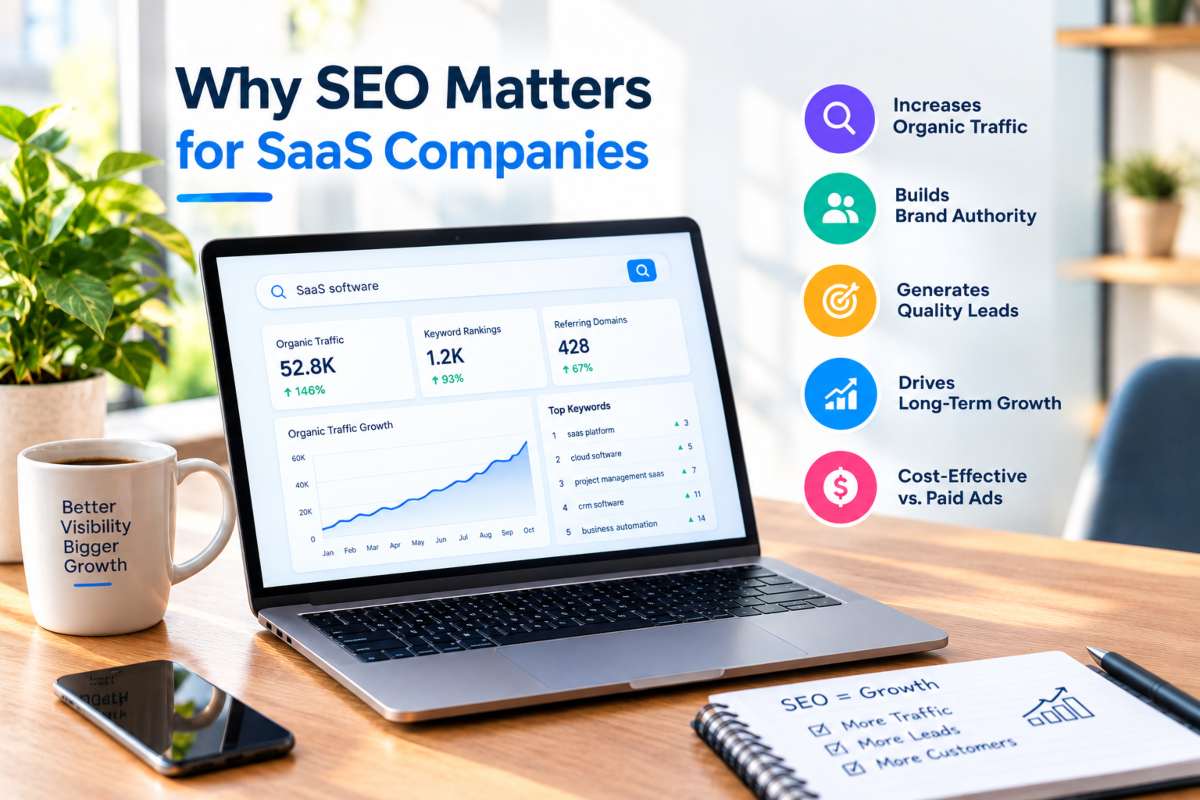
SEO matters for SaaS companies because it delivers qualified buyers at a lower and more predictable cost over time than most other channels and it reaches them while they are still deciding what to buy. For a subscription business, where every customer must repay their acquisition cost through months of renewals, that efficiency shapes profitability.
Lower long term customer acquisition cost
SEO lowers customer acquisition cost because the work is paid for once and keeps producing visitors afterward. A well built guide, comparison page or feature page can bring in signups for years without a fee for each click. Paid channels work the opposite way, since spend stops the moment the budget does.
First Page Sage SaaS data, as summarized in an Ahrefs roundup, puts the average cost per lead from organic traffic at $147, compared with $280 from paid search. That gap matters most in SaaS, where a shorter payback period gives a company more room to reinvest in growth.
Compounding traffic vs paid ads
Organic traffic compounds, while paid traffic is rented. Each new page adds to a site’s topical authority, earns links and strengthens the pages around it, so later content tends to rank faster than earlier content did. Paid ads deliver immediate volume, which suits launches and testing, but the results reset to zero when spending pauses.
The two channels work best together, with paid search validating which messages convert and SEO building the durable base beneath it. Companies that lean only on ads often find their growth tied directly to their budget, while those investing in search build an asset that keeps working when spending is tight.
Reaching buyers across the funnel
SEO reaches buyers at every stage of a subscription purchase, which few channels can do. Early on, someone searching for a solution to a workflow problem finds an educational guide. Later, the same person searches for alternatives, integrations or pricing and lands on comparison and product pages.
At the decision stage, use case and demo pages turn interest into trials and signups and help content afterward support retention and expansion, which protects monthly recurring revenue. Quality matters here as much as reach. SEO Sherpa’s roundup reports that organic search leads close at 14.6%, versus 1.7% for outbound efforts, because these buyers came looking for an answer.
SaaS SEO statistics and benchmarks
A few benchmarks help set realistic expectations. First Page Sage reports average B2B SaaS SEO returns of around 702% over three years, with break-even at about seven months, which shows why patience pays off. SEO Sherpa compilation also finds that organic search accounts for roughly 44.6% of B2B revenue and that about 71% of B2B research begins with a generic, non branded query, which is why top of funnel content earns its place.
The landscape is shifting as well. The same source reports that around 60% of Google searches now end without a click and Ahrefs estimates AI Overviews cut clicks to websites by 34.5%. That does not make SEO less valuable. It raises the bar for clear, authoritative, citation worthy pages and it makes measuring signups and revenue more useful than tracking traffic alone.
SaaS SEO vs Traditional SEO
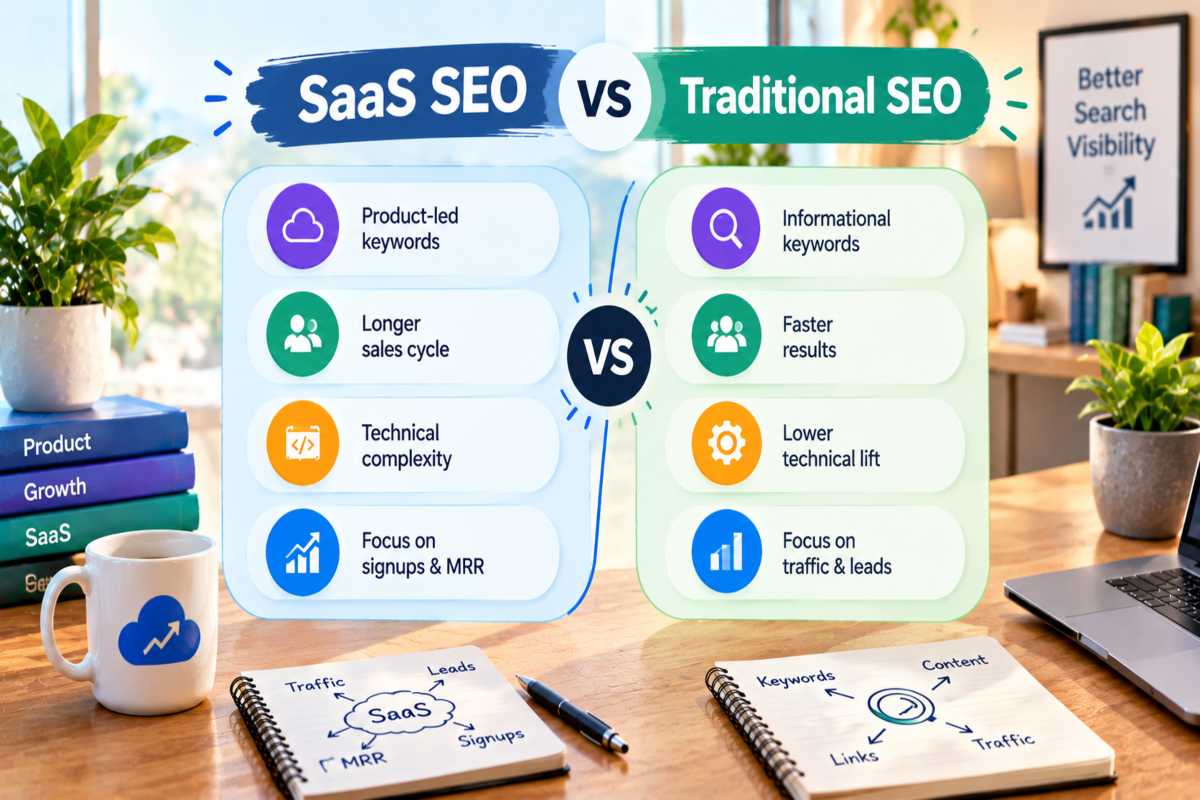
SaaS SEO differs from traditional SEO in four main ways, buyers take longer to decide, they discover software through different behaviors, success is measured in recurring revenue instead of single conversions and the strategy has to work closely with product and marketing. Traditional SEO often targets a quick purchase or a local, transactional search, while SaaS SEO supports a subscription relationship that begins well before signup and continues long after it.
Longer sales cycles and multi stakeholder B2B buying
SaaS purchases take longer than typical consumer or local buys because several people usually weigh in, from the end user to a finance or IT approver. Each person searches for different things, the practitioner looks for how-to guides and feature comparisons, while the budget holder looks for pricing, security and proof of return.
SEO Sherpa B2B roundup reports that the average buyer runs between 8 and 12 searches before visiting a specific brand’s website. A SaaS site therefore needs content for every stakeholder and every stage, not one landing page aimed at a single decision-maker. Traditional SEO, built around a fast, single-person decision, rarely has to plan for that.
Product led vs sales led search behavior
Search behavior changes depending on how a SaaS product is sold. In a product-led model, users often search for a free trial, a template, an integration or a specific feature and expect to try the software before talking to anyone. In a sales led model, buyers lean on comparison pages, case studies, security details and pricing context to build a shortlist before requesting a demo.
Both patterns differ from traditional SEO, where the searcher typically wants a product or service and a place to buy it. A SaaS team should decide which motion it runs and shape its pages accordingly, with self serve signup paths for the first and demo focused proof pages for the second.
Recurring revenue metrics vs one off conversions
Traditional SEO usually stops at traffic, leads or a completed sale, but SaaS SEO is judged by what happens after the click. The metrics that matter include trial to paid conversion, pipeline influenced by organic search, customer acquisition cost, retention and monthly recurring revenue. A page that attracts thousands of visitors but few qualified trials may look strong in a traditional report and still fail a SaaS one.
This changes content priorities too. Pages that answer high intent questions and draw the right users often outperform broad, high volume articles. It also means SEO reporting has to connect with product analytics and the CRM, which is often where specialized SEO services help teams build clean attribution.
Where SaaS marketing and SEO overlap
SaaS marketing and SEO overlap wherever content, positioning and conversion meet and the best results come when they are planned together. Content marketing supplies the guides and comparisons that rank, product marketing shapes the messaging on feature and use-case pages and paid campaigns reveal which phrases attract signups so SEO can pursue them organically.
Email, lifecycle and customer education content also reinforce search efforts by reducing churn and building the brand mentions that support authority. Treating SEO as a separate silo tends to produce pages that rank but do not convert. Treating it as one part of a shared growth plan gives each channel more to work with.
SaaS SEO Strategy The Framework That Works
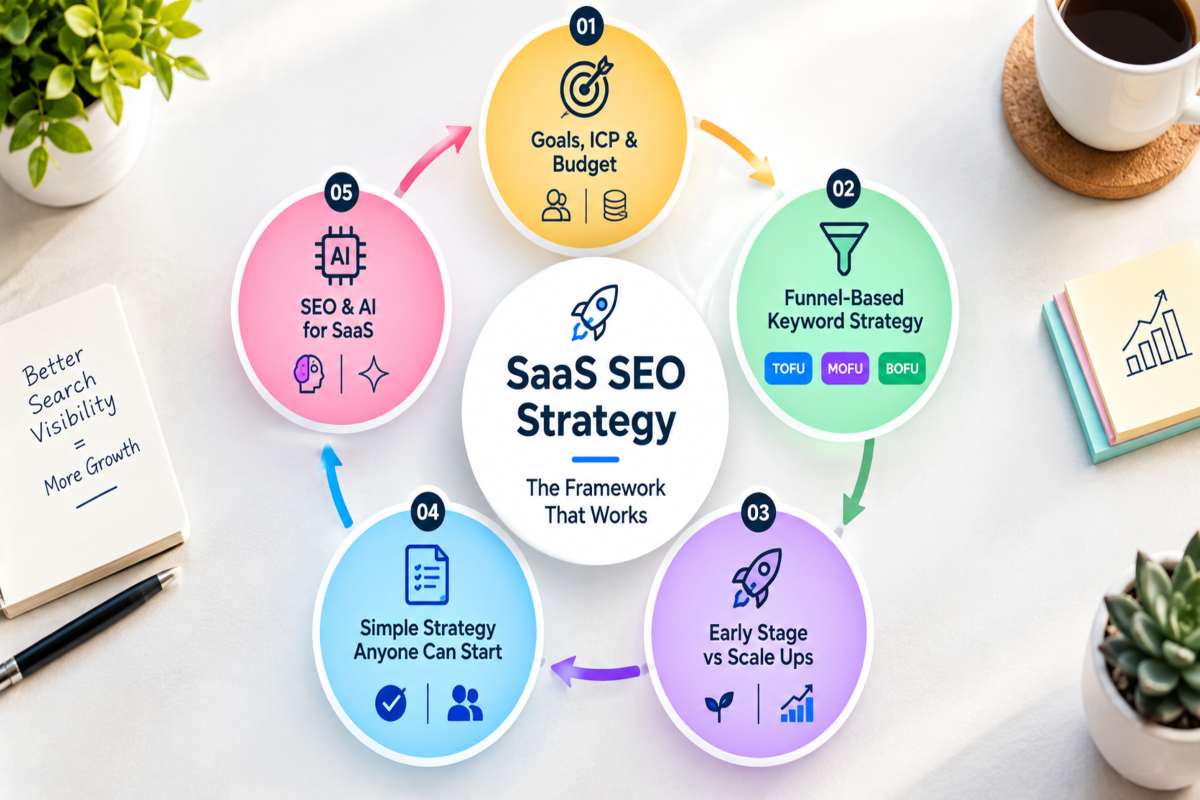
An effective SaaS SEO strategy starts with clear business goals and a defined customer, maps keywords to each stage of the buying journey and matches its scope to the company’s size and resources. It then adds the technical foundation and AI-ready content that keep the site visible as search changes.
Start with goals, ICP and budget
A SaaS SEO strategy should begin with three decisions, what the business needs from search, who it is trying to reach and how much it can invest. Goals should be tied to revenue outcomes such as trial signups, demo requests or pipeline, not to traffic alone.
The ideal customer profile matters just as much, because it determines which problems, job titles and industries the content addresses. The budget then sets the pace. A team with limited resources should pick a narrow set of high value topics and cover them well, instead of spreading thin across dozens. Writing these three answers down before any keyword research keeps later choices consistent and makes results easier to judge.
Funnel based keyword strategy (TOFU, MOFU and BOFU)
A funnel-based keyword strategy assigns each search phrase to a stage of the buying journey so every stage has a page built for it. Top of funnel keywords capture people who describe a problem but do not yet know the solution and they suit guides, glossary entries and how-to content.
Middle-of-funnel keywords reach buyers comparing approaches or tools, which calls for comparison pages, alternative pages and integration content. Bottom-of-funnel keywords target people ready to act, such as those searching for pricing, use cases or a specific feature and belong on product and demo pages. Mapping one primary keyword to one page prevents overlap between pages and internal links between stages guide readers from learning to evaluating to buying.
The best SEO strategy for early stage startups vs scale ups
The best SEO strategy for an early-stage startup is to focus tightly on a few bottom- and middle-funnel topics that convert, while a scale up should widen its reach and build topical authority. Startups have small teams, little domain authority and short runways, so they gain more from pages targeting specific, lower competition searches like integrations, alternatives and narrow use cases.
These pages can rank sooner and bring in users who are already close to buying. Scale ups have the resources to publish across the whole funnel, refresh older content, pursue links through data and partnerships and expand into international markets. The shift is one of emphasis, startups prove what converts and scale ups turn that into broad coverage.
A basic SaaS SEO strategy anyone can start with
A basic SaaS SEO strategy can be built in five steps that need no large team. First, choose ten to twenty keywords tied directly to the problems your product solves. Second, create or improve one page for each, with a clear answer, a relevant example and a single next step for the reader.
Third, connect those pages with internal links so related topics support one another. Fourth, make sure the site has a sound technical SEO base, meaning fast pages, clean structure and correct indexing, so search engines can read what you publish. Fifth, track organic signups and revisit the plan every quarter, keeping what converts and dropping what does not.
SEO and AI for SaaS search generative experiences and AI citations
SEO and AI now overlap for SaaS because buyers increasingly get answers from AI Overviews and chat tools and those systems pull from pages that are clear, current and authoritative. Being cited in an AI answer has become a visibility goal alongside ranking. Ahrefs research shows AI search platforms tend to cite content that is about 25.7% fresher than what appears in traditional organic results, so regular updates carry real weight.
Practical steps include opening sections with direct answers, using clear headings, adding structured data and keeping facts accurate and sourced. Teams that want dedicated support can look into AI optimization to make their content easier for these systems to find, understand and quote.
SaaS Keyword Research
SaaS keyword research is the process of finding the search phrases your buyers use at each stage of their decision, then matching each phrase to the page that should rank for it. The best research goes beyond search volume. It weighs how close a searcher is to buying, how well the phrase fits your product and whether your site can realistically compete for it.
Problem aware, solution aware and product aware keywords
SaaS keywords fall into three awareness levels that describe how much a searcher already knows. Problem-aware keywords come from people who feel a pain but have not named a fix, such as “why do invoices get paid late.” Solution-aware keywords come from people who know a category of tool exists such as “invoicing software for freelancers.”
Product aware keywords come from people comparing specific vendors or evaluating yours, such as a brand name paired with “pricing” or “reviews.” Each level needs a different page type, educational guides for the first, category and buyer guide content for the second and product, pricing and comparison pages for the third. Sorting a keyword list this way shows quickly which stages of the journey have no content.
Feature, use case, integration and alternative keywords
Four keyword families tend to convert best in SaaS because they reflect specific needs. Feature keywords describe what the software does, like “automated expense reports.” Use-case keywords tie the product to a role or industry, such as “project management for design agencies.” Integration keywords capture people who want the tool to work with software they already use, like “connect a CRM to email marketing.”
Alternative keywords come from buyers weighing options or leaving a competitor, such as “competitor alternatives for small teams.” These phrases are narrower than broad category terms, which usually means less competition and a clearer reason to sign up. Many can be built from your own product, feature lists, integration directories and customer segments are ready-made keyword sources.
Finding keywords with buying intent
Keywords with buying intent usually contain a signal that the searcher is close to a decision. Common signals include words like “pricing,” “alternative,” “vs,” “best for,” “free trial” and “demo” along with phrases naming a specific job the software must do. Good sources for these terms go beyond keyword tools.
Sales call transcripts, support tickets, review sites and onboarding surveys show the exact language customers use before they buy. Search results themselves help too, if the top pages for a phrase are product pages or comparisons instead of blog posts, the query has commercial intent. Prioritize phrases where intent, product fit and achievable ranking overlap, even when volume is modest. A term searched a hundred times a month by ready buyers can outperform one searched ten thousand times by casual readers.
Mapping one keyword to one page to avoid cannibalization
Mapping one primary keyword to one page prevents keyword cannibalization, which happens when several pages on the same site compete for the same search. When that happens, authority and links get split and search engines may rank the wrong page or none. The stakes are high because position matters so much.
Powered by Search reports that the top three results on the first page receive 54.4% of all clicks, so two pages sharing a query can leave both stuck below the positions that earn traffic. To avoid this, build a simple spreadsheet listing each target URL, its primary keyword and the close variants it should also cover. Before publishing anything new, check the sheet for an existing page that already owns the topic and update that page instead of creating a competitor.
SaaS Content Marketing for SEO
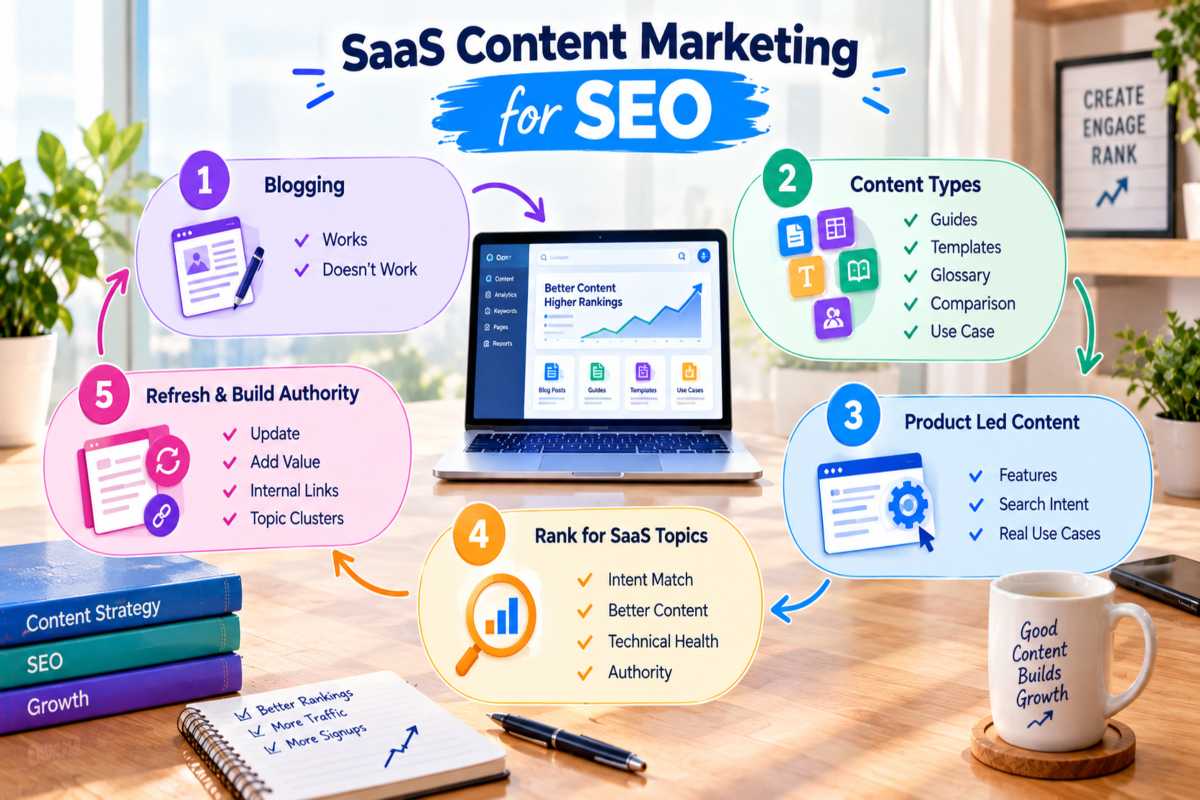
SaaS content marketing for SEO means publishing pages that answer buyers’ questions at every stage of their decision, so search engines and AI tools surface your product when it matters. It works when each piece serves a specific search intent and a business goal. Publishing more does not help if the content does not.
Blogging for SaaS SEO what works and what does not
Blogging works for SaaS SEO when posts target specific problems your buyers search for and lead naturally toward your product. It fails when the blog chases broad, high-volume topics that attract readers who will never need the software. A post explaining how to reduce customer churn will draw the right audience for a customer success platform, while a general article on productivity trends will not.
Depth also beats frequency. A handful of thorough, accurate, well-linked articles typically outperform a stream of thin ones. Original research is a strong example of depth paying off, one compilation of B2B SaaS data by SHNO reports that companies publishing original research grow organic traffic by an average of 29.7%. The lesson is to publish less filler and more material other sites want to cite.
Content types guides, templates, glossary, comparison and use case pages
Five content types carry most of the weight in SaaS SEO and each serves a different intent. Guides capture early-stage learners with in depth explanations of a problem or process. Templates and tools give visitors something immediately useful, which earns links and shares. Glossary pages target definition searches and build topical coverage across a field.
Comparison and alternative pages reach buyers weighing vendors, which makes them some of the highest converting pages on a SaaS site. Use case pages show how the product solves a defined problem for a specific role or industry. A balanced program includes all five, because relying on only one leaves gaps at certain stages of the buying journey.
Product led content that ties features to search intent
Product-led content shows how a feature solves the exact problem a searcher describes, so the product becomes part of the answer instead of a sales pitch at the end. Instead of writing about a feature in general terms, starting from the task, a post on how to automate weekly client reports can walk through the steps, with your reporting feature as the practical way to do it.
This approach helps readers finish the task while seeing the product in action. Screenshots, short walkthroughs and templates that open inside the product make the connection concrete. It also keeps content honest, since every feature mentioned rests on a real use case instead of a vague benefit claim.
How to make content rank for SaaS topics
Content ranks for SaaS topics when it matches the search intent, covers the subject more completely than competitors and sits on a site search engines trust. Start by reading the pages already ranking for the target phrase to see what format and depth they offer, then aim to answer the question more clearly and add something they lack, such as original data, an expert quote or a worked example.
Put the direct answer near the top, use descriptive headings and link to related pages on your site. Authority comes from earned links and consistent quality over time. Finally, make sure the page can be crawled and loaded quickly, since strong content on a poorly built page rarely reaches its potential.
Content refreshes and topical authority
Content refreshes keep existing pages accurate and competitive and they help build topical authority, which is a site reputation for covering a subject thoroughly. Review high-impression pages every few months, updating outdated statistics, adding new sections for questions that have emerged, improving weak introductions and fixing broken links or screenshots.
Refreshing an older page often yields faster gains than writing a new one, because it already has history and links. Topical authority grows when related pages link to each other around a central theme, forming a cluster that shows depth. Good website maintenance supports this work by keeping links, speed and page health in shape, so refreshed content isn’t held back by site issues.
On Page SEO for SaaS Websites
On page SEO for SaaS websites is the practice of shaping each page’s content, structure and markup so search engines understand what it offers and visitors know what to do next. The essentials are clear product and feature pages, well written titles and headings, structured data and page elements that turn interest into trials. Strong on-page SEO ties all of these together.
Optimizing product and feature pages
Product and feature pages rank when they describe what the software does in the words buyers use and show proof that it works. Each page should concentrate on one primary topic, such as a single feature, use case or integration, instead of packing every capability into one overview. Open with a plain statement of what the feature does and who it helps.
Then add specifics, how it works, a screenshot or short demo, a customer result and links to related pages. Avoid vague claims like “powerful and easy to use,” which say nothing to a searcher or an AI answer tool. Concrete details, like the tasks it automates or the tools it connects with, give both readers and search engines something to work with.
Titles, metas, headings and internal linking
Titles, meta descriptions, headings and internal links tell search engines what a page covers and persuade people to click. A title should place the primary keyword near the front and stay within roughly 55 to 60 characters so it isn’t cut off. Meta descriptions don’t affect rankings directly, but a clear one written around the searcher’s need can raise clicks.
That matters because position is worth so much, Powered by Search reports the top organic result earns an average click-through rate of 27.6%. Use one H1 per page, with H2 and H3 headings that mirror the questions readers ask. Internal links should use defining anchor text and connect related pages, moving readers from educational posts toward feature and pricing pages. If your site operates on WordPress, a tool such as an All in One SEO plugin can simplify editing titles, descriptions and other page level settings.
Schema markup for SaaS companies
Schema markup is structured data added to a page so search engines can read its details without guessing. Three types matter most for SaaS. SoftwareApplication markup describes the product, including its name, category, operating environment and pricing details. Organization markup identifies the company, its logo and its official profiles, which helps search engines connect the brand across the web.
FAQ markup structures common questions and answers, making them easier to extract for rich results and AI answers. Use JSON-LD, keep the markup consistent with what visitors see on the page and test it with Google’s Rich Results Test. Markup that contradicts the visible content can be ignored or flagged, so accuracy matters more than volume.
Conversion focused page elements
Conversion-focused elements turn organic visitors into trials, demos and signups, so a ranking page also produces business results. Put a clear call to action above the fold and repeat it after key sections, using specific wording like “Start your free trial” over generic labels. Add proof close to the action, customer logos, short testimonials, review ratings or a quantified result.
Reduce friction by keeping forms short and stating what happens after submission. Match the call to action to the page’s intent, offering a template download on an educational guide and a demo request on a comparison page. Fast load times and a pure mobile layout support all of this, since visitors leave slow or awkward pages before they see the offer.
Technical SEO for SaaS
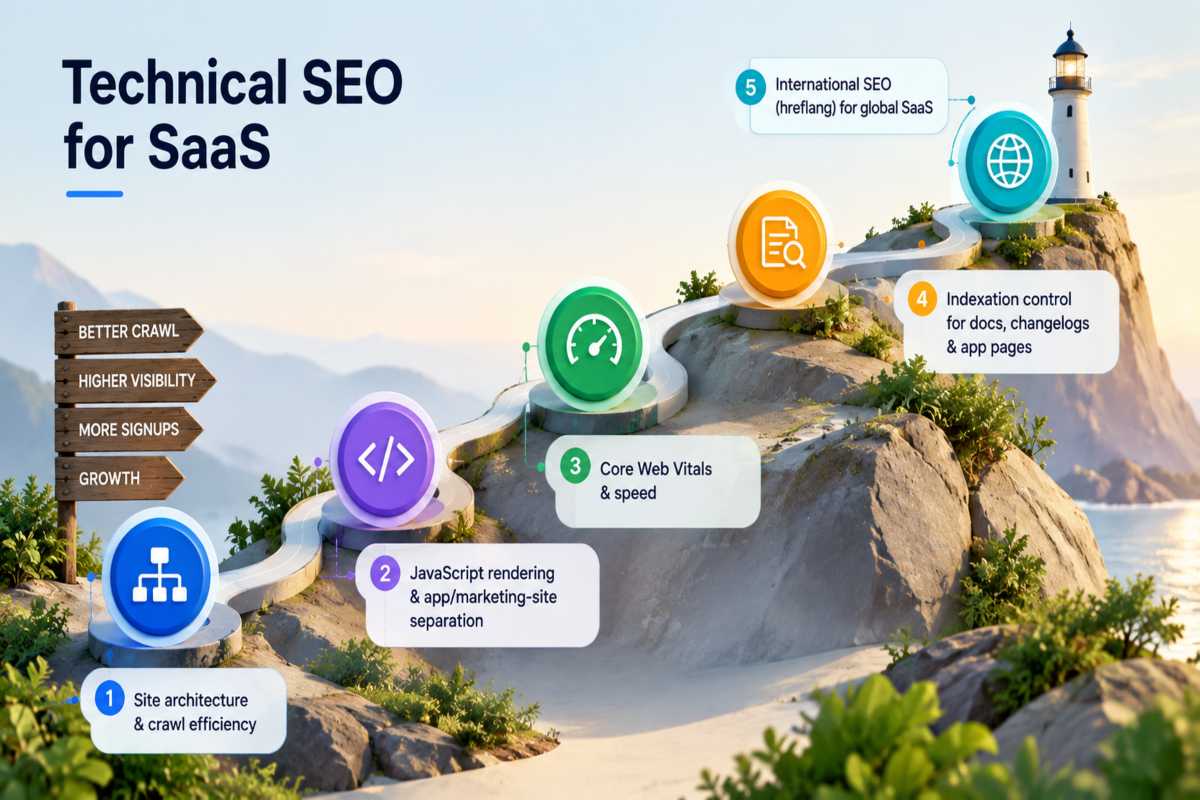
Technical SEO for SaaS is the work of making sure search engines can crawl, render and index the right pages of a software site quickly and without confusion. It matters more for SaaS than for many industries because a single domain often mixes marketing pages, documentation, changelogs and a logged in app. Solid technical SEO keeps the valuable pages visible and the rest out of the way.
Site architecture and crawl efficiency
A good SaaS site architecture keeps important pages within a few clicks of the homepage and groups related content under a logical URL structure. Search engines assign a limited amount of crawling to each site, so clean hierarchies, descriptive URLs and a maintained XML sitemap help them reach the pages that earn revenue.
Product, feature, integration and use case pages should link to each other and to the educational content that supports them. Watch for common crawl wasters, orphaned pages with no internal links, long redirect chains, duplicate URLs created by parameters and thin auto generated pages. Fixing these lets crawlers spend their time on pages that matter, which is especially helpful as a site grows into hundreds or thousands of URLs.
JavaScript rendering and app/marketing site separation
JavaScript rendering can hide content from search engines when key text, links or metadata only appear after scripts run in the browser. Many SaaS marketing sites are built with modern frameworks, so it pays to confirm that titles, headings, body copy and internal links appear in the rendered HTML, using Google Search Console’s URL Inspection tool.
Server-side rendering or static generation for marketing pages removes most of the risk. Separating the marketing site from the product also helps. Placing the app on its own subdomain or path, such as app.yourdomain.com, keeps heavy, logged in experiences from affecting how the public pages are crawled and evaluated and makes indexation rules easier to manage.
Core Web Vitals and speed
Core Web Vitals are Google measures of real-world page experience and SaaS sites should aim to meet all three. Google published thresholds for a good experience are a Largest Contentful Paint within 2.5 seconds, an Interaction to Next Paint under 200 milliseconds and a Cumulative Layout Shift below 0.1. SaaS pages often miss them because of heavy scripts, chat widgets, analytics tags and large hero images or videos.
Compress and lazy load media, defer nonessential scripts, reserve space for elements so the layout does not jump and audit third-party tags regularly. A practical Core Web Vitals guide can help teams measure and improve each metric and faster pages also tend to convert better, since visitors leave slow ones before seeing the offer.
Indexation control for docs, changelogs and app pages
Indexation control means deciding deliberately which pages search engines may show in results and which they should skip. Public documentation and help articles are often worth indexing, since they answer real questions and attract buyers researching the product. Changelogs, release notes and other high volume update pages may add little search value and can be consolidated or set to no-index if they are thin or repetitive.
Logged in app pages, account screens, internal search results, staging environments and parameter based duplicates should stay out of the index. Use no-index tags for pages that can be crawled but shouldn’t appear in results, canonical tags to point duplicates at the preferred URL and robots.txt to limit crawling of areas with no search value. Then review Search Console’s indexing report regularly to catch mistakes early.
International SEO (hreflang) for global SaaS
International SEO helps a SaaS company show the right language or provincial version of a page to each searcher and hreflang tags are the main signal for that. Each version should declare itself and its alternates using correct language and region codes and the references must be reciprocal, meaning every version points to the others and back.
Choose a clear URL structure, such as subfolders like /fr/ or country-code domains and stay consistent. Translate the content properly instead of relying on raw machine output and localize details like currency, examples and legal wording. Without correct hreflang, search engines may serve the wrong version or treat translated pages as duplicates. For an ongoing routine, a technical SEO checklist keeps these controls on schedule instead of leaving them to chance.
Off Page SEO and Link Building for SaaS
Off-page SEO for SaaS is the work of earning signals of trust from outside your website, mainly backlinks, brand mentions and third-party profiles, so search engines and AI tools see your product as credible. Links from relevant, respected sites remain the strongest of these signals. Effective off-page SEO for software companies focuses on earning that trust through useful assets and real relationships, not on buying volume.
Digital PR and data led linkable assets
Digital PR earns links by giving journalists, bloggers and industry writers something worth citing and original data is the most reliable way to do it. SaaS companies sit on useful raw material, anonymized usage trends, customer survey results, benchmark reports and pricing or adoption studies.
Turning one of these into a clear report with a headline finding gives writers a reason to reference and link to it. Free tools, calculators and templates work the same way, because people link to resources they use. Pitch the finding to publications your buyers already read and tailor each pitch to the writer’s beat. A single well placed mention in a respected trade outlet is worth more than dozens of generic submissions.
Integration and partner backlinks
Integrations and partnerships create natural backlink opportunities that most SaaS companies overlook. When your product connects with another platform, that platform often lists you in an app marketplace, a directory or a partner page, each with a link back to your site.
Co marketing adds more, joint webinars, shared case studies and guest posts on a partner’s blog put your brand in front of an overlapping audience and earn relevant links. These links carry weight because they come from sites in your own ecosystem, where the connection is obvious to both users and search engines. Keep your integration pages complete and well described, since they are what partners will link to and ask each partner for a listing when a new connection launches.
Review sites, directories and brand mentions
Review sites, software directories and brand mentions build authority and shape how buyers and AI tools perceive a SaaS company. Profiles on established software review platforms often appear high in search results for comparison queries, so a complete, accurate profile with recent customer reviews can bring in both traffic and trust.
Unlinked mentions in articles, podcasts and forums also matter, because search engines and AI systems increasingly use them to judge how well known a brand is. The stakes are rising, Ahrefs data reported in a statistics roundup shows the top 50 brands account for 28.9% of all citations in AI Overviews, so broad recognition helps concentrate visibility. Encourage satisfied customers to leave reviews, keep company details consistent across every profile and track new mentions so you can request links where they are missing.
Link quality vs quantity
Link quality matters far more than quantity, because a few links from relevant, trusted sites help more than many from weak or unrelated ones. A good link comes from a site with real editorial standards, covers a topic connected to your product and sits inside content people actually read. Low-quality tactics, such as buying links, joining link exchanges or posting on spammy directories, can trigger penalties or simply pass no value. Judge prospects by relevance, audience and editorial standards instead of relying only on a single authority score.
Review your backlink profile regularly and disavow only clearly harmful links, since Google usually ignores most junk on its own. Teams without the time for outreach can work with link building services that focus on editorially earned, relevant placements instead of bulk submissions. Steady growth from credible sources builds durable authority in a way that fast, low-grade link building cannot.
How to Measure SaaS SEO Results
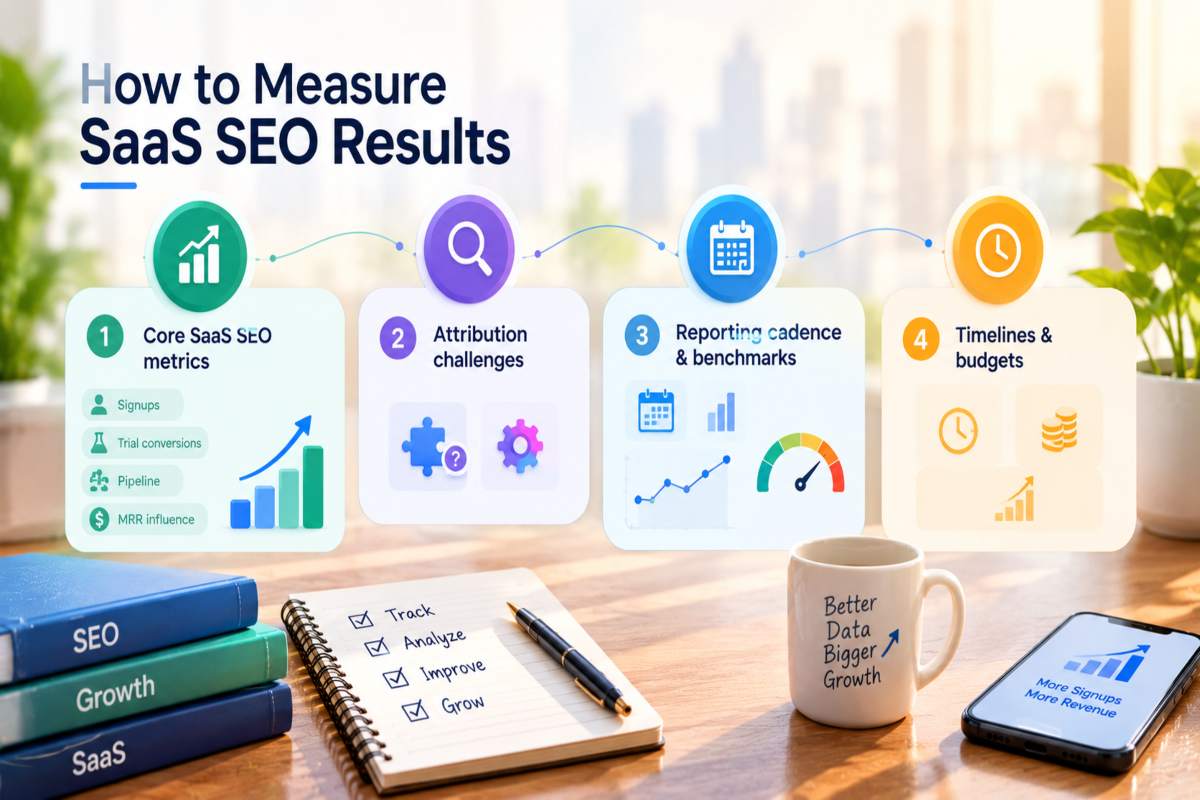
The best way to measure SaaS SEO results is to track outcomes tied to revenue, such as organic signups, trial conversions and pipeline, instead of stopping at rankings and traffic. Rankings and visits show whether the work is reaching people, but only conversion and revenue data show whether it is paying for itself.
Core SaaS SEO metrics
Four metrics show whether SaaS SEO is producing business value. Organic signups count the free accounts, trials and demo requests that come from search visitors and they are the clearest early signal. Trial conversion rate tracks how many of those organic users become paying customers, which reveals whether the traffic is the right kind.
Pipeline measures the sales opportunities that organic search started or influenced and it matters most in sales led models. Monthly recurring revenue influence estimates how much subscription revenue can be traced to organic touchpoints. Supporting metrics like impressions, clicks and rankings still help diagnose problems, but they belong beneath these four in any report.
Attribution challenges and workarounds
Attribution is difficult in SaaS because buyers visit many times, on different devices, over weeks or months before they convert. A reader might find a guide through search, return later through a direct visit and sign up after a sales email, leaving last click reports crediting the wrong channel. Several workarounds help. Ask new users how they found you, using a required field on the signup form.
Use multi touch or first-touch models in your analytics or CRM alongside last-click. Tag landing pages by content type so you can see which pages appear in converting journeys. Connect Google Search Console, analytics and the CRM so an organic visit can be followed through to a closed deal. None of these is perfect, but together they give a far more honest picture than any single report.
Reporting cadence and benchmarks
A useful reporting rhythm separates quick operational checks from deeper strategic reviews. Review rankings, indexing and technical health monthly and review conversions, pipeline and revenue influence quarterly, since revenue results move slowly. Benchmarks give those numbers context and the most useful ones compare your own results over time.
Position benchmarks matter too, because visibility falls sharply beyond the first page, Ahrefs data reported in a statistics roundup shows that 96.98% of clicks go to results in the top 10. That is why tracking how many priority keywords sit in the top 10 is a better health check than counting total keywords ranked. Keep reports short, lead with revenue-linked results and note what will change next as a result.
Realistic timelines and budgets
SaaS SEO usually takes several months to show meaningful results and most companies see revenue impact later than traffic impact. Early months go to technical fixes, keyword mapping and publishing and rankings for competitive terms build gradually as content earns links and trust. A reasonable expectation is early movement in impressions and long-tail rankings within a few months, with measurable signups and pipeline growth following as the program matures.
Budgets vary widely with company stage, competition and whether the work is done in house or by outside specialists. Instead of chasing a specific number, decide what share of acquisition spend to shift toward organic, fund content, technical work and links consistently and judge the program over quarters. Stopping early is the most common way to waste the investment, since the gains compound only if the work continues.
SaaS SEO Roadmap (First 12 Months)
A SaaS SEO roadmap for the first 12 months moves through three phases, fix the technical foundation in months 1 to 3, build a steady content engine in months 4 to 6 and grow authority and scale what works in months 7 to 12. Following that order matters, because content and links perform best on a site that search engines can already crawl and understand.
Months 1-3 foundation and technical fixes
The first quarter should establish the groundwork that every later effort depends on. Start with a technical audit covering crawlability, indexation, site speed, mobile usability and how JavaScript heavy pages render. Fix the problems that block visibility first, such as broken links, redirect chains, duplicate URLs and pages that should be indexed but are not.
Set up measurement early, connecting Search Console, analytics and the CRM so organic signups and revenue can be tracked from day one. Define the ideal customer profile, complete keyword research and map each target keyword to a single page. Finish the quarter by improving your highest-value product and feature pages, since these are closest to revenue and often benefit quickly from clearer copy and better structure.
Months 4-6 content engine and on page optimization
The second quarter turns the plan into a repeatable publishing routine. Prioritize content by intent, bottom funnel comparison, alternative and use case pages first, then problem focused guides that feed the middle and top of the funnel. Each piece should answer its query directly, include a real example or original detail and link to related pages.
Consistency shows measurable value here. SHNO’s organic traffic statistics report that B2B SaaS companies publishing nine or more blog posts a month grew monthly traffic by 35.8% year over year, though few small teams need that pace. A steady rhythm of quality pieces matters more than a target number. Alongside new content, refine titles, headings, internal links and schema on existing pages and begin tracking which pages bring in trials, not just visits.
Months 7-12 authority building and scale
The final phase focuses on earning trust from outside the site and expanding what has proved effective. Begin link acquisition in earnest, using original research, free tools, integration listings, partner content and digital PR that gives writers something worth citing. Review the first six months of data to see which topics, page types and keywords produce qualified signups, then increase output in those areas.
Refresh older pages that have gained impressions but stalled in rankings, since updates often move faster than new posts. If the business serves global customers, this is a sensible point to add localized pages and hreflang. Reporting should now connect organic search to pipeline and recurring revenue, so the following year’s budget rests on evidence.
A simple checklist to get started
A short checklist is the practical way to begin and it works best when each item has an owner and a date.
- Run a technical audit and fix crawl, indexing and speed issues
- Connect Search Console, analytics and the CRM for revenue linked tracking
- Define the perfect customer profile and build a keyword to page map
- Optimize the top product, feature and pricing pages
- Publish comparison, alternative and use case pages before broad guides
- Add internal links, schema markup and clear calls to action to every key page
- Start link building with original data, integrations and partner content
- Refresh underperforming pages each quarter
- Review organic signups, trial conversions and pipeline every quarter
Common SaaS SEO Mistakes to Avoid
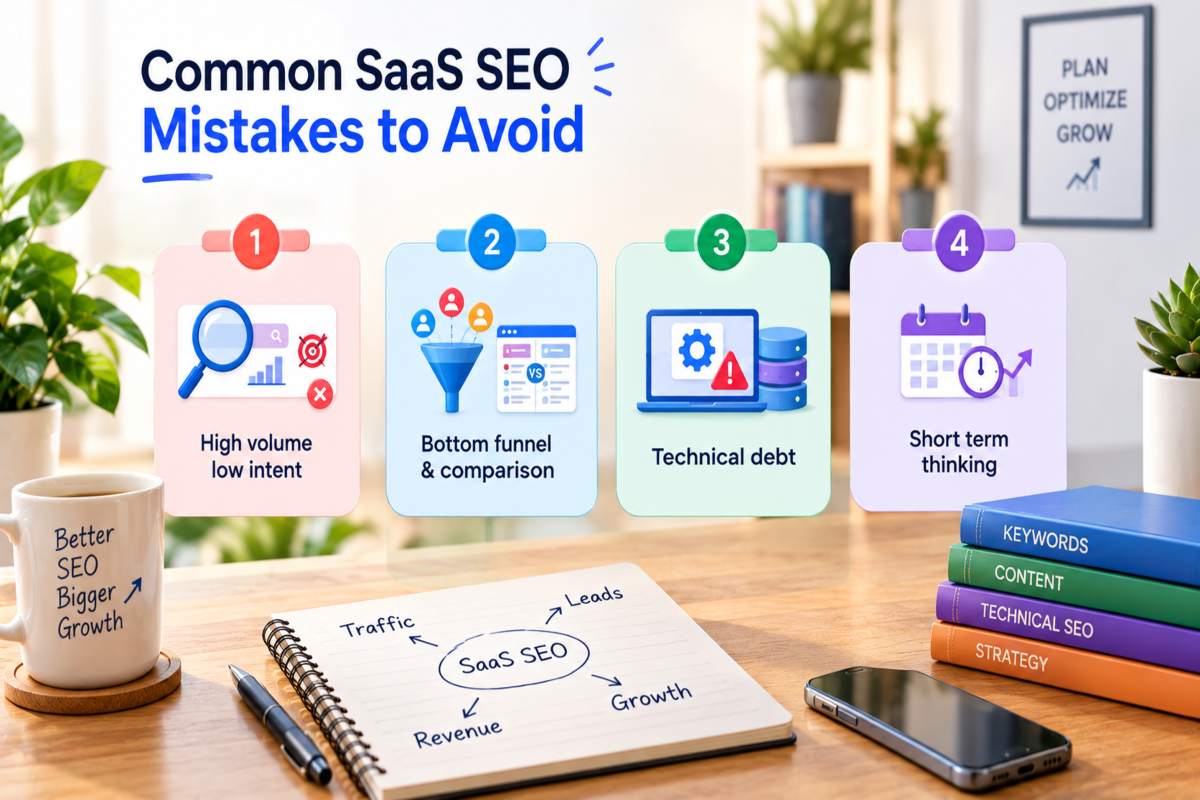
The most common SaaS SEO mistakes are chasing traffic that never converts, skipping the pages buyers use to decide, letting technical problems pile up and expecting fast results from a slow-building channel. Each one wastes budget in a different way and each is avoidable with a clearer plan.
Targeting only high volume, low intent keywords
Targeting only high volume, low intent keywords fills a site with visitors who have no reason to buy. Broad terms look attractive in a keyword tool because the search numbers are large, but the people behind them are often students, job seekers or casual readers. A project management company that ranks for a general productivity topic may see traffic climb while trial signups stay flat.
Balance the plan by pairing a few broad topics with a larger set of specific, problem led phrases from buyers who are actively looking for a solution. Judge each keyword on the likelihood that its searcher needs your product, not on volume alone. A modest phrase that regularly produces trials is worth more than a popular one that produces only page views.
Ignoring bottom funnel and comparison content
Ignoring bottom funnel and comparison content leaves the pages closest to revenue unbuilt. Buyers who search for alternatives, pricing, “X vs Y” or a feature by name have already decided they need software and are choosing between vendors. If your site has nothing for them, a competitor or a third party review site will shape that decision instead.
Many teams avoid these pages because they feel promotional or because naming competitors seems risky, but fair, well researched comparisons build trust when they acknowledge where another tool fits better. Give each comparison a clear structure, honest trade offs and a straightforward next step. These pages are often the fastest to rank, since fewer sites cover a specific pairing in depth.
Neglecting technical debt on a product-heavy site
Neglecting technical debt lets small problems compound until they hold back everything else. Product-heavy sites collect it quickly, outdated redirects, duplicate feature pages, bloated scripts from marketing tools, app pages that leak into the index and templates that slow every page they touch.
Any one of these seems minor, but together they waste crawl budgets, dilute rankings and hurt the experience of visitors on their way to a signup. Build technical review into the regular routine instead of waiting for a traffic drop and assign an owner in engineering so fixes do not stall between departments. Addressing a small issue each sprint costs far less than a large rebuild after rankings have already slipped.
Treating SEO as a short-term channel
Treating SEO as a short-term channel leads companies to quit just before it starts to pay off. Unlike paid ads organic search builds gradually and the earliest months often show effort without visible returns. That gap is easy to misread as failure. Ranking position explains why patience is needed, Powered by Search reports that only 0.63% of users click a result from the second page of Google, so pages must climb into the first page before they produce meaningful traffic and that climb takes time.
Set expectations with leadership from the start, report on leading indicators like impressions, top 10 rankings and qualified signups and commit to at least two to three quarters of consistent work before judging the program. Companies that stop early lose the compounding gains they paid for.
SaaS SEO Tips
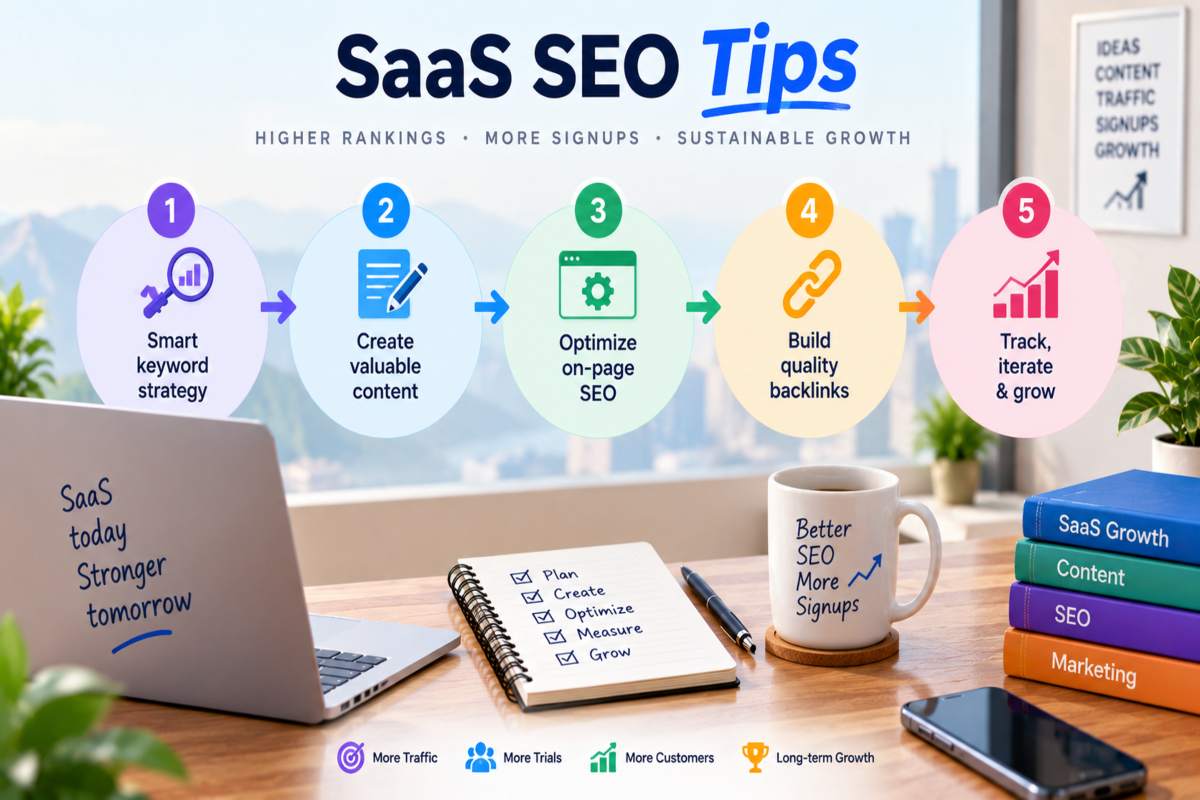
The fastest SaaS SEO wins come from improving what you already have, updating pages that earn impressions but few clicks, linking your strongest articles to product pages and adding short, direct answers that search engines and AI tools can lift. These changes take days, not months, because they build on pages search engines already know.
Optimize existing high-impression pages first
Pages that already appear in search results but attract a few clicks are the quickest route to more traffic. Open Google Search Console, filter for pages with high impressions and low click-through rates or with average positions between 5 and 15 and start there. Rewrite the title and meta description to fit the searcher’s wording, tighten the opening so it answers the query at once and add a missing section or two that competitors cover.
Refresh outdated statistics and screenshots while you are at it. Because these pages already have some authority, small edits often lift rankings within weeks. If a page performance has fallen instead of stalled, first diagnose the cause, since a website traffic drop can point to technical faults or algorithm changes that no rewrite will fix.
Build internal links from high-authority blog posts to product pages
Internal links from your strongest blog posts pass authority to the product and feature pages that drive signups. Most SaaS sites have a few articles that attract the bulk of their links and traffic, yet those articles often link to nothing commercial. Find them using a backlink report or your analytics, then add contextual links where a product or feature page is the natural next step. Use descriptive anchor text such as the feature name or the task it performs, not vague phrases like “click here.” Place the link near the point where the reader’s problem is described, so it feels like a helpful pointer and not an ad. This costs almost nothing and gives your money pages support they would otherwise lack.
Add FAQ schema and concise answer blocks
Concise answer blocks and FAQ schema make a page easier for search engines and AI tools to extract and quote. An answer block is a short, self contained response of roughly 40 to 60 words placed directly under a question style heading, written so it makes sense without the rest of the page.
FAQ schema then marks up common questions and answers in structured data, helping search engines interpret them accurately. Visibility in AI answers is far from guaranteed, Ahrefs data reported in a statistics roundup shows that 26% of brands have zero mentions in AI Overviews. Adding clear answers to your key pages improves the odds of being included. Keep the schema consistent with the visible text and write answers that state facts plainly instead of hinting at them.
Conclusion
SaaS SEO is a long term growth channel that works by matching the right page to each stage of a buyer’s decision, backed by a technically sound site and measured in signups and recurring revenue. The companies that succeed treat it as a system, a clear strategy, content built around real search intent, strong technical health, earned authority and steady measurement.
The starting point is rarely a large budget. It is a clear picture of who you serve, a short list of keywords tied to real buyer problems and a site that search engines can crawl and understand. From there, each piece builds on the last. Comparison and use case pages capture buyers close to a decision, guides bring in people earlier in their research and internal links and schema help both search engines and AI tools understand how it all fits together. Links, integrations and original data then add the authority that lifts competitive pages.
Search also remains the channel worth investing in, even as AI answers grow. Ahrefs data reported in a statistics roundup shows Google still sends 345 times more traffic to websites than ChatGPT, Gemini and Perplexity combined. Ranking well and being cited in AI answers now reward the same qualities, clear, accurate, well-structured content from a trusted source.
For next steps, run a technical audit, connect your analytics to revenue data and improve your top product pages before publishing anything new. Then follow the roadmap in order, review results each quarter and put more effort into what produces qualified trials. If you would like an experienced team to help plan or carry out that work, IT Leadz can support each stage, from technical fixes to content and authority building.
Frequently Asked Questions (FAQs)
What is SaaS SEO?
SaaS SEO is the practice of optimizing a software company’s website so buyers find it while researching problems, comparing tools or evaluating a purchase. It matters because SEO Sherpa’s roundup reports that about 68% of online affairs start with a search engine query.
How is SaaS SEO different from regular SEO?
SaaS SEO supports longer, multi-stakeholder buying journeys and measures success in trials, pipeline and recurring revenue instead of single sales. It also has to manage a mix of marketing pages, documentation and app pages on one site.
How long does SaaS SEO take to show results?
Most companies see early movement in impressions and long tail rankings within a few months, with signups and pipeline growth following as content and authority build. Competitive terms usually take longer, so judge progress over quarters, not weeks.
How much should a SaaS company budget for SEO?
There is no fixed number, since the right budget depends on company stage, competition and whether work is done in house or outsourced. A practical approach is to shift a set share of acquisition spend to organic and fund content, technical work and links consistently.
Is blogging effective for SaaS SEO?
Yes, when posts target specific buyer problems and lead naturally toward your product. Broad, off topic posts bring traffic that rarely converts, so depth and relevance matter more than publishing volume.
Can startups do SaaS SEO without a big team?
Yes. A small team can focus on a few high intent pages, such as comparisons, alternatives and use cases and improve them steadily. Start narrow, track which pages bring trials and expand only after those results show what works.