What Is Ecommerce SEO? Ecommerce SEO is the practice of optimizing an online store product pages, categories, technical structure and content so it can rank higher in search results and attract shoppers without paid ads. Rather than relying on Google Ads or social promotions for every sale, Ecommerce SEO builds long term, compounding visibility that keeps bringing in traffic month after month.
The impact is measurable, organic Google search accounts for roughly 43% of all ecommerce traffic, making it the single largest traffic source for online retailers. For store owners, that means one thing, if your site is not structured and optimized for search, you are likely losing a significant share of potential customers before they ever see your products.
This guide breaks down exactly what ecommerce SEO involves, why it matters for revenue and not just rankings and how to apply it across platforms like Shopify and BigCommerce, so you can turn search traffic into a reliable, ongoing sales channel.
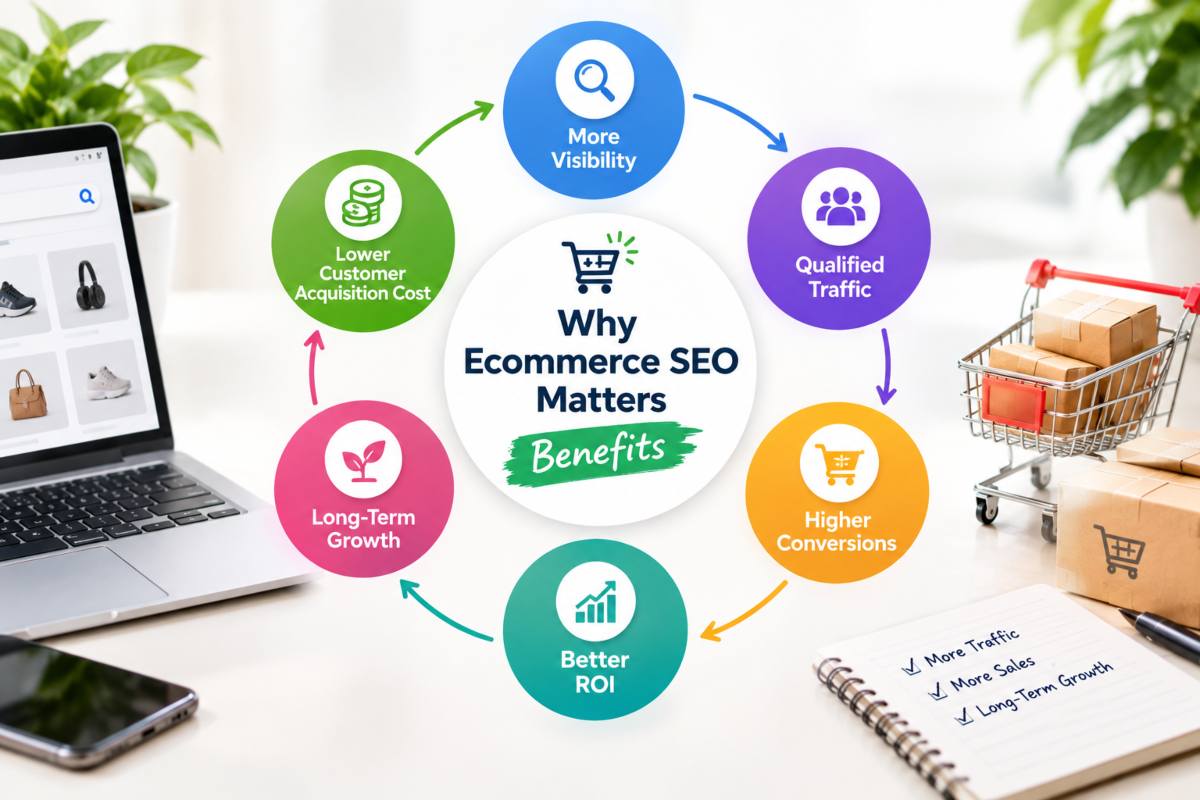
Why Ecommerce SEO Matters Benefits
Ecommerce SEO matters because it determines whether shoppers find your store at the exact moment they are ready to buy, without you paying for every single click. A well optimized store earns visibility that lasts, turning search engines into a steady source of qualified traffic rather than a one time expense.
Organic Traffic vs Paid Ads for Ecommerce
Paid ads deliver traffic only as long as the budget keeps flowing, the moment spending stops, so does the visibility. Organic search works differently, once a product or category page earns a strong ranking, it can continue attracting visitors for months or years with little additional investment.
This distinction matters more than most store owners realize, since organic search consistently outperforms paid channels as a traffic source, generating roughly 53% of all website visits compared to around 15% from paid search. For an online store, that gap represents a large pool of possible customers who are actively searching but will never see a paid ad, they will only find you through organic rankings.
Long Term ROI of Ecommerce SEO
The real advantage of ecommerce SEO shows up in cost efficiency over time. Where paid campaigns require continuous spend to sustain rankings in the ad auction, SEO builds equity, a page that ranks well keeps generating traffic without a recurring cost per click. Studies on organic visibility have estimated the equivalent PPC cost of ranking organically for competitive ecommerce terms at close to £11,790 per month, a cost that SEO effectively eliminates once rankings are established.
This is why most sustainable ecommerce brands treat SEO as a long term asset rather than a campaign, often working with dedicated SEO Services to build and protect that visibility as the store scales, rather than trying to recreate it from scratch every time paid budgets shift.
How Ecommerce SEO Works (Core Process)
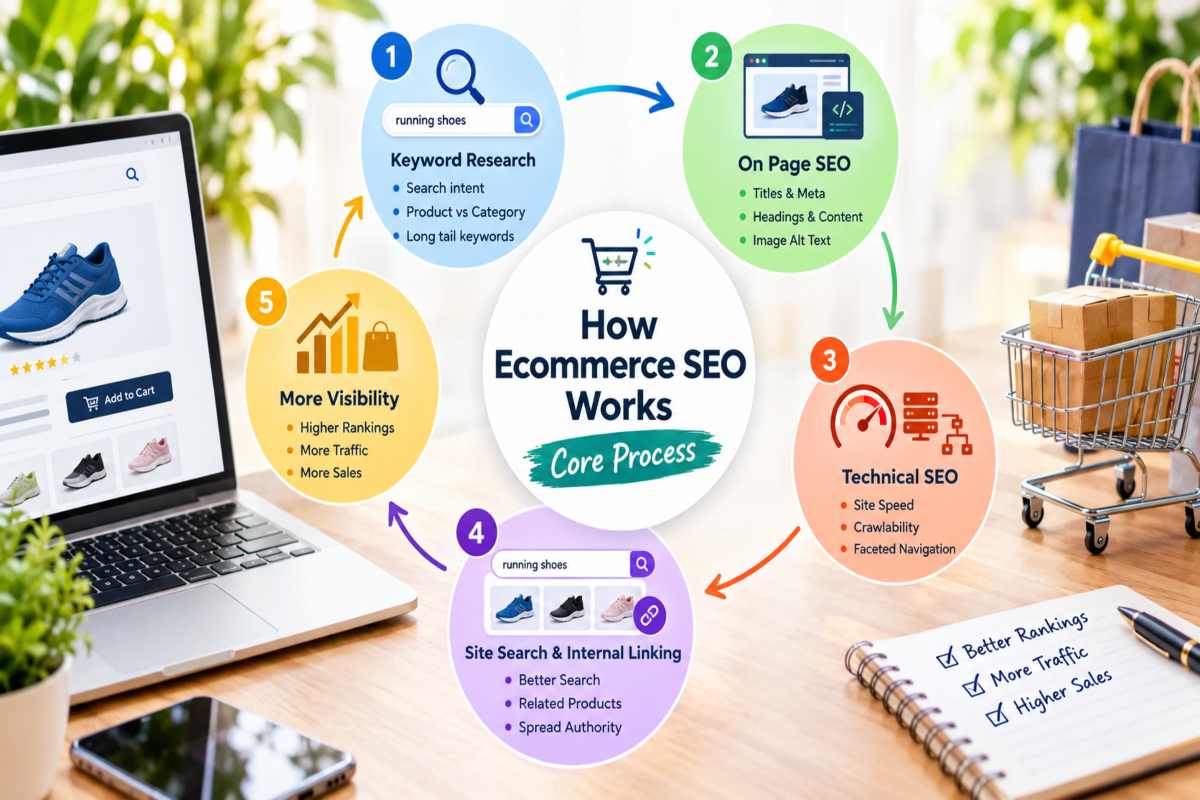
Ecommerce SEO works by aligning three things, the keywords shoppers actually search, the on page content that answers those searches and the technical foundation that lets search engines crawl and rank the site efficiently. Get all three right and product and category pages start appearing for the exact terms buyers use before they even reach checkout.
Keyword Research for Product and Category Pages
Keyword research for ecommerce starts with matching search intent to page type, not just chasing volume. Category pages typically target broader, higher volume terms like “men running shoes,” while product pages rank better for specific, longer tail searches such as “waterproof trail running shoes size 10”, terms with lower volume but far higher purchase intent. The goal is to map each keyword to the page best suited to answer it, avoiding a situation where two pages compete for the same term and split ranking potential instead of reinforcing each other.
On Page SEO for Ecommerce (Titles, Meta and Content)
On Page SEO covers the elements shoppers and search engines see directly on the page, title tags, meta descriptions, headings, product descriptions and image alt text.
Each of these needs to reflect the target keyword naturally while giving a real reason to click, this matters because the top ranking result in Google typically earns close to 28% of all clicks on that search, meaning a compelling title and description can be the difference between ranking well and actually getting the traffic. Unique, detailed product descriptions also help avoid duplicate content issues that are common on ecommerce sites using manufacturer supplied copy across multiple retailers.
Technical SEO for Ecommerce (Site Speed, Crawlability and Faceted Navigation)
Technical SEO is what allows all the keyword and content work to actually get indexed and rewarded by search engines. For ecommerce sites, this usually centers on three issues, page speed, since slow loading product pages hurt both rankings and conversions, crawlability, ensuring search engines can find and access every important page, and faceted navigation, where filters like size, color and price can generate thousands of near duplicate URLs that waste crawl budget if left unmanaged. Addressing these technical issues is often what separates a store with good content that still does not rank from one that consistently shows up in search results.
Ecommerce Site Search and Internal Linking
Site search and internal linking work together to keep shoppers moving toward a purchase instead of bouncing when they can not find what they are looking for. A strong internal search function helps visitors locate products quickly even when they use different phrasing than your category names, while internal links guide both users and search engines through related products, categories and buying guides, spreading ranking authority across the site rather than concentrating it on the homepage alone.
This matters more than many store owners assume, shoppers who use on site search tend to convert at a noticeably higher rate than those who browse alone, since they have already signaled specific intent. Yet on site search is frequently under optimized, set up to match exact product names but not handle typos, synonyms or plural variations, which quietly pushes ready to buy visitors toward a dead end instead of a product page.
Internal linking closes the rest of the gap. Linking from blog content and category pages to relevant products and from products back to related items or buying guides, helps search engines understand which pages matter most and helps shoppers discover items they’d otherwise miss through navigation alone. On large catalogs especially, this linking structure often does more to lift underperforming product pages than any single piece of new content.
Ecommerce SEO by Platform
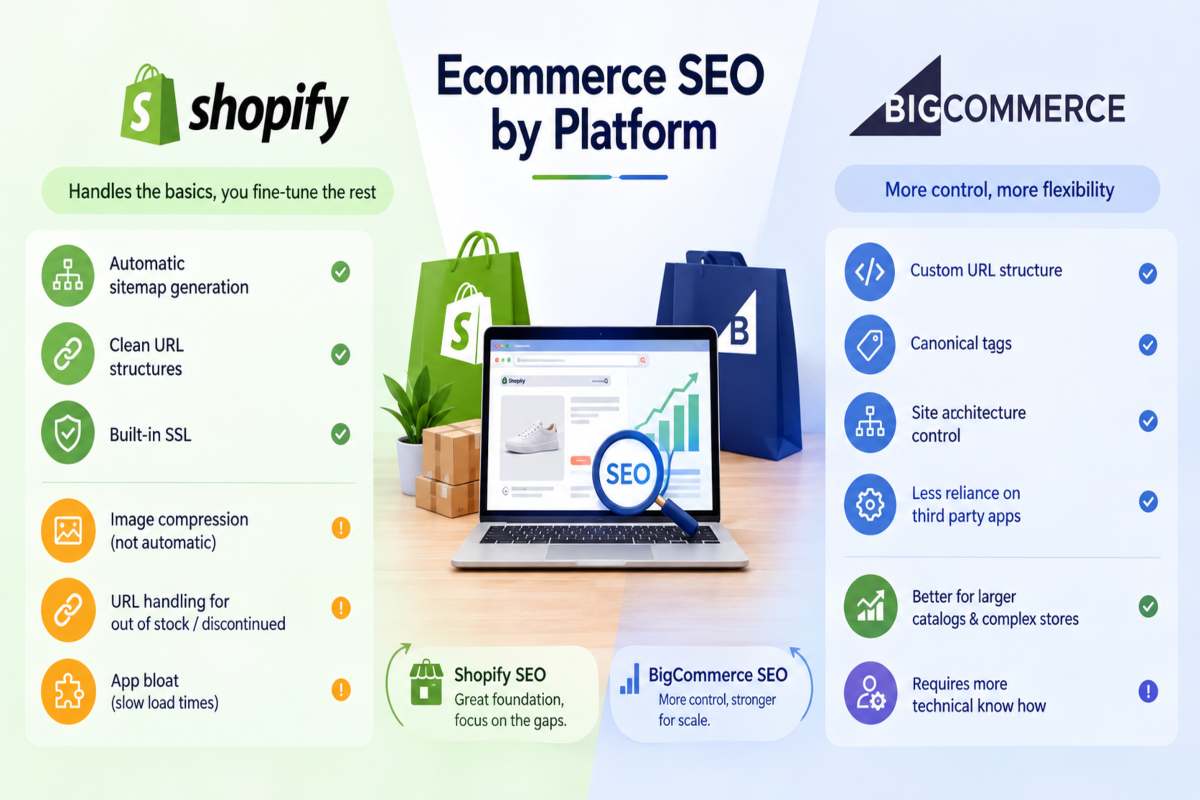
The platform an online store runs on shapes how much SEO work is needed and how much is handled automatically. Shopify and BigCommerce are two of the most widely used platforms and while both support strong search performance, they differ in flexibility, default configuration and where store owners need to intervene manually.
Shopify SEO
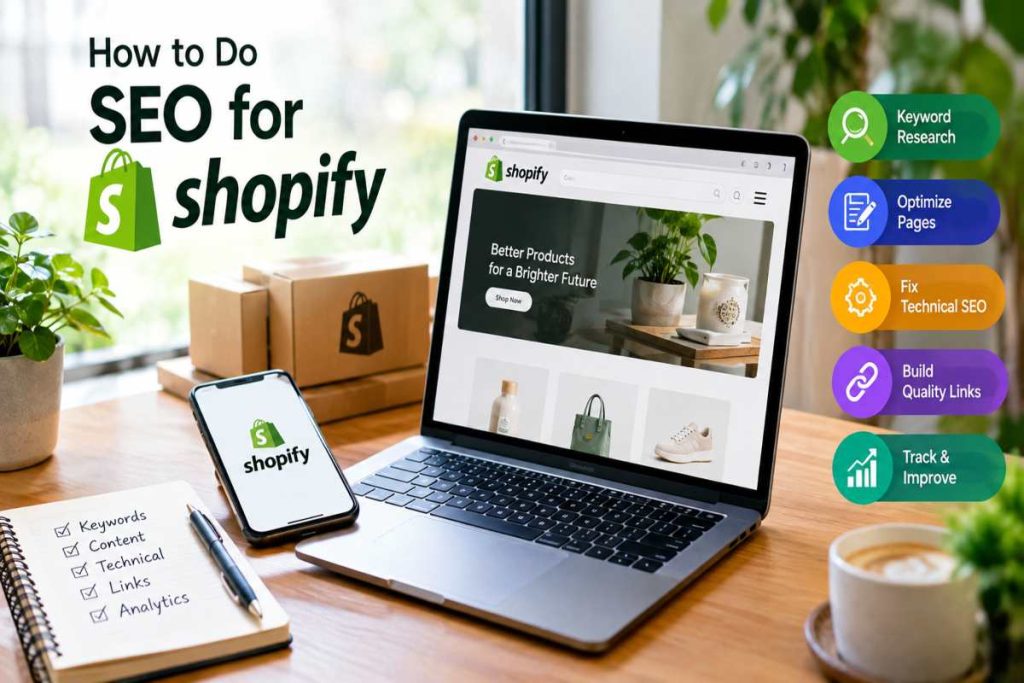
Shopify handles much of the SEO groundwork out of the box, automatic sitemap generation, clean URL structures and built in SSL are standard on every store. Where Shopify SEO requires more hands on attention is in areas the platform does not fully automate, image compression, since Shopify does not natively optimize large product images for speed, URL handling for out of stock or discontinued products, which can create orphaned pages if not redirected properly, and app bloat, where too many third party apps slow page load times and hurt both rankings and conversions.
Stores that invest in dedicated Shopify SEO Services typically focus on these gaps rather than the basics Shopify already covers, since that is where the real ranking differences show up between similar stores on the same platform.
BigCommerce SEO
BigCommerce takes a more open approach, giving store owners deeper control over technical elements like URL structure, canonical tags and site architecture without relying as heavily on third party apps.
This flexibility tends to benefit larger catalogs and stores with complex category structures, since more SEO configuration can be handled natively rather than bolted on. The trade off is that BigCommerce added control requires more technical know how to use well, stores that configure it properly often see it reflected in performance, with BigCommerce merchants averaging conversion rates around 2.5%, above the 1–2% typical across the wider ecommerce industry.
Choosing the Best Platform for SEO
There is no universally “best” platform for SEO, the right choice depends on catalog size, technical resources and how much manual control a team wants over site structure. Shopify tends to suit smaller to mid sized stores that want strong defaults with minimal technical maintenance, while BigCommerce often fits larger or more complex catalogs where deeper technical customization pays off. In either case, the platform sets the starting point, but consistent execution on keyword targeting, content and technical SEO is what actually determines whether a store outranks its competitors.
Ecommerce SEO Best Practices and Tips
Getting ecommerce SEO right comes down to consistent execution across every page type, products, categories and the content connecting them, rather than any single fix. The stores that rank well tend to treat these best practices as ongoing maintenance, not a one time setup.
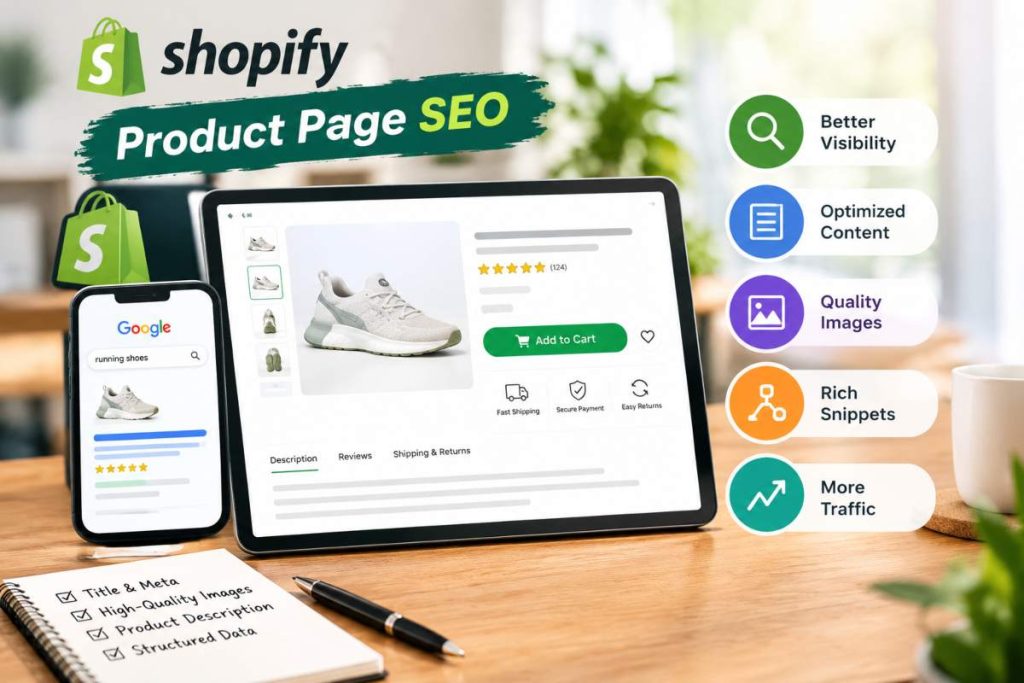
Product Page Optimization Checklist
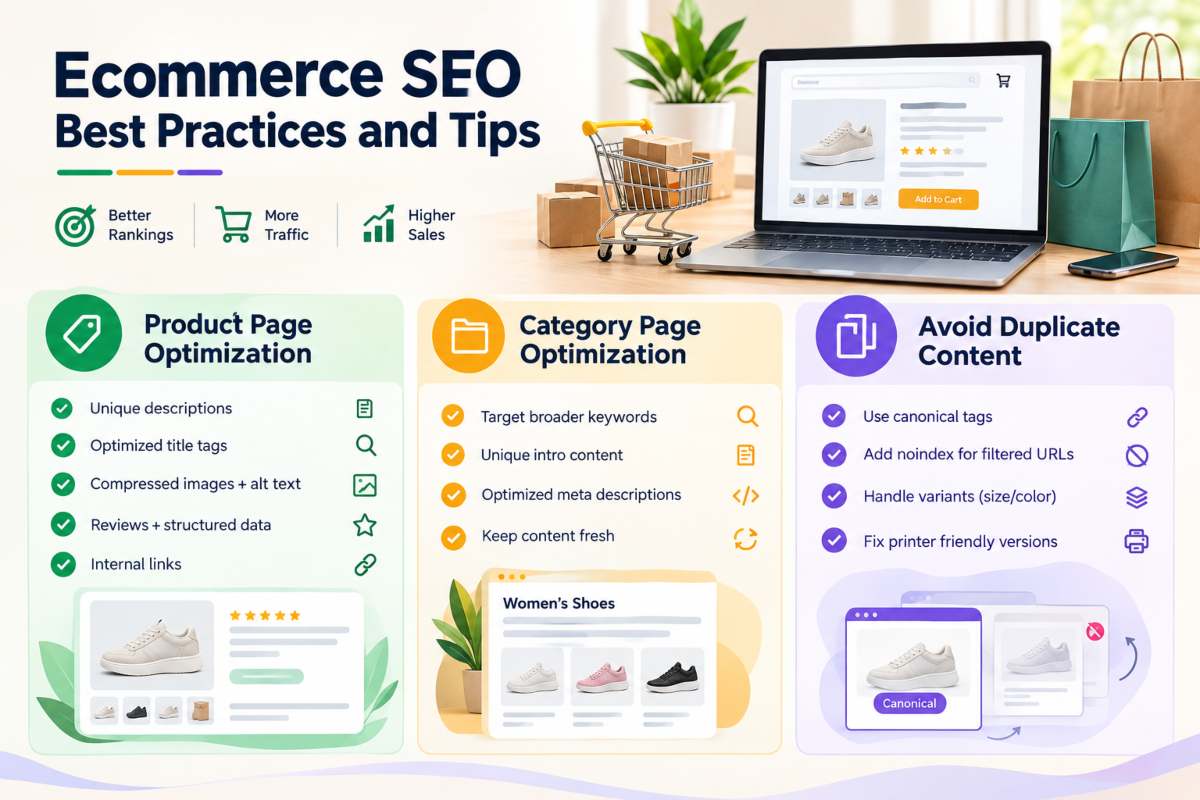
Product pages carry the most direct purchase intent on an ecommerce site, so they deserve the most granular optimization. A few elements make the biggest difference:
- Unique product descriptions written for the page, not copied from manufacturer feeds
- Descriptive, keyword relevant title tags that include the product name and key attributes (size, material, brand)
- Compressed, properly labeled images with descriptive alt text
- Customer reviews and structured data (schema markup) to support rich snippets in search results
- Clear internal links to related products and parent categories
Getting these right on even a handful of high traffic product pages often delivers a faster ranking lift than broader site wide changes.
Category Page Optimization
Category pages act as the connective tissue between broad search intent and specific products, which makes them some of the highest value pages on an ecommerce site to optimize. Unlike product pages, categories should target broader, higher volume keywords and include enough unique on page content, a short introductory paragraph, for example, to give search engines context beyond just a grid of products.
Category pages left as bare product listings, with no unique text and thin or duplicated meta descriptions, tend to underperform even when the products within them are well optimized individually. Regular Content Updates to category descriptions, especially as inventory and seasonal offerings shift, help these pages stay relevant to both shoppers and search engines over time.
Avoiding Duplicate Content in Ecommerce
Duplicate content is one of the most common technical issues on ecommerce sites, often created unintentionally through filtered URLs, printer friendly page versions or product variants (size, color) that generate separate but nearly identical pages. Left unaddressed, this can split ranking signals across multiple URLs instead of consolidating them onto one authoritative page.
Canonical tags are the standard fix, they tell search engines which page version should be treated as the primary one, alongside careful use of noindex tags on filtered or parameter based URLs that do not need to appear in search results. Getting this right matters more than it might seem, search engines that struggle to identify a page canonical version often rank none of the duplicates well, which quietly costs stores traffic they’d otherwise earn.
Best Tools for Ecommerce SEO
The right tools for ecommerce SEO depend less on budget and more on what stage a store is at, early stage sites often need different insights than established stores managing thousands of product pages. Both free and paid options can meaningfully improve visibility when matched to the right use case.
Free vs Paid Tools
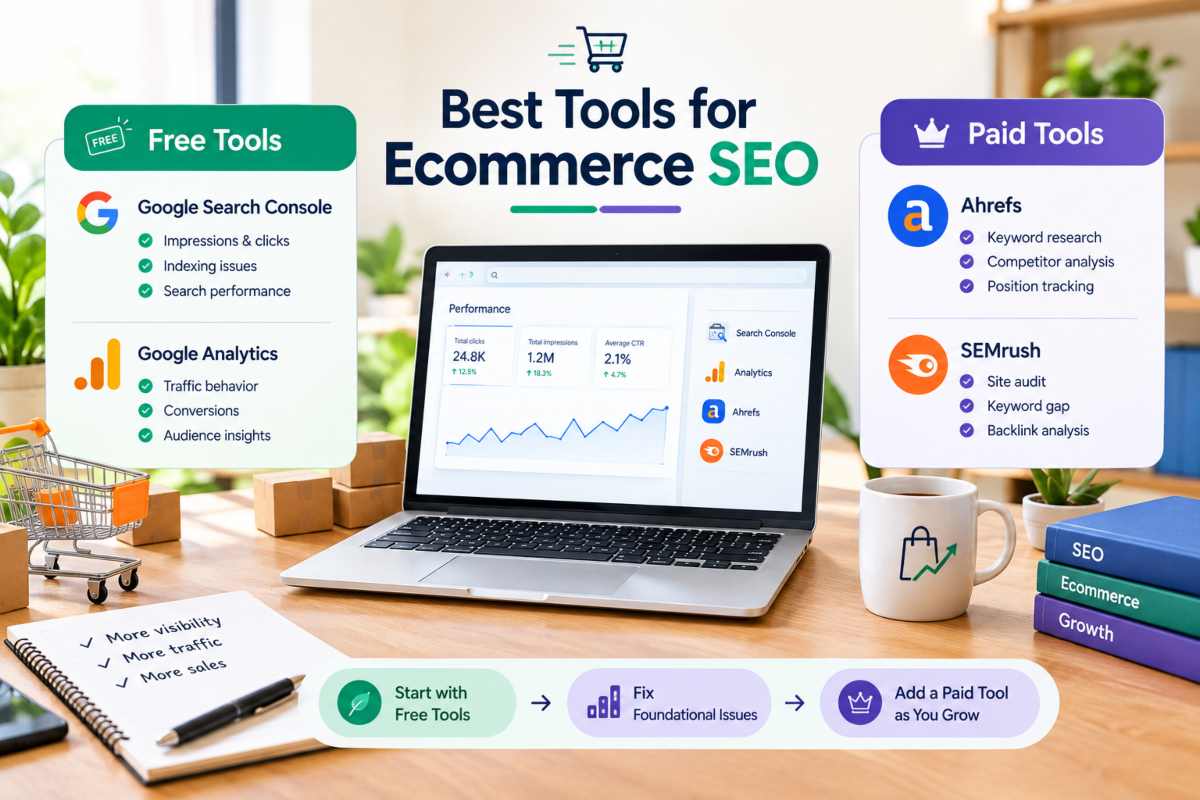
Free tools cover the essentials most stores need to get started. Google Search Console shows exactly which queries are already driving impressions and clicks, along with indexing issues that need fixing, while Google Analytics tracks how that traffic actually behaves once it lands on a page. These two alone are often enough to catch major technical problems and confirm whether SEO efforts are translating into real traffic.
Paid tools become more valuable as a store scales and competition increases. Platforms like Ahrefs and similar keyword research tools reveal what competitors are ranking for, surface content gaps and track keyword position changes over time, insight that’s difficult to get from free tools alone. This kind of competitive visibility matters because most ecommerce categories are crowded, research on organic rankings shows the average ecommerce brand ranks for over 1,700 keywords, which means understocked or newer stores are often competing against sites with years of established content and backlinks already in place.
For most stores, the practical approach is starting with free tools to fix foundational issues, then adding a paid tool once the site has enough pages and traffic to make competitive analysis worth the investment.
Retail and Online Store SEO
Retail SEO and online store SEO are essentially the same discipline as ecommerce SEO, applied under slightly different labels depending on the business type. Whether a company calls itself a “retailer,” an “online store,” or an “ecommerce brand,” the underlying goal is identical, ranking for the searches shoppers use to find and buy products.
The terminology differences usually come down to business model rather than technique. “Retail SEO” is often used by brands with both physical and online locations, where search visibility needs to support in store foot traffic alongside online sales, think “near me” searches and local listings alongside product pages. “Online store SEO” and “ecommerce SEO” tend to be used interchangeably for businesses operating purely online, with no physical retail presence to factor into the strategy.
In practice, though, the core work overlaps heavily, keyword targeting by page type, technical site health and content that matches buyer intent apply across all three labels.
What does shift depending on the model is priority. A retailer with physical stores may weight local search signals more heavily, while a purely online brand puts more emphasis on national or international keyword competition. In both cases, results depend less on which label a business uses and more on consistent execution over time, search rankings shift as competitors publish new content, update products and fix technical issues, which is why regular monitoring and reporting is what keeps a retail or online store SEO performance from quietly slipping as the market moves around it.
Conclusion
Ecommerce SEO is the ongoing work of aligning keyword targeting, on page content, technical structure and platform specific fixes so an online store earns lasting visibility rather than relying on a one time setup and it pays off because organic search still drives roughly 43% of all ecommerce traffic, more than any other channel. Getting there takes consistent execution, mapping the right keywords to the right pages, keeping product and category content strong, fixing technical issues that block crawling and monitoring rankings as the competitive landscape shifts.
For store owners who’d rather focus on running the business than tracking every algorithm update, working with a team that handles this end to end is often the more sustainable path, which is the kind of ongoing support IT Leadz provides for ecommerce brands looking to turn organic search into a dependable, long term sales channel.
Frequently Asked Questions (FAQs)
What is ecommerce SEO in simple terms?
Ecommerce SEO is the method of optimizing online store pages so they rank higher in search results and attract shoppers without paid ads. It covers keywords, page content and technical site health working together.
How is ecommerce SEO different from regular SEO?
Ecommerce SEO focuses heavily on product and category pages, which need to handle large volumes of similar items without creating duplicate content. It also deals with unique challenges like faceted navigation and out of stock URLs that standard SEO rarely encounters.
How long does ecommerce SEO take to show results?
Most stores see initial movement in rankings within 3 to 6 months, with more powerful results building over 6 to 12 months. Timelines vary based on site age, competition and how much technical work is needed upfront.
Which ecommerce platform is best for SEO?
There is no single best platform, Shopify suits stores wanting strong defaults with less technical upkeep, while BigCommerce offers deeper native control for larger, more complex catalogs. The right choice depends on catalog size and available technical resources.
What are the most important on page SEO factors for product pages?
Unique product descriptions, keyword relevant title tags, compressed images with alt text and customer reviews or schema markup all matter most. Together, these help both search engines and shoppers understand and trust the page.