How to do answer engine optimization comes down to one core discipline, structuring your content so AI engines like ChatGPT, Perplexity and Google AI Overviews can extract, trust and cite it as a direct answer. It’s not a single tactic but a five-step process, answer-first formatting, entity clarity, schema implementation, citation-worthy authority building and ongoing tracking, applied consistently across your highest-value content.
This matters more than most businesses realize. Companies that implement AEO effectively see roughly 27% of their AI-driven traffic convert into leads, a conversion rate that outpaces much of traditional organic search. That gap exists because AI engines don’t return ten competing links for a user to sort through, they select two to five sources, synthesize them into a single answer and move on.
Getting selected as one of those sources is the entire goal of AI Optimization and AEO is the specific discipline within it focused on earning that direct-answer placement. If your content isn’t structured to be that source, you’re invisible in a growing share of searches, regardless of how well you rank on a traditional results page. The framework below breaks that process into five actionable steps, starting with how to structure content so it’s extractable in the first place.
What Doing AEO Actually Means
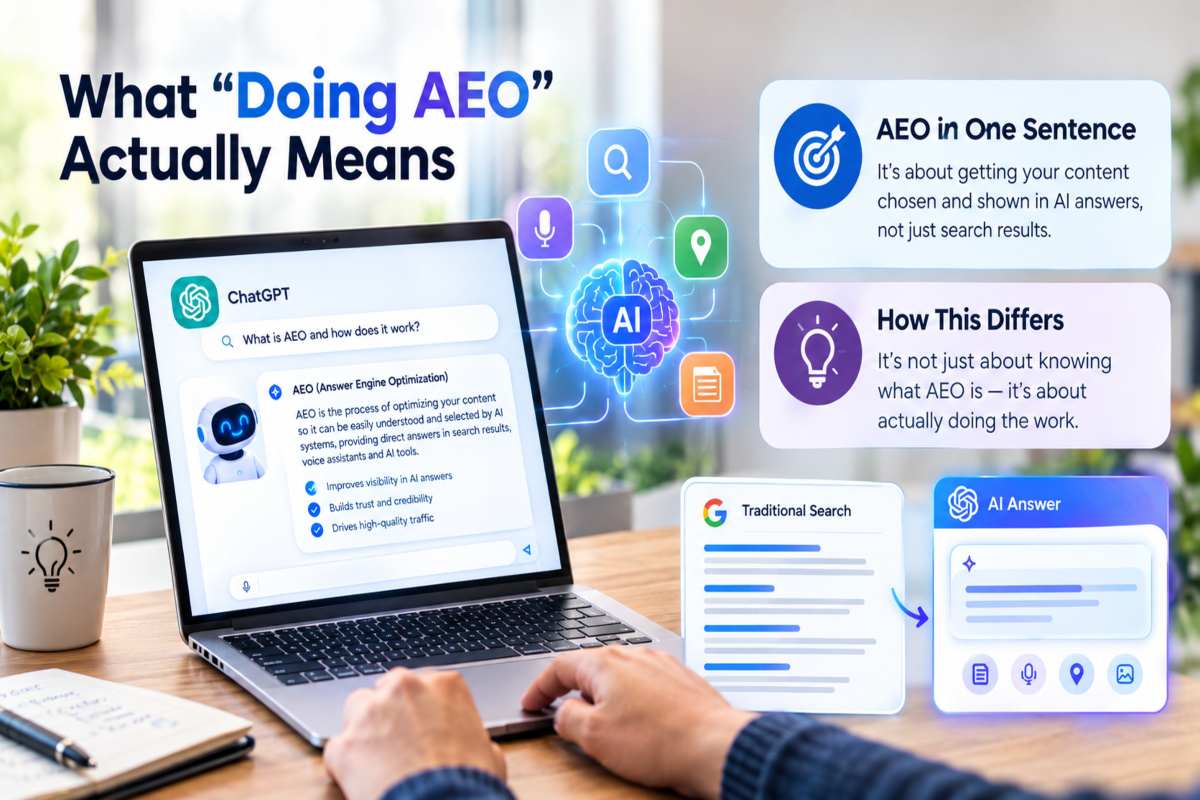
AEO in One Sentence
Doing answer engine optimization means structuring, formatting and technically marking up your content so AI systems can lift a specific answer from it with confidence, not just crawl and index it the way traditional search does. Where SEO earns a ranking position, AEO earns a citation slot inside the answer itself.
How This Differs From Just Knowing What AEO Is
Understanding the concept and executing it are two different skill sets and most businesses stall at the first one. Knowing that AI engines prefer answer-first content is not the same as rewriting your existing pages so every section leads with a direct 40–60 word answer, carries the right schema and reinforces a consistent entity across your site.
If you are still working through the foundational definitions, how AEO relates to GEO and LLMO or why Google AI Overviews behave differently from a normal search result, that groundwork is covered in what is AI Optimization. This section assumes that context and moves straight into execution: the five steps that turn an AEO-aware page into an AEO-optimized one.
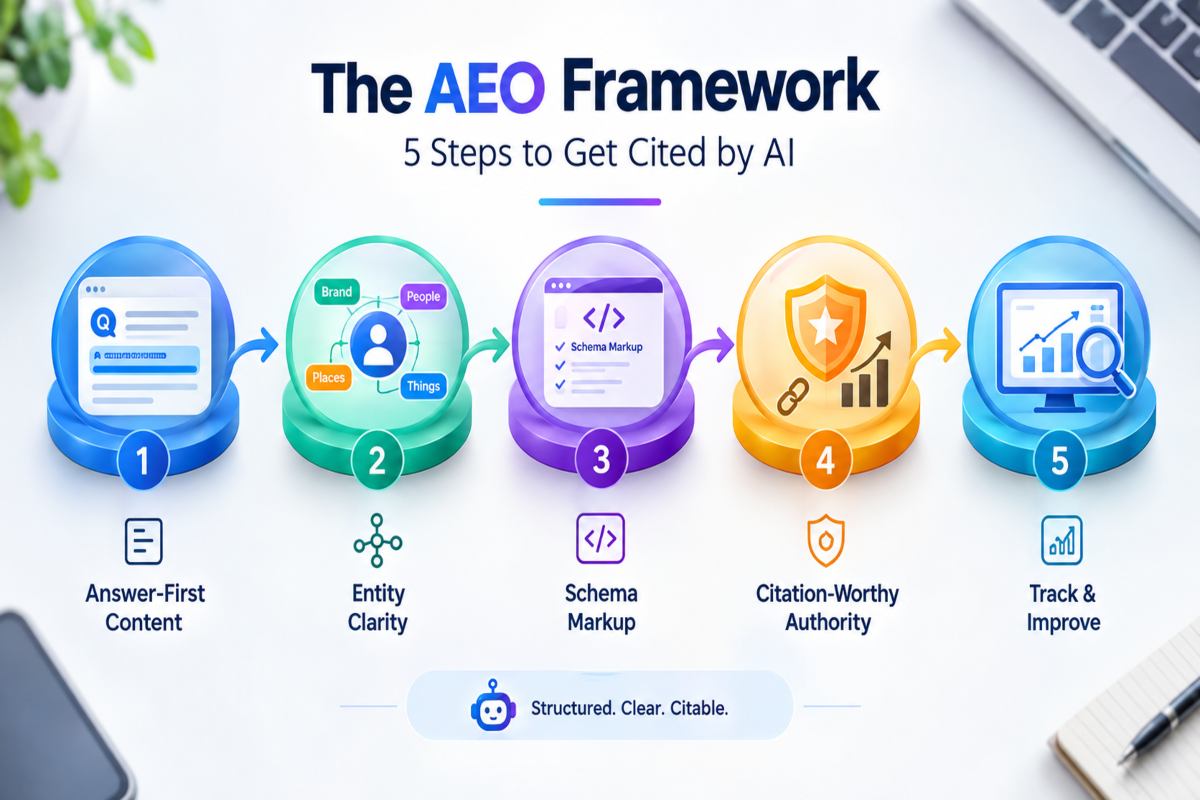
The AEO Framework 5 Steps to Get Cited by AI
Getting cited by AI engines is the result of five sequential steps working together, structuring content answer-first, establishing entity clarity, implementing schema markup, building citation-worthy authority and tracking whether it’s working. Skip one and the others lose most of their effect, a perfectly formatted answer with no schema behind it or clean schema wrapped around vague, unstructured prose, rarely earns a citation on its own.
Why a Framework, Not a Tactic List
Isolated AEO tactics tend to produce isolated, short-lived results, which is why treating this as a sequence matters more than treating it as a checklist to sample from. AI engines evaluate content the way they were trained to, they look for structural clarity, then verify the entity behind it, then check whether the technical markup confirms what the prose claims and only then weigh whether the source is trustworthy enough to cite repeatedly.
A page that nails formatting but skips schema is asking an AI system to infer structure it could have been told directly and inference introduces the kind of ambiguity that AI engines tend to route around in favor of a clearer competing source. This sequencing also explains a data point worth keeping in mind, AI and search engines are projected to consume more than a third of all web content by 2026 and businesses without a structured, end-to-end approach are the ones most likely to be excluded from that share.
Executing all five steps correctly and consistently is exactly what IT LEADZ’s AEO Services are built to handle for businesses that don’t have the internal bandwidth to run this framework in-house. The five steps that make up this framework are covered in order below, starting with the one every AI engine checks first, whether your content is structured to answer a question directly.
Step 1 Structure Content Answer-First
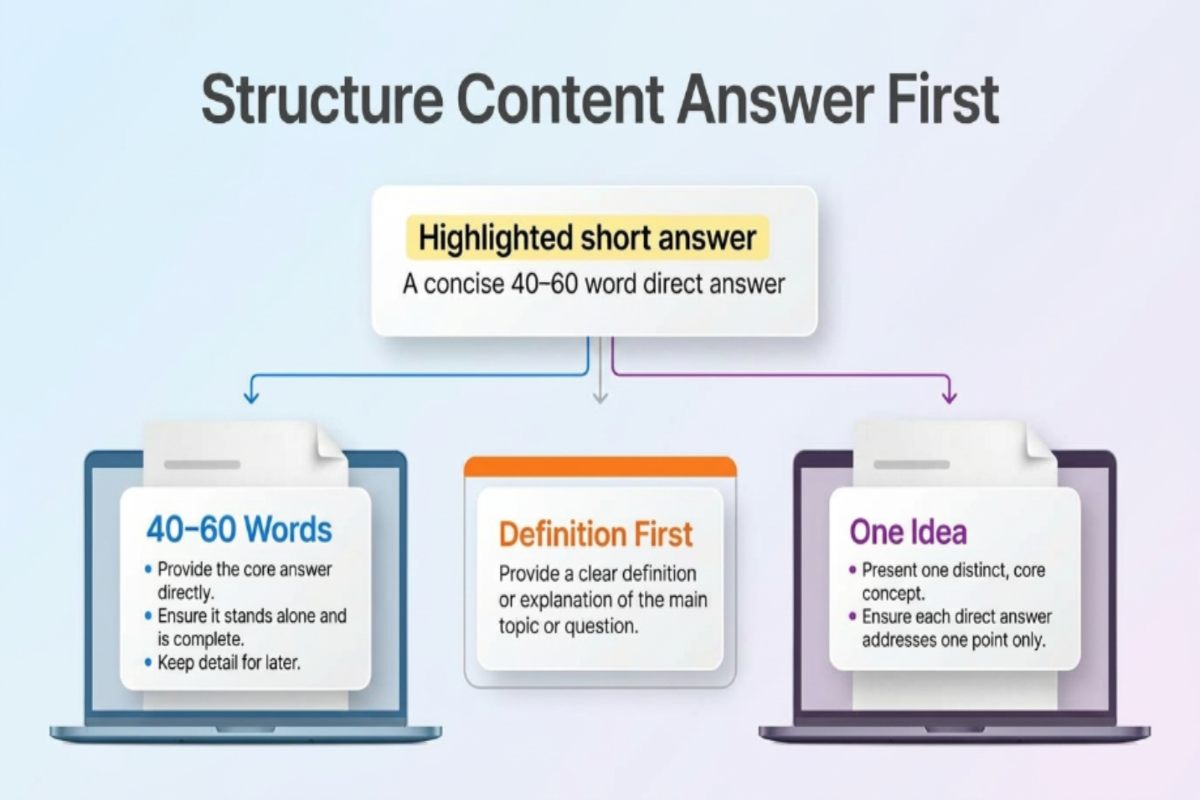
Structuring content answer-first means giving the AI system the answer it’s looking for within the opening sentences of a section, before any context, backstory or supporting detail. This is the single highest-leverage step in the AEO framework because it’s the first thing every AI engine checks before deciding whether a page is worth citing at all.
The 40–60 Word Direct Answer Format
The most reliable pattern for an extractable answer is 40 to 60 words, long enough to fully address the question, short enough for an AI engine to lift as a self-contained response without needing to trim or paraphrase it.
Content written this way tends to get cited more consistently than longer, meandering explanations, because AI models are trained to prefer answers that don’t require interpretation to reuse. This doesn’t mean every sentence on the page has to be clipped, it means each section’s opening answer should hit that window before the deeper explanation follows.
Leading Each Section With a Definition
Every section should open the same way a good FAQ answer does, with a direct definition or answer to the question implied by its heading, not a lead-in sentence that delays the point. AI engines are trained to summarize the way this structure already reads, so a section that opens with “X is…” or “The way to do Y is…” mirrors that summarization pattern far more closely than one that opens with scene-setting or a rhetorical question. Supporting detail, examples and nuance can follow, but the definition has to come first.
One Idea Per Section (No Blended Topics)
Each section needs to stand on its own as a complete, self-contained answer, because AI engines extract passages individually rather than reading a page start to finish. A section that blends two ideas, say, a definition mixed with a comparison to a different concept, forces the AI system to either extract an incomplete answer or skip the section entirely in favor of a competitor’s cleaner one. Keeping one idea per section, with its own heading and its own direct answer, is what makes a page extractable at the passage level instead of only at the page level.
Step 2 Build Entity and Topic Clarity
Building entity and topic clarity means making sure AI systems can identify exactly who you are, what you do and how you relate to the subject you’re writing about, without ambiguity. This matters because AI engines don’t just match keywords anymore, they evaluate whether a source is a recognized, consistent entity before deciding whether it’s trustworthy enough to cite.

What “Entities” Mean to AI Search Engines
An entity is any real-world object an AI system can identify and reason about, a person, a company, a product or a concept, rather than just a string of text. AI search engines increasingly understand queries this way, connecting a search for “customer relationship management” to the specific brands, people and products already associated with that concept across the web. A page that clearly establishes its entity, what the business is, what it specializes in, how it relates to the topic at hand, gives an AI system something concrete to attach the content to, rather than forcing it to guess from context alone.
Keeping Brand Naming Consistent Across the Web
AI systems build confidence in an entity by cross-referencing how consistently it is named and described across multiple sources, so a brand that is called three different things across its own website, social profiles and third-party mentions makes that verification harder than it needs to be.
Using the same name, the same core description and the same positioning everywhere it appears, from the site’s About page to its social bios to any directory listings, reinforces that this is one recognizable entity rather than several loosely related ones. This consistency compounds over time, since every accurate, matching mention strengthens the connection an AI system draws between the brand and the topic it wants to be known for.
Building Topical Authority Around Your Core Subject
Topical authority comes from covering a subject comprehensively across multiple connected pages rather than publishing a single isolated article and hoping it’s enough. AI systems tend to favor sources that address a query fully and repeatedly over ones that mention it once in passing, since consistent, in-depth coverage signals that a site is a reliable reference for that specific topic rather than a one-off match.
This is also where AEO and SEO share the same underlying principle, a site with genuine topical depth outperforms a thin one in both traditional rankings and AI citations, because both systems are ultimately measuring the same thing, how well a source actually knows its subject.
Step 3 Implement Schema and Structured Data
Implementing schema means adding structured data markup to a page so AI systems can confirm, programmatically, what the prose is already telling them, the content type, the question it answers and how it is organized. This step doesn’t replace answer-first writing, it verifies it, which is why pages with strong prose but no schema still get passed over in favor of ones that back up their structure with explicit markup.

FAQ Schema vs HowTo Schema vs Article Schema
FAQ schema marks up question-and-answer pairs and works best for sections structured around direct queries, while HowTo schema is built for sequential, step-based processes like the framework in this guide. Article schema, by contrast, identifies the page itself, its author, publish date and topic, giving AI systems the baseline context needed to evaluate everything else on the page. Most AEO-optimized pages use more than one of these together, Article schema for the page as a whole, then FAQ or HowTo schema layered onto the specific sections that match those formats.
Which Schema AI Engines Actually Prioritize
AI engines lean most heavily on FAQ and HowTo schema because those formats map directly onto how questions get asked in conversational search, a user asking “how do I do X” is functionally querying for HowTo-marked content and one asking a direct question is querying for FAQ-marked content.
Article schema still matters, but mainly as supporting context rather than the primary signal an AI system uses to decide what to extract. This is one of the more technical layers of AEO and it’s the area where a dedicated AIO Services engagement tends to add the most value, getting schema implementation right across an entire site, not just one page, requires ongoing technical maintenance most in-house teams don’t have bandwidth for.
Common Schema Mistakes That Block Citations
The most frequent schema mistake is markup that doesn’t match the visible content, FAQ schema wrapped around a paragraph that isn’t actually structured as a question and answer or HowTo schema applied to a process that isn’t genuinely sequential. AI systems that detect this mismatch tend to discount the page’s schema entirely rather than partially trust it, which erases the advantage schema was supposed to provide.
Outdated or incomplete markup causes a similar problem, schema that references fields no longer supported or that’s missing required properties, gets treated as unreliable and is often ignored in favor of a cleaner, fully-validated competitor page.
Step 4 Earn Citations From AI Engines
Earning citations from AI engines means becoming one of the small number of sources an AI system selects to build its answer from, rather than one of many pages it crawled and passed over. This is the step where the first three, structure, entity clarity and schema, actually get tested, because citation is the outcome all of them were built to produce.

Why AI Engines Only Cite 2–5 Sources Per Answer
AI engines synthesize a single response from a narrow set of sources instead of surfacing a full page of competing links, typically pulling from two to five sources per answer. This narrow selection is what makes citation more valuable than a traditional ranking position, a page ranked fifth or sixth can still be cited if its content is clearer and better structured than what is sitting above it, but a page that is not selected at all gets zero visibility regardless of how it would have ranked traditionally. That scarcity is also why the earlier steps compound, a source with better structure, clearer entity signals and validated schema is simply easier for an AI system to justify including in that short list.
Content Freshness and Update Frequency Signals
AI systems weigh how current a page’s information is more heavily than traditional search does, since answers built on outdated data risk misinforming the user directly rather than just ranking poorly. A page that is updated regularly, with statistics and claims kept current, signals that it can be trusted repeatedly rather than cited once and then dropped once the information ages.
This is part of why AEO is described as an ongoing process rather than a one-time optimization, a page that earned a citation six months ago can lose it if a fresher, equally well-structured competitor takes its place.
How ChatGPT, Perplexity and Google AI Overviews Select Sources
Each platform applies its own weighting, but the underlying selection logic is similar across ChatGPT, Perplexity and Google AI Overviews, structural clarity first, entity and topical trust second and freshness or recency as a tiebreaker among otherwise-comparable sources.
The specific mechanics of how each platform triggers and selects for AI-generated answers are covered in more depth in How to Rank on AI Search Engines, which walks through the platform-level differences this section only summarizes. Understanding those differences matters because a page optimized purely for one platform’s preferences can underperform on another, the five-step framework here is designed to satisfy all three at once rather than favor a single engine.
Step 5 Track Whether You are Being Cited
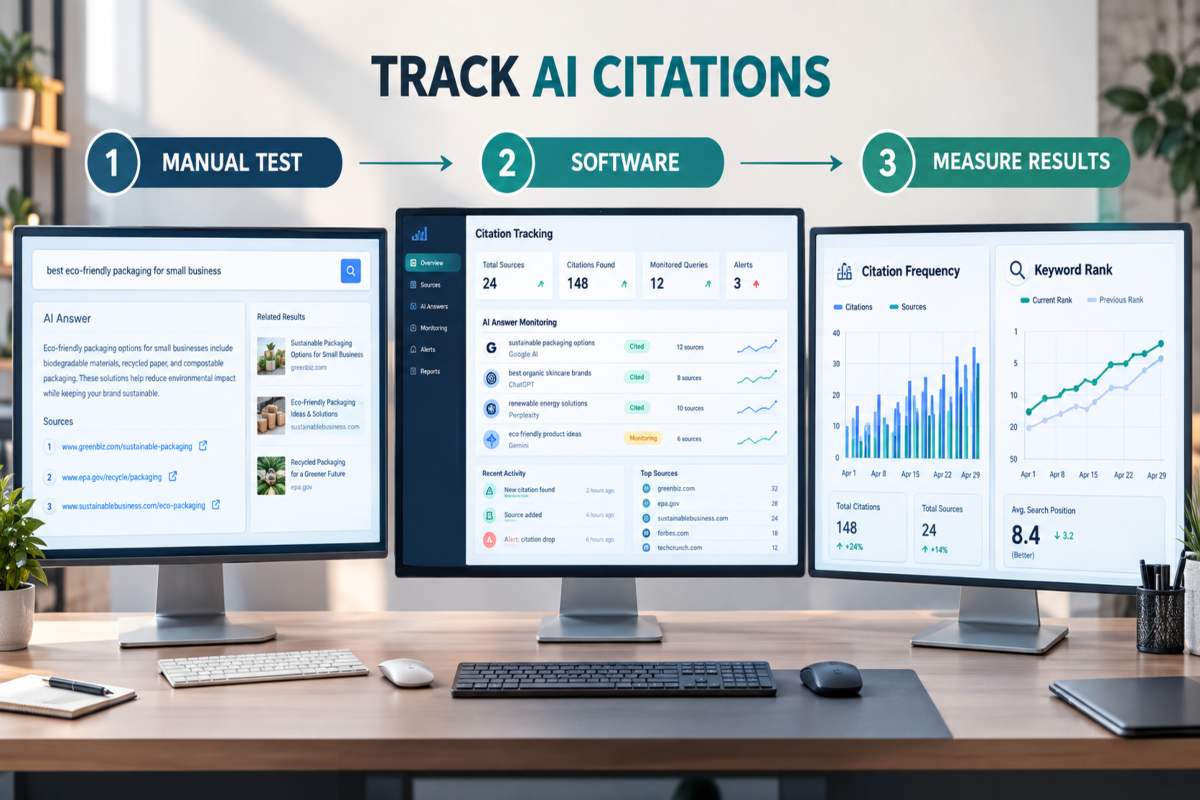
Tracking whether you’re being cited means checking, systematically, if AI engines are actually pulling your content into their answers, not assuming the first four steps worked because the page reads well. This is the step most businesses skip and skipping it is why so many AEO efforts stall without anyone realizing why.
Manual Prompt-Testing Method
The simplest way to check citation performance is to ask the exact questions your target content is meant to answer directly inside ChatGPT, Perplexity or Google AI Overviews, then check whether your site appears among the sources cited.
This costs nothing beyond time and works well for a small set of priority pages, though it doesn’t scale well across dozens of queries or track changes over time without manual repetition. Running this test on a fixed schedule, weekly or biweekly for a page’s core target questions, is enough to catch whether a citation gained after publishing is holding or fading.
AI Citation Tracking Tools
Once the number of pages or target queries grows past what manual testing can reasonably cover, dedicated AI citation tracking software becomes worth the investment, since these tools automate prompt testing across platforms and log results over time instead of requiring repeated manual checks.
The right time to adopt one is usually when a business has more than a handful of AEO-optimized pages to monitor or when comparing citation performance against named competitors becomes a regular part of the strategy rather than an occasional check. Software also tends to surface patterns manual testing misses, like which competing sources consistently appear alongside yours in the same answers.
Metrics That Matter Citation Frequency vs Keyword Rank
Citation frequency, how often and how consistently a page gets pulled into AI-generated answers, matters more in AEO than traditional keyword rank position, because a page can be cited reliably without ever holding a top-three ranking on a conventional results page.
Businesses that shift their measurement toward citation frequency, answer composition (which sources appear alongside them) and sentiment trends in how they’re described tend to get a clearer picture of AEO performance than keyword rank trackers alone provide. This distinction matters enough that treating keyword rank as the primary success metric for an AEO page is, by itself, a common reason businesses underestimate how well their AEO efforts are actually working.
AEO Checklist All 5 Steps at a Glance
This checklist condenses the full AEO framework into a single reference for teams implementing it across multiple pages, without needing to re-read each section in full. Use it as a pass/fail audit for any page you’re optimizing for AI citation.
Downloadable/Printable Summary
- Structure Every section opens with a 40–60 word direct answer before supporting detail follows
- Format Each section covers one idea only, no blended topics within a single heading
- Entity Brand name, description and positioning are consistent across the page and the wider web
- Authority The subject is covered comprehensively across connected pages, not in a single isolated article
- Schema Article schema applied site-wide, with FAQ or HowTo schema layered onto matching sections
- Validation Schema markup matches the visible content exactly, no mismatched or outdated fields
- Freshness Statistics and claims are current, with a defined update cadence
- Tracking Target queries are prompt-tested on a fixed schedule, manually or via tracking software
- Metric Citation frequency is the primary success measure, keyword rank is secondary
A page that passes all nine checks is genuinely AEO-optimized, a page that passes only the structural checks but skips schema, tracking or freshness is still AEO-aware, not AEO-complete, the distinction that separates a citation gained once from one held consistently.
Common AEO Mistakes That Kill Citation Chances
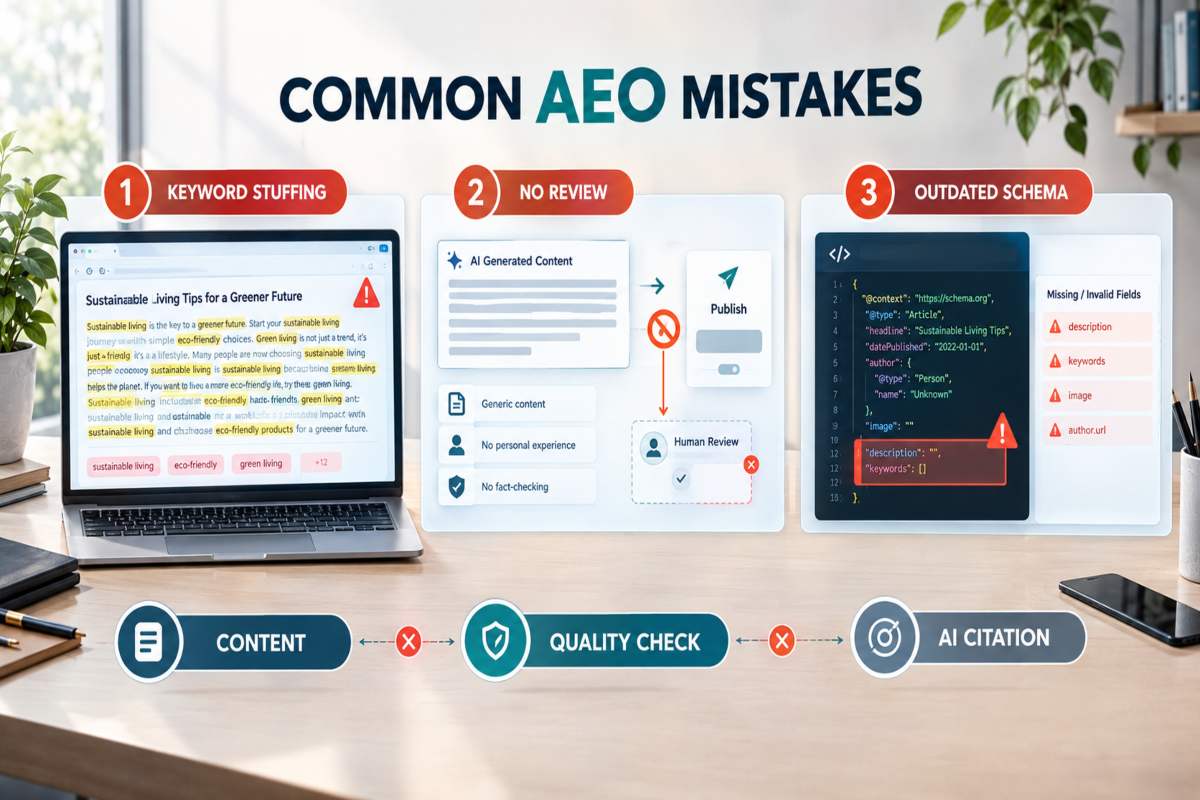
The most common AEO mistakes are the ones that undo the five-step framework after it’s already been implemented, over-optimizing for keywords instead of structure, publishing unreviewed AI-generated content and shipping incomplete schema. Each of these quietly suppresses citation eligibility even on a page that otherwise looks AEO-ready.
Over Optimizing for Keywords Instead of Structure
AI engines interpret meaning and context rather than matching keyword density, so a page stuffed with repeated target phrases doesn’t perform better in AI citations the way it might have on a legacy search algorithm, it just reads worse to both the AI system and the human eventually reading the answer.
Content structure, clarity and topic boundaries carry more weight than keyword repetition in how answer engines evaluate a page, which means a business still chasing keyword density as its primary optimization lever is solving the wrong problem. The fix isn’t dropping keywords entirely, it’s making sure they appear naturally within already well-structured, answer-first sections rather than being forced in as a separate pass.
Publishing AI Generated Text Without Human Review
Publishing AI-generated content without human refinement is a frequent and costly mistake, since unreviewed output tends to blend multiple ideas per section, bury the direct answer under generic framing or state claims with false confidence, all of which reduce both credibility and citation eligibility.
AI systems are specifically trained to favor content that reads as precise and confidently accurate and unreviewed AI text often fails that bar in ways that aren’t obvious on a quick skim. Human review isn’t optional polish here; it’s the step that catches the structural and factual gaps an AI-generated draft is statistically likely to contain.
Outdated or Incomplete Schema
Incomplete or incorrect schema markup confuses the systems it was meant to help and regular audits are necessary to prevent that outdated markup from actively weakening a page authority rather than just failing to help it. A page with a schema that once matched its content but has since drifted out of sync, after a content update that wasn’t reflected in the markup, for example, often performs worse than a page with no schema at all, because the mismatch signals unreliability rather than simple absence of structure. This is one of the more overlooked reasons a well-structured page still gets passed over for citation and it’s a common gap GEO Services engagements are built to catch through ongoing schema audits rather than a one-time setup.
Conclusion
Doing answer engine optimization isn’t a single fix, it’s the disciplined application of five connected steps, answer-first structure, entity clarity, schema implementation, citation-earning authority and consistent tracking, applied together rather than sampled individually. Businesses that treat this as a checklist to skim rarely see it work, while those that run the full framework put themselves in the narrow set of sources AI engines actually cite, capturing a share of discovery that’s only growing as more search behavior shifts toward direct AI answers. If building and maintaining that framework across an entire site isn’t something your team has the bandwidth for in-house, IT LEADZ specializes in exactly this kind of AI optimization work, from initial structure and schema through the ongoing tracking that keeps citations from fading over time.
Frequently Asked Questions (FAQs)
Is AEO the Same as GEO?
Not quite, though they are closely related. AEO focuses on structuring content to be directly extracted as an answer, think featured snippets and voice responses, while GEO focuses on getting cited inside AI-generated summaries like Google’s AI Overviews. Most businesses need both, since the underlying techniques overlap heavily.
How Long Does AEO Take to Show Results?
Early signals, like improved structure being picked up by AI crawlers, tend to appear within a few weeks. Consistent citation inside AI Overviews or chatbot answers typically takes a few months of sustained, ongoing effort.
Do I Need AEO If I Already Do SEO?
Yes, AEO builds on SEO rather than replacing it, since strong on-page and technical SEO remain the foundation AI systems rely on to find your content at all. Skipping AEO means missing the growing share of searches that never produce a traditional ranked result.
Can One Page Realistically Rank for Multiple AEO Keywords?
Yes, when the keywords share the same core intent and can be answered within one well-structured, semantically connected page. Keywords that require genuinely different answers or intents still need their own dedicated pages to avoid cannibalization.