A SaaS digital marketing agency is a specialist team that plans and runs digital marketing for software as a service companies, covering SEO, paid media, content and email. It measures success by pipeline, trial to paid conversion and recurring revenue rather than clicks, helping B2B SaaS brands win demos, subscribers and long term customers.
Unlike a general agency, a SaaS specialist understands subscription economics such as customer acquisition cost, lifetime value and churn. It also knows how to market to long buying cycles where several stakeholders sign off and how to earn visibility in AI generated answers as well as traditional search results. This guide explains what these agencies do, how they differ from generalists, what they cost in the US and UK and how to choose the right one.
What Is a SaaS Digital Marketing Agency?
A SaaS digital marketing agency is a marketing partner that focuses on software as a service businesses and builds campaigns around the subscription model. Its work covers search, content, paid media, email and conversion optimization, all aimed at turning strangers into trials, demos and long term paying customers. The difference from other agencies is the goal. A SaaS specialist is judged on recurring revenue and customer retention, not on traffic, impressions or one off sales.
How a SaaS agency differs from a general digital marketing agency
A SaaS agency differs from a general one mainly in what it optimizes for and how well it understands the product being sold. A generalist might celebrate a surge in website visitors or a low cost per click. A SaaS specialist asks whether those visitors start trials, whether the trials convert and whether the customers stay long enough to repay the cost of winning them.
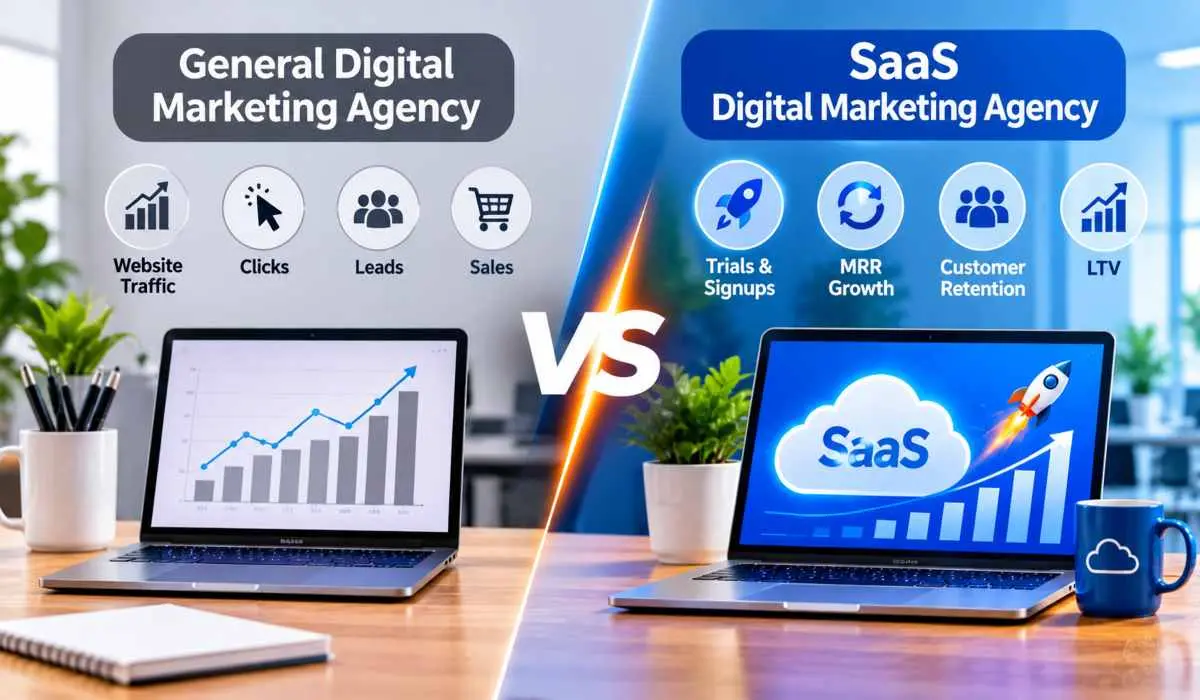
The specialist also adapts to how software gets bought. B2B SaaS purchases usually involve several people, from the end user who wants the tool to the finance lead who approves the budget and the decision can take months. That calls for content aimed at each stage and each stakeholder, such as comparison pages, integration guides, use case content and proof from similar companies. A general agency used to quick, single decision purchases often builds campaigns that fill the top of the funnel while the pipeline stays thin.
The third difference is channel judgment. Software buyers research heavily before they ever speak to sales and more of that research now happens inside AI generated answers. A SaaS focused team plans for both traditional rankings and visibility in those answers. Smaller companies weighing this choice can also see how specialist support works in practice in our guide to a digital marketing agency for startups.
SaaS specific metrics they own
A SaaS digital marketing agency is accountable for a defined set of subscription metrics and each one links marketing activity to revenue.
Customer acquisition cost (CAC) is the total sales and marketing spend needed to win one new customer. Lifetime value (LTV) is the revenue a typical customer is expected to generate before they leave. Comparing the two is the core health check of a subscription business and a ratio of roughly 3:1 (three dollars of lifetime value for every dollar spent acquiring the customer) is a widely used benchmark. A much lower ratio suggests growth is costing too much, while a much higher one can mean the company is underinvesting in growth.
Monthly recurring revenue (MRR) tracks the predictable revenue the business earns each month, so an agency uses it to show whether campaigns add durable income rather than one time sales. Churn measures the share of customers or revenue lost over a period. Marketing influences it more than many teams expect, because attracting the wrong audience leads to cancellations later. Pipeline is the value of qualified opportunities in progress and it is the figure most agencies should report against rather than raw lead counts. Trial to paid conversion shows how many free trial or freemium users become paying customers, which reveals whether the traffic being generated is actually the right audience.
A good agency reports these figures together, not in isolation, so you can see which channels bring customers who stay and which only bring sign ups.
Who needs one startups, scale ups and mid market B2B SaaS
SaaS companies need a specialist agency when growth depends on marketing skills they cannot yet hire or manage in house. The need looks different at each stage.
Early stage startups usually benefit most from a lean, focused partner. Founders at this stage are often juggling product, hiring and fundraising and they need a clear acquisition channel, a message that fits the market and a site that converts, without the overhead of a full marketing department.
Scale ups tend to need depth and speed. Once a company has proven demand, the challenge becomes expanding across channels, entering new regions such as the US and UK and raising output without letting efficiency slip. An agency can add capacity for SEO, paid media and content at the same time.
Mid-market B2B SaaS businesses often already have an in-house team but need specialist support in areas such as technical SEO, paid media management, conversion optimization or AI search visibility. Here the agency acts as an extension of the team, filling specific gaps rather than replacing it.
Companies that already have a mature, fully staffed marketing function with strong channel expertise usually gain less. For almost everyone else, a specialist can shorten the learning curve and help avoid expensive early mistakes.
What Does a Digital Marketing Agency for SaaS Companies Actually Do?
A digital marketing agency for SaaS companies runs the channels that bring software buyers from first search to paid subscription. That typically means SEO and content, paid media, lifecycle email, conversion optimization, AI search visibility and the analytics that connect each of them to revenue. The work is coordinated around one outcome: qualified pipeline and retained customers, not isolated channel wins.

SEO and content marketing for SaaS
SaaS SEO focuses on capturing buyers at the moment they are choosing a solution, not just readers browsing for general advice. Gartner research has found that B2B buyers spend only about 17% of the purchase journey meeting potential suppliers and far less with any single vendor, so most of the evaluation happens through content before sales is ever involved. An agency therefore prioritizes pages that support that research: comparison pages, “alternative to” pages, integration and use case pages and pricing explainers.
This is built on solid on page SEO, meaning clear page structure, intent matched copy, fast load times and clean technical foundations. It is reinforced by off page SEO, where relevant mentions and authoritative links signal credibility in a crowded category. Because SaaS products change quickly, strong agencies also keep published pages accurate through regular content updates, refreshing features, screenshots, pricing and statistics so rankings and trust do not slip.
Paid media PPC, LinkedIn and social ads
Paid media gives a SaaS company demand it can control and measure and an agency manages it with the full funnel in mind. Search campaigns capture people who are already looking for a solution, while LinkedIn is used to reach specific job titles, company sizes and industries, which suits B2B products with defined buyer roles. Retargeting on social platforms keeps the brand in front of visitors who read a page but did not start a trial.
The agency’s real value is in what it optimizes for. Instead of chasing cheap clicks, it tracks cost per qualified demo or trial and adjusts budgets toward the campaigns that produce customers who stay. Companies that want hands-on campaign management can explore dedicated PPC services and early stage teams with tight budgets often start with the focused approach described in our guide to a digital marketing agency for startups.
Email, lifecycle and product led growth marketing
Lifecycle email turns sign ups into active, paying users and keeps existing customers from leaving. An agency designs automated sequences around key moments in the customer journey: welcoming new trial users, guiding them to the feature that proves value, nudging them before a trial ends and re-engaging accounts that go quiet.
For product led growth models, where the product itself drives acquisition, this work is especially important because the product and the messaging have to support each other. Triggered emails based on in app behavior tend to outperform generic newsletters, since they respond to what the user has actually done. Businesses building these programs can look at professional email marketing services to see how sequences, segmentation and reporting fit together.
Conversion rate optimization and landing pages
Conversion rate optimization (CRO) increases the share of existing visitors who start a trial, book a demo or sign up, which usually lowers acquisition cost without needing more traffic. An agency reviews how visitors move through key pages, tests headlines, calls to action, form length and page layout and builds dedicated landing pages for each campaign so the message matches the ad or search that brought the visitor.
Good CRO also depends on a site that is fast, stable and flexible enough to test ideas. That is why agencies often support changes through website customization services and keep the site healthy with ongoing website maintenance, so a slow page or broken form does not quietly erase campaign results.
AI search visibility (AEO/GEO) getting cited in ChatGPT, Gemini and Google AI Overviews
AI search visibility is the practice of structuring a brand’s content and authority so that AI tools such as ChatGPT, Gemini and Google AI Overviews mention or cite it in their answers. This matters for SaaS because software buyers increasingly ask these tools for recommendations and comparisons before visiting any website.
An agency approaches this by writing clear, self contained answers to the questions buyers ask, using structured data, building consistent brand mentions across trusted sources and tracking where the brand appears in AI generated responses. It complements traditional SEO rather than replacing it, since the same quality signals tend to support both. Teams that want a dedicated program can learn more about AI Optimization.
Analytics, attribution and reporting
Analytics and attribution show which channels actually produce revenue, which is what allows an agency to justify and refine its work. This includes setting up tracking across the site and product, connecting marketing data to the CRM and using attribution models to understand how search, ads, email and content work together over a long sales cycle.
Reporting should be tied to business results such as pipeline, trial to paid conversion and customer acquisition cost, not vanity metrics. A reliable agency delivers this on a set rhythm and you can see how that looks in practice in our approach to regular monitoring and reporting. The goal is a clear view of what is working so the budget moves toward it quickly.
Why B2B SaaS Companies Hire a Specialist Agency
B2B SaaS companies hire a specialist agency because their buyers, sales cycles and revenue model are too different from ordinary marketing for a generalist approach to work well. A SaaS focused agency brings proven playbooks for complex buying decisions, ties its work to new subscription revenue and gives a company expert capacity quickly and more flexibly than making an in-house team from scratch.
Long sales cycles and multi stakeholder buying
A specialist agency is built to market through long sales cycles in which many people influence a single purchase. Gartner’s B2B buying research describes typical buying groups of six to ten decision makers, each doing their own research and each with different concerns. The end user wants a tool that fits their workflow, IT wants security and integrations, finance wants a clear return and an executive wants confidence in the vendor.
Reaching all of them takes a content and campaign plan that works across months rather than days. A SaaS agency maps the questions each stakeholder asks at each stage, then produces the assets that answer them, such as technical documentation, ROI explainers, comparison pages, case studies and security overviews. It also sets up nurture programs and retargeting that keep the brand present while the group deliberates. Without this planning, companies often generate interest from one person and lose the deal when the rest of the committee cannot find answers.
Driving net new SaaS revenue, not just traffic
A specialist agency measures success by new recurring revenue, which changes what it does day to day. Traffic is easy to buy and easy to report, but it says little about whether a subscription business is growing. A SaaS agency instead tracks how many visitors become qualified leads, how many leads become trials or demos and how many of those become paying customers who stay.
This focus shapes the decisions that matter most. Budget moves away from channels that produce sign ups with high cancellation rates and toward those that bring customers with strong lifetime value. Content targets the searches that signal buying intent rather than the broadest possible audience. Reporting connects marketing activity to pipeline and revenue, so leadership can see what each dollar or pound produced. For founders and CMOs answering to a board or investors, that clarity is often the deciding reason to bring in outside expertise.
Speed, expertise and avoiding in house hiring costs
An agency gives a SaaS company a full team of specialists immediately, without the time and expense of recruiting one. Building the same capability in house would mean hiring separate experts for SEO, paid media, content, email, analytics and conversion optimization, along with the salaries, benefits, tools and management time that come with each role. Hiring alone can take months and a single wrong hire in a small team is costly.
An agency spreads those costs across a retainer and brings experience from many comparable SaaS accounts, which shortens the learning curve and reduces trial and error. It also scales more easily. A company can increase paid media effort ahead of a product launch or shift focus to content and SEO in a quieter period, without changing headcount. That flexibility matters most for startups and scale ups, where priorities shift quickly and every hire has to justify itself.
The trade off is that an agency works best alongside clear internal ownership. Companies see the strongest results when someone on their side owns the relationship, shares product knowledge and acts quickly on feedback.
SaaS PPC Agency vs General Digital Marketing Agency
A SaaS PPC agency specializes in paid acquisition for software companies, while a general digital marketing agency covers many channels for many industries. A PPC specialist usually gets faster, sharper results from paid search and social, whereas a full service or integrated team is better when growth depends on SEO, content, email and paid media working together. The right choice depends on your stage, budget and where your funnel is weakest.
Specialist vs full service a side by side
The two models differ in depth, scope and what they are accountable for. A specialist goes deep on one channel, while a general agency spreads its effort across several and coordinates them.
| Factor | SaaS PPC specialist | General digital marketing agency |
| Core focus | Paid search, LinkedIn and social ads | SEO, content, paid, email, web and social |
| SaaS knowledge | Deep: trials, demos, CAC, payback period | Varies by agency, often broad, cross-industry |
| Channel depth | Very high in paid media | Moderate across many channels |
| Speed to results | Fast: campaigns can produce data within weeks | Slower where SEO and content are involved |
| Strategy scope | Acquisition through paid only | Full funnel, from awareness to retention |
| Coordination | You manage other channels separately | One team aligns messaging across channels |
| Typical cost | Retainer plus ad spend, narrower scope | Larger retainer, wider scope |
| Best for | Validating demand and scaling paid | Building compounding, multi-channel growth |
Neither model is better in every situation. The SaaS specific dimension matters more than the label, because an agency that does not understand subscription economics will optimize for sign ups rather than paying customers, whichever model it uses. Paid search in B2B software is also a costly channel, with click prices for competitive terms often far above those in consumer markets, so poor optimization wastes the budget quickly.
When a niche PPC agency is enough
A niche PPC agency is enough when your main constraint is paid acquisition and the rest of your marketing foundation already works. This usually means you have a clear product market fit, a website that converts reasonably well and a team that handles content, email and SEO in house or through other partners.
It also suits companies that want to test and scale demand quickly. A new product launch, a funding round that calls for fast growth or a new market entry such as expanding from the US into the UK often benefits from focused paid expertise, because campaigns can generate data on messaging, audiences and cost per demo within weeks rather than months. If you already have strong organic and lifecycle programs, a specialist can add paid demand without disrupting them.
The caution is dependency. Paid results stop when spending stops and a PPC only strategy leaves you exposed to rising ad costs. Specialists also cannot fix problems outside their channel, such as a weak landing page or a thin content library that fails to convince buyers who click through.
When you need an integrated team (SEO + paid + content + email)
You need an integrated team when growth depends on several channels reinforcing each other, which is the case for most B2B SaaS companies with long sales cycles. A buyer might find you through a search ad, read a comparison article from organic search a week later, join an email nurture sequence and then request a demo after seeing a retargeting ad. If separate vendors run each of these steps, messaging often becomes inconsistent and nobody owns the full journey.
An integrated team also shares data between channels. Search terms that convert in paid campaigns can guide SEO and content priorities and content that performs well organically can be promoted through paid media. Over time this lowers blended acquisition cost and builds assets that continue producing leads without ongoing ad spend.
This approach suits companies that want predictable, compounding growth, those with limited internal marketing staff and teams tired of coordinating several agencies. The trade off is a larger commitment and a longer timeline to see the full effect, since organic channels build gradually. A practical middle path for many companies is to start with a specialist to prove demand, then move to an integrated partner as the number of channels grows.
How to Choose a Digital Marketing Agency for SaaS (How SaaS CMOs Evaluate Agencies)
To choose a digital marketing agency for SaaS, judge it on proven SaaS results, pipeline based reporting and real depth in the channels you need, then confirm the fit through a structured discovery call and a clear scorecard. SaaS CMOs tend to weigh evidence of revenue impact above creative polish or price, because a cheaper agency that cannot influence pipeline costs more in the end.

Non negotiable criteria SaaS case studies, pipeline based KPIs, channel depth
The first test is relevant proof. A credible agency can show case studies from software companies with a similar model, price point and sales cycle to yours and those studies include numbers such as pipeline created, trial to paid conversion or reduced acquisition cost. A result stated only as “traffic grew 200%” says little. A result stated as “qualified demos rose from 40 to 95 a month over two quarters” shows the agency understands what matters. Ask to speak with a current or former client, since a confident agency will usually arrange it.
The second test is how the agency defines success. Strong agencies agree on pipeline based KPIs at the start, such as marketing qualified leads, sales accepted opportunities, customer acquisition cost and payback period and they report against those every month. If the proposed KPIs stop at rankings, clicks or impressions, the agency is optimizing for activity instead of growth.
The third test is channel depth. Whichever channels you need, whether SEO, paid media, content or lifecycle email, the team should have named specialists who run them day to day, not one generalist covering everything. Ask who would actually work on your account and how much of their time it would take.
Questions to ask in the discovery call (checklist)
A discovery call should reveal how the agency thinks, not just what it sells. These questions separate prepared specialists from generic sales pitches:
- Which SaaS companies of our size and model have you worked with and what changed in their pipeline?
- How do you define and report success and which metrics would you hold yourselves to in the first six months?
- What would your first 90 days look like on our account?
- Who will work on our account and what is their SaaS experience?
- How do you handle attribution when buyers take months and several touchpoints to convert?
- How do you approach visibility in AI generated answers as well as traditional search?
- What do you need from our team and how often will we meet?
- What are the contract terms, notice period and ownership of accounts, data and content if we part ways?
Pay attention to how specific the answers are. A good agency will ask you hard questions in return about your sales cycle, ideal customer and current conversion rates, because it needs them to plan well.
Red flags vanity metrics, guaranteed rankings, no SaaS references
Three warning signs deserve particular caution. The first is vanity metrics. Reports built around impressions, followers or raw traffic, with no link to trials, demos or revenue, suggest the agency cannot or will not show real impact.
The second is guaranteed rankings. No legitimate agency can promise a specific position on Google, because search results depend on factors outside anyone’s control, including algorithm changes and competitor activity. Google’s own guidance warns that no one can guarantee a top ranking, so a firm promise is a sign of either inexperience or a willingness to cut corners.
The third is a lack of SaaS references. An agency that cannot name comparable clients or gives only vague or confidential examples, is learning on your budget. Other cautionary signs include long lock-in contracts with no performance review points, unclear ownership of ad accounts and analytics and pressure to sign quickly.
What a SaaS digital marketing audit should include
A SaaS digital marketing audit is a structured review of your current marketing performance that identifies what is working, what is wasting budget and where the biggest opportunities sit. A useful audit covers several areas:
- Funnel and revenue metrics: current trial, demo and paid conversion rates, acquisition cost by channel and churn patterns.
- SEO and content: technical health, rankings for buying intent searches, gaps against competitors and the quality of comparison and use case pages.
- Paid media: account structure, targeting, spend efficiency and cost per qualified lead.
- Website and conversion: page speed, messaging clarity, form friction and the strength of calls to action.
- Email and lifecycle: onboarding sequences, trial nurture and re engagement.
- Analytics and attribution: whether tracking is accurate and connected to the CRM.
- AI search visibility: whether your brand appears in AI generated recommendations for your category.
The output should be a prioritized plan with estimated impact and effort, not a long list of generic findings. Many agencies offer an audit as a first step and the quality of that document is often the clearest preview of how they will work.
Agency evaluation scorecard (downloadable or table format)
A scorecard turns subjective impressions into a comparable score. Rate each agency from 1 to 5 on every criterion, multiply by the weighting that fits your priorities and compare totals.
| Criterion | What good looks like | Suggested weight |
| SaaS case studies | Comparable clients with pipeline and revenue results | 25% |
| KPI and reporting approach | Pipeline, CAC and payback period, not vanity metrics | 20% |
| Channel depth | Named specialists in the channels you need | 20% |
| Strategy and audit quality | Specific, prioritized, tied to your data | 15% |
| AI search and modern SEO capability | Clear method for AI answer visibility | 10% |
| Contract and transparency | Flexible terms, you own accounts and data | 5% |
| Cultural and communication fit | Responsive, honest, easy to work with | 5% |
Adjust the weights to your situation. An early stage startup might weight speed and flexibility higher, while a mid market company with a long sales cycle might weight attribution and reporting more heavily. Scoring two or three shortlisted agencies side by side usually makes the best choice clear. This can also be offered as a downloadable PDF or spreadsheet to capture leads.
What to Look for in the Best Digital Marketing Agencies for B2B SaaS in 2026
The best digital marketing agencies for B2B SaaS in 2026 combine SaaS specific revenue experience, a clear approach to AI search visibility and responsible AI assisted workflows and a fit with your stage, goals and target market. Rather than relying on a ranked list, which dates quickly and rarely reflects your situation, evaluate each agency against these criteria and see how closely it matches your needs.

AI driven growth capabilities and how they change agency selection
AI has changed agency selection in two ways: where buyers find you and how agencies produce their work. Software buyers now ask tools such as ChatGPT, Gemini and Google AI Overviews for category recommendations and comparisons, so an agency needs a method for earning citations and mentions in those answers, not only rankings in a list of blue links. Ask how it structures content for extraction, builds brand mentions across trusted sources and measures whether your brand appears in AI generated responses.
The second change is internal. Many agencies now use AI to speed up research, reporting and drafting, which can lower costs and shorten turnaround. The question is whether people still review the output. AI assisted work without expert editing tends to produce generic content that neither ranks nor persuades. A strong agency can explain where it uses automation, where human judgment stays in control and how it protects your brand voice and factual accuracy. Treat vague claims about “AI powered” services with caution unless the agency can show a specific process and results.
Fit by stage early stage vs scaling vs niche B2B SaaS
The right agency depends heavily on your stage. Early stage companies need speed, focus and flexibility. The best fit is usually a lean team that can test messaging, find one or two reliable acquisition channels and work with a small budget, without long contracts or heavy reporting overhead.
Scaling companies need depth and coordination. Once demand is proven, the priority becomes expanding across SEO, paid media, content and lifecycle email while holding acquisition cost steady. Look for an agency with specialists in each channel, mature attribution practices and experience managing larger budgets and multiple regions.
Niche B2B SaaS, such as software for a regulated or specialist industry, needs an agency that can learn a narrow vertical quickly. Search volume is small, the buyer group is specific and generic tactics waste money. Here, domain curiosity, strong account based approaches and high quality content that earns trust with a small audience matter more than channel breadth.
Fit by goal lead gen, demand gen, efficiency focused growth
Match the agency to your primary goal, because each calls for different strengths. Lead generation is centered on attracting potential customers who are already looking, through search, comparison pages and well built landing pages. Agencies strong here excel at intent based SEO, paid search and conversion optimization.
Demand generation emphasizes on creating awareness and interest among buyers who are not yet searching. It relies on thought leadership, LinkedIn and social campaigns, webinars and content that shapes how the category is understood. The right agency can show how it measures influence that does not convert immediately, rather than only counting last click leads.
Efficiency focused growth is about lowering acquisition cost and shortening payback, which has become a priority for many SaaS businesses. Agencies suited to this goal look first at what is already working, improve conversion rates and retention programs, cut spend on weak channels and build compounding assets such as organic content. Whichever goal you pick, ask the agency how it would measure progress against it in the first six months.
US vs UK market considerations (compliance, buyer behavior, ad costs)
Marketing to the US and the UK requires different handling of privacy, buying habits and costs and a good agency will plan for each separately. On compliance, the UK operates under UK GDPR and the Privacy and Electronic Communications Regulations, which require a lawful basis for data use and stricter consent for cookies and some forms of email marketing, with fines under UK GDPR reaching up to £17.5 million or 4% of annual global turnover, whichever is higher. US rules are less uniform. Federal email law follows an opt out model, while state laws such as California’s privacy legislation add their own requirements, so campaigns often need adjusting by region.
Buyer behavior also differs. UK buyers often respond better to measured, evidence led messaging and are generally more skeptical of aggressive claims, while US audiences tend to be more receptive to bold positioning and strong calls to action. Procurement norms, preferred review sites and buying committees can vary as well, so copy and offers should be tested rather than copied across markets.
Ad costs usually run higher in the US, where competition for B2B software terms is intense, though the UK’s smaller audience can saturate faster and limit how far spend can scale. An agency that works across both markets should be able to explain how it sets separate budgets, tracks performance by region and adapts spelling, currency, case studies and legal notices to each audience.
What the best agencies for B2B SaaS have in common
Despite differences in size and specialty, strong SaaS agencies share a recognizable set of traits. They report on pipeline, acquisition cost and payback period, not just traffic. They can show comparable SaaS clients and explain the work behind the results. They assign named specialists to your account and are open about who does what.
They are also honest about limits. Good agencies decline to guarantee rankings, say plainly when a channel is a poor fit and recommend changes to your website or offer when those are the real constraint. Finally, they treat the engagement as a partnership, with regular reviews, clear contract terms and full ownership of data and accounts staying with you. An agency that meets these standards will usually serve you well, whatever its size or reputation.
How Much Does a B2B SaaS Digital Marketing Agency Cost?
A B2B SaaS digital marketing agency typically costs between $3,000 and $15,000 per month or roughly £2,300 to £11,500, depending on scope, channels and company stage. Small, single channel engagements can start lower and enterprise level programs can run well above that range. What you pay is driven mainly by how many channels the agency manages, how senior the team is and how much reporting and strategy the engagement includes.
Pricing models monthly retainer, project based, performance based
The monthly retainer is the most common model. You pay a fixed fee for a defined scope of ongoing work, such as SEO, content, paid media management and reporting. It suits SaaS companies that need steady, compounding effort and it makes budgeting simple. The weakness is that a retainer on its own does not tie the agency’s income to your results, so clear KPIs and regular reviews matter.
Project based pricing covers a fixed deliverable with a start and end date, such as a website rebuild, a marketing audit, a positioning workshop or a conversion optimization sprint. Published SaaS agency surveys put typical project fees anywhere from about $5,000 to $50,000, depending on complexity. This model works well when you know exactly what you need, but it does not build ongoing momentum on its own.
Performance based pricing links some or all of the fee to outcomes. Common versions charge per qualified lead or meeting booked or pair a smaller base retainer with a bonus for hitting pipeline targets. Fees per qualified meeting are often quoted in the range of $150 to $400. This aligns incentives, but it requires accurate tracking and a shared definition of what counts as qualified. Hourly billing and fees set as a percentage of ad spend also exist, though many buyers avoid the percentage model because it rewards spending more rather than spending well.
Typical ranges by scope and company stage
Costs rise with scope and with the seniority of the people doing the work. The figures below are indicative market ranges drawn from published 2026 agency pricing guides, shown in both currencies. UK figures are approximate conversions, so confirm the current exchange rate and your quoted prices before relying on them.
| Stage / scope | Typical monthly retainer (US) | Approx. monthly retainer (UK) |
| Early-stage, one or two channels (for example SEO or paid search only) | $1,000 to $5,000 | £800 to £4,000 |
| Growth-stage, multi-channel (SEO, content, paid, email) | $5,000 to $15,000 | £4,000 to £12,000 |
| Scale-up or enterprise, full-funnel with senior strategy | $15,000 to $45,000+ | £12,000 to £35,000+ |
Single service pricing follows the same pattern. Boutique SEO agencies are commonly quoted at about $5,000 to $15,000 a month, with mid market firms charging more. Be cautious with very low quotes, since they often mean junior staff, shared accounts or limited reporting. SaaS specialists also tend to charge a premium over generalists because they understand lifetime value, churn and long buying journeys.
Agencies generally cost far less than building the same capability in house. An experienced in house marketer can cost $80,000 to $150,000 a year in salary alone, before benefits, tools and management time and that single person rarely covers every channel an agency team does.
Ad spend vs agency fees
Ad spend and agency fees are separate costs and confusing them is one of the most common budgeting mistakes. Agency fees pay for the people, strategy, creative, management and reporting. Ad spend is the money amount paid directly to platforms such as Google and LinkedIn to show your ads and it normally goes straight from your account to the platform, not through the agency.
For example, a company might pay an agency £5,000 a month to manage paid campaigns and separately spend £15,000 a month on ads, for a total paid media budget of £20,000. The agency’s fee does not increase the amount that reaches the ad platform. Ask any agency to state clearly whether quotes include or exclude media spend, who owns the ad accounts and how any fee based on a percentage of spend is calculated. A fair arrangement keeps ad accounts in your name so you retain access and data if you change providers.
How to judge ROI and payback period
The most useful measure of agency return is whether the customers it brings in repay what you spent acquiring them and how quickly. Start with customer acquisition cost, which is your The total marketing and sales expenditure divided by the number of newly acquired customers. Then compare it with lifetime value, the revenue a typical customer generates before leaving. A common benchmark is a lifetime value about three times acquisition cost.
Payback period shows how many months of a customer’s revenue it takes to recover the cost of winning them. Many SaaS companies aim for 12 months or less, though acceptable payback varies with margins and contract length. Measure these against pipeline and closed revenue, not traffic or leads alone.
Give the work a fair window. SEO and content usually take several months to show meaningful results, while paid media can produce usable data within weeks. Set targets for the first 90 days, agree how success will be reported and review at each quarter. If an agency cannot connect its work to pipeline and payback after a reasonable period, that is a stronger signal than any price comparison.
Our Approach How IT Leadz Helps SaaS Companies Grow
IT Leadz helps SaaS companies grow by running search, content, paid and web work as one connected program, starting with an audit and ending with reporting tied to pipeline rather than traffic. The approach is built for B2B software teams that need predictable, measurable growth in the US and UK and it stays flexible enough to start with one priority and expand as results come in.
Our process audit, strategy, execution, reporting
Every engagement starts with an audit, because the right plan depends on what is already working. We review your funnel metrics, search visibility, content, paid accounts, website performance and tracking setup, then identify where budget is leaking and where the fastest gains sit. For a SaaS business, that usually means checking how well your site converts trial and demo visitors, which buying intent searches you are missing and whether your analytics connect to your CRM.
The audit feeds a strategy built around your goals, whether that is more qualified demos, lower acquisition cost or faster payback. We agree the priorities, the channels and the metrics up front, so everyone knows what success looks like in the first 90 days and beyond.
Execution follows in focused sprints. Rather than spreading effort thinly, we sequence the work so quick wins, such as fixing conversion blockers or refining high intent pages, fund the slower, compounding work of organic growth. Reporting closes the loop. We share results on a regular rhythm and focus on pipeline, trial to paid conversion and cost per customer, supported by our approach to regular monitoring and reporting, so decisions are based on evidence and budget moves toward what performs.
Services for SaaS
Our services cover the main ways software buyers discover and evaluate a product and they work best when combined. Our SEO work targets the comparison, alternative and use case searches that signal real purchase intent, backed by technical health and well structured content. As more buyers ask AI tools for recommendations, our AI Optimization work helps your brand earn visibility in answers from ChatGPT, Gemini and Google AI Overviews.
Authority matters in crowded software categories, so our link building focuses on relevant, credible mentions rather than volume. Social media and search marketing add controlled demand, from paid search for people already looking to LinkedIn and social campaigns for specific job titles and industries. Our web design and development work turns that attention into action, with fast, clear pages built to convert visitors into trials and demos. We also offer ongoing website maintenance and hosting, so performance and security do not undermine campaign results.
You do not need every service at once. Many SaaS teams start with the channel that addresses their biggest constraint and add others as the program matures.
Serving SaaS teams in the US and UK
We work with SaaS teams across the US and UK, including clients in California and Surrey and we plan each market on its own terms. That means separate keyword research and budgets, local spelling and currency, region appropriate case studies and campaigns that respect each market’s privacy and consent rules. A message that works for a US audience often needs adjusting for a UK one, so we test and refine rather than copy a single campaign across both.
For companies expanding from one region into the other, this saves months of trial and error. We help you understand how buyers, competition and ad costs differ and we set up tracking so you can compare performance by market and invest where returns are strongest.
Mid page CTA free SaaS marketing audit
Not sure where your SaaS marketing is leaking pipeline? Our free SaaS marketing audit reviews your search visibility, paid performance, website conversion and tracking, then gives you a prioritized plan showing where to focus first. There is no obligation and you keep the findings whether or not we work together. Request your free SaaS marketing audit and get a clear view of your biggest growth opportunities.
Final Thoughts
The right SaaS digital marketing agency is the one that can tie its work to pipeline, retention and payback, not the one with the lowest fee or the longest client list. Choose on evidence, match the agency to your stage and goals and give the work a fair window to prove itself.
Four points to take with you:
- Specialism matters. A SaaS agency understands subscription economics, long buying cycles and multi stakeholder decisions, so it optimizes for trials, pipeline and retained customers instead of traffic.
- Judge on revenue, not activity. Look for comparable SaaS case studies, reporting built on acquisition cost, trial to paid conversion and payback and named specialists in each channel. A common health check is lifetime value at roughly three times acquisition cost.
- Match the model to your stage. A PPC specialist can scale paid demand fast, while an integrated team suits companies that need SEO, content, email and paid media to compound together. Budget for agency fees and ad spend separately.
- Plan for AI search as well as Google. Buyers now ask AI tools for software recommendations, so the best partners build visibility in both traditional rankings and AI generated answers.
If you are weighing your options, the quickest next step is a conversation grounded in your own numbers. IT Leadz works with B2B SaaS teams in the US and UK and we will review your current search visibility, paid performance, website conversion and tracking, then show you where the fastest growth opportunities sit. You will leave with a clear, prioritized plan whether or not we work together.
Frequently Asked Questions (FAQs)
What is a SaaS digital marketing agency?
A SaaS digital marketing agency is a specialist marketing partner for software as a service companies. It manages channels such as SEO, paid media, content and email and measures success by trials, pipeline and recurring revenue rather than clicks. Its knowledge of subscription metrics like acquisition cost, lifetime value and churn sets it apart from generalist agencies.
How do I choose a digital marketing agency for my SaaS company?
Choose an agency that can show comparable SaaS case studies with pipeline results, agrees to report on revenue based KPIs and has named specialists in the channels you need. Then run a discovery call, request a written audit and score two or three shortlisted agencies on a weighted scorecard before signing.
How much should a B2B SaaS digital marketing agency cost?
Most B2B SaaS digital marketing agencies charge roughly $3,000 to $15,000 per month (about £2,300 to £11,500), depending on scope, channels and seniority. Early stage, single channel work can cost less, while full funnel enterprise programs can exceed $15,000. Ad spend is usually paid separately to the platforms, so confirm whether quotes include it.
What’s the difference between a SaaS PPC agency and a general agency?
A SaaS PPC agency focuses only on paid acquisition and goes deep on search and social ads for software buyers. A general agency covers several channels across industries. Choose a PPC specialist to scale paid demand quickly and an integrated team when SEO, content, email and paid media need to work together.
Which channels work best for B2B SaaS lead generation?
The best channels combine intent capture and trust building: SEO targeting comparison and use case searches, paid search for active buyers, LinkedIn for specific job titles and email nurturing for longer sales cycles. The right mix depends on your audience and budget, so test two or three channels and scale the ones that produce qualified pipeline.
How long does it take to see results from a SaaS agency?
Paid media can produce usable data within a few weeks, while SEO and content typically take three to six months or longer to build meaningful momentum. Lifecycle email and conversion improvements often show gains sooner. Set 90 day milestones, review quarterly and judge progress by pipeline and payback rather than traffic alone.
Can a digital marketing agency help my SaaS show up in AI search results?
Yes. An agency can improve your chances of being cited in tools like ChatGPT, Gemini and Google AI Overviews by creating clear, self contained answers, adding structured data and building consistent brand mentions on trusted sources. Nobody can guarantee a citation, so look for agencies that track and report AI visibility.
Which are the best digital marketing agencies for SaaS?
Rather than relying on a ranked list, judge agencies on SaaS case studies with pipeline results, revenue based reporting, named channel specialists and a clear approach to AI search. Also look for honest answers about limits, no guaranteed rankings, flexible contracts and full ownership of your data and ad accounts.