Is SEO dead with AI? No, SEO is not dead with AI. AI Overviews, AI Mode and chatbots have changed how people find answers and which searches still produce clicks, but rankings, authority and well structured content still decide who gets seen. SEO has shifted from winning clicks alone to earning visibility everywhere answers appear.
The shift is real and the data shows it. Pew Research Center found that US Google users clicked a traditional result in only 8% of visits when an AI summary appeared, compared with 15% when none did. That is a genuine drop in clicks per search, which is why the “SEO is dead” question keeps resurfacing. But fewer clicks is not the same as a dead channel.
Search is still where most discovery begins and AI systems pull their answers from pages that are crawlable, trustworthy and clearly written, which is exactly what good SEO has always produced. This guide explains what AI has changed, what it hasn’t and how businesses in the UK and US can adapt their strategy for both Google and AI search.
Key Takeaways
- SEO is not dead, but the goal has widened from ranking and clicks to visibility and citation across Google and AI assistants.
- AI Overviews reduce clicks on many informational searches, so traffic from those queries is harder to win.
- Traditional SEO fundamentals (technical health, quality content, authority) still feed AI answers.
- AI assisted content can rank, but only when it is helpful, accurate and original, not mass produced.
- The businesses that adapt fastest are optimising for both search engines and AI answer engines at once.
Is SEO Dead With AI?
No, SEO is not dead with AI, but the version built on chasing one ranking for one keyword is fading fast. What has replaced it is broader, earning visibility in classic results, AI Overviews, AI Mode and chat assistants at the same time.
Why People Say “SEO Is Dead”
People say SEO is dead because every major change in search has made some old tactics stop working and AI answers are simply the latest change. Mobile search, voice assistants, featured snippets and zero click results each triggered the same headline. This time the worry has more behind it, because AI summaries answer many questions on the results page itself, which leaves fewer reasons to visit a website. When traffic on informational queries dips, it looks like the whole channel is collapsing. More often, one type of query has changed shape while the rest of search carries on.
What AI Has Actually Killed in SEO
AI has killed low effort SEO, not SEO itself. Thin pages that existed only to answer a definition or a quick fact now lose to a summary that delivers the answer instantly. Articles written to hit a keyword count, mass produced content that adds nothing new and reporting that judges success by clicks alone have all lost value. Measurement has changed too, a brand can now be cited and read by thousands of people in an AI answer without receiving a single visit, so a click only view of performance misses part of the picture.
What Is Still Alive and Working
Crawlable, helpful and trustworthy pages still earn visibility and that is what SEO has always been about. Fast, well structured sites, content that shows real experience, clear internal linking and a reputation built through quality mentions and links all continue to work. They now do double duty, because AI answers draw on the same web content that search engines index.
Searches where people compare options, check reviews, confirm pricing or choose a local provider also tend to need more than a short summary can offer. Businesses that want that foundation in place can start with professional SEO services built around technical health, content quality and authority.
What Google Says About AI and SEO
Google says the same SEO best practices apply to its AI features and that no additional requirements or special optimizations are needed to appear in AI Overviews or AI Mode. Its Search Central guidance points site owners back to the fundamentals, meeting technical requirements, following spam policies and creating helpful, reliable, people first content. Google also reports traffic from these AI features inside the standard search data in Search Console, so there is no separate dashboard to learn first.
Two limits are worth knowing. Google’s advice explains how to be eligible, not that clicks will hold steady. And it covers Google’s own AI features only. Assistants such as ChatGPT and Perplexity work independently, which is why many businesses add a dedicated AI optimization layer on top of core SEO to improve their chances of being cited across platforms.
Is SEO Still Worth It With AI Search?
Yes, SEO is still worth it with AI search, because the pages AI tools cite must first be found, understood and trusted and that work still starts with SEO. The return is changing shape rather than disappearing. Expect value to show up as brand visibility, citations, higher intent visits and conversions, not only raw traffic. The sensible approach is to keep investing in core SEO, track impressions and conversions alongside clicks and add AI visibility work wherever your audience is already using assistants to make decisions.
How AI Is Impacting SEO Right Now
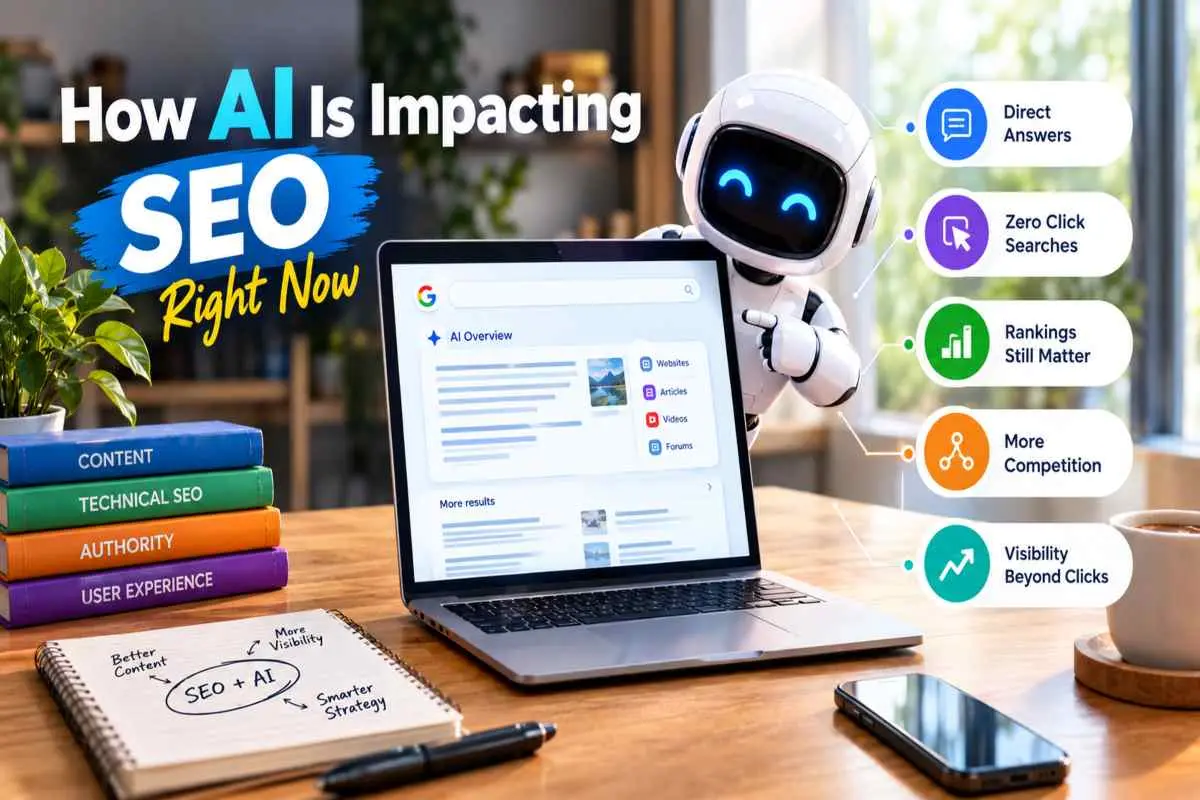
AI is changing SEO in three main ways, it moves answers onto the results page, reduces clicks on many informational searches and makes visibility harder to measure by rankings alone. The core signals that decide which pages get used (crawlability, relevance, authority and quality) still matter. What has changed is what you win when those signals work in your favour.
How AI Search Differs From Traditional Search
AI search differs from traditional search because it composes an answer from several sources instead of handing the user a ranked list of pages to open. Traditional search matches a query to indexed pages and orders them by relevance and authority. AI search interprets the question, often splits it into related sub questions, gathers material and writes a combined response.
Google has said its AI Overviews and AI Mode may use a technique called query fan out, which issues multiple related searches across subtopics and data sources to build a response. For SEO, this means a page can be drawn on when it covers one of those related questions well, even if it isn’t the top result for the exact phrase the user typed.
The Shift From Ten Blue Links to Direct Answers
The results page is shifting from a list of ten links to a direct answer with links serving as supporting evidence. Searchers once scanned titles and chose a page. Now many see a written summary first and in AI Mode they can keep asking follow up questions without leaving the experience.
Organic listings still appear, but they sit lower and compete for attention with summaries, videos, forums and other features. The practical effect is that ranking first matters less than being a source the answer can be built from. Pages that open sections with a clear answer, use descriptive headings and state specific facts are easier for both search engines and AI systems to lift from.
Zero Click Searches and Changing Click Behaviour
Zero click searches matter more now because an AI answer can satisfy the question without any visit to a website. Pew Research Center’s analysis of US browsing found that people closed out the search page 26% of the time when it carried an AI summary, compared with 16% when it did not. That data comes from March 2025 and covers US users, so UK behaviour may differ, but the direction is hard to ignore.
Click behaviour is splitting by intent. Quick factual questions produce fewer visits, while people still click when they need to compare options, check reviews, buy, book or verify a claim. The useful question for any page is no longer only “will it earn a click?” but also “will it earn a citation or a brand impression?”
How AI Affects Traditional SEO Rankings
AI affects traditional rankings mainly by changing what surrounds them, not by replacing the signals behind them. Google states that the same foundational SEO practices apply to its AI features, including technical eligibility, compliance with its policies and helpful, reliable, people first content. A page that isn’t crawlable, indexed and trustworthy is unlikely to be used in an AI answer at all.
What does change is competition. More features now share the page with organic listings and fan out searches mean your content is evaluated against narrower sub questions as well as the main query. This is why tracking a handful of keyword positions gives an incomplete picture. Topic coverage, impressions and conversions show the real effect far better.
AI Impact on Organic Traffic and Visibility
AI is reducing organic traffic on some informational queries while moving visibility into summaries, citations and brand mentions. Pages that exist only to supply a short fact are the most exposed. Pages with original insight, real experience, tools or depth that a summary cannot fully replace are in a stronger position.
Google says people visit a wider range of websites for complex questions through AI Overviews, but that is a company claim and not a guarantee, so measure your own results. Look at impressions and clicks in Search Console, branded search growth, referral visits from AI assistants and, above all, leads or sales. To build visibility inside AI answers deliberately, see this guide on how to do answer engine optimization.
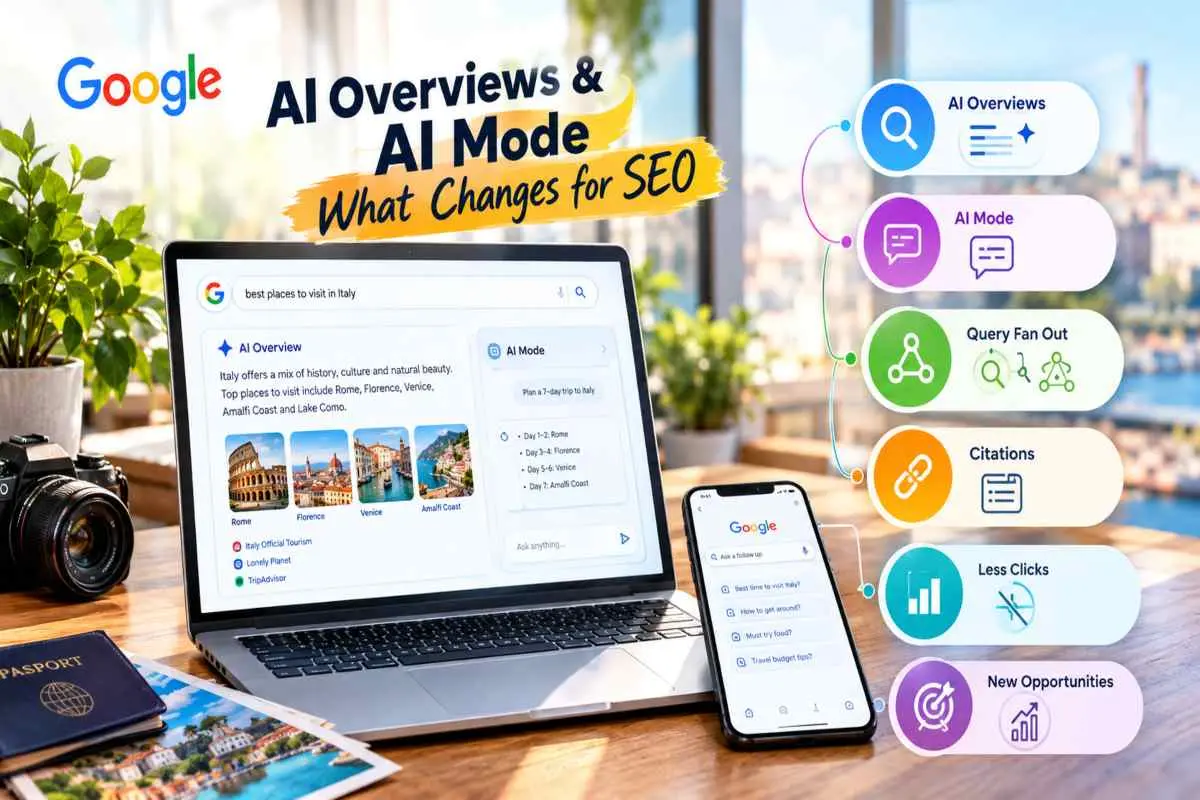
Google AI Overviews and AI Mode What Changes for SEO
Google AI Overviews and AI Mode change SEO by placing an AI written answer above or in place of the classic results. That reduces clicks on simple questions but opens a new route to visibility through citations. The ranking fundamentals stay the same. What shifts is how much attention each result can win.
What AI Overviews and AI Mode Are
AI Overviews are short, AI generated summaries that appear at the top of some Google results pages, with links to the sources behind the answer. AI Mode is a separate, conversational search experience in which people ask longer questions, follow up and receive fuller, researched responses.
Google says both may use query fan out, meaning they run several related searches across subtopics before writing a reply and that the two features can use different models, so the links they show will differ. For site owners, the practical point is that traffic from both is counted within the normal search data in Search Console, not in a separate report.
Negative Impacts of AI Overviews on SEO
The main negative impact of AI Overviews is fewer clicks on simple informational searches, because the answer is already on the page. Pages built to deliver a definition, a quick fact or a basic how to are the most exposed. Reporting also becomes harder, AI answers vary between users and over time, so a fixed ranking position says less than it used to and visibility can occur without a visit.
Competition for citations is uneven too. Pew’s analysis found that the sources shown in these summaries lean heavily on large platforms such as Wikipedia, YouTube and Reddit, which makes it harder for smaller sites to appear unless they offer something clearly distinctive.
Opportunities How to Get Cited in AI Overviews
The best way to get cited in AI Overviews is to publish crawlable original and clearly structured pages that answer specific questions directly. Google says no special optimization, extra technical requirement or special markup is needed beyond standard SEO best practice, so the work is mostly about quality and clarity. Open each section with a plain answer, then add evidence, examples and context.
Cover the related sub questions around your topic, since fan out searches look for those. Name real authors with relevant experience, keep pages indexable and avoid snippet controls that limit how your content can be shown, as they can reduce your chances of appearing. For a fuller walkthrough of tactics beyond Google, read this guide on how to rank on AI search engines.
Impact on Blogging and Publishers
AI Overviews hit generic blogging hardest, because definition posts, listicles and surface level explainers are the content a summary replaces most easily. Publishers that rely on high volume informational traffic feel this first, which is why the concern about declining referrals is so widespread.
The posts that hold their value tend to contain something a summary cannot fully reproduce, original research, first hand testing, expert opinion, case studies, tools and a recognisable point of view. Building a direct audience through newsletters, communities, video and repeat visitors also lowers dependence on any single search feature. Blogging is not finished, but the bar for a post worth ranking has risen.
Impact on YMYL Topics (Health, Finance and Legal)
YMYL topics (Your Money or Your Life) are affected heavily because AI Overviews appear often on them, yet the accuracy stakes are higher. SE Ranking’s study of 1,200 queries found that about half of the YMYL keywords tested produced an AI Overview, with legal queries highest at roughly 78%, health at around 65% and finance at about 42%.
These figures come from one sample and will shift over time, but they show how exposed these categories are. Scrutiny is rising as well. After a Guardian investigation in January 2026 reported misleading health summaries, Google removed AI Overviews for some medical queries. For publishers in these fields, the response is to demonstrate trust openly, credentialed authors, clear sourcing, review dates, plain language accuracy and original expertise that an automated summary cannot supply.
Impact by Industry Travel, Restaurants, Entertainment and E commerce
The impact varies by industry because each one relies on a different kind of search and the patterns below are trends to watch rather than measured industry wide figures. In travel, AI Mode can draft itineraries and compare destinations, so the strongest content offers first hand local knowledge, current detail and booking value that a general answer cannot match. Restaurants depend mostly on local intent, where accurate Google Business Profile details, reviews, menus and opening hours matter more than blog content.
Entertainment brands see quick factual questions about release dates or cast answered directly, which pushes value toward original coverage, video and fan communities. In e-commerce, product research increasingly begins in AI answers, so clean product data, honest reviews, current pricing and availability and comparison content help a store stay part of the conversation.
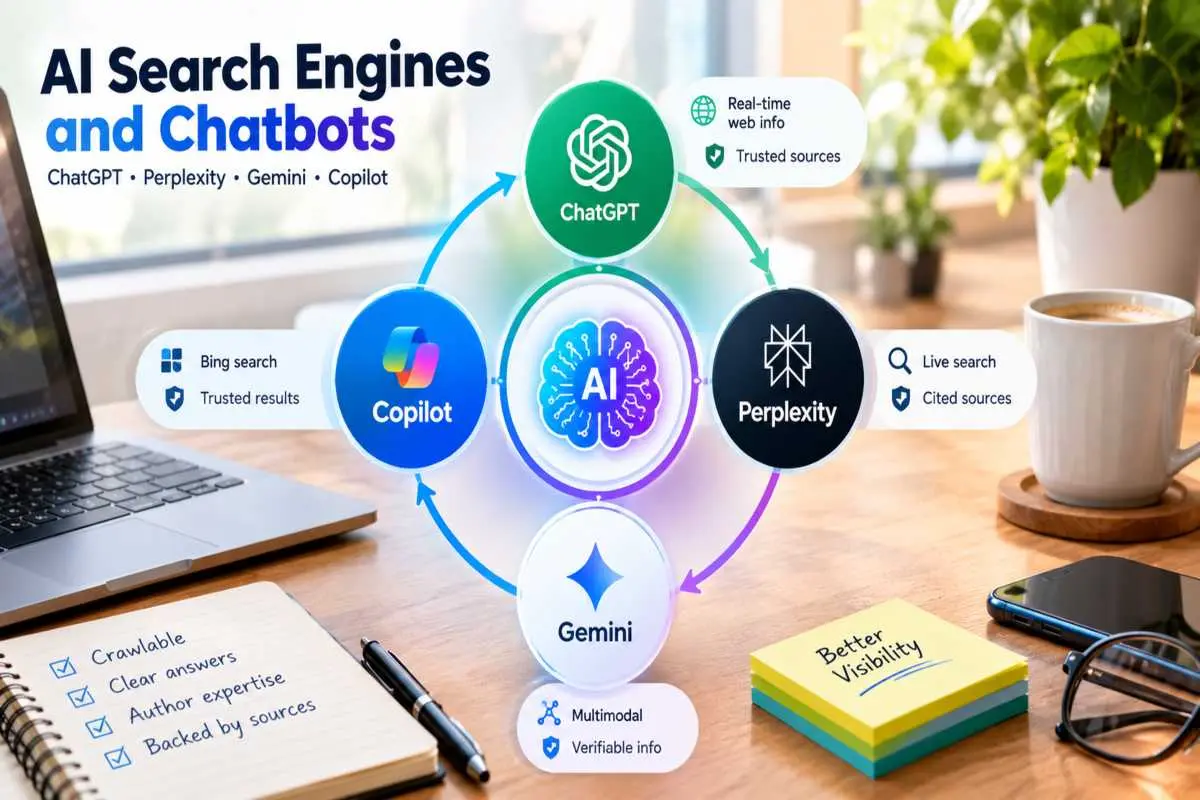
AI Search Engines and Chatbots ChatGPT, Perplexity, Gemini and Copilot
ChatGPT, Perplexity, Gemini and Copilot answer questions by pulling together information from across the web and they favour sources that are relevant, clear and trustworthy. Each tool works a little differently, but pages that are easy to find, easy to understand and easy to verify have the best chance of being used.
How AI Search Engines Choose Their Sources
AI search engines choose sources by matching a question to content they can access, then favouring pages that state facts clearly, come from credible publishers and are backed up elsewhere. Most tools retrieve live web content and then write a combined answer from it. Some, such as Copilot, are closely tied to a traditional search index (Microsoft’s Bing), while others rely on a mix of their own crawlers and licensed data, so the sources they favour can differ.
Four things consistently help a page get picked up. It must be reachable, which means your robots.txt file and any security or CDN settings should not block the crawlers you want. It must answer the question in a direct, self contained passage. It should come from a recognisable author or brand with visible expertise. And its claims should agree with what other reputable sources say, because AI tools tend to prefer information they can corroborate.
AI Search vs Traditional SEO What Overlaps and What is New
AI search and traditional SEO overlap on the fundamentals and differ mainly in what counts as success. In both, a page needs to be crawlable, relevant, well written and trusted and strong technical health and authority help in each. What is new is the unit of competition and the outcome. Traditional SEO competes at page level and rewards a ranking and a click.
AI search often competes at passage level, picking the single paragraph that best answers one part of a question and rewards a citation or a brand mention. Questions are also longer and more conversational, so content needs to cover follow up questions naturally. Visibility is spread across several platforms instead of one and the sources that shape an answer may include forums, reviews and third party articles about your brand, not only your own site. Measuring progress therefore means watching citations and mentions alongside rankings.
Does Old Fashioned SEO Help With AI Search?
Yes, old fashioned SEO still helps with AI search, as long as “old fashioned” means technical health, genuinely useful content and earned authority and not keyword stuffing or link schemes. Many AI tools lean on search indexes or on pages that rank well, so a site that is crawlable, fast, well structured and trusted starts with a real advantage. Tactics built to game algorithms add little, because AI systems are designed to find the clearest, most reliable answer, not the page with the most repeated phrases.
To get more from traditional SEO, adapt it, lead each section with a direct answer, keep paragraphs focused enough to be lifted on their own, use descriptive headings, add original facts or examples and keep your brand details consistent across the web. Google says its own AI features need no special optimization beyond standard SEO, but other assistants offer no equivalent promise, so treat those steps as sensible practice, not a guaranteed formula.
Is AI a Long Term Threat to Google Search?
AI is a credible long term challenge to how people search, but the evidence so far does not show it replacing Google. Ahrefs’ tracking across more than 74,000 websites found that all AI chatbots combined sent about 3.5 million visitors in March 2026, which was only 0.28% of total web traffic. That is a small share, though it is based on one dataset and measures only clicks to websites. It misses the many AI conversations that end without a visit, so it understates AI’s real influence on decisions.
Google is also responding by building AI directly into search through AI Overviews and AI Mode, which means part of the competition now happens inside Google itself. Nobody can say with certainty where this settles. The practical conclusion is to keep Google visibility strong while building a presence in the assistants your customers use, so no single platform controls your discovery.
Positive and Negative Impacts of AI on SEO
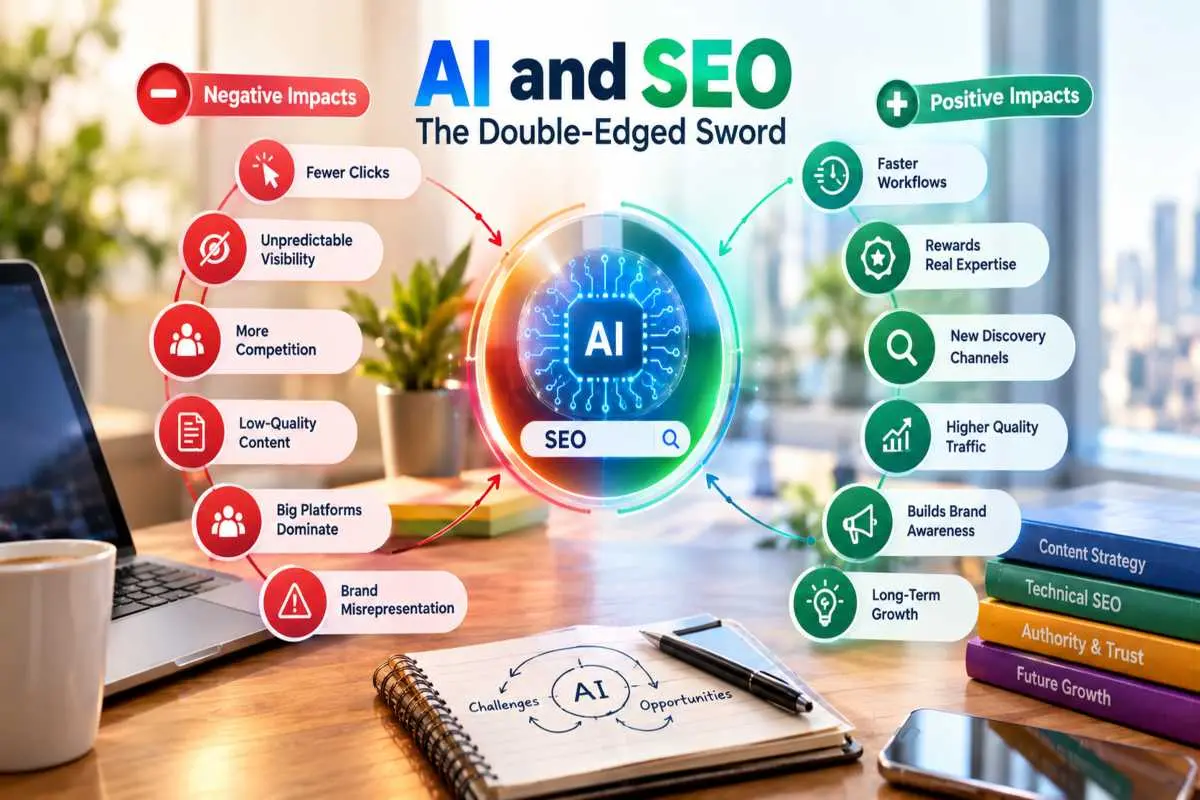
AI affects SEO in both directions. It reduces clicks and adds competition for attention, but it also speeds up SEO work, rewards genuine expertise and creates new routes to being found. Whether it helps or hurts depends largely on what kind of content a site publishes and how well it adapts.
Negative Impacts
The main negative impacts of AI on SEO are fewer clicks on simple searches, less predictable visibility and more competition for attention. When an AI answer resolves a question on the results page, pages built only to supply a quick fact lose visits they once earned. Visibility is harder to track as well, because AI answers change between users over time and a brand can be mentioned without any measurable traffic.
The web is also filling with low effort, machine written pages, which raises the bar for standing out and makes trust signals more important. Large platforms tend to dominate citations, which squeezes smaller publishers. And AI tools sometimes summarise a brand inaccurately, creating a reputation risk that classic rankings never posed. Together, these pressures make informational, low differentiation content the most vulnerable.
Positive Impacts
AI also benefits SEO by making the work faster, rewarding quality and opening new channels where a business can be discovered. On the practical side, AI tools help teams analyse search data, group keywords, audit pages, outline content and spot gaps in coverage in a fraction of the time, provided a human checks the output. On the strategic side, AI search tends to favour clear, expert and original sources, which benefits businesses that already invest in real knowledge.
Visitors who arrive from AI answers have often done their research first and that shows in results. Ahrefs reported that on its own website, AI search visitors made up about 0.5% of traffic but produced roughly 12.1% of signups. That is one company’s data, so treat it as a signal and not a rule, but it shows why a small traffic share can still carry real value. Citations and brand mentions also build awareness well before a click ever happens.
Traditional SEO vs AI Era SEO (Comparison Table)
Traditional SEO focuses on ranking pages and earning clicks, while AI era SEO adds the goal of being cited and mentioned inside generated answers. The two are not rivals. AI era SEO builds on the same foundations and extends them, as the table shows.
| Area | Traditional SEO | AI-Era SEO |
|---|---|---|
| Main goal | Rank pages and earn clicks | Earn visibility, citations and clicks |
| Unit of competition | The whole page | The individual passage or answer |
| Typical query | Short keywords | Longer and conversational questions |
| Content style | Keyword-focused, comprehensive pages | Direct answers, clear structure and original insight |
| Authority signals | Backlinks and on-site quality | Backlinks plus brand mentions and expert authorship |
| Where visibility happens | Google and Bing results | Search results, AI Overviews and AI assistants |
| Key metrics | Rankings, organic traffic | Rankings, citations, impressions and conversions |
| Role of the click | Primary outcome | Important but not the only outcome |
Does Using AI Content Hurt SEO?
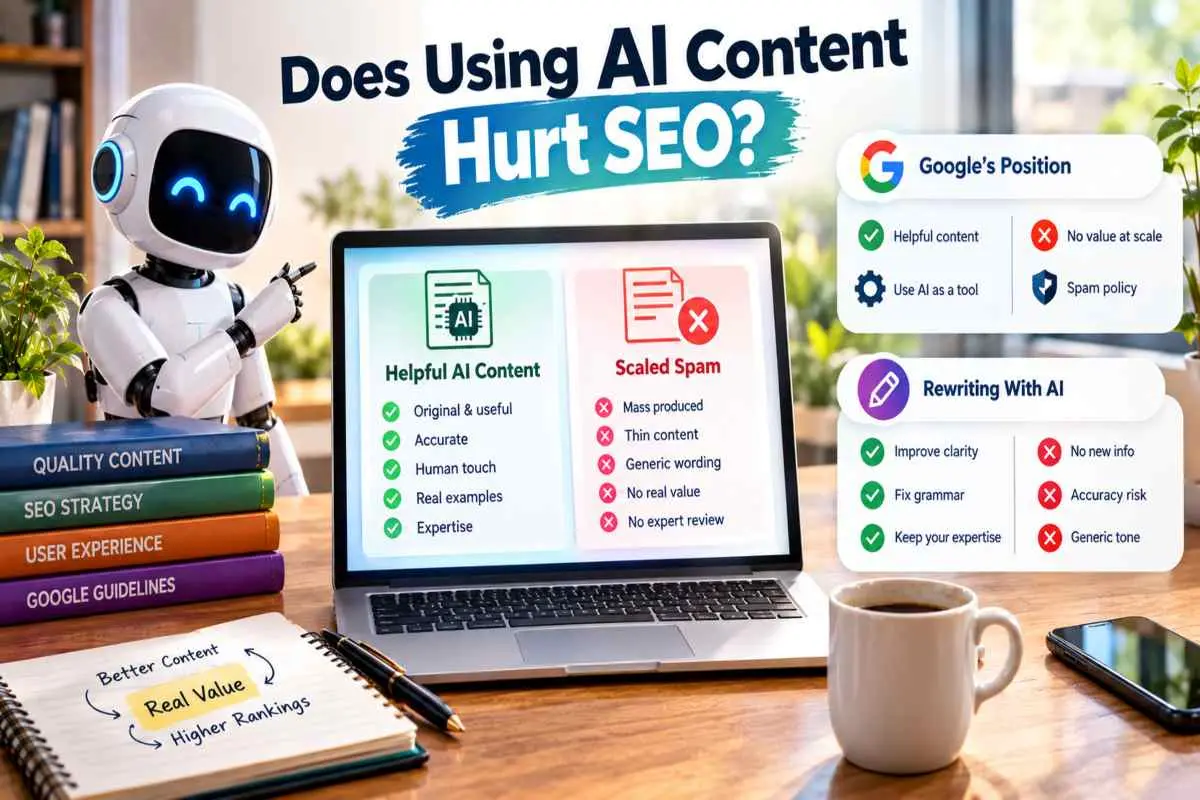
No, using AI content does not hurt SEO by itself. What hurts rankings is content that is unoriginal, inaccurate or published in bulk to game search results and that applies equally to AI written and human written pages. Google judges the value of a page to readers, not the tool that helped produce it.
Google’s Position on AI Generated Content
Google’s position is that AI generated content is acceptable when it is helpful and accurate and a violation when it is used to mass produce pages that add no value. Its Search Central guidance says generative AI can be useful for researching a topic and adding structure to original content, but warns that using it to generate many pages without adding value for users may breach its spam policy on scaled content abuse.
That policy has been in place since Google introduced it in March 2024 and it has been enforced since, a Google spam update that began on 24 September 2026 lists scaled content abuse among the policies in scope. Google also encourages publishers to explain how automation was used when readers would reasonably wonder and to focus on accuracy, quality and relevance above all. In short, Google has no objection to AI as a tool, only to low value output at scale.
Helpful AI Assisted Content vs Scaled Spam
Helpful AI assisted content is created for a reader’s need and improved by human knowledge, while scaled spam is created because a keyword list said a page should exist. The difference shows up in intent and in the finished page. Helpful content has a clear purpose, a named author or accountable brand, accurate details, original examples or data and an editor who has checked every claim.
Scaled spam tends to show the opposite pattern, dozens or thousands of near identical pages, generic phrasing that repeats what already ranks, thin answers padded to look complete and no evidence that anyone with real expertise reviewed the result. A useful test is to ask whether the page would still deserve to exist if search engines disappeared tomorrow. If the honest answer is no, the problem is the strategy, not the AI.
Does Rewriting With AI Affect Rankings?
Rewriting with AI does not affect rankings on its own, but what you do with the rewrite does. Using AI to improve clarity, fix grammar or tighten your own draft is low risk, because the substance and expertise still come from you. The risk rises when AI is used to reword other publishers’ articles with no new information.
That adds nothing to the web and it can lead to thin or derivative pages that rank poorly or fall foul of spam policies. Two other things go wrong with automated rewriting, factual errors can slip in as the wording changes and a distinctive voice can be flattened into the same generic tone found everywhere else. If you rewrite with AI, treat the output as a draft, add something new and check every fact against the original source.
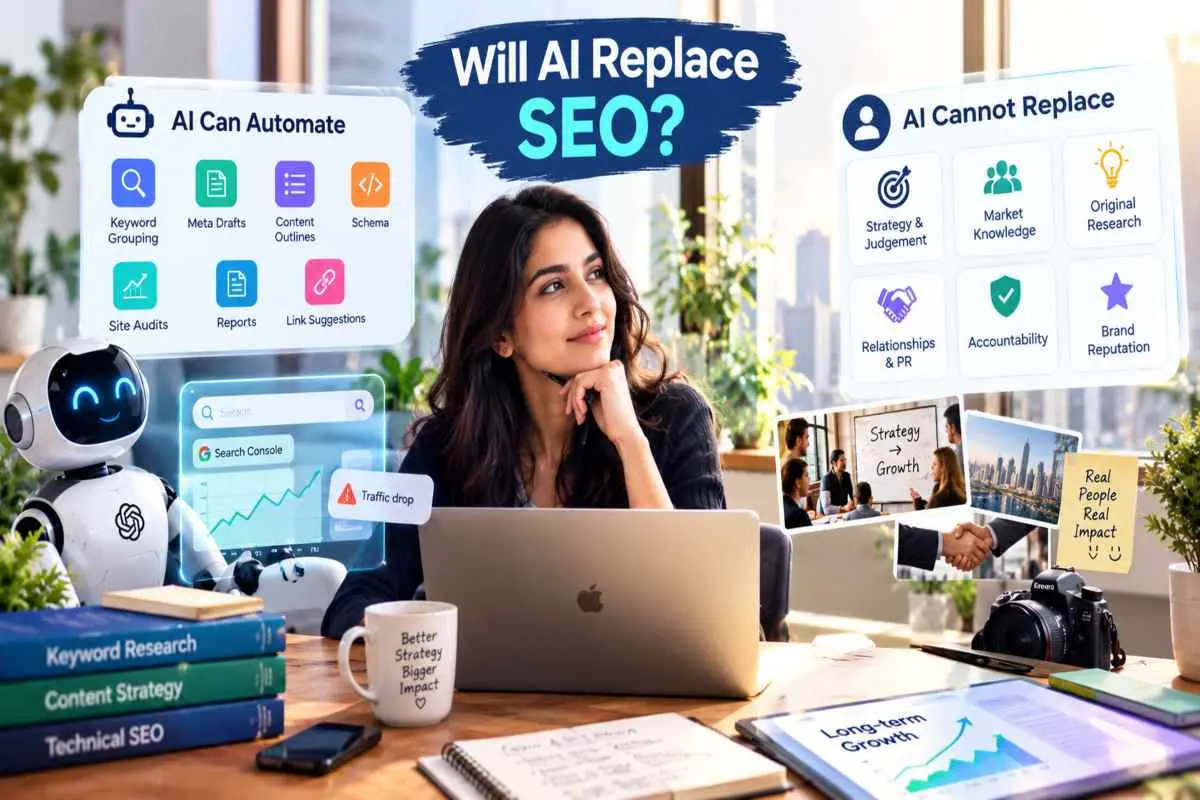
Will AI Replace SEO?
No, AI will not replace SEO, but it is already replacing parts of how SEO work gets done. It automates repetitive tasks and changes which skills matter most, while strategy, judgement and original expertise stay firmly in human hands. The work is shifting, not vanishing.
What AI Can Automate Today
AI can already automate the repetitive, data heavy parts of SEO, which speeds up the work without replacing the thinking behind it. It handles keyword grouping, search intent labelling, title and meta description drafts, content outlines, schema generation, internal link suggestions and first pass site audits.
It can summarise large exports from analytics and Search Console, flag unusual drops in traffic and turn raw numbers into a readable report. Tasks like these used to take hours of manual effort and now take minutes. The caveat is reliability: AI output can contain invented details or miss context, so every automated result still needs a person to check it before it is acted on or published.
What AI Cannot Replace
AI cannot replace the parts of SEO that depend on judgement, accountability and real world knowledge. It cannot decide which business goals a search strategy should serve, weigh trade offs between competing priorities or know a client’s market, margins and customers the way a close advisor does. It has no first hand experience to draw on, so it cannot supply the original research, case studies, interviews and genuine opinions that make content worth citing.
Relationship driven work such as digital PR, partnerships and earning links from respected sites also relies on trust between people. Finally, someone must take responsibility for results, compliance and brand reputation. That accountability does not transfer to a tool and it is a large part of why experienced professionals remain valuable.
Will AI Replace SEO Experts and Specialists?
AI is unlikely to replace SEO experts and specialists outright, but it will change what the role involves and make some junior, task based work less valuable. In practice, professionals are adopting AI as an assistant rather than handing over control. A Search Engine Journal survey of 371 professionals across 52 countries found that 58% use AI to help while keeping people in charge of the final content.
The people most at risk are those whose value lies only in repetitive production, such as bulk meta tags or generic articles. The people best placed are those who combine technical understanding, strategic thinking, strong writing and the ability to use AI well. Hiring and training will likely move toward these blended skills.
Why “AI Is Killing SEO” Is the Wrong Framing
“AI is killing SEO” is the wrong framing because it treats SEO as a single tactic when it is really the practice of making useful information easy to find and AI search still depends on that. AI answers are built from web content that has to be crawled, understood and trusted and Google says the same SEO best practices apply to its AI features.
What AI is ending is the idea that SEO means ranking one page for one keyword and counting clicks. A more accurate picture is that discovery now happens across search results, AI summaries and assistants and that businesses need visibility in all of them. Seen this way, AI does not remove the need for SEO. It raises the standard for it and widens what it has to cover.
How AI Is Changing SEO Strategy and Workflows
AI is changing SEO strategy by shifting the focus from single keywords and rankings to complete answers, trusted entities and visibility across several platforms. The workflow still starts with understanding what people need, but research, writing, technical checks, authority building and reporting all adjust to how AI systems find and use content.
Keyword Research in the AI Era
Keyword research in the AI era starts with questions and topics instead of isolated phrases, because AI search breaks a query into many related searches. Google has said its AI Overviews and AI Mode may use query fan out, issuing several related searches across subtopics before writing a response, so a page can be used for a sub question it was never explicitly targeting.
In practice, build research around a topic and map every question a buyer would ask before, during and after a decision. Sales calls, support tickets, reviews and community threads reveal the real wording better than any tool. AI can speed up grouping and intent labelling, but search volume data still deserves a human sanity check, since conversational prompts often show little or no recorded volume even when they matter commercially.
On Page SEO Answer First Writing and Entity Coverage
Answer first writing means giving the direct answer in the opening one or two sentences of a section, then supporting it with detail, evidence and examples. This helps readers and it makes a passage easy for a search engine or AI tool to lift cleanly. Each section should make sense on its own, with a descriptive heading that matches a real question and no reliance on earlier paragraphs for context.
Entity coverage is the second half of the approach. An entity is a clearly defined thing such as a brand, product, person, place or concept and AI systems build understanding from how these connect. Define key terms plainly, use consistent names, explain how related concepts fit together and include the facts a knowledgeable reader would expect. Comprehensive, well organised pages cover a topic’s entities naturally without repeating keywords.
Technical SEO That Still Matters
Technical SEO still matters because AI features can only use content that search systems can crawl, render and index. Google states there are no additional technical requirements to appear in its AI features, which means the standard checklist remains the checklist, indexable pages, sensible canonical tags, clean internal linking, fast and mobile friendly performance and content that does not hide behind scripts that fail to render.
Use clear semantic HTML so headings, lists and tables are understood by people and machines alike. Review robots.txt and any security or CDN rules to make sure you are not blocking crawlers you actually want, including AI search bots. Structured data is not required for AI features, but it remains useful when it accurately matches visible content and supports rich results.
E E A T Experience, Expertise and Original Data
E E A T stands for experience, expertise, authoritativeness and trustworthiness and it matters more as AI makes generic content easy to produce. It is a framework Google’s quality raters use to judge content, not a single score you can raise with a plugin. Demonstrate experience by showing real work, such as original photos, test results, case studies and the lessons learned along the way.
Show expertise through named authors with credentials relevant to the topic and make ownership, contact details and editorial standards easy to find. Original data is especially powerful, because a survey, benchmark or internal analysis gives AI tools and journalists something unique to cite. Where the topic affects health, money or legal decisions, expert review and clear sourcing become essential.
Link Building and Brand Mentions
Link building still matters and brand mentions now matter alongside it, because AI systems form their view of a business from what the wider web says about it. Earned links from respected, relevant sites continue to signal authority to search engines. Unlinked mentions in articles, reviews, forums, podcasts and industry directories help establish who you are and what you are known for.
The most dependable route is the same as before, create something worth referencing, such as research or a useful tool and promote it through digital PR and genuine relationships. Be careful with shortcuts. Google’s guidance warns that seeking inauthentic mentions can be treated as spam, so avoid paid placements disguised as editorial coverage and mass outreach built purely for volume.
Measuring Visibility Beyond Clicks
Measuring SEO in the AI era means tracking visibility, influence and revenue together, because a click is no longer the only evidence that search worked. Google reports traffic from AI Overviews and AI Mode within the standard search data in Search Console, so start there and watch impressions, clicks and query patterns by page.
Add branded search growth, since people who see your name in an AI answer often search for you afterwards. In analytics, set up filters to isolate referrals from AI assistants and review which pages they land on. Run a fixed set of target questions through the main AI tools each month and record whether your brand is mentioned or cited. Most importantly, connect all of this to leads, sales and assisted conversions, which show whether visibility is turning into business results.
How to Optimise for AI Search (AEO and GEO Basics)
To optimize for AI search, make your content easy to find, easy to understand and easy to trust, then write each section so it can stand alone as a clear answer. The tactics are largely extensions of good SEO. The difference is that the goal widens from ranking a page to being selected, cited and remembered inside AI answers.
What AEO and GEO Mean and How They Relate to SEO
AEO means answer engine optimisation and GEO means generative engine optimisation. AEO is the practice of structuring content so search engines and assistants can pull out a direct answer, as in featured snippets, voice results and AI summaries. GEO focuses on increasing the chance that generative AI tools mention or cite your brand when they write a response.
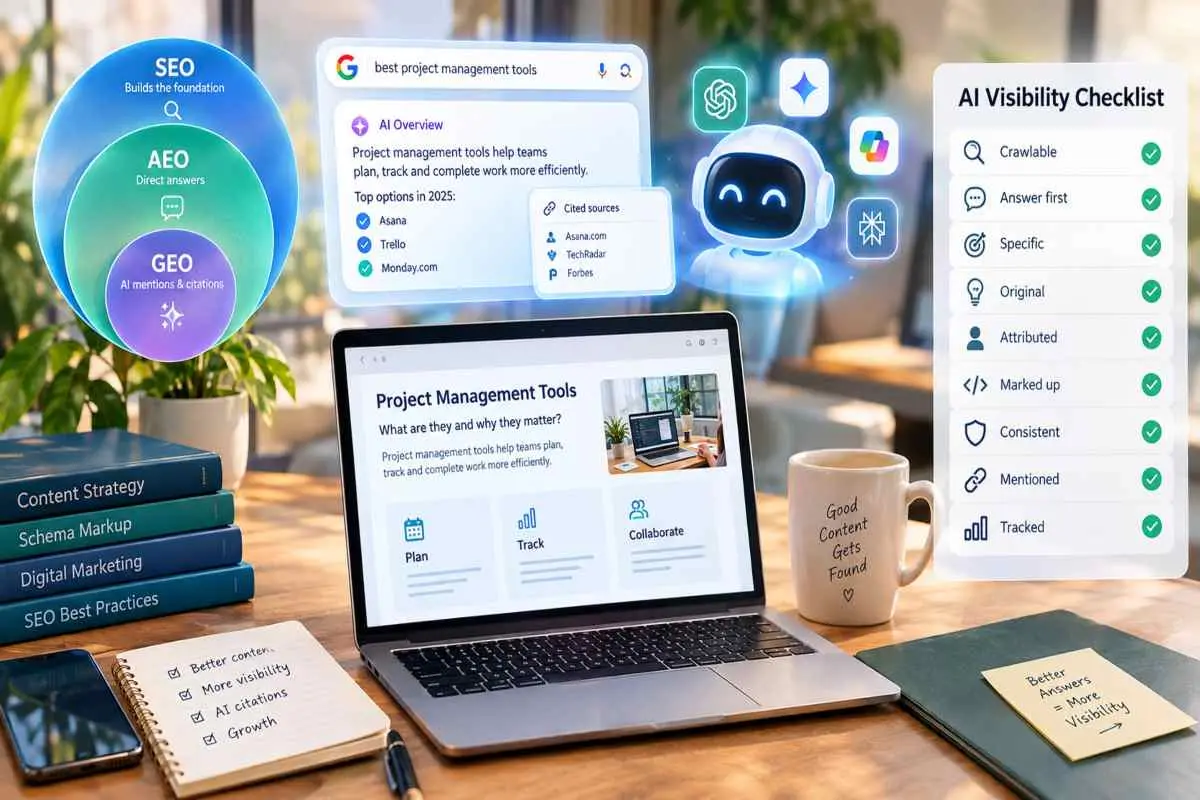
Both build on SEO instead of replacing it, because AI answers rely on content that has already been crawled, indexed and judged trustworthy. Google takes the same view for its own features. Its guidance, as reported by Practical Ecommerce, treats optimising for generative AI search as part of optimising for the search experience, which is still SEO. Think of AEO and GEO as a layer of focus on top of a solid SEO base, not a separate discipline.
Writing Content That AI Engines Cite
AI engines cite content that gives a clear, specific and verifiable answer in a form they can lift without losing meaning. Begin each section with a direct answer in one or two sentences, then add the reasoning, evidence and examples. Write headings that match real questions and keep each passage self contained, so a reader who sees only that paragraph still understands it.
Use precise facts, named sources and dates in place of vague claims, because specific statements are easier to trust and quote. Add something other pages lack, such as original data, a worked example or a professional opinion. Avoid padding, filler introductions and keyword repetition, which make a passage harder to extract and less useful to the reader.
Structured Data and Schema for AI Visibility
Structured data can help machines understand your pages, but it is not required to appear in Google’s AI features. Google states that no special markup or additional technical requirements are needed beyond standard best practice, so schema should never be treated as a shortcut to citations. It is still worth using where it accurately describes visible content.
Useful types include Organization, Article, Person for authors, Product, LocalBusiness and Review and links from your Organization markup to your official profiles help confirm who you are. Keep the markup accurate and aligned with what readers can see, validate it for errors and update it when details change. Incorrect or exaggerated markup can cause more harm than having none.
Building Entity Authority
Entity authority is how clearly and consistently search and AI systems understand who you are, what you do and what you are known for. Start with consistency, use the same business name, description, address and key facts everywhere. Build strong About, author and service pages that state your expertise plainly. Keep profiles such as Google Business Profile, industry directories and professional networks complete and accurate.
Focus your content on a defined set of topics instead of publishing on everything, so the connection between your brand and those subjects becomes unmistakable. Over time, mentions in credible third party sources reinforce the same picture, which makes it easier for AI tools to treat your brand as a reliable source on those topics.
How AI Mentions Impact SEO
AI mentions affect SEO mostly indirectly, by building awareness, trust and demand that show up in other signals. When an assistant names your brand, people often search for it afterwards and growth in branded search, direct visits and links can follow. Mentions across articles, forums and reviews also feed the wider web picture that AI systems draw on.
There is no official confirmation that mentions act as a direct ranking factor in Google, so avoid claiming it. Be cautious about manufacturing them. Google’s guidance warns that seeking inauthentic mentions can be treated as spam. The dependable route is to earn mentions by publishing original work, supporting your industry and being worth recommending.
AI Visibility Checklist
Use this list as a quick audit of your AI search readiness:
- Crawlable key pages are indexable and robots.txt or security settings do not block the crawlers you want.
- Answer first each section opens with a direct answer under a question style heading.
- Specific claims include named sources, dates and figures, all verified.
- Original each major page contains data, experience or insight that competitors lack.
- Attributed pages show named authors with relevant credentials and a clear About page.
- Marked up accurate structured data supports the content that readers can see.
- Consistent your brand name, description and details match across every profile and directory.
- Mentioned reputable third party sites cite or discuss your brand.
- Tracked you test target questions in AI tools each month and monitor referrals, branded search and conversions.
How to Prepare Your Business for AI Driven Search
To prepare your business for AI driven search, keep your Google SEO strong, then extend your visibility to the other places where customers now ask questions and form opinions. The work is practical, fix your foundations, make your content easy to quote, build trust beyond your own website and measure what actually reaches customers.
Moving From Google Only SEO to Multi Platform Visibility
Moving beyond Google only SEO means treating Google as your main channel while also being findable in the assistants, platforms and sources that shape buying decisions. Google remains the primary starting point for most searches in both the UK and the US, so there is no case for abandoning it. But discovery is spreading.
A Search Engine Journal survey of 371 professionals found that 77% believe AI generated answers could reduce website clicks, which is a good reason not to depend on one source of traffic. Begin by listing where your customers ask questions, Google, Bing and Copilot, ChatGPT, Perplexity, Gemini, YouTube, Reddit, review sites and industry directories. Make sure your site is indexed in Bing as well as Google, keep your business profiles complete and publish useful material in formats that suit each place, such as video, FAQs and detailed guides. The aim is to be present wherever your audience looks for answers.
30/60/90 Day Action Plan
A 30/60/90 day plan gives you a realistic order of work, audit and fix in the first month, create and strengthen in the second, then expand and measure in the third.
Days 1 to 30 audit and fix the foundations. Check that your key pages are crawlable, indexed and fast and that robots.txt and security settings do not block crawlers you want. Review your top pages for outdated facts, thin sections and missing author details. List the 20 to 30 questions your best customers ask, then test them in Google and two or three AI assistants to record who is being cited today. Set up tracking in Search Console and in your analytics tool, including a filter for AI assistant referrals.
Days 31 to 60 create and strengthen. Rewrite your highest value pages so each section opens with a direct answer, uses question style headings and includes specific, verified facts. Add original proof such as a case study, a customer result or a small piece of research. Complete your About, author and service pages and align your business details across every profile and directory. Add accurate structured data where it matches visible content.
Days 61 to 90 expand and measure. Pursue earned mentions through digital PR, partnerships, expert commentary and useful resources others will want to reference. Build content for gaps your testing exposed, especially comparison and decision stage questions. Re run your question tests, compare them with day one and tie changes in visibility, branded search and enquiries to revenue so you can see what is working.
What to Stop, Keep and Start Doing
Stop doing the things AI search has made ineffective, keep the fundamentals that still drive visibility and start the habits that build trust beyond your own site.
Stop publishing generic, keyword led articles that repeat what already ranks and stop treating a keyword’s ranking position as the only measure of success. Stop mass producing pages with AI and no human review, since Google treats scaled content created to manipulate rankings as spam. Avoid buying mentions or links that exist only to look like endorsements.
Keep investing in technical health, helpful content, strong internal linking and genuine authority, because AI answers draw on the same web content that search engines index. Keep local profiles, reviews and accurate business details up to date, since they influence decisions at the moment of choice.
Start writing answers first, with each section able to stand alone. Start publishing original evidence, expert authorship and real examples. Start monitoring citations, branded search and AI referrals alongside rankings and start building a presence in the communities and publications your customers already trust.
Conclusion
SEO is not dead with AI, but it is no longer only about ranking a page and collecting a click. It now means earning visibility, citations and trust across search results, AI summaries and assistants. AI Overviews and AI Mode have reduced clicks on many simple questions, yet Google says the same SEO best practices still apply to its AI features, with no extra requirements, because AI answers are built from crawlable, helpful and trustworthy web content. What has lost value is shallow work, thin pages, keyword repetition and bulk content with no original thinking.
What works is a blend of old and new, healthy technical foundations, answer first content backed by real expertise and original evidence, earned links and genuine brand mentions and measurement that goes beyond clicks to include impressions, citations, branded search and leads. If you want support putting this into practice, IT Leadz can help with your SEO and AI search strategy, from the first audit through to ongoing growth.
Frequently Asked Questions (FAQs)
Is SEO dead with AI?
No, SEO is not dead with AI. AI answers are built from web content that still has to be crawled, understood and trusted, so the fundamentals of SEO remain in place. What has changed is the goal, which now includes citations and brand visibility alongside rankings and clicks.
Is SEO dead in 2026?
No, SEO is not dead in 2026, but it looks different from a few years ago. Searchers now find answers in classic results, AI summaries and chat assistants, so SEO has widened from ranking one page to being visible wherever customers ask questions.
Will AI replace SEO?
AI will replace some SEO tasks, such as keyword grouping, draft outlines and routine audits, but not the discipline itself. Strategy original expertise, trust building and accountability still need people and Google says standard SEO best practices apply to its AI features.
Does AI hurt SEO?
It can, but mainly for thin, generic content. AI answers reduce clicks on simple questions and add competition for attention, while also making SEO work faster and rewarding original, expert content. The effect depends on the quality of the pages you publish.
How do AI Overviews affect organic traffic?
They tend to reduce clicks on simple informational searches. Pew Research Center found US users clicked a traditional result in 8% of visits when an AI summary appeared, compared with 15% when none did. Complex, comparison and purchase searches often still earn visits.
Is traditional SEO still important after AI Mode?
Yes. Google says there are no extra requirements to appear in AI Mode and that the same SEO best practices apply. Crawlable pages, helpful content and strong authority still decide which sources AI systems can find and use.
Does AI generated content rank on Google?
Yes, it can, if it is accurate, original and genuinely useful. Google does not penalise content for being AI assisted, but it treats mass produced pages created mainly to manipulate rankings as spam. Human review, expertise and added value are what separate the two.
How do I get cited by ChatGPT and Google AI Overviews?
Publish crawlable, specific and trustworthy pages that answer questions directly, with each section able to stand on its own. Add original data or experience, show real authorship, keep business details consistent across the web and earn genuine mentions from reputable sources.