A digital marketing agency for startups is an outside team that runs your SEO, paid, content and social channels on a lean, test-and-learn basis. Most retainers run roughly 2,500-10,000 (£1,800-£8,000) a month and the right time to hire is once your product has early traction and you need repeatable growth rather than guesses. Startups play by different rules than established brands. Budgets are tight, positioning is still settling and every month the runway has to earn its keep. A good agency respects those limits by starting with the channels most likely to produce customers quickly, then expanding only when the numbers justify it.
The stakes are real. In CB Insights’ review of startup post-mortems, 14% of founders named poor marketing as a cause of failure. The pattern behind that figure is familiar, teams that never pinned down their audience or never consistently got in front of it, ran out of time before demand arrived. This guide covers the decisions that matter most for founders in the UK and US, when hiring an agency makes sense, how to compare your options, what you should expect to pay and which marketing services deserve your first dollar or pound. By the end, you’ll know what to ask, what to avoid and how to set up a partnership that builds momentum instead of burning a budget.
What is Digital Marketing Agency for Startups?
A digital marketing agency for startups is an outside team that plans and runs online marketing, including SEO, paid media, content and social, for early-stage companies on lean budgets. It’s built for speed and learning, with the aim of finding repeatable ways to win customers before money runs out.
How Startup Agencies Differ From Traditional Agencies
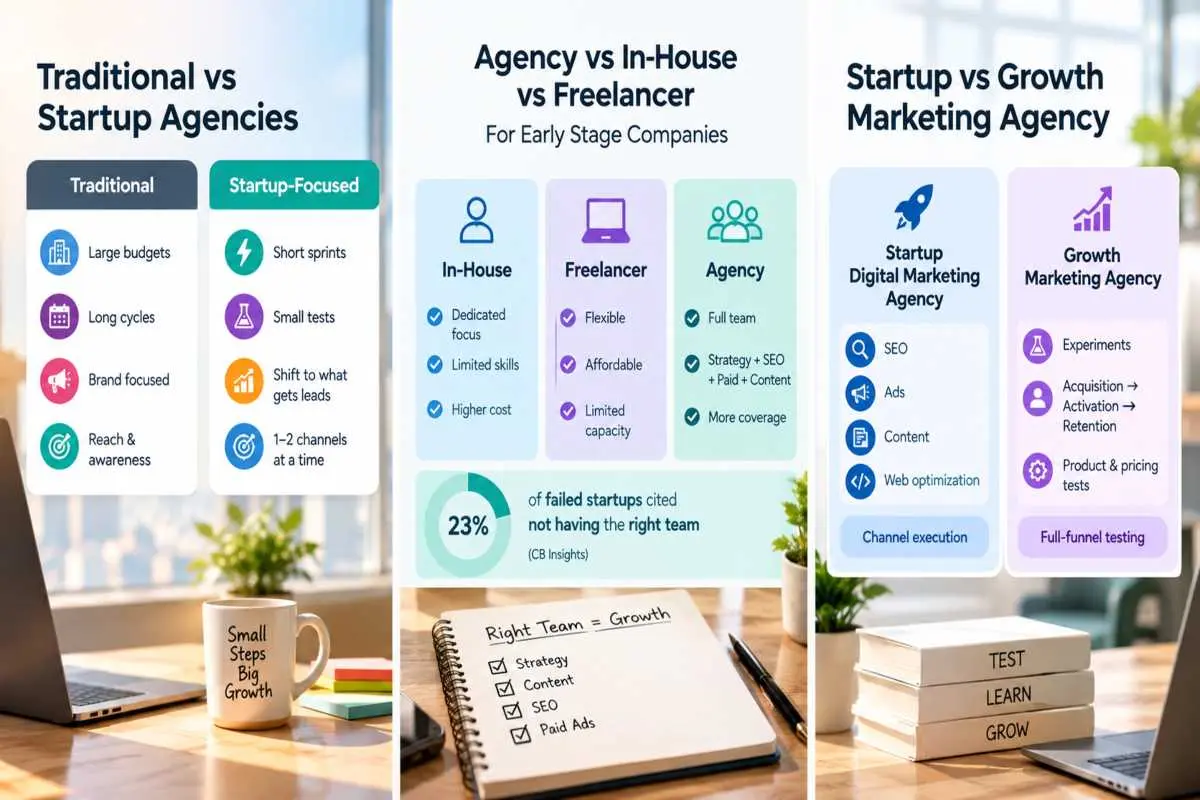
Traditional agencies often serve established brands with large budgets, long planning cycles and heavy brand work. A startup-focused agency works in shorter sprints, runs small experiments and shifts spending quickly toward what produces leads. It also scopes work tightly, starting with one or two high-impact channels rather than a full campaign calendar and reports on cost per customer rather than reach.
Agency vs In House vs Freelancer for Early Stage Companies
An in-house hire gives you dedicated focus but one person’s skills and a senior generalist can be expensive for a young company. A freelancer is flexible and affordable for a single task, though capacity and coverage are limited. An agency brings a broader team across strategy, SEO, paid and content. That matters because 23% of failed startups in CB Insights’ post-mortems cited not having the right team.
Startup Digital Marketing Agency vs Growth Marketing Agency
The two overlap and many firms do both. A startup digital marketing agency usually delivers channel work such as SEO, ads, content and web optimization organized around the stage you’re at. A growth marketing agency leans further into rapid experimentation across the whole customer journey, from acquisition through activation and retention, often involving product and pricing tests. Choose by whether you need channel execution or a broader testing program.
When Should a Startup Hire a Digital Marketing Agency?
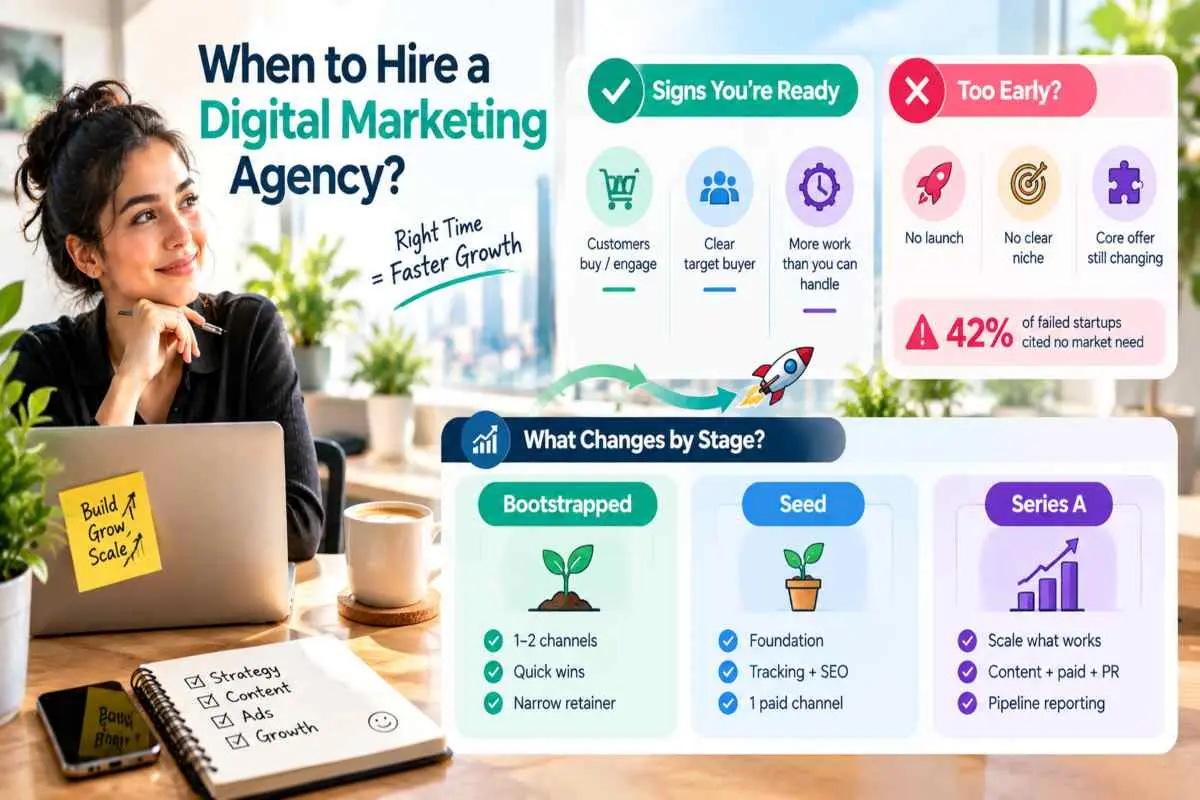
A startup should hire a digital marketing agency once it has a validated offer, early customer traction and more marketing work than the founders can handle well. Hiring much earlier tends to waste budget, while waiting too long leaves growth on the table.
Signs You are Ready
You’re ready when customers are buying or engaging without heavy persuasion, you can describe your ideal buyer in a single sentence and marketing tasks keep slipping because the founders are busy building. At that point, an agency adds capacity and expertise instead of covering product gaps.
When It is Too Early
It’s too early if you haven’t launched, haven’t defined who you serve or are still reshaping the core offer. Marketing can’t create demand that isn’t there and 42% of failed startups in CB Insights’ post-mortem analysis cited no market need. Validate the problem first, then pay to amplify the answer.
Seed, Series A and Bootstrapped What Changes
Bootstrapped startups do best with a narrow retainer on one or two channels that pay back quickly. Seed-stage teams usually need a foundation plus a few controlled tests, such as site, tracking, SEO and one paid channel. By Series A, the focus shifts to scaling what works, with broader content, paid, PR and reporting tied to pipeline.
Which Marketing Services Should Startups Prioritize First?
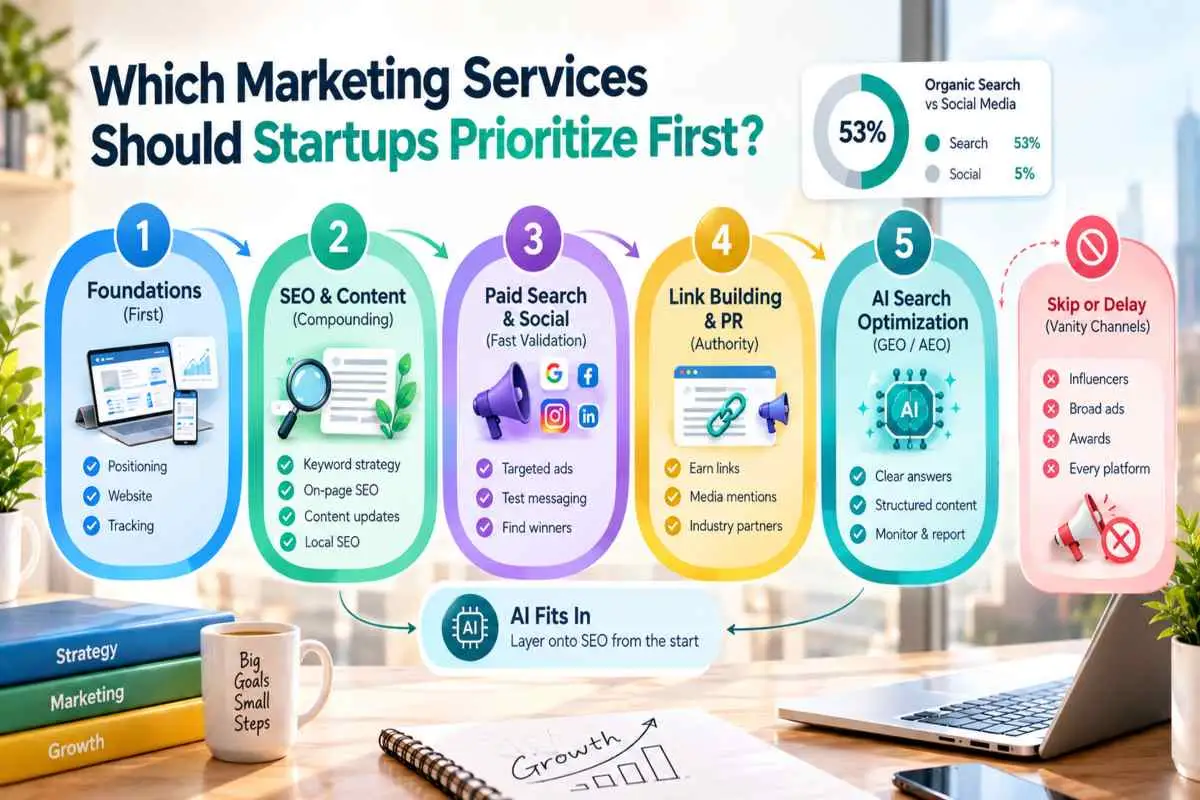
Startups should prioritize foundations first (positioning, website and tracking), then SEO and content, then paid channels for fast validation and only later authority-building and brand work. This order keeps spend tied to learning and compounding returns. One data point supports the emphasis on search: BrightEdge’s research found organic search supplied 53% of trackable website traffic, far ahead of social media at 5%.
Stage 1 Positioning, Website and Tracking Foundations
Before spending on traffic, make sure visitors understand what you do, who it’s for and what to do next. Fix the message, speed up the site and set up analytics and conversion tracking so every later channel can be judged on real numbers.
Stage 2 SEO and Content for Compounding Growth
Search is the channel that keeps paying after the work is done. A focused set of SEO services built around buyer-intent topics, with solid on-page SEO and regular content updates, lets a small team earn traffic that gets cheaper over time. Startups serving a specific area should add local SEO.
Stage 3 Paid Search and Social for Fast Validation
Paid campaigns give you answers in weeks instead of months. Use a small, tightly targeted budget on search ads or one social platform to test messaging, offers and audiences, then feed the winners back into your SEO and content plan.
Stage 4 Link Building and Digital PR for Authority
Once your content and site are solid, off-page SEO helps search engines and AI tools trust you. Earn links and mentions from relevant publications, partners and industry resources rather than chasing volume.
Where AI Search Optimization (GEO/AEO) Fits In
AI optimization is best layered onto your SEO work from the start, not run as a separate project. Clear answers, consistent brand facts and structured content help your startup get cited in AI-generated responses and regular monitoring and reporting shows whether those mentions are growing.
What to Skip or Delay (Vanity Channels)
Delay anything that looks impressive but doesn’t connect to pipeline: large influencer campaigns, broad brand advertising, awards and posting on every social platform. They can make sense later, but early on they drain the budget that should fund tests with clear results.
How Much Does a Digital Marketing Agency for Startups Cost?
Most startups pay between roughly $1,000 and $10,000 (£1,000 to £4,000 or more) a month for a digital marketing agency, depending on scope, channels and seniority. A focused single-channel engagement sits at the lower end, while multi-channel full-service work costs several times more.
Pricing Models Monthly Retainer, Project-Based and Performance-Based, Hybrid
A monthly retainer is the most common model, giving you ongoing work for a fixed fee. Project-based pricing suits one-off needs such as a website build, audit or launch campaign. Performance-based models tie fees to results like leads or sales, which sounds attractive but can push agencies toward short-term wins. Hybrid pricing combines a smaller retainer with a performance bonus, balancing predictability and accountability.
Typical Cost Ranges in the US ($) and UK (£)
In the UK, published 2026 estimates put single-channel retainers for SEO, PPC or social at about £1,250 to £3,500 a month, with multi-channel full-service retainers running from £3,500 up to £16,750. In the US, small-business estimates are roughly $1,000 to $2,500 monthly for PPC management and $2,500 to $10,000 for full-service packages. London and major US metros typically cost more. Treat these as benchmarks and request current quotes.
Affordable Options How to Get Results on a Lean Budget
Start with one channel that suits your buyers rather than buying a bundle. Narrow the scope to your highest-value pages or campaigns, keep the contract short with clear checkpoints and handle simple tasks in-house while the agency covers strategy and specialist work. A fixed-scope audit or a short project is also a lower-risk way to test an agency before committing to a longer retainer.
What Drives Price Up
Scope is the biggest driver: more channels, pages and campaigns mean more hours. Competitive markets raise costs, as do senior strategists, regulated industries that need compliance knowledge and fast timelines. Contract length matters too, since longer commitments are often discounted while rolling monthly terms can cost more for the flexibility.
Hidden Costs Founders Overlook
The retainer is rarely the full bill. Paid advertising spend is usually separate and agencies often charge a management fee on top. Budget for tools such as analytics and SEO platforms, content production like design, video and copy and your own team’s time for approvals and feedback. Ask for a written breakdown of what’s included and what is billed extra.
How to Estimate ROI and Payback Period
Start with your gross margin per customer and the number of customers you need to cover the agency’s total cost, including ad spend and tools. Divide total monthly marketing cost by the gross profit from each new customer to see how many you need to break even. Then compare the cost to acquire a customer with that profit and track how many months it takes to earn the spend back.
How to Choose Best Digital Marketing Agency for Your Startup
The best digital marketing agency for your startup is one with relevant early-stage experience, transparent reporting tied to revenue goals, channels that match your buyers and contract terms that let you adapt. Judge agencies on evidence and process, not on polished pitches or bold promises.

A 7-Point Evaluation Checklist
Score every agency you shortlist against the same seven criteria, so the comparison stays fair:
- Startup experience: they’ve worked with companies at your stage and understand lean budgets and fast pivots.
- Data-driven reporting: they tie work to leads, pipeline and revenue, not just traffic.
- Transparency: you see what is being done, who’s doing it and where the budget goes.
- Channel fit: their strengths match where your customers actually search and buy.
- Communication: you get a named contact, a regular cadence and plain-English updates.
- Contract flexibility: short initial terms, clear exit rights and ownership of your accounts and data.
- Case studies: real examples with context, numbers and a similar business model.
Questions to Ask on the First Call
Good questions reveal how an agency thinks. Ask how they would approach your first 90 days, which metrics they’d track and why and who will actually do the work. Ask for an example where a campaign underperformed and what they changed. Finally, ask what they would not recommend for your stage. An agency that says no to something shows discipline.
Red Flags Guaranteed Rankings, Vague Reporting and Long Lock-Ins
Be wary of any promise of guaranteed rankings. Google’s own guidance on hiring an SEO states that nobody can guarantee a number-one ranking. Other warning signs include reports that show activity but no business outcomes, reluctance to share account access and long minimum contracts with no performance checkpoints.
Full-Service vs Specialist Agency
A full-service agency suits startups that want one team coordinating SEO, paid media, content and web work, which reduces handoffs. A specialist is usually better when one channel clearly drives your growth and you need deeper expertise there. Many early-stage companies start with a specialist and widen the scope as budgets and channels mature.
Evaluating Data-Driven Claims What Real Reporting Should Include
Real reporting connects marketing activity to business results. Look for conversions and cost per qualified lead, traffic broken down by channel, the pages and campaigns driving results and a plain summary of what was done, what was learned and what happens next. If a report is mostly impressions and rankings, it’s describing effort rather than outcomes.
What to Look for in the Best Agencies for Tech Startups in 2026
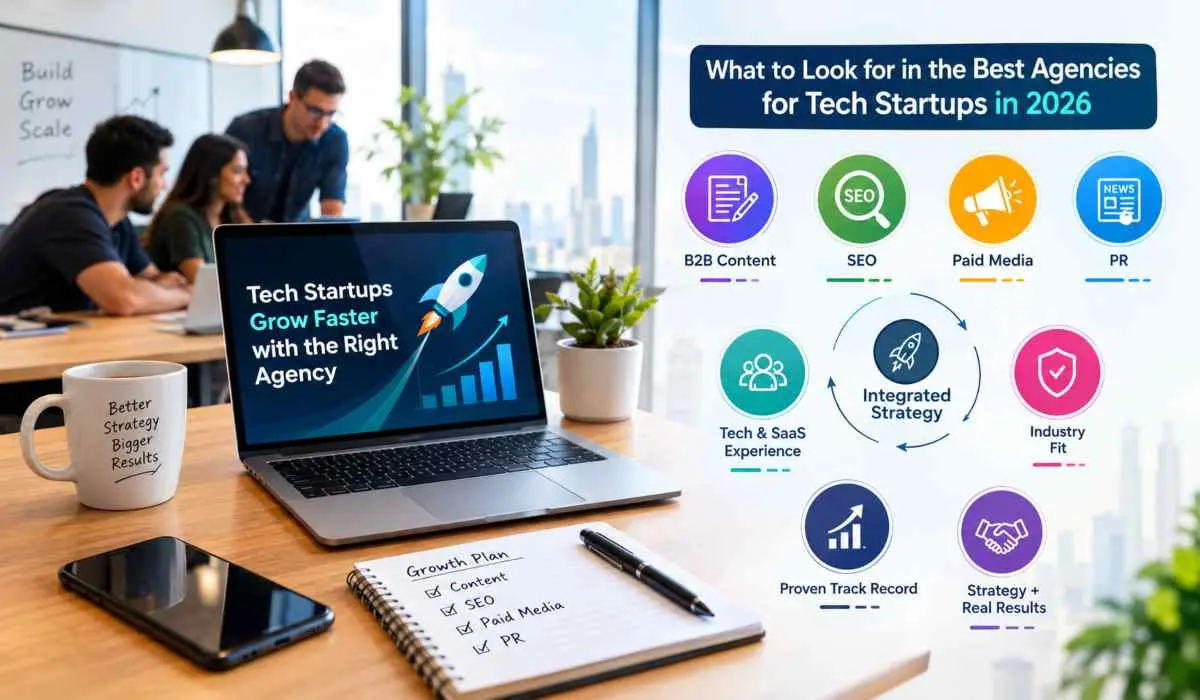
The best agencies for tech startups combine B2B content, SEO, paid media and PR into one measurable plan and they understand long buying cycles, product-led growth and technical audiences. Look for a team that can explain your product’s category in plain language and tie its work to pipeline, not vanity traffic.
SaaS and Tech-Specific Needs
Tech buyers rarely decide quickly or alone. Gartner research indicates that B2B buyers spend only about 17% of their buying time meeting with suppliers, so most evaluation happens through content, search and peer validation before a sales call ever occurs. A strong agency builds for that reality with educational B2B content, comparison and use-case pages and, for product-led startups, onboarding and free-trial journeys that convert users without a salesperson.
Integrated PR, Content and Digital Marketing for Tech Companies
Tech brands earn trust from several directions at once: search results, expert articles, press coverage and third-party mentions. An agency that coordinates PR, content and digital marketing lets each effort strengthen the others, since a press placement can lift branded search and a well-researched guide can attract links and citations. Separate vendors working from separate plans often duplicate effort and send mixed messages to the market.
A Note on Industry-Specific Fit
Regulated or specialized sectors such as healthcare, fintech and ecommerce bring their own rules, audiences and compliance concerns. If your startup operates in one of them, ask for experience in that space, particularly around approved claims, data privacy and sector-specific buyer behavior. General tech skills help, but sector knowledge prevents expensive missteps.
What Top-Rated Agencies Have in Common
Highly regarded agencies tend to share a handful of habits. They prioritize strategy over tactics, report on revenue-linked metrics and are honest about what won’t work at your stage. They also show relevant case studies, assign senior people to your account and review performance on a regular rhythm, adjusting plans as the data comes in.
Digital Marketing Agency for Startups in the US and the UK
A digital marketing agency for startups works differently in the US and UK mainly because of market size, competition, pricing and privacy law. US teams face a bigger, more crowded market and typically higher fees, while UK teams must build around GDPR and PECR from day one.
What US Startups Should Expect
The US offers a large customer base, but it also means fierce competition for the same keywords, ad auctions and press attention. That competition tends to push agency pricing up, with startup retainers commonly landing in the low-to-mid four figures per month for focused scopes and rising from there. Because audiences vary by state and sector, strong US agencies segment by region, buyer type and funding stage rather than treating the country as one market. Ask for case studies that match your category and target geography.
What UK and London Startups Should Expect
The UK search market is smaller and often less saturated, so well-targeted SEO and content can be more cost-effective, though London remains highly competitive in tech and finance. Retainers are generally somewhat lower than comparable US work, but check current quotes. Compliance deserves real attention: under the Data (Use and Access) Act 2025, the maximum fine for breaching PECR’s marketing and cookie rules rose from £500,000 to £17.5 million or 4% of annual global turnover, whichever is higher. Your agency should handle cookie consent, email permissions and tracking setup in line with UK GDPR and PECR.
Working With a Remote or Hybrid Agency Across Time Zones
Remote agencies can serve US and UK startups well if expectations are set early. Agree on a fixed weekly or fortnightly call during overlapping hours, a shared dashboard for live reporting and a written channel for quick questions. Time-zone gaps matter less when reporting is transparent and decisions are documented and they matter more for time-sensitive work such as live paid campaigns or PR responses. Confirm who covers urgent issues and what response times to expect.
How IT Leadz Works With Startups
IT Leadz is a digital agency that works with startups in the US and UK, matching SEO, AI optimization, link building, social and search marketing and web design to the stage the business has reached. Engagements start with an audit and a prioritized plan, so early budget goes to the work most likely to produce measurable growth.
Services Mapped to Startup Stages
Early on, web design and development give you a fast, conversion-focused site that explains the offer clearly. Once the foundation is solid, SEO services build steady organic demand, while social and search marketing test messages and audiences quickly. Link building then adds authority to pages that are ready to rank and AI optimization helps your content get found and cited in AI-driven search. Our wider digital marketing work ties these pieces into one plan.
Engagement Model and What the First 90 Days Look Like
The first month focuses on discovery: auditing your site, tracking, competitors and audience, then agreeing on goals and priorities. Month two is for fixing foundations and launching the first priority channel, whether that is content, search ads or technical SEO. Month three is about reviewing early data, doubling down on what’s working and setting the roadmap for the following quarter. Throughout, regular monitoring and reporting keeps progress visible and tied to leads and revenue.
What Results to Expect and When
Paid and social campaigns can generate early signals within weeks, but SEO takes longer. In an Ahrefs study of two million pages, only 5.7% of newly published pages reached the top 10 for at least one keyword within a year. That’s why we set expectations around leading indicators first, such as indexed pages, rankings movement, qualified traffic and lead quality, with revenue impact building as the work compounds. We don’t promise specific rankings.
Get a Free Startup Growth Audit or Strategy Call
If you’re deciding where to put your first marketing budget, book a free startup growth audit or strategy call with IT Leadz. We’ll review your site, market and goals, then outline the channels and sequence we’d recommend, whether or not you work with us afterward.
Common Mistakes Startups Make When Hiring a Marketing Agency
The most common mistakes are hiring before the positioning is clear, spreading budget across too many channels, measuring success by traffic instead of pipeline and failing to secure ownership of accounts and data. Avoiding them protects limited budgets and makes any agency partnership far more productive.
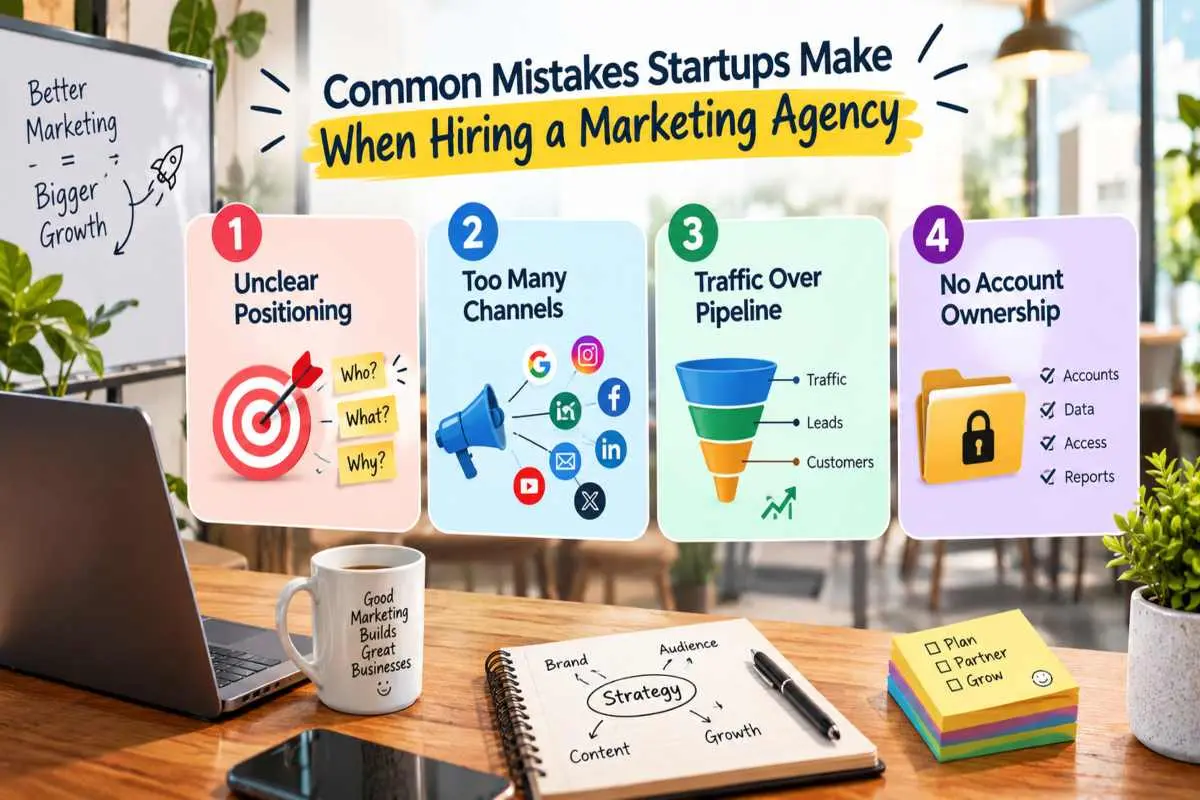
Hiring Before Positioning Is Clear
An agency can only amplify a message that already exists. If you can’t state who your product serves, what problem it solves and why it beats the alternatives, the agency will spend the first months guessing and you’ll pay for the experiments. Settle your core offer and ideal customer first, even if it takes a handful of customer conversations. The agency can then refine and scale the message instead of inventing it.
Chasing Too Many Channels at Once
Early budgets rarely stretch across SEO, paid search, paid social, email, PR and video simultaneously and thin coverage everywhere usually means strong results nowhere. Channel performance also varies widely: in BrightEdge’s research organic search delivered roughly eleven times as much traffic as organic social. Pick one or two channels where your buyers already look, prove they work and expand from there.
Judging Success by Traffic Instead of Pipeline
Visits and impressions are easy to report and easy to inflate, but they don’t pay salaries. Ask for reporting that follows visitors through to qualified leads, booked demos, trials and closed revenue, along with cost per acquisition. A smaller audience that converts is worth more than a large one that doesn’t. If an agency can’t connect its work to a pipeline, ask why before renewing.
Ignoring Ownership of Accounts and Data
Many startups discover too late that their ad accounts, analytics properties, domains or website logins sit in the agency’s name. Insist that you own every account and that the agency works as an authorized user, so you can leave without losing history or assets. Put this in the contract, along with access to raw reports, creative files and tracking setups and confirm that data handling follows the relevant privacy rules.
Conclusion
The suitable digital marketing agency for a startup is one that fits your stage, measures what matters and leaves you in control of your accounts and data. Hire when your offer is validated, start with a few high-impact channels and judge every engagement by pipeline rather than vanity metrics. The stakes are worth taking seriously. CB Insights’ post-mortem analysis found that 14% of startups cited poor marketing as a cause of failure, showing how costly it is to get this decision wrong. Clear positioning, a sensible sequence of services, transparent reporting and flexible contracts give you the best chance of turning a limited budget into steady growth. If you’re weighing your options in the US or UK, IT Leadz can review your site, market and goals in a free startup growth audit or strategy call and recommend where to focus first, with no obligation to continue.
Frequently Asked Questions (FAQs)
What does a digital marketing agency do for a startup?
A digital marketing agency gives a startup the strategy, specialists and tools to attract and convert customers without building an in-house team. It typically handles SEO, paid search and social, content, website optimization and reporting, focusing first on the channels most likely to generate qualified leads on a limited budget.
How much should a startup spend on digital marketing?
There’s no universal figure, so set a monthly budget based on your target cost per customer and runway. Focused agency retainers for early-stage startups often start in the low thousands per month, with ad spend on top. Begin with one or two channels, then scale spending only where results are proven.
What is the best digital marketing agency for startups?
The best agency is the one whose startup experience, channel strengths, reporting and contract terms match your stage and goals, so no single name suits everyone. Shortlist two or three, compare them on the same criteria and ask for relevant case studies. IT Leadz is one option for startups in the US and UK.
Is it worth hiring an agency for a startup?
It’s worth it when you have a validated offer and need specialist skills faster or cheaper than hiring in-house. An agency adds immediate expertise and flexibility without full-time salaries. It’s not worth it before positioning is clear or if you can’t commit budget long enough to test, learn and optimize.
How can I choose a digital marketing agency for my startup?
Compare agencies on startup experience, data-driven reporting, transparency, channel fit, communication, contract flexibility and case studies. Ask how they’d approach your first 90 days and which metrics they’d track. Avoid anyone promising guaranteed rankings and make sure you will own all accounts and data.
Do startups need a full-service agency?
Not always. A full-service agency suits startups wanting one team to coordinate SEO, paid media, content and web work. A specialist is often better when a single channel drives most growth. Many startups begin with a specialist or a narrow scope and broaden the engagement as budget and channels mature.
How long does it take to see results?
Paid and social campaigns can show early signals within weeks, while SEO usually takes several months. In an Ahrefs study of two million pages, only 5.7% of newly published pages reached the top 10 within a year. Expect leading indicators first, such as traffic quality and leads, with revenue impact building over time.
What is the difference between the growth marketing agency and a digital marketing agency?
A digital marketing agency typically runs a broad set of channels such as SEO, paid media, social and content, often on a retainer. A growth marketing agency concentrates on rapid experimentation across the whole customer journey, from acquisition to retention, optimizing for measurable growth metrics. The two overlap and many agencies do both.